
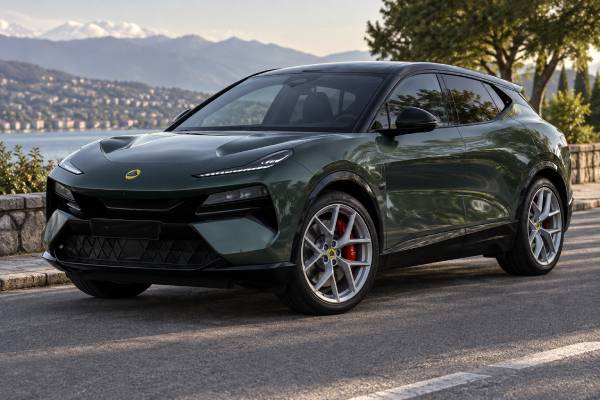
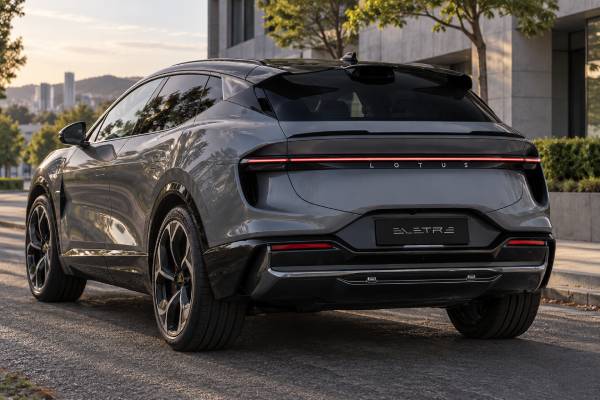
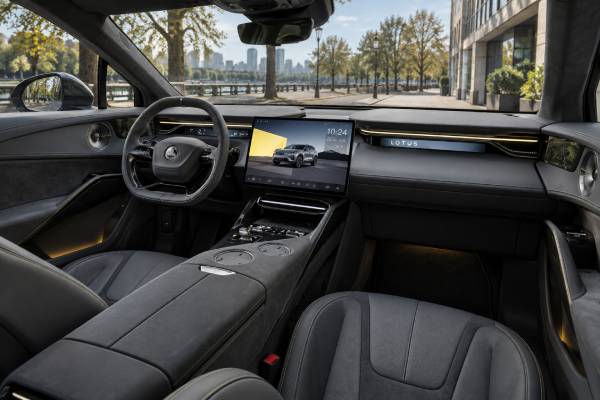
The Eletre L+ is a China-market 450 kW Type 132 variant that appeared in the later phase of the original Eletre naming scheme, before Lotus moved to the clearer 600/900 family labels. Its fundamentals are familiar: dual electric motors, all-wheel drive, 710 Nm of torque, a 112 kWh battery, and around 612 PS from 450 kW. What makes the L+ worth treating separately is trim context. It was sold as a distinct configuration in China, where range certification, comfort equipment, software services, and charging interfaces can differ from European Eletre models even when the propulsion hardware is similar. The model is especially relevant to import buyers because 2024–2025 examples can appear almost new while already belonging to a discontinued naming structure. That makes exact identification essential. A buyer should verify the factory trim, CLTC range certification, seating and wheel package, connected-service status, and remaining warranty before comparing price. The L+ can be a compelling long-range luxury EV, but only when its regional technology works where the car will actually be used.
Table of Contents
- Where the L+ fits in the Eletre range
- Powertrain, battery, dimensions, and capability
- Range and charging for everyday use
- Luxury configuration and cabin inspection
- Running costs and maintenance priorities
- Export-market risks to check
- Buying decision and inspection sequence
Where the L+ fits in the Eletre range
The L+ belongs to the Chinese-market Eletre family and uses the 450 kW drivetrain rather than the 675 kW high-performance system. Its role is therefore closer to a long-range, luxury-oriented Eletre than to an R-family performance flagship.
By 2025, China-market Eletre naming changed to 600 and 900 versions, making the earlier L+, S+, and R+ labels easier to confuse in export listings. The safe identifier for an L+ is the original documentation combined with the 450 kW / 710 Nm drivetrain and the exact factory equipment record.
A model-year label alone can also mislead. A car built late in one calendar year may be sold under a later model-year designation, while export sites sometimes describe registration year rather than factory model year. Use the VIN and manufacturing plate to anchor the timeline.
Powertrain, battery, dimensions, and capability
The L+ is a battery-electric large SUV with a motor at each axle and a single-speed electric reduction system. Its mechanical specification prioritizes strong performance and range rather than the R model’s two-speed, 675 kW layout.
| Item | Specification |
|---|---|
| Maximum power | 450 kW / 612 PS |
| Maximum torque | 710 Nm |
| Motors | Dual, front and rear |
| Drive | AWD |
| Gear reduction | Single speed |
| Battery | 112 kWh |
| High-voltage system | 800 V class |
| Item | Specification |
|---|---|
| 0–100 km/h | About 4.5 seconds |
| Top speed | About 258 km/h |
| China-market range | Listings for L+ commonly cite a long-range CLTC figure around 650 km; verify the exact homologation certificate |
| Tailpipe CO₂ | 0 g/km |
| Item | Specification |
|---|---|
| Length | 5,103 mm |
| Width | 2,019 mm excluding mirrors |
| Height | Approximately 1,636 mm |
| Wheelbase | 3,019 mm |
| Front storage | 46 L |
| Five-seat rear luggage volume | 688 L |
| Maximum rear luggage volume | About 1,532 L with rear seats folded |
| Item | Specification |
|---|---|
| DC charging class | Ultra-rapid charging supported by the 800 V platform |
| Global Eletre benchmark | 10–80% in about 20 minutes in suitable conditions |
| Battery cooling | Liquid thermal management |
| Connector | China-market standard on domestic L+; confirm before export |
| Item | Specification |
|---|---|
| Suspension | Air suspension with electronically controlled damping |
| Common wheel format | 22-inch staggered setup, with larger options depending on trim |
| Typical 22-inch tires | 275/40 R22 front; 315/35 R22 rear |
| Braked towing reference | Up to 2,250 kg where certified |
The exact L+ equipment can change curb mass and energy use. Treat published values from another 450 kW Eletre as supporting context, not permission to fill gaps in the L+ specification.
Range and charging for everyday use
A long CLTC range figure makes the L+ attractive, but the ownership question is how far it travels between convenient charging stops in the driver’s actual climate and road network. High-speed European use can produce a very different result from the Chinese certification cycle.
The L+ benefits from a large battery and efficient high-voltage system, yet its size, weight, and wide tires create unavoidable energy demand. At low and moderate speeds the drivetrain can be impressively efficient for such a large SUV. At sustained high speed, aerodynamic drag becomes the dominant factor.
Wheel size is one of the few choices an owner can evaluate before buying. A 22-inch setup generally offers a better compromise of range, ride, tire price, and pothole resistance than the most aggressive 23-inch package. The visual difference is obvious; the efficiency difference is less dramatic but accumulates over long journeys.
For rapid charging, battery temperature matters. Entering a charger into the vehicle’s route planner can allow preconditioning on supported software. If an imported L+ cannot access the correct local charger database, manual planning becomes more important and preconditioning behavior should be tested.
Home charging should be planned before purchase. An imported Chinese car may require charging hardware or protocol solutions not used by locally delivered Eletres. It is better to prove compatibility with a real charger than to rely on an adapter seller’s claim.
Luxury configuration and cabin inspection
The L+ is bought as much for equipment and comfort as for raw propulsion. That means every premium feature should be treated as part of the inspection, not as a bonus that can be checked later.
Begin with seating. Confirm whether the car is a four-seat or five-seat configuration and test every powered adjustment, memory function, heating, ventilation, and massage feature fitted. Four-seat cars can have a very different rear-cabin arrangement and luggage practicality.
Check the panoramic roof for chips, stress marks, water staining, and interior trim noises. Large fixed glass panels are expensive components, and poor body repair near the roof can create wind-noise or sealing problems.
The infotainment system should boot cleanly and retain settings. Test the vehicle profile, Bluetooth, smartphone integration if supported, navigation, voice functions, audio, and all camera views. If the system is still tied to a previous owner’s Chinese account, ensure the account can be removed and the vehicle rebound properly.
Driver-assistance hardware deserves a static and dynamic test. A clean dashboard with no warnings is not enough; verify adaptive cruise, lane functions, parking sensors, surround-view cameras, and any lidar-dependent features that are legally enabled. Replacement of windscreens or bumpers may require sensor calibration.
Running costs and maintenance priorities
Electric propulsion cuts fuel and engine-service complexity, but an Eletre L+ remains a large luxury vehicle with expensive tires and sophisticated chassis hardware. Budgeting should reflect the class of car rather than assuming “EV” means inexpensive to maintain.
Tires are the first obvious cost. Check date codes, tread depth, inner-edge wear, sidewall damage, and whether all four tires belong to an appropriate matched set. The instant torque of a 450 kW AWD system can consume low-quality rear tires quickly.
Air suspension is another area where preventive inspection saves money. The vehicle should sit level after being parked, change height without excessive compressor noise, and show no persistent suspension warnings. Uneven ride height can point to a leak, valve issue, height sensor, or control fault.
Brake wear may be low because of regeneration, but corrosion can be high. Inspect disc faces and use several progressive stops during a test drive. Vibration under braking is not something to dismiss on a heavy SUV.
Keep the high-voltage cooling system healthy and use official fluids and procedures. Fast charging, cabin heat, motor output, and battery life all depend on thermal management. A car that suddenly rapid-charges much more slowly than expected may need more than a software reset.
Export-market risks to check
The most important L+ risk outside China is regional support. Before buying, establish how the car will charge, update, navigate, connect, and receive warranty service in the destination country.
A proper pre-purchase audit should answer these questions:
- Is the charging port native to local infrastructure, or is an adapter required?
- Does the adapter support the full voltage and communication protocol safely?
- Can the VIN be added to the local Lotus app or owner account?
- Does the built-in modem connect to local networks?
- Are maps and charger databases available for the destination region?
- Can official software updates be installed outside China?
- Will a local Lotus repairer access parts and diagnostics for the specific market variant?
- Is the remaining battery and vehicle warranty recognized after export?
A negative answer is not automatically fatal, but it should affect price. Unsupported software or charging can erase the saving that made a parallel import attractive in the first place.
Buying decision and inspection sequence
The L+ makes the most sense for a buyer who wants the 450 kW Eletre experience with China-market equipment and who has verified the regional technology. It is less suitable for someone who expects a parallel import to behave exactly like a locally supplied European car.
Inspect in a deliberate order. First verify identity and documents. Second inspect structure, underbody, battery enclosure, wheels, and tires. Third test every cabin and driver-assistance function. Fourth drive long enough to evaluate air suspension, steering, brakes, and drivetrain. Fifth perform a real charging session.
If possible, obtain a high-voltage diagnostic report and battery state-of-health reading. Range shown on the dashboard is not a substitute because it reflects recent energy consumption. A state-of-health result, fault scan, and successful charging test provide much stronger evidence.
The 450 kW drivetrain is a good match for the Eletre’s role. It is extremely fast in ordinary traffic yet leaves more range headroom than the 675 kW version. If the L+ equipment and import support check out, it can deliver a distinctive mix of luxury, utility, and EV performance without paying for the R family’s extra acceleration.
Understanding the L+ as a transitional model
The L+ sits in an awkward but interesting place in Eletre history. It belongs to the pre-600/900 naming system, yet many examples were produced close to the later range revision. That can create confusion in registration databases, insurance systems, and parts catalogues that expect either S/R names or 600/900 names.
Owners should keep copies of original registration and specification documents. If a workshop searches the wrong commercial trim name, the VIN still identifies the correct factory build. This is especially useful for ordering trim, wheels, charging components, and software-related parts.
A transitional badge does not make the car obsolete. The underlying platform and 450 kW drivetrain remain central to later Eletre 600 models. What changes more quickly is software packaging and market support, which is why update history should be part of the buying decision.
Comfort-oriented checks on a long test drive
A luxury Eletre can pass a short performance test and still disappoint after an hour. Spend enough time in the driver’s seat to judge cushion support, steering-wheel position, pedal alignment, and climate noise. Then ride in the rear seat while someone else drives over broken surfaces.
Listen for trim noises around the panoramic roof, door panels, rear console, and tailgate. A quiet EV makes rattles easier to hear than in a combustion vehicle. Small noises are not always serious, but they can be irritating in a car purchased for refinement.
Test the climate system at both temperature extremes if conditions allow. Weak heat, slow cooling, or noisy compressor operation can indicate issues that also intersect with battery thermal management. Because EV cabin heating and battery conditioning share electrical and thermal resources, climate problems deserve proper diagnosis.
Charging an L+ after export
Do not treat charging conversion as a one-time hardware purchase. The solution must remain safe at the power levels the car can request. Ask who supports the adapter, whether firmware updates are available, what current and voltage limits apply, and whether public charging networks recognize the communication handshake reliably.
Some owners may choose to limit charging power intentionally when using adaptation hardware. That can be sensible if supported by the vehicle and equipment, but it should be based on documented limits rather than guesswork. High-voltage charging is not an area for improvised modifications.
Home charging is easier to control because the owner can install a known compatible unit and test it thoroughly. Public travel is harder because charger hardware and firmware vary by network. Before a long trip, identify multiple proven locations rather than assuming every station of a certain plug type will work.
Resale considerations for a China-market L+
Resale value depends on how much uncertainty the next buyer has to accept. Keep service invoices, diagnostic reports, adapter documentation, software records, and any correspondence confirming warranty or dealer support. A well-documented import is easier to sell than one that requires the next owner to rediscover every compatibility issue.
Avoid irreversible modifications to the charging system, infotainment, lighting, or body unless they are professionally engineered and legal. A conversion that solves one owner’s problem can reduce appeal later if original parts are missing.
The L+ can represent good value precisely because it is less familiar than the mainstream S/R or newer 600/900 labels. The buyer who understands its specification can benefit from that market confusion; the buyer who does not can inherit it.
Understanding what makes the L+ distinct
The L+ should be identified as a specific Chinese-market configuration, not as a convenient label for any 450 kW Eletre with luxury options. Its 2024–2025 context places it between the earlier S/S+ era and the renamed 600-series lineup. That timing is important because superficially similar cars can differ in certified range, equipment grouping, software, and the way dealers described the trim.
When examining an export listing, request the original Chinese invoice or build record and compare the VIN, production date, battery, seating configuration, wheels, interior trim, and option content with the vehicle in front of you. Translation can blur model names, and marketplace filters sometimes reclassify cars to attract searches. Factory documentation carries more weight than a badge photographed on the tailgate.
The same discipline should be used for parts and service. Order by VIN whenever possible. An interior switch, control module, lamp, or suspension component may have a revision change even when it bolts into the same physical location. Maintaining a digital folder with build documents, part numbers, service invoices, and software versions will save time each time the car changes workshop or owner.
Mapping a long trip before importing the car
A useful test of an L+ import plan is to map a representative 500–800 km journey in the destination country before buying the vehicle. Identify where the car will charge, which connector each site uses, whether the proposed adapter supports that charging mode, and where the backup sites are. Do not rely on a seller’s statement that “European fast charging works” without knowing the exact hardware and network conditions.
The exercise reveals whether the import compromise is minor or fundamental. If home AC charging is straightforward and several proven DC sites sit along regular routes, the car may be easy to live with. If every rapid charge requires a rare converter, manual authentication, or a detour to one compatible operator, the ownership experience will be very different from that of a locally delivered Eletre.
Repeat the plan for winter. Add margin for heating, rain, wind, and a cold battery. A large nominal range figure is valuable, but reliable access to charging is what converts battery capacity into real travel freedom.
Battery evidence worth requesting
A serious seller should allow more than a photograph of the dashboard range estimate. Ask for a diagnostic report that identifies the battery pack, records relevant fault codes, and provides a credible state-of-health measurement if the available tooling supports it. The meaning of a percentage depends on the diagnostic method, so the report should name the tool or system used rather than presenting an unexplained number.
Review charging behavior as well. A supervised DC session can expose communication faults, thermal limits, or repeated interruptions. The peak number on a charger screen is less important than a smooth session under known conditions because power naturally changes with state of charge and temperature. Record starting percentage, ambient conditions, session duration, energy delivered, and any warning messages.
Inspect the battery enclosure from below with the car safely lifted by someone familiar with EV lifting points. Deep dents, gouges into structural areas, displaced covers, sealant that looks newer than surrounding material, or unexplained fastener changes merit specialist review. A cosmetic undertray mark is not equivalent to pack damage, but the difference should be established before purchase, not after.
Accident repair and sensor calibration
The L+ combines expensive body panels with a dense collection of cameras and driver-assistance sensors. Minor collision history therefore deserves more attention than paint depth alone. Examine mounting points around the windscreen, roof, bumpers, mirrors, and lighting. Check panel gaps against the opposite side of the vehicle and look for overspray on seals or fasteners.
If glass, a bumper, or a sensor-bearing panel has been replaced, ask for calibration records. A system can appear to function while its aim or alignment is outside specification. During a test drive, verify camera views, parking aids, lane-related functions, and warning indicators without deliberately provoking the safety systems.
Repair quality also affects resale. Keep photographs and invoices from any known work, including the part numbers used. Transparent documentation is preferable to a supposedly “accident-free” history that conflicts with physical evidence. For an imported L+, where a future buyer may already be cautious about support, a clear repair record can preserve confidence and value.
Preparing a clean handover to the next owner
An imported L+ becomes easier to own when its history is transferred as carefully as the physical keys. Before sale, export or print the service timeline, list the charging adapters with their ratings, record the current software version, and remove personal accounts only after the buyer has confirmed the correct transfer procedure. Include both original and replacement parts documentation where modifications were made.
Photograph the odometer, tire condition, charging accessories, and any existing cosmetic marks at handover. This protects both parties from later confusion and gives the new owner a reliable baseline. A complete handover package also supports resale value because it shows that market-specific issues were managed systematically rather than left for each workshop to rediscover.
References
– Lotus Eletre | How it Drives | Lotus Cars 2026 – Lotus Charging | Lotus Cars 2026 – Lotus Eletre Handbook for Drivers | Lotus Cars 2026 (Owner’s Manual) – Lotus Eletre: the world’s first electric Hyper-SUV – Lotus Cars Media Site 2022 – Lotus Cars Official Site 2026 (Warranty) – SEC Filing 2026
Disclaimer
This article is for informational purposes, not a replacement for professional diagnosis or repair. Specifications, torque values, intervals, charging interfaces, software features, and procedures vary by VIN, market, and equipment. Confirm all technical work with official service documentation for the individual L+.
If this guide helped you evaluate an L+, please share it on Facebook, X/Twitter, or your preferred EV community.