
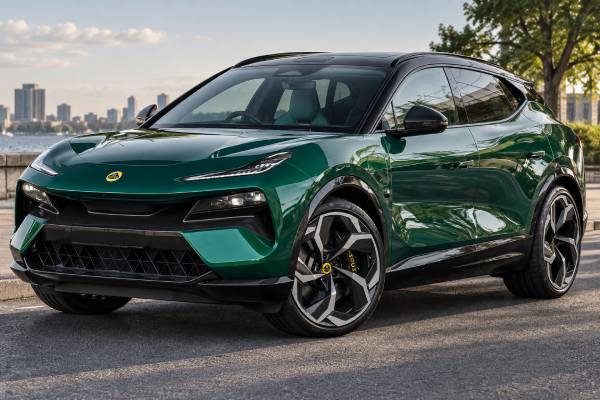
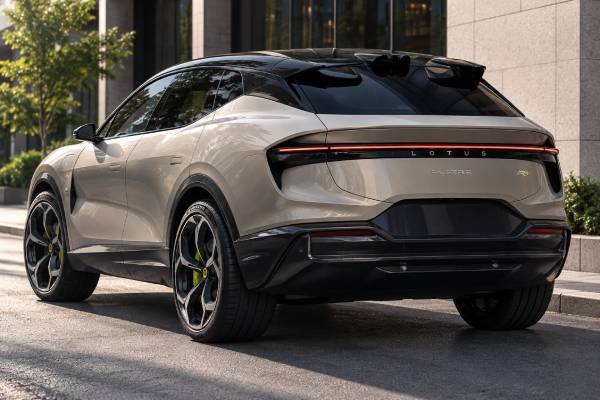
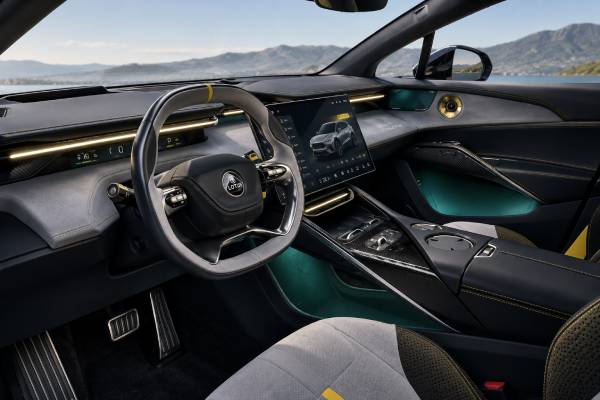
The Eletre R+ is best understood as a China-market high-performance expression of Lotus’s Type 132 electric SUV, not as a mechanically unrelated model to the better-known Eletre R. Its core identifiers are the 675 kW dual-motor all-wheel-drive system, 985 Nm of torque, 112 kWh battery, and roughly 918 PS output. The “+” badge is important because Chinese-market Eletre naming and equipment packages do not map perfectly to UK or European trim labels. That matters to buyers importing one: a car can have familiar powertrain numbers yet differ in connected services, charging hardware, driver-assistance configuration, language support, warranty coverage, and standard equipment. The R+ is extremely quick, but its ownership case depends on more than the 0–100 km/h time. Battery condition, software support, charging compatibility, suspension health, and the exact provenance of an imported example should all be verified before purchase. Treat the VIN and original market specification as primary evidence, not a translated sales listing.
Table of Contents
- What the R+ badge means
- Technical data for the 675 kW R+
- Acceleration, gearing, and thermal limits
- CLTC range and charging in real use
- Import compatibility and software considerations
- Maintenance and high-cost wear items
- How to inspect a used R+
What the R+ badge means
The R+ designation is tied to Chinese-market product positioning. The safest way to identify one is by its 675 kW system output, 985 Nm torque figure, 112 kWh battery, and high-performance dual-motor AWD layout rather than assuming every “R” or “R+” sold globally carries identical equipment.
Lotus has used different naming conventions as the Eletre range evolved. Early international markets generally knew the highest-output model as Eletre R, while Chinese material also used R+ and other trim names. The same 675 kW output is about 918 metric horsepower, which is why Chinese and continental specifications often show 918 PS. British material may state 905 bhp because mechanical brake horsepower and metric horsepower are different units.
That distinction is not cosmetic when shopping across borders. A translated advertisement may replace PS with “hp” and may also simplify option descriptions. It is therefore useful to verify the original build sheet or official vehicle configuration rather than comparing imported cars solely by English-language listings.
The R+ sits at the performance end of the Eletre family. It adds the more powerful driveline and two-speed rear transmission that distinguish the 675 kW system from the 450 kW versions. In practical terms, this means stronger acceleration, a higher top-speed capability, and a lower range rating than the less powerful models when tested under the same general conditions.
Technical data for the 675 kW R+
The R+ is a BEV with a large underfloor traction battery, one electric drive unit per axle, and electronically controlled all-wheel drive. Its 800-volt architecture is designed to support very high DC charging power as well as sustained high drivetrain output.
| Parameter | Value |
|---|---|
| Vehicle type | Battery-electric large SUV |
| Motor layout | Dual motor, front and rear |
| Drive | AWD |
| Maximum output | 675 kW / 918 PS |
| Maximum torque | 985 Nm |
| Battery capacity | 112 kWh |
| High-voltage platform | 800 V class |
| Rear transmission | Two-speed reduction gearbox |
| Parameter | Value |
|---|---|
| 0–100 km/h | About 2.95 seconds |
| Top speed | Up to about 265 km/h |
| China-market rated range | Figures around 560 km CLTC appear for related 675 kW high-performance specifications; exact R+ certification should be checked by model year |
| Tailpipe emissions | Zero |
| Parameter | Value |
|---|---|
| Fast-charge capability | High-power DC, approximately 350 kW class on global Eletre architecture |
| Typical published fast-charge window | 10–80% in about 20 minutes under suitable conditions |
| European AC reference | Up to 22 kW onboard charging on European cars |
| China connector note | China-market cars use market-specific charging interfaces; verify compatibility before export |
| Parameter | Value |
|---|---|
| Length | 5,103 mm |
| Width | 2,019 mm excluding mirrors in published Chinese/early data |
| Height | About 1,636 mm |
| Wheelbase | 3,019 mm |
| Five-seat rear cargo volume | 688 L on common Eletre specification |
| Rear cargo, seats folded | Up to 1,532 L |
| Front luggage compartment | 46 L |
| Parameter | Value |
|---|---|
| Suspension concept | Air suspension with electronically controlled damping |
| Common wheel diameter | 22 or 23 inches depending on configuration |
| Common 22-inch tires | 275/40 R22 front; 315/35 R22 rear |
| Braked trailer limit | Up to 2,250 kg where the vehicle is homologated for towing |
The numbers above should not be used to “convert” an imported R+ into another market’s R specification on paper. Homologation, connector standard, software region, and legal equipment remain tied to the individual car even where dimensions and powertrain hardware are closely related.
Acceleration, gearing, and thermal limits
The R+ can deliver acceleration comparable with dedicated supercars, but the way it repeats that performance depends on battery temperature and state of charge. Electric output is controlled by the battery-management and inverter systems, so a 675 kW maximum is a peak capability within an operating envelope rather than a constant entitlement in every condition.
The rear two-speed unit is central to the high-performance variant. The lower ratio helps multiply wheel torque during hard acceleration, while the taller ratio reduces the compromise between launch performance and maximum road speed. This is unusual among large EVs, many of which use only a single reduction ratio.
A prospective owner should understand that repeated high-output runs produce heat in the battery, motors, inverters, gearbox, tires, and brakes. The Eletre’s liquid cooling and thermal-management systems are designed around that demand, but they still operate within protection limits. If temperatures rise beyond target values, the car can reduce available power to protect components. Similar power reduction can occur with a very cold or depleted battery.
This behavior matters during a test drive. A seller who demonstrates one launch from a warm, well-charged car is showing peak capability, not necessarily overall health. More useful checks include stable operation over 30–40 minutes, clean gear transitions, no drivetrain warnings, no coolant odors, and consistent regenerative and friction braking.
Because the R+ is heavy and exceptionally powerful, tire quality is inseparable from performance. Mixing tire brands or fitting incorrect load ratings can compromise steering response and stability-control calibration. A bargain set of tires on an R+ is not a bargain if it undermines the systems responsible for putting nearly 1,000 Nm to the road.
CLTC range and charging in real use
CLTC range figures should be used for comparison within the Chinese certification system, not treated as a direct prediction of motorway distance. The CLTC cycle is generally more favorable to EV range than WLTP in Europe, especially for high-speed driving, so an imported R+ may display a large official number while delivering substantially less on a fast road trip.
The difference becomes easy to understand when looking at where energy goes. Urban driving includes frequent deceleration, where regeneration can recover part of the vehicle’s kinetic energy. At steady motorway speed, there are fewer regeneration opportunities and aerodynamic drag rises rapidly. Add winter cabin heat, cold battery chemistry, wet roads, and large 23-inch tires and the practical range can fall well below a laboratory figure.
Charging performance can offset that limitation. Eletre’s 800-volt system was engineered for fast DC replenishment, and official Lotus material has long cited approximately 20 minutes for a 10–80% rapid charge under suitable conditions. Owners should focus on the charging curve and total time rather than the single peak-kW number. A car that briefly touches a very high peak but tapers early may add less energy over 20 minutes than expected.
For an R+ exported from China, the physical charging standard can be the biggest obstacle. Europe commonly uses CCS2 for DC and Type 2 for AC, whereas mainland China uses GB/T-family interfaces. Adapters are not automatically equivalent to native support; communication protocols, voltage handling, locking, thermal sensing, and legal approval all matter. Before buying an imported car, confirm a proven charging solution for home and public charging in the destination country.
Software can also influence charging. Route planning, charger databases, battery preconditioning, remote app functions, and over-the-air updates may depend on regional servers. A car that charges electrically can still be frustrating to own if the original connected ecosystem does not function abroad.
Import compatibility and software considerations
For an R+ outside China, import compatibility is often more important than the difference between one option package and another. The core vehicle may be excellent, but unsupported digital functions or incompatible charging can turn a seemingly cheap purchase into a complicated ownership project.
Check these items before money changes hands:
- Charging inlet and protocol: identify the actual port fitted to the car and demonstrate charging on the infrastructure you intend to use.
- Cellular modem and eSIM: determine whether connected services work in the destination country and whether the account can be transferred.
- Navigation and maps: confirm local map coverage, language support, live traffic, and charger search.
- App pairing: verify that the Lotus account can bind to the VIN in your region.
- OTA updates: ask whether the car can receive official updates after export or requires dealer intervention.
- ADAS legality: lidar, camera, automated parking, or lane functions may be restricted differently by jurisdiction.
- Lighting and homologation: headlamp pattern, rear fog lamps, regulatory labels, speedometer units, and emergency-call equipment can affect registration.
- Warranty: confirm in writing whether local Lotus representation will honor the original warranty on a parallel import.
Do not rely on a reseller’s statement that a car is “global version” unless the VIN and equipment substantiate it. Even genuine factory equipment can be market-locked at software level.
Maintenance and high-cost wear items
The R+ removes many conventional engine-service jobs but adds expensive EV-specific and performance-SUV components. A sensible maintenance budget should include tires, brakes, suspension, alignment, cooling-system inspection, cabin filtration, 12-volt battery condition, software diagnostics, and high-voltage system checks.
Wide staggered tires are likely to be the most frequent major consumable. The Eletre’s mass and torque can wear rear tires quickly if driven hard, and aggressive alignment settings or pothole damage can create inner-edge wear that is invisible from a casual walk-around. Use a lift or steering lock to inspect the whole tread.
Air suspension deserves equally serious attention. Check that the car raises and lowers evenly, holds height when parked, and does not run the compressor excessively. Any chassis warning should be diagnosed before purchase because active dampers, height sensors, rear-steering hardware, and air components are not low-cost items.
The brakes can suffer in two opposite ways. Track-like use can consume pads and overheat discs, while gentle regenerative driving can leave friction surfaces rusty. A smooth, firm stop from moderate speed can reveal judder, vibration, or uneven braking that a low-speed test may hide.
The high-voltage thermal circuit is critical because it supports both performance and charging. Cooling faults may first appear as reduced fast-charge speed or limited power rather than a dramatic breakdown. Check coolant levels only according to official procedures and have leaks or warnings investigated by trained EV technicians.
How to inspect a used R+
A strong R+ purchase begins with documentation. Confirm the VIN, original Chinese trim, build date, first registration, option list, accident history, service records, and whether the car has been exported or re-registered before. Compare these records with physical labels on the vehicle.
Then inspect the underside. The battery pack is large, low, and expensive. Cosmetic scratches to covers are common, but deep impacts, crushed rails, torn fasteners, or unexplained sealant repairs deserve specialist inspection. A repaired battery enclosure is not something to accept on verbal assurance alone.
Use every electronic system. Test all screens, cameras, parking functions, radar/lidar features where enabled, powered seats, climate functions, audio, doors, tailgate, charge-port release, keys, phone pairing, and app controls. Reboot loops, missing menus, or functions that work only in Chinese online mode may be more difficult to solve after export.
Finally, insist on a charging demonstration. AC charging proves one part of the system; a DC session proves much more. Observe whether the car communicates normally, begins charging promptly, ramps power plausibly for battery temperature and state of charge, and completes the session without faults.
The R+ can be a compelling buy for someone who specifically wants its Chinese-market specification and understands the import ecosystem. For a buyer seeking the simplest ownership experience in Europe, however, an officially supplied local-market Eletre R may be worth paying more for because charging, warranty, software, and regulatory support are already aligned.
When an R+ import makes financial sense
A parallel-import R+ can be attractive when the purchase-price difference versus a locally delivered Eletre R is large enough to cover additional risk. The calculation should include taxes, registration work, charging adaptation, insurance, software support, transport damage risk, and the possibility that a local dealer may not perform warranty work on the car. A low auction or export price is not the same as a low all-in ownership cost.
A good candidate is one whose charging solution has already been proven in the destination country, whose account and app can be transferred, and whose diagnostic access is understood. A poor candidate is a car sold with phrases such as “adapter included” or “software can be changed later” without demonstrations. Those statements push technical uncertainty onto the buyer.
The value gap also needs to be large enough to compensate for resale. A future buyer may be more cautious about a China-market VIN, particularly if connected features do not work locally. This does not make an R+ undesirable; it simply means the import discount should be real rather than cosmetic.
How to distinguish normal limitations from faults
High-output EVs deliberately protect themselves. Reduced regenerative braking at 100% state of charge, lower fast-charge power with a cold battery, and reduced peak acceleration at very low charge can all be normal. The diagnostic question is whether behavior improves when the expected conditions change.
For example, a cold R+ that charges slowly after arriving directly from overnight parking may be behaving normally. The same car that remains far below expected power after a long preconditioned motorway run deserves investigation. Similarly, limited performance at 5% battery is not surprising; limited performance at 70% with normal temperatures and warning messages is different.
Owners should record conditions when a fault appears: outside temperature, battery percentage, drive mode, charger type, route, and warning text. That information helps a workshop distinguish software strategy from a component problem.
Body repair and sensor calibration
The Eletre’s body contains much more than painted panels. Cameras, radar, parking sensors, and deployable or fixed lidar hardware may be mounted close to areas commonly damaged in low-speed collisions. A visually good bumper repair can still leave a driver-assistance system misaligned.
Check panel gaps around the front fascia, wheel arches, tailgate, and roof sensor housings. Look for overspray on rubber seals and fasteners, missing factory labels, or inconsistent texture on plastic trim. If repair history includes the windscreen, ask whether camera calibration was performed afterward.
A diagnostic scan should show no calibration or communication faults. On a car imported across regions, it is important not to confuse a disabled feature caused by local regulation with a hardware fault. Original documentation and a Lotus-capable diagnostic system can separate the two.
Long-term battery thinking
Battery condition matters more than odometer mileage alone. A pack that has covered substantial distance with moderate temperatures and sensible charging may be healthier than a low-mileage pack repeatedly stored full in extreme heat. The R+ uses active thermal management, which helps, but history still matters.
A state-of-health percentage is useful only if it comes from a trustworthy diagnostic source and is interpreted correctly. Different systems can calculate health differently, and a single number does not describe cell balance, insulation status, cooling performance, or fault history. Combine the report with a charge test and module scan.
For daily use, the easiest habit is to treat 100% as a trip tool rather than a parking target. Use the vehicle’s recommended daily limit and charge fully when the extra range is actually needed. This reduces time spent at high cell voltage without making ownership inconvenient.
Registration and compliance after export
An R+ can be mechanically healthy and still be difficult to register, so compliance research should begin before money changes hands. The original Chinese certificate, VIN record, build label, purchase invoice, export paperwork, and evidence of first registration should all agree. Ask the destination registration authority which documents it will accept and whether lighting, glazing, speed display, emergency-call hardware, or other market-specific equipment requires inspection or alteration. Rules vary by country, and the fact that another Eletre has been registered there does not prove that this particular specification will pass without additional work.
Pay particular attention to software-dependent compliance features. A rear fog lamp or speed-unit setting that can be selected in one software region may not behave identically after an update. Driver-assistance warnings may also depend on map data and regional configuration. Any required modification should be documented so a later owner can understand what was changed and whether an OTA update could reverse it.
Insurance should be discussed just as early. Give the insurer the full VIN and explain that the vehicle is a Chinese-market R+ rather than a locally supplied R. Confirm agreed-value treatment, glass and sensor coverage, battery-underbody claims, and whether repairs must use an approved network. The cheapest policy is of little value if the insurer later disputes the specification or cannot source high-value electronic parts.
Inspecting adapters, cables, and charge-inlet heat history
Imported EVs are often sold with a collection of adapters and cables, but their presence is not proof of a safe charging solution. Identify the vehicle-side inlet, the connector used by local AC posts, and the connector used by local high-power DC chargers. An AC adapter and a DC conversion device solve different problems and should never be described as interchangeable.
Examine every contact surface for discoloration, pitting, melted plastic, looseness, or a burnt smell. Heat damage can result from poor contact resistance even when a session appears to complete normally. During a supervised charge, periodically check the plug and cable for abnormal heating without touching exposed conductors or defeating any safety interlock. If the hardware becomes unusually hot or charging repeatedly derates, stop using it and have the system assessed by an EV-qualified technician.
A buyer should also ask how the adapter handles locking, control-pilot communication, temperature monitoring, and emergency shutdown. Cheap hardware that merely makes two connector shapes fit together is not an acceptable solution for hundreds of kilowatts. Keep invoices and model information for any conversion hardware because future troubleshooting will depend on knowing exactly what sits between the charger and the car.
Building an ownership reserve for an R+
The sensible reserve for an R+ is not just a conventional maintenance fund. Budget separately for tires, wheel repair, alignment, glass and sensor calibration, charging hardware, software assistance, and unexpected import-specific work. None of these costs is certain, but each is plausible enough that buying at the limit of a finance budget can make ownership stressful.
Consumables should be priced before purchase using the actual wheel and brake package fitted to the car. A seller may advertise the same headline power as another R+, while optional 23-inch wheels or premium braking hardware make the ongoing costs quite different. Obtain local quotations for front and rear tires and ask whether replacements are normally held in stock.
The final question is support. Identify who can perform routine mechanical work, who can scan the high-voltage and chassis systems, who can calibrate driver-assistance sensors after glass or body repair, and who can help with market-specific software. When those answers are known before purchase, the R+ becomes a calculated specialist import rather than a collection of unresolved assumptions.
References
– ELETRE OFFERS THE BEST PRICE-TO-VALUE PROPOSITION AMONG PEERS 2023 – Lotus Eletre | How it Drives | Lotus Cars 2026 – Lotus Charging | Lotus Cars 2026 – Lotus Eletre Handbook for Drivers | Lotus Cars 2026 (Owner’s Manual) – Lotus Eletre: the world’s first electric Hyper-SUV – Lotus Cars Media Site 2022 – Lotus launches charging solutions for electric vehicles – Lotus Cars Media Site 2023
Disclaimer
This article is for informational purposes and is not a substitute for professional diagnosis or repair. Specifications, torque values, intervals, charging standards, software functions, and procedures vary by VIN, market, and equipment; verify the exact vehicle against official Lotus service documentation and local homologation requirements.
If this guide helped clarify the R+, please share it on Facebook, X/Twitter, or another enthusiast community to support our work.