
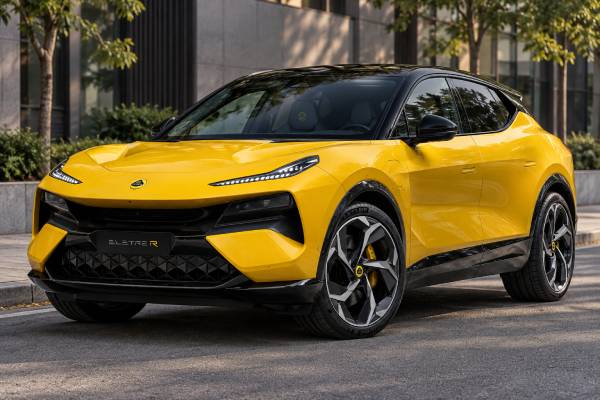
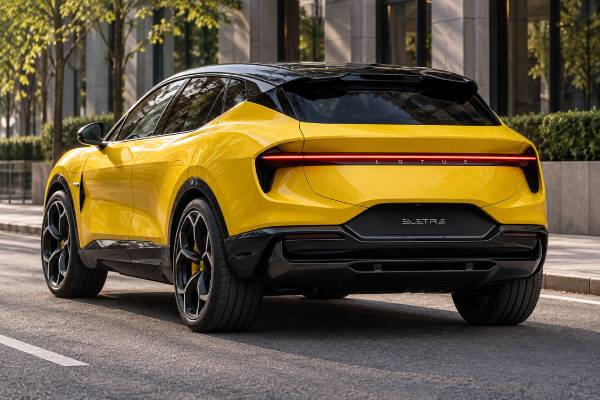
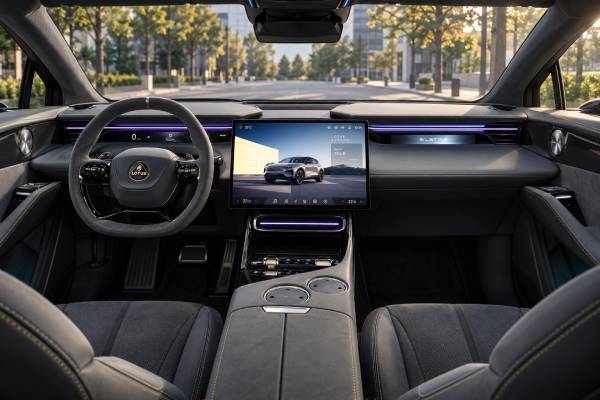
The Lotus Eletre R is the version that turns the Type 132 electric SUV into a genuine straight-line performance machine. In UK specification, its 675 kW dual-motor system is quoted at 905 bhp, with 985 Nm of torque, all-wheel drive, and a two-speed rear drive unit that helps it combine explosive acceleration with a high maximum speed. It uses the same basic 112 kWh battery concept and 800-volt electrical architecture as the broader Eletre family, but its powertrain, chassis calibration, braking hardware, and performance-oriented equipment make it meaningfully different from the lower-output versions. For a used buyer, the big questions are not simply whether an Eletre R is fast; that part is obvious. The useful questions concern charging history, tire and brake condition, software status, suspension operation, battery warranty, and whether the car’s market-specific specification matches the advertised equipment. Those details matter more than headline horsepower once the vehicle has entered everyday ownership.
Table of Contents
- Eletre R specifications and technical data
- How the 675 kW powertrain delivers its performance
- Range, charging, and long-distance use
- Chassis, brakes, steering, and tires
- Maintenance priorities for an Eletre R
- Used-buying inspection and ownership checks
- Who the Eletre R suits best
Eletre R specifications and technical data
The Eletre R is a battery-electric, dual-motor, all-wheel-drive large SUV built on an 800-volt architecture. Its defining mechanical difference is the 675 kW high-performance drivetrain with a two-speed transmission on the rear axle; that hardware is what separates the R from the 450 kW Eletre versions that use a simpler single-speed arrangement.
| Item | Specification |
|---|---|
| Powertrain | Dual electric motors, front and rear |
| Drive | All-wheel drive |
| Maximum system output | 675 kW / 905 bhp in UK-market convention |
| Maximum system torque | 985 Nm |
| Battery capacity | 112 kWh |
| Electrical architecture | 800 V class |
| Rear drive unit | Two-speed transmission |
| Item | Specification |
|---|---|
| 0–100 km/h | 2.95 seconds |
| Maximum speed | Up to 265 km/h, market dependent |
| WLTP range | Up to about 490 km on early R specification |
| Tailpipe CO₂ | 0 g/km |
| Item | Specification |
|---|---|
| DC rapid charging | Up to approximately 350 kW class |
| 10–80% DC charge time | About 20 minutes under suitable conditions |
| AC onboard charging | Up to 22 kW in relevant European specification |
| European connectors | Type 2 AC and CCS2 DC |
| Battery thermal management | Liquid-cooled high-voltage system with active temperature control |
| Item | Specification |
|---|---|
| Body style | Five-door large SUV |
| Length | 5,103 mm |
| Width without mirrors | 2,019 mm on published early specification |
| Width with conventional mirrors | 2,231 mm |
| Height | About 1,630–1,636 mm depending on wheel/specification |
| Wheelbase | 3,019 mm |
| Front luggage compartment | 46 L |
| Rear luggage volume, five-seat form | 688 L |
| Rear luggage volume, seats folded | Up to 1,532 L |
| Braked towing capacity | Up to 2,250 kg where homologated |
| Item | Specification |
|---|---|
| Common front tire size | 275/40 R22 |
| Common rear tire size | 315/35 R22 |
| Unbraked trailer limit | 750 kg where homologated |
| High-voltage battery/drive warranty | Market terms commonly extend to 8 years; mileage limits vary by region |
| Battery state-of-health warranty threshold | 70% in current Lotus warranty wording for applicable markets |
The horsepower figure deserves a specific clarification. A 675 kW motor system converts to about 905 mechanical brake horsepower but about 918 metric horsepower. That is why an Eletre R may be advertised as 905 bhp in the UK and 918 PS elsewhere without any change in actual 675 kW output. A buyer should use kilowatts and torque as the cleanest cross-market identifiers.
How the 675 kW powertrain delivers its performance
The R’s acceleration comes from more than simply fitting stronger motors. Lotus pairs the high-output front and rear drive units with software-controlled all-wheel drive and a two-speed rear transmission, giving the car both very hard launch capability and a higher-speed operating range than a one-ratio EV driveline normally provides.
From rest, electric motors can deliver strong torque immediately, and the Eletre R’s 985 Nm system figure is available without waiting for an engine to build revs or a turbocharger to make boost. The result is a claimed 0–100 km/h time of 2.95 seconds. That number puts the car into territory once associated with exotic two-seat machinery, despite the Eletre being a large, heavy, five-door SUV.
The two-speed rear unit is a key piece of engineering. A conventional single-speed electric axle asks the motor to cover low-speed launch and high road speed through one fixed reduction ratio. A second ratio gives engineers another tool: a short ratio can support acceleration, while a taller ratio reduces motor speed at higher vehicle speeds. In normal driving the shifts are controlled automatically, so the driver does not operate the transmission like a conventional manual or dual-clutch gearbox.
The useful ownership point is that repeated maximum-performance launches demand much more from the battery, motors, tires, and brakes than normal road use. An R that has spent its life demonstrating launch control may still be mechanically sound, but its consumables can tell that story. Rear tires in particular deserve close inspection across the full tread width, not merely at the outer shoulder.
The car’s power delivery also changes with drive mode and available battery power. Like other high-output EVs, maximum performance depends on battery temperature, state of charge, thermal limits, and software strategy. A cold battery at a low state of charge should not be expected to reproduce brochure acceleration. That is normal behavior rather than evidence of a fault.
Range, charging, and long-distance use
The Eletre R is capable of serious long-distance travel, but it trades some rated range for its higher-performance hardware. Early R specifications quote roughly 490 km WLTP, while wheel choice, climate, speed, topography, and driving style can move real-world results substantially in either direction.
At motorway speeds, aerodynamic drag becomes a dominant energy user. The Eletre’s active aerodynamic ideas and carefully managed airflow help, but no body shape can escape the physics of pushing a large frontal area through the air. Driving at a steady high speed will consume markedly more energy than a mixed route with moderate speeds and regeneration opportunities. Cold weather adds cabin-heating demand and makes the battery less efficient until it reaches its preferred temperature.
The stronger part of the long-distance story is charging. Lotus built the Eletre around an 800-volt electrical system and designed it for very high DC charging rates. On a compatible high-power charger, Lotus quotes roughly 20 minutes for a 10–80% session under suitable conditions. That should be read as an ideal-system result, not a promise that every public charger will deliver the same outcome.
Three conditions make the largest practical difference:
- Arrive at the rapid charger with the battery warm enough to accept high power. Navigation-led battery preconditioning can help when the car supports and activates it for the selected charger.
- Start at a relatively low state of charge. Charging power normally tapers as the battery fills, so a 70–100% stop is usually much slower per added kilometre than a 10–60% stop.
- Use a charger capable of supplying the necessary voltage and current. A “350 kW” label is not useful if the stall, site, cable, or shared cabinet is power-limited at that moment.
For home or destination charging, 22 kW three-phase AC capability is unusually useful where the electrical supply supports it. Many homes do not have the three-phase service needed to exploit the full 22 kW, so buyers should check their property rather than assuming the car’s onboard rating determines home-charging speed.
If the car will tow, plan a larger charging margin. A 2,250 kg braked towing limit is impressive for an EV, but a tall trailer can sharply increase drag and energy consumption. Charging-bay geometry also matters: many rapid-charging spaces still require a trailer to be disconnected before the car can reach the cable.
Chassis, brakes, steering, and tires
The Eletre R’s chassis has to manage two conflicting jobs: keep a very heavy luxury SUV comfortable and control the body when nearly 700 kW is deployed. Air suspension, continuously controlled damping, active systems, large wheels, and strong brakes are therefore central to the way the R works rather than optional decoration.
The Eletre platform places its large battery low in the floor, helping keep the centre of gravity lower than an equivalently tall combustion SUV. That does not remove mass, but it changes where the mass sits. Lotus then uses chassis electronics to control pitch, roll, traction, and wheel movement. Depending on market and specification, active rear steering and active anti-roll hardware can further reduce the sensation of size in corners and during low-speed manoeuvres.
A test drive should therefore include more than a straight acceleration run. Use rough urban roads, a smooth faster road, full-lock parking manoeuvres, and a section where the suspension changes ride height or mode. Listen for repeated knocks, compressor strain, or one corner that settles differently. Watch for suspension warnings after startup and after the car has been driven long enough to reach normal operating conditions.
Tires are a major expense and a major safety item. The staggered 22-inch fitment often listed for the Eletre uses 275/40 R22 at the front and 315/35 R22 at the rear. Optional 23-inch wheels increase visual impact but typically reduce sidewall depth and can raise replacement cost. On a 900-plus-horsepower SUV, cheap mismatched tires are a warning sign. Correct load rating, speed rating, homologated size, and axle pairing matter.
Regenerative braking reduces use of the friction brakes in everyday traffic, which is good for pad life but creates another issue: discs can corrode if they are rarely worked hard enough to clean their surfaces. During inspection, look for heavy scoring, pronounced lips, uneven rust patches, vibration under firm braking, or steering shake. A high-performance braking package can be expensive, so condition matters more than cosmetic caliper appearance.
Maintenance priorities for an Eletre R
An electric Eletre has no engine oil, spark plugs, fuel filter, or exhaust system, but it is not maintenance-free. Its service needs shift toward tires, brakes, suspension, thermal-management circuits, cabin filtration, wipers, software, high-voltage diagnostics, and general chassis inspection.
The first rule is to follow the schedule for the exact VIN and market. Lotus can change inspection items, fluid specifications, software campaigns, and service intervals during production. A generic internet checklist should never overrule the handbook or service information attached to the vehicle.
Important ownership habits include:
- Keep tire pressures correct and check wear frequently. A heavy AWD EV can hide low pressure until shoulder wear is advanced.
- Do not use maximum DC charging as the default simply because the car can accept it. Routine AC charging is convenient and reduces unnecessary heat generation; rapid charging is best used when journey time makes it valuable.
- Avoid leaving the battery parked at an extreme state of charge for long periods when it is unnecessary. Daily charge limits offered by the vehicle should be used according to Lotus guidance.
- Keep the front cooling openings and underbody free from damage. Battery, drive-unit, and charging performance all depend on effective thermal control.
- Apply the friction brakes firmly from time to time when conditions safely allow, particularly after wet or salted-road use, to help keep disc surfaces clean.
- Install official software updates and check that charging, navigation, phone connectivity, cameras, and driver-assistance functions operate correctly afterward.
Because the Eletre uses complex electronically controlled chassis and high-voltage systems, warning messages should not be cleared casually. A stored fault in an air-suspension module, battery-control unit, or charging system can be more informative than a seller’s assurance that the warning “comes and goes.” A proper diagnostic scan by a Lotus-capable workshop is valuable before purchase.
Damage underneath the vehicle deserves special attention. The traction battery forms a large structural package under the passenger compartment. Scrapes to replaceable aero panels are one thing; impact marks, deformation, fluid staining, or damage around the battery enclosure are another. Any suspected battery-case impact should be assessed by qualified personnel rather than treated as ordinary undertray damage.
Used-buying inspection and ownership checks
A good used Eletre R should be assessed as a software-defined luxury EV and as a high-performance vehicle. That means the inspection must cover digital functions and charging behavior just as seriously as paint, tires, suspension, and accident history.
Start with identity. Confirm the VIN, build date, market of origin, and exact model designation. Imported cars can differ in charging connector, navigation services, cellular connectivity, warranty coverage, driver-assistance legality, digital mirror equipment, and over-the-air support. The 905 bhp versus 918 PS naming issue is harmless; a charging-port mismatch or unsupported connected-service package is not.
Next, ask for service records and warranty evidence. The Eletre is young enough that many examples may still have substantial factory coverage, but remaining warranty depends on original in-service date, mileage, geography, ownership conditions, and market policy. Do not assume a warranty automatically transfers across borders.
Then check the battery and charging system. A dashboard range estimate by itself is weak evidence of battery health because it is influenced by recent consumption. Better evidence includes a diagnostic state-of-health report where available, a successful AC charge, a successful DC session, stable charge-port locking, correct thermal behavior, and no high-voltage warnings. The seller should be able to explain any unusually slow charging event rather than blaming every problem on the charger.
Inspect all cameras, parking sensors, lidar-related hardware where fitted, powered doors or tailgate functions, seat controls, climate zones, audio, screens, keyless entry, app pairing, and charging timers. These features are not peripheral on an Eletre; they are part of the car’s value and can be expensive to diagnose if several fail together.
Finally, look for evidence of hard use. Uneven tire wear, heat-marked brakes, multiple wheel repairs, repeated launch demonstrations, or poorly repaired underbody contact are more relevant on an R than minor cabin wear. A carefully owned high-mileage car can be a better purchase than a low-mileage example that has lived on short, aggressive demonstration drives.
Who the Eletre R suits best
The Eletre R makes sense for a driver who genuinely wants the fastest version, can charge conveniently, and is prepared for performance-car consumable costs. Its 675 kW output, two-speed rear drivetrain, sophisticated chassis, and rapid-charging capability give it abilities that go far beyond an ordinary luxury SUV.
It is less compelling if the extra acceleration will rarely be used. The lower-output Eletre versions retain the same fundamental platform, large battery, practical cabin, high charging capability, and all-wheel drive while generally offering more rated range and placing less stress on tires. That does not make the R irrational; it simply means its premium should be justified by the experience the buyer actually wants.
For a used purchase, condition and market compatibility should outrank a small difference in mileage. Verify the battery and warranty status, make sure every chassis and electronic system works, confirm the charging hardware matches where the car will live, and budget realistically for wide premium tires. Do that, and the Eletre R remains one of the more unusual ways to combine family-SUV space with supercar-level acceleration.
Ownership costs that do not appear in the power figure
The purchase price of an R is only the beginning of the cost difference from a lower-output Eletre. Insurance can be sensitive to the 675 kW rating, replacement tires are wide and expensive, and large wheels are vulnerable to cosmetic and structural damage on poor roads. A buyer who intends to use the car as a daily driver should obtain insurance quotes and tire prices before purchase rather than after delivery. A set of premium staggered tires can represent a meaningful annual expense for a driver who regularly uses the available torque.
Energy cost also depends strongly on where the car is charged. Home electricity at an overnight tariff can make a 112 kWh EV surprisingly economical per kilometre. Relying on premium ultra-rapid public charging can make energy cost much closer to that of a powerful combustion SUV. The R’s ability to accept very high charging power is primarily a time benefit, not a guarantee of low cost.
Depreciation is another unknown. The Eletre is technologically advanced, but luxury EV values can move quickly when new battery, charging, or software features appear. A used buyer should therefore pay for condition and specification rather than assuming the highest-output badge will automatically protect resale value.
Cold weather, storage, and infrequent use
An R that is driven only on weekends needs a slightly different care routine from a daily commuter. The high-voltage battery should not be left for long periods at an unnecessarily high or very low charge level. Follow the storage guidance in the handbook, keep the 12-volt system healthy, and allow the car to complete software updates rather than disconnecting power casually.
In winter, expect lower range and weaker initial regenerative braking until the battery warms. Preconditioning while connected to mains power can improve cabin comfort and preserve more battery energy for driving. Snow and ice also make tire choice more important; enormous summer performance tires are not a substitute for a suitable winter tire when temperatures and local law require one.
After winter road-salt exposure, clean the wheel wells and underbody carefully and inspect brake hardware. The battery casing and high-voltage components are designed for road use, but physical damage or missing underbody panels should be corrected promptly rather than leaving sensitive areas exposed.
Questions worth asking the seller
A useful conversation with an Eletre R seller is specific. Ask what percentage the car is normally charged to, where it is charged, whether it has had any high-voltage or suspension warnings, which software version it runs, and whether any wheels have been straightened or replaced. Ask about accident repairs around the front and rear sensor zones, because camera and radar calibration can be necessary after bodywork.
Also ask for evidence rather than reassurance. A service invoice, alignment printout, battery diagnostic, charging receipt, or warranty record is more valuable than a statement that the car has “never had a problem.” The R is too complex and too expensive to inspect only by appearance.
If the vehicle is still covered by factory warranty, confirm the exact start date and remaining mileage. Warranty terms can differ across regions, so the written terms for the VIN should override generalized web claims. A transferable, locally supported warranty can justify paying more for one car over another that looks identical in an advertisement.
References
- Lotus Eletre | Lotus Electric SUV | Lotus Cars United Kingdom 2026
- Lotus Eletre | How it Drives | Lotus Cars 2026
- Lotus Charging | Lotus Cars 2026
- Lotus Eletre Handbook for Drivers | Lotus Cars 2026 (Owner’s Manual)
- Lotus Eletre: the world’s first electric Hyper-SUV – Lotus Cars Media Site 2022
- Lotus launches charging solutions for electric vehicles – Lotus Cars Media Site 2023
Disclaimer
This article is for informational purposes and is not a substitute for professional diagnosis or repair. Specifications, torque values, service intervals, software requirements, and procedures can vary by VIN, market, model year, and equipment, so verify all work and technical data against the official Lotus service documentation for the specific vehicle.
If this guide was useful, please consider sharing it on Facebook, X/Twitter, or another automotive community to support our work.