

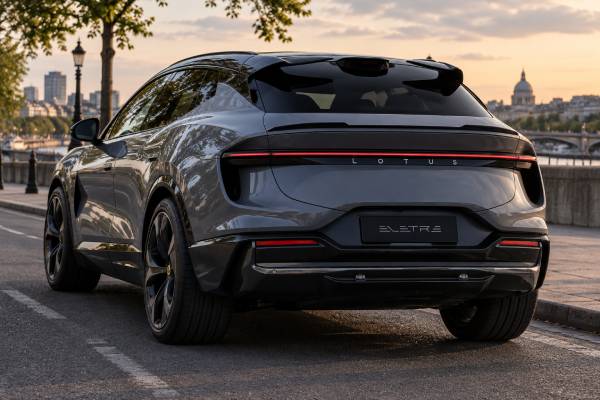
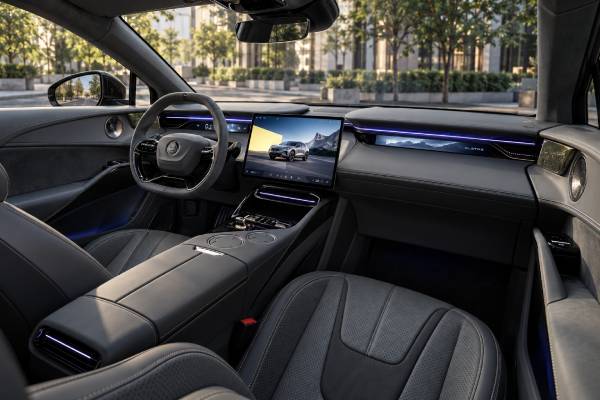
The Eletre R Type 79 is a special version whose significance lies as much in provenance and specification as in raw performance. Unveiled through Lotus’s Chapman Bespoke program, it takes the 675 kW, 918 PS Eletre R drivetrain and dresses it in a black-and-gold theme inspired by the Lotus Type 79 Formula 1 car that helped Mario Andretti and Team Lotus win the 1978 Drivers’ and Constructors’ championships. Mechanically, the modern SUV remains an Eletre R: dual-motor AWD, 985 Nm, a 112 kWh battery, 800-volt architecture, and a two-speed rear drive unit. The collector question is therefore not whether the Type 79 edition is faster than a normal R; the key questions are authenticity, original bespoke details, finish condition, documentation, and whether any damaged trim can still be reproduced correctly. A standard Eletre R can be repaired as a production model. A Type 79 car with missing bespoke graphics, refinished special components, or incomplete provenance may lose much of what makes the edition desirable.
Table of Contents
- Why Lotus used the Type 79 name
- Modern Eletre R Type 79 specifications
- Chapman Bespoke details and authenticity
- Performance, chassis, and road use
- Preservation and maintenance priorities
- Collector-focused buying inspection
- How to judge value versus a standard R
Why Lotus used the Type 79 name
The Type 79 reference is historically meaningful. The original Lotus Type 79 was the black-and-gold Formula 1 ground-effect car associated with Lotus’s 1978 world championship success, and it became one of the defining racing designs of its era.
The road-going Eletre edition does not claim a mechanical connection to the 1970s F1 machine. Instead, Chapman Bespoke uses the historic visual identity as inspiration: a black body with gold detailing that recalls the race car’s famous livery. That distinction matters because the value is in an officially executed Lotus bespoke interpretation, not in pretending the SUV shares period racing hardware.
Lotus presented the Eletre R Type 79 in 2024 as part of its growing personalization strategy. For buyers, that places the model in a different category from an aftermarket wrap made to imitate the same colors. Factory provenance, specification records, bespoke documentation, and original finish all matter.
Modern Eletre R Type 79 specifications
Under its special appearance, the Type 79 edition uses the high-performance Eletre R architecture. It is a large battery-electric SUV with one motor on each axle and a two-speed transmission on the rear drive unit.
| Item | Specification |
|---|---|
| System output | 675 kW / 918 PS |
| System torque | 985 Nm |
| Drive | Dual-motor AWD |
| Rear transmission | Two-speed |
| Battery capacity | 112 kWh |
| Architecture | 800 V class |
| Item | Specification |
|---|---|
| 0–100 km/h | About 2.95 seconds |
| Top speed | Up to about 265 km/h |
| Torque delivery | Electronically controlled between front and rear axles |
| Tailpipe CO₂ | 0 g/km |
| Item | Specification |
|---|---|
| DC charging | Approximately 350 kW class |
| Published 10–80% benchmark | About 20 minutes under suitable conditions |
| Thermal management | Liquid-cooled high-voltage system |
| Connector | Depends on original sales market |
| Item | Specification |
|---|---|
| Length | 5,103 mm |
| Width | 2,019 mm excluding mirrors on early/China data |
| Height | About 1,636 mm |
| Wheelbase | 3,019 mm |
| Front luggage compartment | 46 L |
| Five-seat rear luggage reference | 688 L |
| Item | Specification |
|---|---|
| Suspension | Adaptive air suspension |
| Common tire format | Wide staggered performance tires, wheel package dependent |
| Braked towing reference | Up to 2,250 kg where homologated |
The exact Type 79 bespoke specification should come from its build documentation. Special paint, graphics, interior materials, wheels, calipers, and personalization can differ from a regular R, and those details should not be inferred from photographs of another Type 79-style car.
Chapman Bespoke details and authenticity
Authenticity is the most important non-mechanical issue on a Type 79. The special edition was created through Lotus Chapman Bespoke, so the original factory specification has greater significance than an ordinary option list.
Start with documentation. Look for the original order, build sheet, delivery paperwork, bespoke certificate or correspondence, and invoices that identify the Type 79 treatment. A vehicle history that clearly ties the VIN to the Lotus program is stronger evidence than a seller’s claim based on color alone.
Next inspect the black-and-gold finish in bright, diffuse light. Gold pinstripes and decorative elements should be consistent in width, placement, and tone. Differences between panels can reveal repainting or replacement. Paint-depth readings may help, but they must be interpreted carefully because bespoke finishes can differ from mass-production paint thickness.
Interior details need the same scrutiny. If the car received unique stitching, badges, materials, or color accents, photograph and document them before purchase. Replacement of a damaged bespoke seat panel may require custom work rather than ordering a generic Eletre R component.
Originality does not mean a collector should tolerate neglected mechanical maintenance. A perfectly preserved livery over worn tires, damaged suspension, or a compromised battery enclosure is not a good car. The aim is to find both authentic presentation and sound engineering.
Performance, chassis, and road use
The Type 79 edition is still an Eletre R to drive: exceptionally fast, heavy, electronically sophisticated, and capable of covering distance rapidly when charging infrastructure supports it. Its historical graphics do not change the underlying physics.
The 675 kW output and 985 Nm torque can accelerate the SUV to 100 km/h in roughly three seconds. The rear two-speed transmission helps deliver both hard launch performance and high road speed. Maximum output depends on battery temperature, charge state, and thermal protection, so repeat runs may not be identical.
Air suspension and active chassis systems are critical because they manage a vehicle weighing well over two tonnes. During a test drive, use several drive modes and road surfaces. The car should change character without producing suspension faults, steering oddities, or repeated compressor noise.
The special-edition owner should resist treating every drive as a preservation exercise. Mechanical systems benefit from proper use. Friction brakes need occasional work to prevent corrosion, seals and suspension need cycling, and the battery should not spend months parked at an extreme state of charge.
Preservation and maintenance priorities
Maintaining a Type 79 means protecting two assets at once: the Eletre R powertrain/chassis and the bespoke cosmetic specification. The maintenance plan should account for both.
For the exterior, avoid aggressive machine polishing over graphics or pinstriping unless the detailing method is known to be safe for the specific finish. Photograph all special elements before paint-protection-film installation or repair so their original placement is documented. If PPF is already fitted, inspect edges for lifting, discoloration, trapped moisture, and knife marks in the paint.
For the battery and charging system, follow the same good practice as any Eletre R: keep software current, use the recommended daily charge limit, avoid unnecessary long-term storage at 100%, and investigate large changes in rapid-charging performance. Do not confuse a cold-battery charge taper with degradation without diagnostics.
Tires can age before they wear out on a collector car. Check date codes as well as tread depth. A low-mileage Type 79 on six-year-old tires would need replacement even if the grooves still look deep.
Brake discs can corrode on a lightly used EV. A stored car also deserves attention to the 12-volt system, air-suspension behavior, seals, drainage, and climate-control operation. Periodic controlled driving is often better preservation than indefinite static display.
Collector-focused buying inspection
A conventional used-car inspection is necessary but not sufficient for the Type 79. Add an authenticity audit and a replacement-parts strategy before agreeing on price.
First, establish provenance. Confirm the VIN against original Lotus/Chapman Bespoke paperwork and check the sequence of owners. Second, inspect every bespoke exterior and interior feature for originality and repair quality. Third, verify that any modifications are reversible and that original parts are included.
Then move to the technical car. Inspect the battery enclosure and underbody, scan all control modules, check suspension operation, test both AC and DC charging, and assess the condition of the wide tires and brakes. A high-performance EV can hide expensive faults behind a clean cabin and low odometer reading.
Connected services and regional support matter if the Type 79 originated in China. A collector who plans to drive the car abroad should verify charging-port compatibility, app access, OTA support, maps, and warranty recognition. Static display owners may care less, but future buyers probably will.
How to judge value versus a standard R
The Type 79 deserves a premium only when the elements that make it special are intact and documented. Mechanically, a regular Eletre R offers essentially the same 675 kW performance, so the price difference is a payment for rarity, provenance, bespoke execution, and historical connection.
That means a cosmetically damaged Type 79 can be harder to value than a similarly damaged standard R. A bumper repaint on a normal production color is routine; recreating a precise bespoke black-and-gold treatment may involve specialist labor and uncertain parts availability.
For an enthusiast who genuinely values Lotus racing history, a correct Type 79 can be more interesting than a normal R even if the performance is identical. For a driver who simply wants maximum Eletre acceleration, the standard R may be financially smarter and easier to repair.
The best Type 79 purchase is therefore not necessarily the lowest-mileage car. It is the example with traceable factory provenance, original bespoke details, sound battery and chassis health, compatible charging/software for the intended market, and evidence that it has been maintained rather than merely stored.
Documenting a bespoke car before it changes hands
A Type 79 should be photographed and documented more thoroughly than a normal production Eletre. Create a record of the exterior from every angle, close-ups of gold striping and badges, wheel finishes, brake calipers, interior embroidery or stitching, sill plates, dashboard details, and any bespoke plaques. Include the VIN plate and odometer in the same archive.
This record has practical value beyond collecting. If a panel is damaged later, a body shop has a precise reference for stripe location and finish. If a trim part is replaced, the owner can compare the new component with the original. Documentation also helps a future buyer distinguish a factory-correct car from one that has gradually accumulated aftermarket substitutions.
Original sales material is worth keeping as well. Screenshots or PDFs of the original Lotus description, dealer specification, bespoke invoice, and delivery photographs can support provenance years later when web pages have changed. A special edition’s history becomes harder to reconstruct with every ownership transfer.
Paint protection without losing originality
Paint-protection film can be sensible on a black-and-gold vehicle, especially around the nose, wheel arches, and lower doors. The key is installation quality. Film should be applied without cutting into paint, lifting stripe edges, or trapping contamination against delicate graphics.
Before installing film, inspect the finish under bright light and record any existing chips. A future buyer may otherwise assume marks underneath the film occurred during ownership. If film is already present, check edges around stripes and badges because aggressive removal can lift decals or disturb bespoke surface treatments.
Ceramic coatings are less invasive but still require correct surface preparation. Heavy polishing to chase every swirl on a black car can remove clear coat unnecessarily. Preservation favors controlled correction over repeated aggressive detailing.
Mechanical exercise for a low-mileage collector car
Very low mileage can be attractive, but inactivity creates its own maintenance needs. A Type 79 that sits for months can develop flat-spotted tires, brake-disc corrosion, low 12-volt battery voltage, dry seals, and air-suspension leakage that would be noticed earlier on a regularly driven car.
A sensible exercise drive should bring the drivetrain and battery to normal temperature, use the friction brakes enough to clean their surfaces, cycle the suspension, operate climate control, and confirm that cameras and sensors remain functional. It does not need to involve hard launches or high speed.
Charging should also be cycled periodically according to Lotus storage guidance. Leaving the car connected indefinitely at 100% simply because it is a collector vehicle is not automatically good battery care. The battery-management system is sophisticated, but the owner should still follow the manufacturer’s recommended storage state and charging routine.
Assessing accident repair on a black-and-gold car
Black paint can hide some panel differences while emphasizing others. Inspect the vehicle outdoors as well as under workshop lighting. Look down the flanks for waviness, compare metallic or gloss character panel to panel, and check whether gold accents line up perfectly across shut lines.
A repaired Type 79 is not automatically undesirable. The important questions are how severe the damage was, whether structural or battery areas were involved, whether sensors were calibrated, and whether bespoke finishes were recreated correctly. A documented professional repair can be preferable to an “original paint” car with hidden underbody impact damage.
Check the lower battery area for scrapes or deformation independently of body appearance. A front bumper repair and an underfloor strike are very different risk categories even if both are described as minor accident history.
Replacement-part strategy
Before purchasing a rare specification, ask a Lotus center which Type 79-specific pieces remain orderable and which would require bespoke recreation. Badges, decals, wheel finishes, seat trim, and decorative parts may not have the same supply chain as normal Eletre components.
For mechanical parts, the standard R relationship is helpful because drive units, battery architecture, suspension hardware, and many service components are shared. For visual pieces, shared mechanical identity does not guarantee availability.
Owners who replace a special part for protection reasons should keep the original whenever safe and practical. A set of original wheels, for example, may have future provenance value even if the car is driven on a more easily replaceable set.
Insurance and agreed value
A normal market-value policy may not recognize the premium attached to Chapman Bespoke provenance. Owners should discuss whether agreed-value or specialist coverage is available and what documentation the insurer requires to establish the car’s value.
Photographs, purchase invoice, bespoke paperwork, and independent valuation can all help. If the car is imported, verify that the insurer understands the original market specification and charging conversion rather than assuming it is a standard domestic Eletre R.
The same principle applies after modifications. Paint protection is usually easy to explain; aftermarket wheels, wraps, software changes, or charging conversions may need to be declared. The safest collector ownership is transparent and well documented.
Preserving Type 79 provenance without overclaiming rarity
The historical connection is central to this edition, but it should be described accurately. The modern car uses a black-and-gold treatment inspired by Lotus’s Type 79 Formula One heritage and the 1978 championship era; it is not mechanically related to the racing car. A seller who markets the Eletre as if it contains unique motorsport engineering beyond the documented R-based specification is turning a design story into an unsupported technical claim.
For collectors, provenance begins with proof that the vehicle left the relevant market in Type 79 specification. Save the original order sheet, invoice, dealer delivery documents, campaign material, option list, keys, accessories, and any numbered or edition-specific documentation supplied with the car. Photograph unique trim details while they are intact. If a cosmetic piece is damaged, retain the original part after replacement when practical because future buyers may care about authenticity.
Avoid reversible-looking modifications that are difficult to unwind. Wheel refinishing in the wrong shade, replacement badges, altered gold accents, vinyl over original graphics, or aftermarket interior trim can weaken the historical presentation even when the underlying car remains excellent. If protective film is applied, document the paint condition before installation and use a specialist accustomed to complex edges and sensors.
Driving the special edition rather than storing it
A Type 79 Eletre does not benefit automatically from inactivity. Tires age, 12-volt systems discharge, seals sit in one position, brakes can corrode, and a traction battery still requires sensible storage management. An owner who wants to preserve mileage should nevertheless operate the car often enough to bring systems to temperature, exercise the brakes, move the suspension, and confirm that software and charging functions remain healthy.
For longer storage, follow Lotus guidance for battery state of charge and maintenance charging rather than leaving the pack either completely full or nearly empty for months. Keep the vehicle in a dry, stable environment, maintain suitable tire pressures, and avoid parking with a wet or salty underbody. Record storage and maintenance actions just as a collector would document servicing.
When the car is driven, allow the battery and tires to reach appropriate conditions before exploiting maximum performance. The 675 kW drivetrain can consume tires rapidly if every outing includes full launches. Smooth use preserves consumables without diminishing the character of the car; the special edition remains extraordinarily quick even when driven with mechanical sympathy.
Market support and replacement of edition-specific pieces
Before importing a Type 79, determine whether cosmetic parts can be ordered by the destination workshop. A conventional Eletre R bumper or trim piece may physically fit yet fail to preserve the edition’s appearance. Small components can become disproportionately important when the car’s value depends partly on a coordinated livery and interior presentation.
Glass and sensor work need similar planning. Windscreen replacement can involve cameras and calibration, while bumper repairs may affect radar or other driver-assistance hardware. Ask the repairer whether it can access Lotus procedures and calibration equipment for a China- or Korea-market VIN as applicable. The quality of this support network matters more than finding the cheapest insurer excess.
If an edition-specific part is temporarily unavailable, resist improvised permanent substitutions. A documented wait for the correct component is usually preferable to drilling, cutting, or coding around the problem in a way that cannot be reversed cleanly. Keep all repair correspondence; scarcity itself may later explain why a period-correct replacement was delayed.
Valuing condition, history, and specification together
There is no single mileage threshold that determines whether a Type 79 is collectible. A lower-mileage car with neglected tires, weak documentation, software faults, and paint repairs can be less desirable than a carefully used example with complete records. Evaluate the vehicle as a whole: authenticity, mechanical condition, battery health, cosmetic integrity, ownership history, and the ability to use its connected systems all matter.
Price comparisons should also use genuinely comparable cars. An ordinary Eletre R wearing aftermarket black-and-gold graphics is not the same product, while a Type 79 in another market may differ in tax, warranty, or equipment. Separate the premium for the special presentation from the underlying value of an R in similar age and condition.
For an enthusiast, the strongest purchase is one that can be enjoyed without anxiety and documented well enough to satisfy the next owner. The Type 79 story adds meaning, but sound EV inspection and transparent history remain the foundation of value.
References
– Lotus Type 79 – Lotus Cars Media Site 2026 – [보도자료]로터스자동차, 2024 오토차이나 참가… 럭셔리와 모터스포츠 아이덴티티 ‘눈길’ 2024 – Lotus Eletre | How it Drives | Lotus Cars 2026 – Lotus Charging | Lotus Cars 2026 – Lotus Eletre Handbook for Drivers | Lotus Cars 2026 (Owner’s Manual) – Lotus Eletre: the world’s first electric Hyper-SUV – Lotus Cars Media Site 2022
Disclaimer
This article is for informational purposes and is not a substitute for professional diagnosis, restoration advice, or repair. Specifications, torque values, intervals, bespoke details, and procedures vary by VIN, market, and equipment. Verify authenticity and technical work against official Lotus and Chapman Bespoke documentation for the individual vehicle.
If you enjoyed this Type 79 guide, please share it on Facebook, X/Twitter, or with another Lotus community to support our work.