
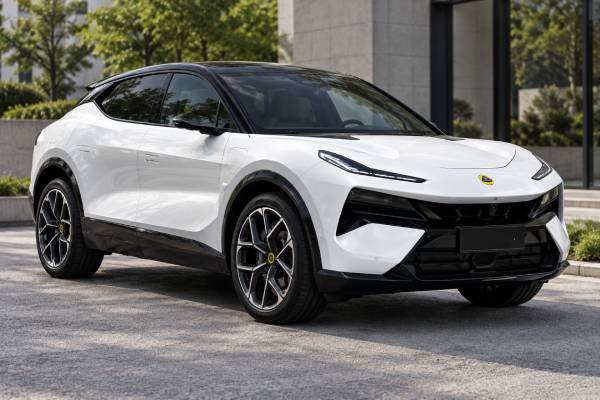
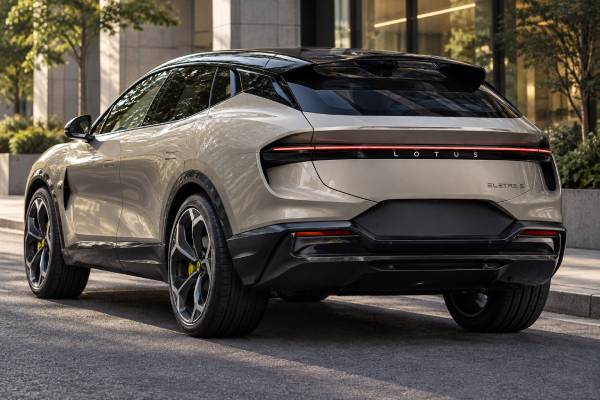
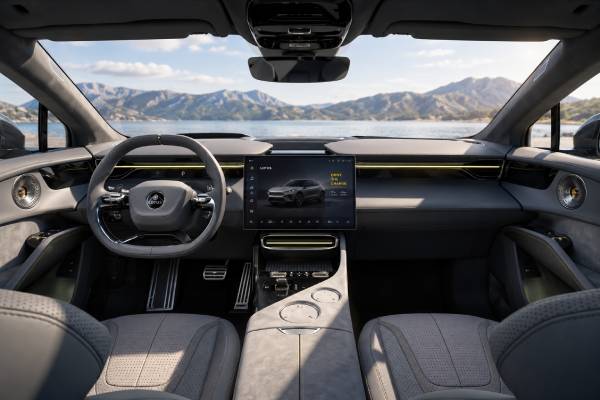
The Eletre S is arguably the most balanced early version of Lotus’s Type 132 electric SUV. Its 450 kW dual-motor system is quoted at 603 bhp in UK-style units, with 710 Nm of torque and all-wheel drive, yet it avoids the R model’s two-speed high-performance drivetrain and its greater appetite for energy and tires. With a 112 kWh battery, 800-volt architecture, and a WLTP figure that reached about 600 km in favorable specification, the S can be the more rational Eletre for drivers who value range, refinement, and rapid charging more than sub-three-second acceleration. It is still a very quick car: 0–100 km/h takes about 4.5 seconds, which is more than enough for overtaking and motorway use. Used buyers should concentrate on wheel size, suspension condition, charging behavior, software updates, and the exact option specification. On an Eletre S, those factors can affect day-to-day satisfaction more than the absence of the R badge.
Table of Contents
- Core specifications for the Eletre S
- Why the 450 kW drivetrain is the sweet spot
- Efficiency, WLTP range, and charging
- Ride, steering, brakes, and wheel choice
- Cabin, luggage, and towing usefulness
- Service and ownership priorities
- Used Eletre S buying guide
Core specifications for the Eletre S
The Eletre S is a battery-electric AWD SUV using one motor on each axle and a single-speed reduction system. Compared with the Eletre R, the S gives up headline power but gains a simpler driveline and generally stronger official range.
| Item | Data |
|---|---|
| Maximum system output | 450 kW / 603 bhp in UK convention |
| System torque | 710 Nm |
| Motor arrangement | Front and rear electric motors |
| Driven wheels | All four |
| Transmission | Single-speed reduction |
| Battery | 112 kWh |
| Architecture | 800 V class |
| Item | Data |
|---|---|
| 0–100 km/h | 4.5 seconds |
| Top speed | Approximately 258 km/h |
| Maximum early WLTP range | Up to about 600 km |
| Official combined consumption | Varies with wheel and homologated configuration |
| Tailpipe CO₂ | 0 g/km |
| Item | Data |
|---|---|
| DC charging class | Approximately 350 kW |
| 10–80% DC time | About 20 minutes in favorable conditions |
| Onboard AC charging | Up to 22 kW in European specification |
| European connection | Type 2 / CCS2 |
| Item | Data |
|---|---|
| Length | 5,103 mm |
| Width without mirrors | 2,019 mm on early specification |
| Width with mirrors | 2,231 mm |
| Height | About 1,630–1,636 mm |
| Wheelbase | 3,019 mm |
| Frunk | 46 L |
| Rear luggage, five seats | 688 L |
| Rear luggage, folded | 1,532 L |
| Item | Data |
|---|---|
| Braked towing | Up to 2,250 kg where approved |
| Unbraked towing | 750 kg where approved |
| Common 22-inch front tire | 275/40 R22 |
| Common 22-inch rear tire | 315/35 R22 |
| Suspension | Air suspension with adaptive damping |
The 603 bhp figure is the British-mechanical-horsepower expression of the 450 kW drivetrain. In metric markets the same power level is commonly shown as 612 PS. When comparing listings, 450 kW is the most reliable identifier.
Why the 450 kW drivetrain is the sweet spot
For normal road use, 450 kW is already far beyond what most drivers can exploit continuously. The Eletre S therefore gives up little in everyday speed while avoiding some of the compromises that come with the 675 kW R.
Its 4.5-second 0–100 km/h time means motorway merging and overtaking are effortless. More importantly, acceleration remains strong at speeds where a less powerful EV can begin to feel softer. Because there is no conventional gear shift, response is immediate and predictable: press the accelerator and the front/rear motors allocate torque according to grip, mode, and stability-control strategy.
The single-speed drivetrain is also mechanically straightforward. There is no need for the R’s two-ratio rear gearbox because the lower-output motors do not need the same combination of launch multiplication and extreme top-speed capability. That simplicity is attractive in a long-term ownership context, even though the electric drive units remain sophisticated assemblies.
The S is not a lightweight sports car disguised as an SUV. It is a very large, heavy luxury EV, and its performance should be understood through that lens. Lotus uses a low-mounted battery, rear-steering and active-chassis options, air suspension, and careful steering calibration to manage the mass. The result can feel far more agile than the dimensions suggest, but physics still appears in braking distances, tire loads, and energy use.
For drivers who never use launch-control-style acceleration, the S can actually feel more coherent than the R. Power is easier to meter, official range is better, and the car remains quick enough that full throttle is rarely necessary.
Efficiency, WLTP range, and charging
The strongest numerical argument for the Eletre S is range. Early specifications reached roughly 600 km WLTP, although the exact certified result depends on wheel size, tires, equipment, and market homologation. Larger wheels generally increase aerodynamic and rolling losses, so a visually dramatic 23-inch car may not match the best range figure.
Owners should separate three ideas: rated range, displayed range, and achievable trip range. WLTP is a standardized laboratory result. The dashboard estimate adapts to recent driving. Actual trip distance depends on speed, temperature, wind, elevation, traffic, HVAC use, tire pressure, and battery starting state.
A useful long-distance strategy is not to chase the last 10% of battery. The Eletre can charge at very high DC power when conditions are right, but charging naturally slows as the pack becomes full. Two shorter stops within the strongest part of the charging curve can be faster than one long session to nearly 100%.
Battery preconditioning is valuable in cold weather because lithium-ion cells accept high charging power best within a controlled temperature range. If the navigation system can prepare the battery for a selected charger, use that feature. Arriving at an ultra-rapid charger with a cold pack can produce disappointing charging power even when the charger itself is capable of 350 kW.
At home, the car’s 22 kW AC capability is a major convenience for owners with three-phase power. A typical single-phase home supply will provide much less, which is not a fault. Overnight charging at lower AC power is still sufficient for many users because daily mileage is usually a fraction of the full battery range.
Battery longevity is helped by sensible habits: avoid leaving the car for long periods at 100% unnecessarily, do not repeatedly run it to extremely low state of charge, and follow Lotus guidance for storage and charging limits. The battery-management system protects the pack, but owner behavior still affects long-term stress.
Ride, steering, brakes, and wheel choice
An Eletre S should be judged by how it rides on ordinary roads, not just by how rapidly it changes direction during a short demonstration. The air suspension and adaptive dampers are there to make a large performance SUV livable, and wheel choice has a large influence on whether they succeed.
A 22-inch wheel already sounds enormous, yet it offers more tire sidewall than a 23-inch alternative. That extra sidewall can reduce impact harshness, wheel-damage risk, and tire cost. Buyers who regularly drive poor roads should think carefully before choosing the largest wheel purely for appearance.
Rear-wheel steering, where fitted, helps in two different ways. At low speed the rear wheels can steer opposite the fronts to reduce the effective turning circle. At higher speeds they can steer in phase to improve stability during lane changes. A fault in that system may be felt as odd steering behavior or may trigger warnings; it should be diagnosed rather than ignored.
Regenerative braking can make the car feel one-pedal-like depending on settings, but the hydraulic friction brakes remain essential. Because regenerative systems reduce routine pad use, disc condition deserves attention. A car used gently in wet climates can develop corrosion even with plenty of pad material remaining.
Alignment is another overlooked issue. A heavy EV on wide tires can wear an inner shoulder rapidly if toe or camber has shifted after a pothole strike. Uneven wear can also create noise that buyers mistake for a wheel bearing. Inspect every tire across its full width and ask for alignment records if the car has recently received a complete set.
Cabin, luggage, and towing usefulness
The Eletre S is not only a performance statement; it is a genuinely large vehicle. The 3,019 mm wheelbase gives substantial passenger space, while the five-seat luggage compartment is rated around 688 liters and can expand to roughly 1,532 liters with the rear seats folded.
The 46-liter front compartment is useful for charging cables, detailing supplies, or smaller bags. Keeping dirty cables out of the main luggage area is one of those minor EV conveniences that becomes more valuable in bad weather.
Some Eletre configurations were offered with four individual seats rather than a conventional five-seat rear bench. A used buyer should make sure the seating layout suits actual family needs; converting between layouts is not something to assume is practical or officially supported.
Towing capability of up to 2,250 kg braked is unusually strong for a high-performance EV. The powertrain has no shortage of torque, but range is the limiting factor. A box trailer or caravan increases aerodynamic drag dramatically, and cold-weather towing can require frequent charging. Before choosing the Eletre as a tow car, examine charging stations on the planned route for pull-through or trailer-friendly layouts.
The vehicle’s width also matters more than a specification table suggests. At over two meters wide before mirrors on early published data, narrow urban garages and older parking structures can be stressful. The camera system and parking aids help, but buyers should physically test their home parking space rather than relying on memory.
Service and ownership priorities
The Eletre S needs less routine powertrain service than a combustion SUV, but its complexity means preventive inspection is still worthwhile. The expensive systems are concentrated in the battery, electric drive units, thermal management, active chassis, driver-assistance hardware, and electronics.
Use official service intervals for the exact VIN. Typical attention areas include brake fluid, cabin filters, tires, brakes, suspension, coolant circuits, wiper systems, 12-volt battery health, and diagnostic scans. A high-voltage coolant or refrigerant service should be handled by technicians familiar with the Eletre because thermal management supports battery life, rapid charging, cabin climate, and motor/inverter operation.
Software maintenance matters too. Over-the-air updates can alter charging behavior, infotainment, driver-assistance functions, and user interfaces. After an update, confirm that profiles, keys, app pairing, cameras, navigation, and scheduled charging work as expected.
Owners should also keep drainage channels and active aerodynamic openings clean. Leaves or debris around cooling areas can reduce airflow, and blocked drains can create water problems in any complex luxury vehicle.
A high-pressure underbody wash should be used with care after winter driving. Removing salt is good, but directing extreme pressure at connectors, damaged seals, or suspension electronics is not. If the undertray has been damaged, repair it before exposing the area to repeated moisture and road contamination.
Used Eletre S buying guide
The best used Eletre S is one with complete documentation, healthy tires and suspension, functioning software, and a charging history that can be demonstrated. Mileage alone is a poor shortcut for condition.
Begin with the VIN and original market. Confirm whether the car is an official local-market vehicle or a parallel import. Then verify the exact output: 450 kW corresponds to the early S/S+ family even when translated horsepower numbers differ.
Check the high-voltage system for warnings and, if possible, obtain a battery state-of-health report from a qualified source. Do not judge battery health from the displayed range after a short drive. The estimate can move substantially after previous high-speed or winter use.
Test AC and DC charging. Inspect the inlet for heat damage, broken locking mechanisms, moisture, or poorly repaired pins. Confirm that the car can initiate a session without repeated errors and that the charge rate rises normally for the battery temperature.
Cycle the suspension through available heights and modes. Listen for compressor overrun and check that all four corners settle evenly. Perform full-lock parking manoeuvres to assess rear steering and front suspension noises. On the road, use a firm brake application to check for vibration.
Finally, inspect the large wheels closely. Cosmetic repairs are common, but repeated cracks, welded rims, sidewall bubbles, or mixed tire specifications suggest a car that has had a hard life. A well-maintained S on sensible wheels can be a more satisfying long-term purchase than a flashy example with neglected consumables.
For most owners, the Eletre S provides the essential Type 132 experience: dramatic design, serious AWD performance, long-range potential, ultra-fast charging, and a spacious cabin. Unless the R’s extra acceleration is a priority, the 450 kW model can be the more usable choice.
Choosing between an S and an R
The decision is less about whether the S is fast enough and more about how the car will be used. A driver who regularly travels long motorway distances, charges at home, and values tire life will usually get more from the 450 kW car. A driver who specifically wants launch performance, the R’s two-speed rear drivetrain, and the highest Eletre top-speed capability has a clear reason to choose the R.
In urban and suburban traffic, the S can feel just as immediate because electric torque arrives instantly. The R’s extra output becomes most obvious during full-throttle acceleration and at higher speed. That means the S gives away less subjective performance than the headline numbers suggest during ordinary driving.
Range can be the more useful difference. Even an extra 50–100 km of practical trip margin can allow a driver to bypass a busy charger or arrive at a destination with a more comfortable reserve. For owners who rarely use maximum acceleration, that benefit is experienced more often than the R’s additional power.
Planning tire replacements intelligently
Do not wait until all four tires are near the legal minimum before researching replacements. Eletre sizes can be expensive and may not be stocked locally in every brand. Start shopping when tread depth is still adequate, particularly before winter or a long trip.
On an AWD EV, maintaining compatible rolling circumference across an axle is important. Replace tires in matched pairs at minimum and follow Lotus guidance if there is a large tread-depth difference front to rear. Never mix a low-load or lower-speed-rated tire just because the size printed on the sidewall matches.
After replacement, ask for an alignment check and retain the printout. It creates a baseline for later wear diagnosis. If the new set becomes noisy or develops inner-edge wear quickly, the alignment record helps identify whether the problem appeared before or after a suspension event.
Using the Eletre S as a family car
A family owner should test practical details that performance reviews often ignore. Fit the actual child seats, check door opening in the home garage, test whether a stroller fits without removing wheels, and make sure the preferred rear-seat configuration still leaves useful luggage space. The Eletre is large outside, but usability depends on the family’s equipment.
The low floor created by the battery can influence seating posture. Rear passengers should spend enough time in the car to judge thigh support rather than relying on a showroom sit. Four-seat configurations may be luxurious but reduce flexibility for families with three children or occasional extra passengers.
The front storage compartment is useful for cables, but wet charging leads should be dried before long storage to reduce odor and corrosion around connectors. A simple cable bag or waterproof liner can keep both the frunk and rear luggage area cleaner.
Road-trip habits that make the S easier to live with
Leave with the battery at the level the trip requires, not necessarily 100% for every journey. Enter rapid chargers into the navigation system early enough for preconditioning. At the charger, stop thinking in terms of “filling the tank” and instead add enough energy to reach the next reliable stop with a sensible reserve.
Watch consumption in energy units rather than obsessing over predicted kilometres. A sudden rise in kWh/100 km can be explained by headwind, rain, climbing, cold weather, roof accessories, or low tire pressure. Understanding the cause is more useful than assuming the battery has deteriorated.
For repeated long trips, note which charger networks consistently deliver high voltage and reliable initiation with the Eletre. A personal shortlist of proven stations can make ownership smoother than relying on a generic map score.
Home charging and the daily-use advantage of the S
For an owner with off-street parking, the S can spend most of its life charging gently at home rather than visiting rapid chargers. A correctly installed wallbox can be scheduled for cheaper electricity periods and can restore a typical day’s energy use overnight without demanding the battery’s maximum AC capability. The installation should be sized by a qualified electrician for the property, local grid rules, earthing arrangement, and the car’s supported charging mode rather than by copying another owner’s setup.
Charging to 100% every night is rarely necessary for a long-range EV. A lower everyday limit can leave regenerative-braking headroom and reduce the time the battery spends at very high state of charge; use Lotus guidance for the exact recommended routine and raise the limit when a long trip requires it. On departure day, preconditioning while plugged in can warm or cool the cabin using mains power and may also improve the battery’s readiness for the first part of the journey.
The S is particularly well suited to this pattern because its 450 kW drivetrain already provides more road performance than normal commuting can exploit. The practical benefit of owning the less powerful early Eletre is therefore not merely a lower specification number. It is the ability to prioritize range, tire life, and predictable energy costs without feeling that the car is slow.
Why wheel choice changes more than appearance
Large wheels alter several ownership variables at once. A wider, heavier package can increase tire price, expose the rim to more pothole damage, sharpen impact harshness, and reduce efficiency. An attractive 23-inch setup may be appropriate for a buyer who values stance and dry-road response, but it should not be treated as a free cosmetic upgrade.
For a used S, verify that all four wheels have the correct load rating, offset, diameter, and compatible tire specification. Inspect the inner barrels as carefully as the visible faces because cracks and bends often hide there. If aftermarket wheels are fitted, ask for documentation and the originals. Incorrect geometry can place additional load on wheel bearings and suspension components or cause rubbing under steering and suspension movement.
A buyer focused on touring may prefer a smaller homologated package even if the car looks less dramatic. The combination of deeper sidewalls, lower replacement cost, and better resistance to road damage can make a meaningful difference over several years. This is one area where choosing the specification that suits actual roads is more valuable than recreating a launch-photo appearance.
References
– Lotus Eletre | Lotus Electric SUV | Lotus Cars United Kingdom 2026 – Lotus Eletre | How it Drives | Lotus Cars 2026 – Lotus Charging | Lotus Cars 2026 – Lotus Eletre Handbook for Drivers | Lotus Cars 2026 (Owner’s Manual) – Lotus Eletre: the world’s first electric Hyper-SUV – Lotus Cars Media Site 2022 – Lotus partners with Bosch and Mobilize to give customers access to over 600,000 European charging stations – Lotus Cars Media Site 2024
Disclaimer
This article is for informational purposes and is not a substitute for professional diagnosis or repair. Specifications, torque values, service intervals, and procedures vary by VIN, market, model year, and equipment. Verify the exact car against its official Lotus handbook and service documentation.
If you found this Eletre S guide useful, sharing it on Facebook, X/Twitter, or an EV community helps support our work.