
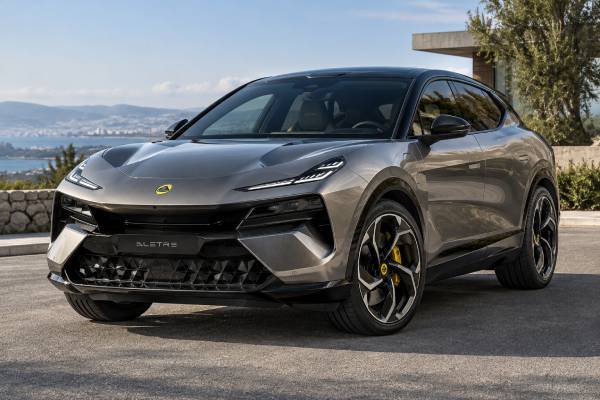
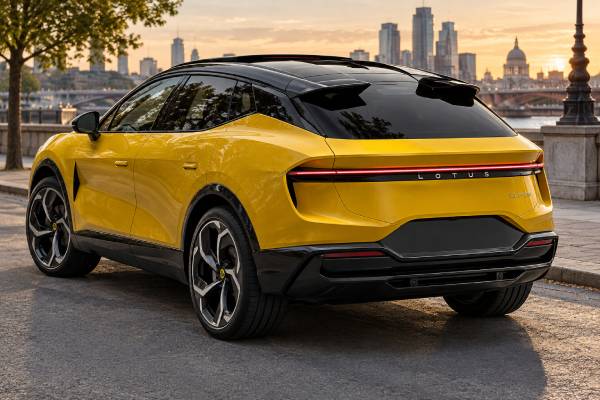
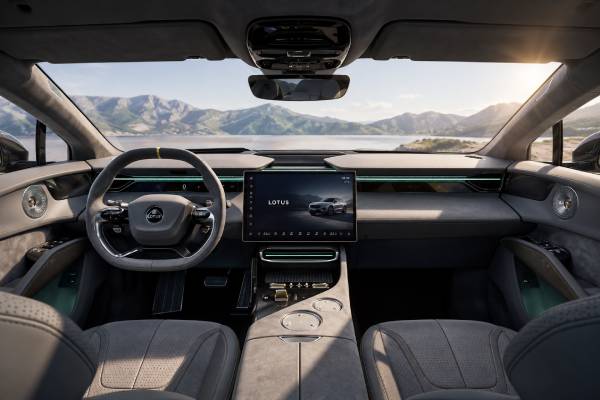
The original Lotus Eletre is more than the least exotic entry in the Type 132 story; it is the car that established the engineering package every later 600- and 900-series version develops. It uses the 450 kW dual-motor all-wheel-drive branch of the Type 132 platform, with 710 Nm of combined torque and an 800 V electrical architecture built for very rapid DC charging. This guide concentrates on the original Eletre as the foundation of the Type 132 family. It also separates verified family-wide engineering facts from equipment that can vary by country, wheel package and production date. That distinction matters with the Eletre because Lotus has revised naming and specifications across markets, and even horsepower figures can differ depending on whether a source uses metric horsepower or brake horsepower. The safest approach is to identify the exact car by VIN and factory build data, then judge its battery, charging, software, suspension, tires and options as a complete ownership package rather than relying on the badge alone.
Table of Contents
- How the original Type 132 Eletre established the formula
- Technical specification of the 450 kW Eletre
- Performance, ride and steering in the base powertrain
- Battery range and charging in real use
- Cabin packaging, aerodynamics and technology
- Maintenance and long-term EV ownership
- Used-buying checks for an early Eletre
How the original Type 132 Eletre established the formula
The base 450 kW Eletre is the reference point for the whole family. Its dual-motor AWD layout, 800 V electrical architecture and large traction battery established the combination of fast charging, long-distance capability and sports-SUV performance that Lotus later split into clearer 600 and 900 series. That context is useful when comparing early cars with refreshed ones, because some naming and equipment details changed even when the core propulsion concept did not.
Early production also deserves careful software attention. The Eletre is unusually software-rich, with connected functions, driver assistance and over-the-air updates layered on top of conventional vehicle systems. A used example should therefore be judged as both a mechanical EV and a connected device: charging must be stable, screens and cameras should work properly, and available updates should be applied.
For early Eletres, the most useful comparison is not simply old versus new. It is whether the specific car has the equipment, software support and charging behavior the buyer needs today. A well-updated early example can be a better ownership proposition than a newer car with an unsuitable wheel or seating configuration.
Technical specification of the 450 kW Eletre
The original 450 kW Type 132 is a dual-motor 800 V BEV with a large underfloor battery, air suspension and fast DC charging. Later naming changes do not erase the fact that this powertrain established the family baseline.
| Specification | Value |
|---|---|
| Powertrain type | Battery-electric vehicle (BEV) |
| Motor layout | One electric drive unit at each axle |
| Electrical architecture | 800 V class high-voltage system |
| Battery | 112 kWh class traction battery (Lotus market literature; verify gross/usable labeling for the exact car) |
| Drivetrain | All-wheel drive |
| Specification | Value |
|---|---|
| Maximum power | 450 kW (603 hp as specified for this assignment) |
| Maximum torque | 710 Nm (524 lb-ft) |
| Drive | Dual-motor all-wheel drive |
| Reduction gearing | Single-speed front and rear |
| 0–100 km/h | about 4.5 s, market specification dependent |
| Top speed | about 258 km/h, market specification dependent |
| Specification | Value |
|---|---|
| DC charging | Up to 350 kW CCS on compatible infrastructure |
| AC onboard charging | Up to 22 kW in markets/configurations that support it |
| DC rapid-charge claim | Lotus has advertised roughly 400 km / 250 miles of added range in about 20 minutes under favorable conditions |
| Regeneration | Adjustable regenerative braking |
| Charge planning | Navigation and app functions can support charging-route planning and battery monitoring |
| Specification | Value |
|---|---|
| Length | 5,103 mm (200.9 in) |
| Wheelbase | 3,019 mm (118.9 in) |
| Height | about 1,630 mm (64.2 in) |
| Width | 2,135 mm with camera mirror system in early published target specification |
| Body | Five-door luxury performance SUV |
| Seating | Four- or five-seat layouts have been offered, depending on market and configuration |
| Specification | Value |
|---|---|
| Front suspension | Multi-link |
| Rear suspension | Five-link / multi-link |
| Springing | Air suspension |
| Damping | Continuous Damping Control adaptive dampers |
| Steering | Electric power steering |
| Torque management | Brake-based torque vectoring; additional active chassis systems depend on trim/options |
| Specification | Value |
|---|---|
| High-voltage battery | Check state-of-health diagnostics, charging history and warning logs |
| Tires | Inspect inner and outer shoulders; large staggered performance tires are costly |
| Brakes | Check disc condition, corrosion and friction-brake operation despite strong regeneration |
| Software | Confirm current vehicle software and completion of applicable campaigns |
| 12 V system | Verify auxiliary-battery health because low-voltage faults can disable high-voltage vehicle functions |
Performance, ride and steering in the base powertrain
In the original Eletre, the key dynamic achievement is scale management. The vehicle is large and heavy, yet the low battery placement, air suspension and quick electric torque help it react more like a low-slung performance car than its dimensions suggest. Physics still matters, so smooth inputs and tire condition are essential if the driver wants the chassis to feel precise.
Early cars should be tested after full warm-up, because first-generation software and cooling behavior are part of the ownership history.
Drive modes change response, steering weight and chassis behavior, but they cannot compensate for poor tires. Correct load and speed ratings, matching axle pairs and appropriate pressure are basic safety requirements on a vehicle with this much torque.
Check brake surfaces carefully on low-mileage early cars; limited use can be as relevant as hard use.
Battery range and charging in real use
Air-suspension behavior should be compared across modes and after the car has sat, helping reveal leaks or calibration issues.
Four-seat and five-seat early cars appeal to different buyers, so original configuration can influence resale as much as trim condition.
Active aero and deployable hardware should be verified because early repair work may have involved parts or calibrations later revised.
Confirm current Hyper OS functions, cameras and connected services rather than assuming an early car behaves like a fully updated one.
For this standard dual-motor Eletre configuration, the practical point is the original Eletre as the foundation of the Type 132 family. That should guide which options are worth paying for and which are only attractive on a showroom specification sheet.
Cabin packaging, aerodynamics and technology
Early Eletre ownership benefits greatly from learning battery preconditioning and route planning. The car can charge very quickly under the right conditions, but arriving at a rapid charger with a cold battery can make the session slower than the headline number suggests.
Use a real DC session to confirm that an early car negotiates modern high-power chargers reliably.
Home charging can make an older example easy to live with even if public-network software has evolved since launch.
Cold-weather planning should include battery and cabin preconditioning where available. In hot climates, parking and charging conditions also matter because the thermal-management system may need to devote energy to keeping the pack within its preferred temperature range.
Maintenance and long-term EV ownership
The earliest Eletres deserve careful attention to campaigns and software revisions. Ask a Lotus service center to confirm outstanding actions by VIN and keep documentation of completed work. This is more reliable than assuming an over-the-air update covers every possible campaign.
Prioritize campaign history, software status and charging reliability over cosmetic novelty.
Use the earliest VIN-specific handbook and later campaign information together when service details have changed over time.
Battery-health evidence is particularly useful on an early build because age and usage pattern may not correlate closely with odometer reading.
Used-buying checks for an early Eletre
For an early Eletre, prioritize software status and warranty history alongside conventional condition. Confirm all screens, cameras and sensors, test both slow and rapid charging, listen for suspension noises and inspect the expensive large wheels from both sides.
- Confirm the VIN, original market and advertised early Type 132 Eletre specification before discussing price.
- Review campaign and software history with special attention to early-production condition.
- Inspect wheels and tires for damage or wear that could affect software maturity and campaign history.
- Cycle the air suspension and test the car on both smooth and broken pavement.
- Verify normal AC charging and complete a DC rapid-charge test when practical.
- Operate every fitted camera, assistance function, seat, climate and infotainment feature.
- Review battery diagnostics, warranty position and repair history before final payment.
An early Eletre should be judged by update history and present function. Moderate mileage with consistent charging and dealer attention may be healthier than minimal use accompanied by an aging 12 V battery and unresolved campaigns.
Early-production context matters
The 2022 launch date marks the Eletre’s public introduction, while customer deliveries and market availability followed later. That distinction matters when a listing describes an “early” car. Build date, first registration and model-year designation can be separated by months, especially around a global launch. A buyer should use the VIN and factory records to establish exactly when the car was produced and which software and hardware level it carried at delivery.
Early cars can also reveal how quickly a connected EV evolves. Navigation, charging logic, phone integration and driver-assistance behavior may improve through updates. A used Eletre therefore needs a software-history conversation in addition to a service-history conversation. Ask what updates were completed, whether any campaigns remain open and whether all current functions operate without error messages.
Why the platform feels different from a conventional SUV
The battery is mounted low in the vehicle, which places a large share of the mass near the floor. That does not make the Eletre light, but it changes how the mass is distributed. Instead of a heavy engine high in the nose, the car has electric drive units at the axles and a broad battery beneath the cabin. The result can feel stable and planted even though the body is tall and the vehicle is physically large.
Air suspension and adaptive damping then manage the compromise between ride comfort and body control. The system can disguise speed effectively, so drivers should watch actual road speed rather than relying on noise or vibration as cues. This quiet competence is part of the Eletre’s appeal but also one reason tire quality and brake condition should never be treated casually.
Charging habits for an early Eletre
The best long-distance routine is to arrive at a high-power charger with the battery warm and at a relatively low state of charge, then leave once charging has slowed enough that continuing is less time-efficient than driving to the next stop. This is different from the petrol habit of always filling completely. Owners who understand the charging curve usually spend less total time stopped on long journeys.
At home, regular AC charging is simpler. Set a target that suits daily mileage and use 100% mainly when the extra range is genuinely useful. Battery-management software protects the pack, but avoiding unnecessary time at extreme states of charge is still a sensible conservative habit for long-term ownership.
What makes an early used car attractive
Depreciation can make an early Eletre compelling because the core 800 V architecture and 450 kW performance remain impressive. The best value comes when a car has current software, strong battery behavior, good tires and a complete history. A low asking price is less attractive if the buyer immediately needs four large tires, wheel repairs, suspension work or a replacement 12 V battery. Condition can easily outweigh model year.
Three ways to evaluate an early Eletre
First, evaluate it as an EV. The car should charge reliably on AC and DC, report no high-voltage warnings and show stable behavior as battery temperature changes. A single range estimate on the instrument display is not a battery test. Diagnostic data and repeatable consumption over a representative route are more meaningful.
Second, evaluate it as a luxury SUV. Check air suspension, climate control, seats, tailgate, cameras, audio, glass and every driver-assistance feature. Small electronic defects can be more annoying in daily ownership than a minor cosmetic mark because they affect functions used on every trip.
Third, evaluate it as an early connected product. Confirm software version, account transfer, available app functions and whether any campaigns remain open. Ask a Lotus service point to check the VIN rather than relying on the seller’s memory. Connected-car support can evolve over time, so current functionality matters more than what a launch brochure promised.
A buyer who completes all three evaluations can judge an early Eletre fairly. The age of the design alone should not disqualify it; the decisive issues are whether its hardware is healthy, its software is supported and its configuration fits present-day needs.
Service access should influence the decision
An early Eletre is easier to own when a capable Lotus service point is reasonably accessible. Before buying, identify where high-voltage diagnosis, software campaigns, glass calibration and active-suspension work can be completed. Ask how replacement parts are supplied in your market and whether routine appointments require long lead times. This matters because some faults cannot be solved by a general workshop even when the symptom looks simple. A car with a slightly higher purchase price but strong local support can be cheaper and less disruptive over several years than a bargain example that must travel long distances for every specialist issue. Ownership convenience is part of value, especially for a technology-heavy first-generation model.
One more ownership consideration
Because early examples helped establish the Eletre platform, buyers should be comfortable with a car that may have had more software intervention than later builds. Updates are not inherently negative; they can show that the vehicle remained within the manufacturer support network. The concern is unexplained recurring faults, missed campaigns or functions that still fail after updates. Ask for the chronology, not just a statement that the software is “current.”
Why early Eletre ownership is partly about support history
The first Eletres were introduced during a period when Lotus was rapidly expanding its software, connected services and EV infrastructure. That makes support history unusually relevant. A car that has returned to the dealer for updates and campaigns is not automatically troublesome; regular manufacturer attention may mean known issues were corrected as the platform matured. What matters is whether problems were resolved and whether current functions are stable.
Ask for a chronological service record rather than a stack of invoices with no explanation. Note when major software versions were installed, whether any charging or driver-assistance complaints recurred and whether hardware was replaced. If a seller cannot explain repeated visits, a Lotus service center may be able to clarify the VIN history.
Parts and calibration access are equally important. Camera, radar, glass and suspension work on a modern connected EV can require model-specific procedures after a seemingly minor repair. For an early car, choose workshops that understand the platform rather than treating it as a generic battery SUV. A well-supported early Eletre can remain highly capable; the ownership risk comes from neglected updates, unclear repairs and weak access to knowledgeable service.
Final practical note
The early Eletre is also a useful candidate for a pre-purchase diagnostic report from a Lotus-capable workshop. Ask the technician to review stored fault history, battery data, software level, open campaigns and charging behavior in one visit. That creates a snapshot of the car at the point of sale and reduces reliance on verbal explanations. If the report shows an old fault that was corrected and has not returned, that can be reassuring. Repeated unresolved codes, especially across charging or driver-assistance systems, deserve a different level of scrutiny before the purchase price is agreed.
References
- Lotus Eletre – The Electric Hyper SUV | Lotus Cars 2026
- Lotus Eletre – Explore Models | Lotus Cars 2026
- Lotus Eletre | How it Drives | Lotus Cars 2026
- Lotus Eletre – Specs, Features and More | Lotus Cars Netherlands 2026
- Lotus Eletre Handbook for Drivers | Lotus Cars 2026
- Lotus Charging | Lotus Cars 2026
Disclaimer
This article is for informational purposes only and is not a substitute for professional diagnosis, repair, or vehicle-specific service information. Specifications, torque values, maintenance intervals, charging behavior, software functions, and procedures can vary by VIN, market, production date, wheel package, and equipment. Verify all service work and technical values against official Lotus documentation for the exact vehicle.
If this guide was useful, please share it on Facebook, X/Twitter, or your preferred automotive community to support our work.