
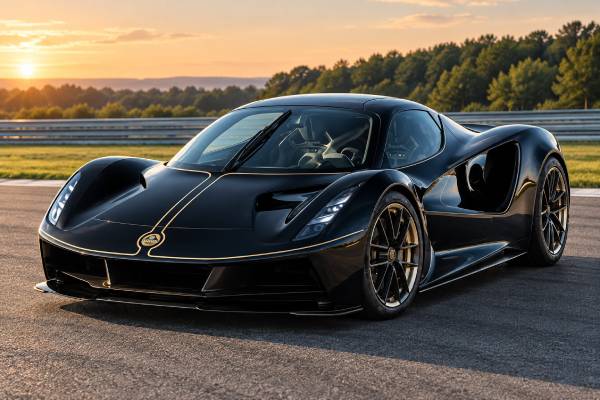
The Lotus Evija Fittipaldi is not a separate mechanical derivative so much as an exceptionally rare, historically themed specification of the Type 130 electric hypercar. Lotus created only eight examples to mark 50 years since Emerson Fittipaldi won the 1972 Formula 1 Drivers’ Championship while Team Lotus secured the Constructors’ title with the Type 72. Under the black-and-gold bodywork sits the same four-motor Evija architecture, rated at 1,500 kW and 2,011 bhp, with individual drive units, torque vectoring, a mid-mounted high-voltage battery and active aerodynamics. What makes the Fittipaldi version special is the depth of its Type 72 references, including genuine recycled race-car aluminium in the cabin. For an owner or collector, that means the car must be evaluated on two levels: as an extreme low-volume EV with unusual charging, thermal and service needs, and as a numbered heritage object whose bespoke components and provenance matter greatly to long-term value.
Table of Contents
- Why the Fittipaldi Edition Exists
- Technical Specifications and Data
- Four-Motor Powertrain and Performance
- Aerodynamics, Chassis, and Driver Modes
- Charging, Range, and Battery Care
- Maintenance, Storage, and Specialist Service
- Buying, Authenticity, and Collector Checks
Why the Fittipaldi Edition Exists
The Evija Fittipaldi was created as a direct tribute to Emerson Fittipaldi, the Lotus Type 72 and the championship season of 1972. Only eight cars were announced, matching the eight surviving Type 72 Formula 1 cars that Lotus gathered at Hethel for the special edition’s launch.
Fittipaldi won five of the 11 championship Grands Prix in 1972 and became Formula 1 World Champion in the Type 72. Team Lotus also won the Constructors’ Championship. Fifty years later, Lotus Advanced Performance used the Evija as the modern half of that story: a car built at Hethel, shaped by motorsport thinking, but powered by four electric motors rather than a Cosworth V8.
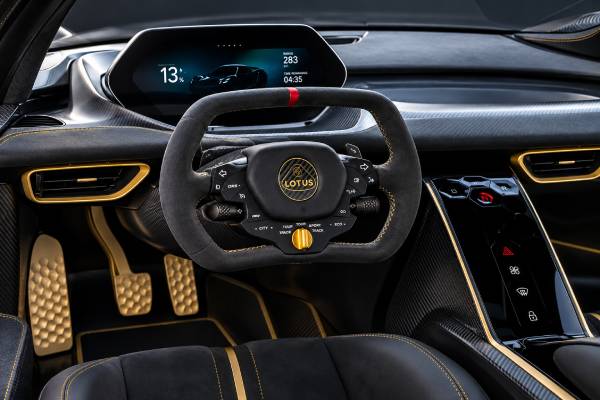
The edition is immediately identifiable by its black-and-gold theme, but the details go much further than paint. A hand-tinted plan view of the Type 72 is etched into the exposed carbon-fibre roof. Fittipaldi’s signature is stitched into the dashboard. Gold lettering identifies the edition near the rear side glazing, while the active rear wing carries graphics celebrating the Type 72’s 1972 race wins. The number 8 on the B-pillar refers to the number Fittipaldi used during that season.
The most important authenticity detail is inside the car. The rotary control on the floating centre panel was made using recycled aluminium from an original Type 72. That gives each Fittipaldi edition a physical link to the racing car that inspired it, not merely a visual reference. The wheels also continue the historic theme, with red anodized centre-lock surrounds on the left side and green on the right, plus black-and-gold brake detailing.
These features change the ownership equation. On a normal Evija, a damaged trim item is already expensive because of the car’s low production volume. On a Fittipaldi, a damaged or replaced special-edition component can also affect historical integrity. Owners should document any repair, refinishing or component replacement with photographs, invoices and Lotus correspondence. For collectors, originality is likely to matter as much as mileage.
Technical Specifications and Data
The Evija Fittipaldi is a battery-electric two-seat hypercar with four individual electric drive units and all-wheel drive. Its technical specification follows the standard Evija rather than introducing a different powertrain, so the key mechanical distinction is not output but the Fittipaldi edition’s bespoke finish and eight-car production run. Several Lotus figures were originally published as targets, which is important when comparing early literature with delivered cars.
| Specification | Value |
|---|---|
| Powertrain type | Battery electric, four-wheel drive |
| Electric motors | 4, one drive unit for each wheel |
| Motor output | 375 kW each |
| Combined output | 1,500 kW; 2,039 PS; 2,011 bhp |
| Combined torque | 1,704 Nm (1,257 lb-ft), with torque vectoring |
| Drive-unit transmission | Single-speed helical-gear planetary reduction gearbox at each drive unit |
| Battery location | Mid-mounted immediately behind the seats |
| Published battery capacity | 93 kWh in Lotus Evija/Fittipaldi technical literature |
The battery-capacity figure deserves context. Lotus published 93 kWh in Evija technical material, while production battery supplier Hyperbat has described its Evija pack as a 90 kWh lithium-ion unit. Because those figures come from different parties and may reflect different rating conventions, they should not be combined or treated as evidence of a usable-capacity figure. For identification and period specification, the Lotus 93 kWh figure is the appropriate reference.
| Specification | Value |
|---|---|
| 0–100 km/h (0–62 mph) | Under 3 seconds |
| 100–200 km/h | Under 3 seconds |
| 200–300 km/h | Under 4 seconds |
| 0–300 km/h (0–186 mph) | Under 9 seconds in Fittipaldi launch specification |
| Top speed | Electronically limited to 350 km/h (217–218 mph) |
| WLTP combined range | 402 km (250 miles), published as a target figure |
| Track-mode sustained full performance | Lotus stated at least 7 minutes without power derating |
| Specification | Value or condition |
|---|---|
| 350 kW DC charge to 80% | 12 minutes, manufacturer figure |
| 350 kW DC charge to 100% | 18 minutes, manufacturer figure |
| Battery charging capability announced at launch | Up to 800 kW pack acceptance was described as a future-capability target |
| Thermal control | Four-radiator cooling package for sustained battery and powertrain performance |
| Regenerative braking | Calibrated by drive mode; City mode reduces regeneration relative to more performance-oriented settings |
The 800 kW statement is best understood as an engineering capability claim, not a normal owner charging specification. Public chargers capable of supplying that level were not available when the car was introduced, and charge rate in real use depends on charger capability, battery temperature, state of charge and software limits.
| Specification | Value |
|---|---|
| Body style | 2-door, 2-seat hypercar |
| Length | 4,459 mm (175.6 in) |
| Width | 2,000 mm (78.7 in) |
| Height | 1,122 mm (44.2 in) |
| Ride height | 105 mm (4.1 in) |
| Chassis | One-piece carbon-fibre monocoque |
| Monocoque mass | 129 kg (284 lb) |
| Vehicle weight | 1,887 kg (4,160 lb), published as a target figure |
| Fittipaldi production | 8 cars |
| Specification | Value |
|---|---|
| Suspension | Motorsport-derived layout with three adaptive spool-valve dampers per axle |
| Damper supplier | Multimatic |
| Steering | Electro-hydraulic power assistance |
| Front wheel diameter | 20 in magnesium wheel |
| Rear wheel diameter | 21 in magnesium wheel |
| Tyres | Pirelli P Zero Trofeo R developed for the Evija |
| Brakes | AP Racing forged aluminium calipers with carbon-ceramic discs |
| Active aerodynamics | Deployable rear wing and F1-style drag-reduction system |
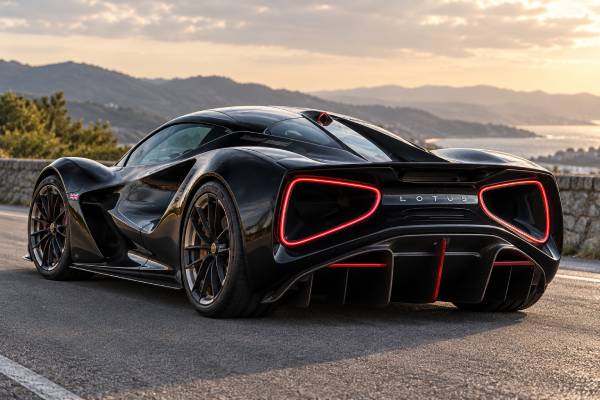
| Rear aero concept | Large Venturi tunnels pass airflow through the rear quarters |
Four-Motor Powertrain and Performance
The Evija’s defining mechanical feature is not simply its 2,011 bhp headline figure; it is the ability to control four drive units independently. That architecture lets the car vary how much torque reaches individual wheels, giving the chassis engineers a tool for traction, stability and cornering response that a conventional central motor and mechanical differential cannot match as directly.
Each compact electrical drive unit combines a motor, inverter and single-speed reduction gearbox. With four units rated at 375 kW apiece, Lotus could spread the powertrain across the car rather than forcing one or two gearsets to handle the entire output. The battery sits immediately behind the seats, echoing the concentrated mass of a traditional mid-engined Lotus. That packaging decision is central to the Evija’s identity: the car is electric, but its mass is arranged to support the directional response expected of a Lotus rather than simply filling the floor with battery modules.
The acceleration figures show why traction management matters. Reaching 100 km/h in under three seconds is impressive but no longer unusual among very powerful EVs. The more revealing figure is the claimed sub-nine-second run to 300 km/h. Sustaining that rate of acceleration requires high power at speed, efficient inverters, strong cooling and careful control of wheel slip. Lotus also stated that full Track-mode performance could be maintained for at least seven minutes without derating, a meaningful target for a car intended to do more than produce one spectacular launch.
The drive modes deliberately change the character of the powertrain. Range mode limits the car to 1,000 PS and 800 Nm and can switch from four-wheel drive to rear-wheel drive to reduce energy use. Tour raises output beyond 1,400 PS and can alternate between rear- and four-wheel drive. Sport brings roughly 1,700 PS and 1,700 Nm. Track unlocks the maximum 2,000 PS-class output, the most aggressive torque-vectoring strategy and the track-focused chassis and aerodynamic settings.
For an owner, those modes are more than novelty settings. Range or Tour makes sense for road use because the car’s maximum power is unnecessary on public roads and because heat generation rises dramatically at hypercar performance levels. Sport and Track should be treated as conditions that demand correct tyre temperature, sufficient battery state of charge, adequate braking temperature control and a suitable environment. The car’s electronic systems can manage torque quickly, but they cannot overcome cold high-performance tyres, standing water or poor surface conditions.
Aerodynamics, Chassis, and Driver Modes
The Evija creates performance by moving air through the body as well as around it. Its enormous rear-quarter Venturi tunnels are structural elements of the design rather than decorative openings, reducing the amount of bodywork that the airflow must push against while helping manage downforce.
Lotus calls this approach “porosity.” Air enters carefully shaped openings at the front and sides, passes through the vehicle and exits in controlled areas. The front splitter divides flow between underbody aerodynamic work and cooling needs. At the rear, the body appears hollowed out because the tunnels occupy space that a conventional supercar would fill with body panels.
Active devices add another layer. The rear wing rises from the body when required, while the drag-reduction system changes aerodynamic resistance to support high-speed performance. In Track mode these systems work with the torque-vectoring and damper strategy. The point is not to imitate a Formula 1 car literally; it is to use the same engineering logic of trading drag, downforce and cooling according to what the car is doing.
The suspension is unusual even by hypercar standards. Each axle uses three adaptive spool-valve dampers: two corner dampers plus a third heave-control unit. Mounting the hardware inboard helps free the airflow around the wheels and body. Multimatic’s spool-valve technology allows tightly controlled damping characteristics, which is useful when a car must cope with both road irregularities and very high aerodynamic loads.
Braking hardware is equally serious. AP Racing supplied forged aluminium calipers, and carbon-ceramic discs are fitted front and rear. Regenerative braking can reduce some load on the friction brakes, but a car capable of 350 km/h still needs a conventional braking system with enormous thermal capacity. Carbon ceramics also require owner awareness: damage, cracking, impact marks or out-of-spec wear can be extremely expensive, so disc condition should be professionally inspected before purchase or track use.
The Fittipaldi edition adds a preservation concern to the dynamic hardware. Its black-and-gold Type 72 wheels, coloured centre-lock surrounds and special brake finish are part of the edition’s identity. Track use can expose those surfaces to stone damage, heat staining and careless wheel handling. Anyone intending to drive the car hard should decide in advance whether preserving factory finishes or accepting visible use is the priority, because restoring bespoke details later may be difficult.
Charging, Range, and Battery Care
The Evija was engineered around extremely high DC charging performance, but owners should plan charging around battery condition rather than chasing a headline peak. Lotus quoted 12 minutes to 80% and 18 minutes to 100% on a 350 kW charger, while also describing an 800 kW-capable battery architecture for future charging hardware.
Those numbers are best treated as ideal manufacturer figures. A real charging session depends on the battery’s starting state of charge, cell temperature, charger output, site power limits and the car’s battery-management software. Repeatedly arriving at a charger with a cold pack, or attempting to fast-charge immediately after extreme track running, may not produce the expected rate because the system can limit power to protect the cells.
The published WLTP range target is 402 km, or 250 miles. That figure should not be interpreted as a guarantee, especially for a low, powerful car on aggressive tyres. High motorway speed has a large effect on an EV because aerodynamic drag rises quickly with speed. Cold ambient temperatures, cabin heating, repeated acceleration and track use can reduce range substantially. Conversely, gentle road driving in Range mode can use the car’s lower power ceiling and rear-drive operation to reduce consumption.
For storage, the key principle is to avoid leaving a lithium-ion traction battery at an extreme state of charge for unnecessary periods. The exact storage percentage and charging procedure should come from the vehicle’s official handbook or Lotus service guidance for the individual car. A collector who uses the Evija only occasionally should think about battery state of charge before parking it for weeks, maintain the 12-volt system correctly and keep the car in a temperature-controlled environment where possible.
The 12-volt battery deserves attention because it powers control systems that must wake up before the high-voltage pack can engage. A healthy traction battery does not prevent a poorly maintained low-voltage battery from causing startup or access problems. Avoid improvising with generic maintainers or jump-start methods unless the official documentation specifically permits them.
Charging equipment should also be treated as part of the car’s provenance. Keep the original cables, adapters, charging accessories and documentation with the vehicle. For an eight-car special edition, missing factory equipment can be disproportionately important to a future buyer even if equivalent hardware is available elsewhere.
Maintenance, Storage, and Specialist Service
The Evija eliminates engine oil, spark plugs and fuel-system servicing, but it is not a low-attention vehicle. Its maintenance burden shifts toward high-voltage diagnostics, cooling circuits, tyres, brakes, suspension, software and low-volume body hardware.
The safest ownership model is manufacturer-led service. Lotus originally described a dedicated support approach for Evija customers, and the car’s limited production means normal independent EV experience is not enough. A technician must understand the specific high-voltage isolation procedures, four drive units, power electronics, cooling system and carbon structure. Major body or battery work should be handled only through facilities with the appropriate Lotus authorization and equipment.
Useful owner priorities include:
- Tyres: inspect for age, cracking, flat spotting, heat cycles and sidewall damage, not only tread depth. The Evija’s performance potential makes old or incorrectly stored tyres a serious safety issue.
- Carbon-ceramic brakes: record disc condition and measurements through specialist inspections. Avoid wheel-cleaning chemicals or impact damage that may compromise carbon-ceramic components or bespoke finishes.
- Cooling system: investigate warnings, coolant loss or pump noise promptly. Sustained performance depends on stable battery, inverter and motor temperatures.
- Suspension: inspect inboard dampers, links and mounting hardware after track use or transport. A low ride height makes underbody contact especially important to document.
- Software and diagnostics: retain service records showing updates, campaigns and diagnostic work. With a connected EV, software history is part of the technical history.
- 12-volt system: follow the correct conditioning and replacement procedure during long-term storage.
Transport requires planning. The car sits only about 105 mm from the ground in published specification, so loading angles, lift points and tie-down methods matter. Incorrect recovery can damage carbon structures, aerodynamic surfaces or the underbody. A transporter familiar with very low carbon-bodied hypercars is preferable to a generic roadside solution.
Cleaning also warrants restraint. Pressure-washing around seals, charging interfaces, exposed aero mechanisms and electrical connectors should follow official guidance. The Fittipaldi’s hand-finished exterior, exposed carbon roof artwork and unique gold details make aggressive polishing a particular risk. Paint correction should be entrusted to a detailer who understands low-volume factory finishes and can document any protective film already fitted.
If the car is tracked, create a pre- and post-event routine rather than relying on annual service alone. Check tyre condition and pressures, brake surfaces, wheel fasteners, underbody contact points, fluid levels that are owner-accessible, cooling warnings and diagnostic messages. Track use is not inherently inappropriate—the Evija was engineered for it—but repeated high-energy use compresses inspection intervals and increases the importance of records.
Buying, Authenticity, and Collector Checks
A prospective Fittipaldi buyer should verify identity and provenance before focusing on mileage or cosmetic perfection. With only eight cars announced, a genuine example should have a clear documentary trail connecting its chassis, bespoke specification, original customer handover and Lotus Advanced Performance history.
Start with the vehicle identification number and build records. Ask Lotus or the relevant authorized representative to confirm that the VIN corresponds to a factory Evija Fittipaldi rather than a standard Evija subsequently refinished in black and gold. Then inspect the edition-specific features as a complete system. The etched Type 72 roof graphic, stitched Fittipaldi signature, gold exterior designation, number 8 detail, victory graphics on the rear wing, coloured centre-lock surrounds and Type 72-derived rotary control should all be present and correctly documented.
The rotary control is especially significant because its material came from an original Type 72. If it has been removed, replaced or refinished, the seller should be able to explain why and provide factory documentation. The same standard should apply to damaged bespoke wheels, special brake finishes or carbon panels. A sympathetic original component may be more desirable to a collector than a cosmetically perfect replacement with unclear provenance.
Next, evaluate the car as a high-voltage machine. Request a Lotus diagnostic report covering battery and drive-system faults, software status and any stored warnings. Do not rely on the displayed range estimate as a battery-health test; that number changes with recent driving and environmental conditions. Ask specifically about long-term storage practices, frequency of charging, any periods when the 12-volt system discharged, and whether the vehicle has had battery, inverter or drive-unit work.
Inspect the underside and aero surfaces carefully. The low ride height can expose splitters, floors and diffuser areas to loading-ramp or road damage. Check the active rear wing and DRS operation using the correct service or test procedure. Look for evidence of body repair around the Venturi tunnels, doors and carbon monocoque, and ask whether any paint-protection film has been replaced over original graphics or hand-finished surfaces.
Tyre date codes are critical on a car that may have spent most of its life in a collection. An eight-car edition can show extremely low mileage yet still sit on aged tyres. If replacement is required, confirm the approved specification rather than choosing a superficially matching size. The same applies to brake consumables and centre-lock hardware: use the exact factory procedure and parts documentation, not generic hypercar assumptions.
Finally, assess the completeness of the package. Original charging equipment, keys, handbooks, special-edition documentation, factory correspondence, event material, fitted luggage or accessories supplied with the car, and detailed service invoices all strengthen provenance. A low-mileage Fittipaldi with gaps in its history is not automatically a better purchase than a carefully used car with complete factory-supported documentation.
The strongest example is therefore not simply the cleanest. It is the car whose identity can be proven, whose unique components remain intact, whose high-voltage system has been maintained correctly and whose use has been documented. That combination preserves what makes the Evija Fittipaldi unusual: it is both a 2,011 bhp electric hypercar and a very small piece of Lotus Formula 1 history.
References
- Evija | Lotus Electric Hypercar | Lotus Cars United Kingdom 2026
- Models | Lotus Press | Evija 2026
- History with a future | The Lotus Evija Fittipaldi Launched | Helix UK 2022
- Hyperbat’s EV battery expertise wins £multi-million Lotus Evija contract – Hyperbat 2022
- AP Racing braking system chosen for UK’s first electric hypercar | AP Racing 2019
- History with a Future: The Lotus Evija Fittipaldi 2022
Disclaimer
This article is for informational purposes only and is not a substitute for professional diagnosis, maintenance or repair. Specifications, torque values, service intervals and procedures can vary by VIN, market, software level and equipment, so verify all work against the official Lotus service documentation for the exact vehicle.
If this guide was useful, please consider sharing it on Facebook, X/Twitter or your preferred automotive community to support our work.