
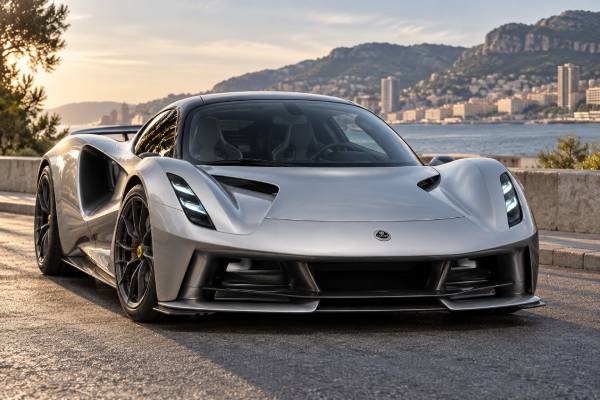
The Lotus Evija is the car that moved Lotus from lightweight combustion-engine sports cars into the electric-hypercar era. Known internally as Type 130, it pairs four 375 kW electric drive units with a carbon-fibre monocoque, active aerodynamics and a battery mounted behind the seats rather than spread conventionally under the floor. The result is a claimed 1,500 kW output, equivalent to 2,011 bhp, with torque vectoring at all four wheels. This guide follows the requested 2022–present scope, but the chronology needs clarification: Lotus discussed customer deliveries during the early 2020s, while official corporate filings now state that Evija deliveries actually began in 2024. That distinction matters when checking registration dates, build records and supposedly “early” cars. For buyers and owners, the Evija is also unlike a mass-market EV. Its charging hardware, carbon structure, bespoke suspension, software, tyres and high-voltage systems demand specialist support, while its maximum 130-car production plan makes provenance and originality unusually important.
Table of Contents
- Model Scope and Production Timeline
- Evija Specifications and Technical Data
- Electric Architecture and Vehicle Dynamics
- Aero, Suspension, Brakes, and Controls
- Range, Charging, and Real-World Use
- Service, Storage, and Buying Checks
Model Scope and Production Timeline
The Evija’s production story is more complicated than its original launch schedule. The car was revealed in 2019, later communications discussed production and deliveries in the early 2020s, but Lotus Technology’s current filings say customer deliveries started in 2024.
That makes the requested 2022–present label best understood as the model’s announced production-era scope rather than proof that ordinary customer Evijas were being delivered throughout 2022 and 2023. Early press cars, engineering vehicles, launch examples and special projects can appear in photographs or records before the documented customer-delivery start. A buyer should therefore verify a car’s actual build date, first registration date and handover history from primary documents instead of inferring them from an online model-year label.
Production remains capped at 130 examples, a number chosen to match the Type 130 project code. Lotus still presents the Evija in its current model range and describes it as the most powerful car to enter series production. The low production total also means specifications did not evolve through conventional annual trim changes in the way they would on a high-volume vehicle. Individual cars can be heavily personalized, so paint, interior materials and decorative details may differ substantially without indicating a different powertrain version.
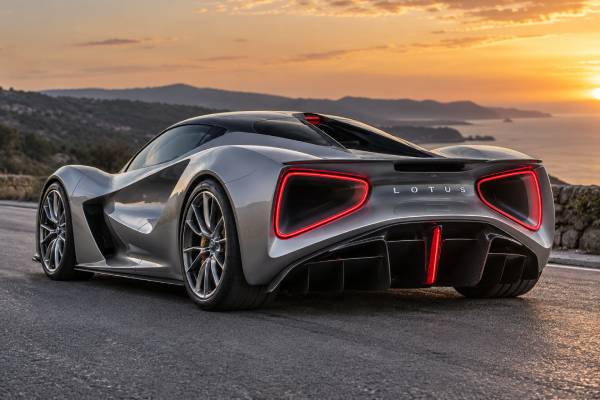
The platform is significant for Lotus because it translates familiar brand priorities into an EV. The battery is positioned immediately behind the two occupants, creating a layout closer in concept to a mid-engined sports car than to a typical “skateboard” EV. A one-piece carbon tub carries the cabin and primary loads. The body then channels air through large rear Venturi tunnels, while four independently controlled motors provide the traction and torque distribution that a mechanical differential would traditionally help manage.
When researching a specific Evija, keep three dates separate: the date a configuration was announced, the date the car was physically completed, and the date it was delivered or registered. The distinction is particularly important for insurance, import compliance, warranty interpretation and resale descriptions.
Personalization creates another documentation issue. Lotus promoted an unusually broad bespoke program for the Evija, so an uncommon paint color, trim combination or inlaid body badge is not automatically evidence of a later modification. The correct question is whether that detail appears on the original build specification. A factory-applied one-off finish can strengthen a car’s story; an undocumented repaint can do the opposite. Before commissioning cosmetic changes, an owner should preserve high-resolution photographs and the original specification sheet so future buyers can distinguish factory choices from later work.
This also affects insurance valuation. A generic database value may not capture the cost of a particular carbon panel, bespoke paint treatment or personalized interior component. An agreed-value policy based on the actual vehicle specification is more useful than assuming that every Evija is interchangeable with another. Transport coverage should reflect the same reality, because damage during loading can involve carbon structure, active aero hardware and unique exterior finishes at the same time.
Evija Specifications and Technical Data
The Evija is a four-motor battery-electric hypercar with all-wheel drive, a centrally concentrated battery pack and individual single-speed drive units. Lotus has published some figures as targets in model material, while later corporate filings give slightly different values for certain performance claims. Those differences should be preserved rather than blended into one artificial specification.
| Specification | Published value | Practical note |
|---|---|---|
| Powertrain | Battery electric, 4WD | Four independently controlled drive units |
| Motor count | 4 | One electrical drive unit serving each wheel |
| Individual motor output | 375 kW | Lotus technical figure |
| Combined output | 1,500 kW; 2,039 PS; 2,011 bhp | Official combined output |
| Combined torque | 1,704 Nm (1,257 lb-ft) | Managed with four-wheel torque vectoring |
| Battery capacity | 93 kWh | Figure used in Lotus technical material and corporate filing |
| Battery position | Behind the seats | Concentrated mid-mounted layout |
A battery supplier has described the production Evija pack as a 90 kWh lithium-ion unit. Lotus itself has published 93 kWh. Because the difference may reflect rating conventions or pack definitions that are not publicly reconciled, 93 kWh is the appropriate vehicle-identification figure here; no usable capacity is inferred.
| Specification | Published figure |
|---|---|
| 0–100 km/h (0–62 mph) | Under 3 seconds |
| 100–200 km/h | Under 3 seconds |
| 200–300 km/h | Under 4 seconds |
| 0–300 km/h | Early Lotus material: under 9 seconds; 2024 corporate filing: 9.1 seconds |
| Maximum speed | Model press material: electronically limited to 350 km/h (217–218 mph) |
| Corporate filing figure | 320 km/h (199 mph) stated in a 2024 Lotus Technology filing |
The top-speed difference is an example of why a prospective owner should use the documentation for the exact car and software state. It would be inaccurate to treat every number published during development as a guaranteed delivered-car specification.
| Specification | Published value |
|---|---|
| WLTP combined range | 402 km (250 miles) |
| 350 kW DC charge to 80% | 12 minutes |
| 350 kW DC charge to 100% | 18 minutes |
| High-power battery capability discussed by Lotus | Up to 800 kW charging acceptance |
| Cooling package | Four-radiator system intended to support sustained performance |
Lotus’s 800 kW statement describes the battery’s intended high-power capability, not a normal public-charging experience. Actual DC charging is constrained by the charging station, pack temperature, starting state of charge, battery-management limits and environmental conditions.
| Specification | Value |
|---|---|
| Body | 2-door, 2-seat hypercar |
| Length | 4,459 mm (175.6 in) |
| Width | 2,000 mm (78.7 in) |
| Height | 1,122 mm (44.2 in) |
| Published ride height | 105 mm (4.1 in) |
| Chassis construction | One-piece carbon-fibre monocoque |
| Monocoque mass | 129 kg (284 lb) |
| Published vehicle mass | 1,887 kg (4,160 lb) |
| Planned production limit | 130 cars |
| Specification | Value |
|---|---|
| Suspension concept | Inboard motorsport-derived arrangement |
| Dampers | 3 adaptive spool-valve dampers per axle |
| Damper supplier | Multimatic |
| Steering assistance | Electro-hydraulic |
| Front wheels | 20 in magnesium |
| Rear wheels | 21 in magnesium |
| Tyre family | Pirelli P Zero / P Zero Trofeo R applications developed for Evija use |
| Brake system | AP Racing forged aluminium calipers, carbon-ceramic discs |
| Mode | Published behavior |
|---|---|
| Range | Power limited to 1,000 PS and 800 Nm; can switch to rear-wheel drive |
| City | Softer power delivery with reduced regenerative braking |
| Tour | More than 1,400 PS; automatic rear- or four-wheel-drive operation with torque vectoring |
| Sport | Approximately 1,700 PS and 1,700 Nm with stability-control integration |
| Track | Maximum output, strongest torque-vectoring strategy, track chassis setting and DRS availability |
Electric Architecture and Vehicle Dynamics
The Evija’s layout is designed to make an extremely powerful EV feel like a Lotus rather than merely accelerate like one. Its most important choice is the concentration of the battery behind the cabin, which keeps the main energy store close to the car’s center instead of spreading its mass across a long underfloor pack.
That layout creates several engineering advantages and tradeoffs. It allows a low seating position and a dramatic underbody and rear-aero shape, while preserving the conceptual mass distribution of a mid-engined sports car. It also frees the floor from a full-length battery slab. The penalty is that packaging a large, high-power pack behind two seats places heavy thermal and structural demands in a compact area.
The four motors add another layer of control. Each motor, inverter and reduction gearbox forms a compact electrical drive unit. Instead of relying only on brakes or a central differential to manage yaw, the control system can adjust drive torque at individual wheels. During acceleration, that helps exploit available grip; in corners, it can influence how eagerly the car rotates and how much power each tyre is asked to transmit.
This is especially relevant because 1,500 kW is far beyond what can be used continuously on ordinary roads. The Evija therefore meters its capability through drive modes. Range and Tour are not “slow” settings in conventional terms; they are ways to make the powertrain usable and efficient while reducing unnecessary thermal load. Sport and Track progressively expose more of the hardware’s potential.
Lotus also engineered the car for sustained high-load running rather than a single acceleration demonstration. Its published target of at least seven minutes of flat-out Track-mode operation without derating depended on the battery, inverters, motors and radiators working as one thermal system. For an owner, that means cooling-system health is inseparable from performance. A warning related to coolant flow, pump operation or temperature control deserves immediate attention even if the car appears to drive normally at road speeds.
The steering uses electro-hydraulic assistance rather than the more common fully electric system. That choice reflects Lotus’s emphasis on steering feel. It also adds another specialist system that should be inspected for leaks, noise and correct operation during a pre-purchase evaluation.
Aero, Suspension, Brakes, and Controls
The Evija’s body is designed around “porosity”: air is deliberately routed through the car, not simply deflected over its exterior. The huge tunnels cutting through the rear quarters are the clearest visual result, but cooling inlets, the front splitter, underbody surfaces and active devices all contribute to the same airflow strategy.
This approach serves two competing goals. Downforce helps the tyres generate cornering and braking force, while low drag supports top speed and range. The deployable rear wing increases aerodynamic load when required. The drag-reduction system changes the car’s aero state for high-speed running, and Track mode coordinates these systems with chassis and torque-vectoring settings.
The suspension is also packaged for aero efficiency. Each axle has two corner dampers plus a third heave-control damper, using Multimatic adaptive spool-valve technology. Mounting components inboard reduces obstruction around the wheels and allows more precise control of body movement under aerodynamic load. The heave element helps manage vertical motion that affects ride height and the aerodynamic platform at speed.
AP Racing’s brake hardware complements the regenerative system rather than being replaced by it. Carbon-ceramic discs and forged aluminium calipers provide the thermal capacity needed to slow a nearly 1.9-tonne car from extreme speed. The front calipers were engineered with weight reduction in mind, illustrating how Lotus pursued grams even where the overall vehicle is necessarily heavier than its traditional sports cars.
Tyres are equally important. Pirelli developed road- and track-oriented P Zero applications for the Evija, including Trofeo R fitment. A buyer should not treat any tyre with the correct nominal size as equivalent. EV torque, speed capability, load rating, compound and manufacturer homologation all matter, and the wrong replacement can change braking, steering and stability-system behavior.
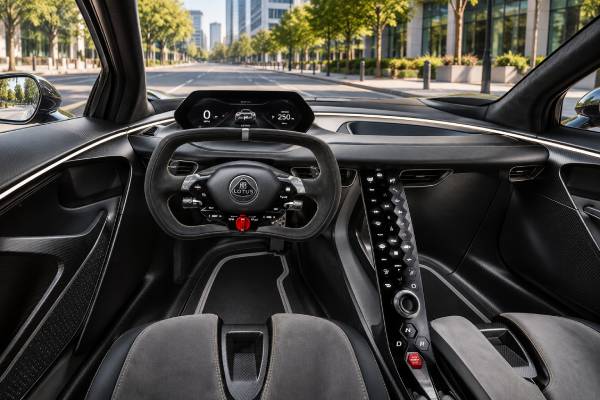
Inside, the car deliberately avoids a conventional luxury-GT layout. The steering wheel resembles a racing-car control surface, with functions for drive modes and aerodynamic systems close to the driver. A digital display prioritizes mode, battery charge and range. The Evija also introduced connected functionality for Lotus, including remote status features and over-the-air software capability in its original engineering plan.
That connectivity creates a modern ownership requirement: software history belongs in the service file. A complete record should show updates, diagnostic sessions and any campaigns applied to the specific VIN. On an ultra-low-volume car, undocumented software changes can complicate fault finding and resale due diligence.
Range, Charging, and Real-World Use
The 402 km WLTP figure is a laboratory-based combined range target, not a prediction of what every Evija will travel between charges. Speed, temperature, tyre choice, HVAC use and driving mode can change consumption dramatically, and the effect of sustained high speed is especially large in a hypercar.
On a relaxed road trip, Range mode can lower output and allow rear-wheel-drive operation, reducing the energy demanded by the four-motor system. In contrast, repeated hard acceleration converts battery energy into both motion and heat at a very high rate. Track driving can consume a substantial portion of the available energy quickly even when the battery and cooling system are working exactly as intended.
Charging should therefore be planned around the next use of the car. The headline 350 kW times assume a capable charger and favorable battery conditions. Arriving with a cold battery, a high starting state of charge or a charger that cannot sustain its advertised output will extend the session. Similarly, a pack that has just completed hard track running may need thermal management before it accepts maximum charging power.
For occasional-use owners, long-term battery care matters more than achieving the shortest possible charging stop. Follow the storage state-of-charge guidance in the official handbook for the exact vehicle and software version. Avoid leaving the traction battery at an unnecessarily extreme state of charge for long periods, and do not assume a displayed range number is a direct battery-health measurement.
The low-voltage battery deserves separate attention. Like other EVs, the Evija relies on a 12-volt system to wake control modules and close the high-voltage contactors. A fully charged traction pack cannot compensate for a failed low-voltage battery. If the car will stand for an extended period, use only the approved conditioning method and connection points.
Road usability also depends on the body, not just the powertrain. At 2,000 mm wide and only 1,122 mm tall, with a published 105 mm ride height, the Evija demands care in car parks, narrow roads, speed humps and transport loading. Camera-based rearward visibility and the absence of conventional mirrors on early specification material require the driver to be comfortable with electronic displays.
Before a long journey, confirm charging-network compatibility and physical access at the destination. A charger may be electrically suitable yet positioned behind a curb, steep ramp or tight bay that is impractical for a low, wide carbon-bodied car.
Service, Storage, and Buying Checks
An Evija should be serviced as a specialist hypercar first and an EV second. It has fewer routine engine-related consumables than a combustion car, but its carbon structure, high-voltage system, active aerodynamics, bespoke suspension and low-volume components make improvised maintenance a poor choice.
For routine ownership, keep a disciplined record of inspections rather than waiting for a warning light. Tyre age and condition are crucial because collector cars often accumulate little mileage. Flat spots, sidewall cracking and hardened compound can appear long before tread depth becomes low. Date codes, approved specification and storage conditions should all be recorded.
Carbon-ceramic brakes also need specialist assessment. Inspect discs for impact damage and condition using the manufacturer’s procedure rather than judging them only by appearance. Wheel removal must follow the correct centre-lock or fastener process for the exact wheel configuration, with proper tools and documented torque procedures from official service information.
The underside deserves careful inspection because the body sits so low. Look for splitter damage, scraped aerodynamic surfaces, crushed lifting points, diffuser contact and evidence of incorrect transporter loading. Carbon damage can be visually subtle, so suspicious areas should be assessed by a qualified composite-repair specialist with Lotus support.
Cooling-system health should be documented through diagnostics and service records. The battery and four drive units produce extreme heat under load, and the car’s ability to deliver its advertised performance depends on that heat being removed consistently. Any history of temperature warnings, reduced-power events or coolant repairs should be investigated rather than dismissed as a software quirk.
For a pre-purchase inspection, prioritize the following checks:
- Confirm VIN, build and delivery history. Establish when the car was completed, first handed over and first registered, especially if it is described as a 2022 or 2023 example.
- Obtain a factory-capable diagnostic report. Review high-voltage faults, drive-unit faults, battery warnings, software versions and stored events.
- Verify battery and charging operation. Confirm that AC/DC charging equipment supplied with the car is present and that the car charges normally on compatible equipment.
- Inspect carbon and aero systems. Check the monocoque-adjacent areas, underbody, Venturi tunnels, front splitter, active rear wing and DRS mechanism for repair or impact history.
- Assess tyres, brakes and suspension. Verify tyre age and homologation, carbon-ceramic condition, damper operation and any evidence of track-related damage.
- Audit documentation and accessories. Retain handbooks, keys, charging cables, factory correspondence, personalization records, service invoices and transport equipment supplied with the car.
Battery health should be assessed with manufacturer-level diagnostics, not by dividing displayed range by the original WLTP figure. The displayed estimate reflects recent consumption, weather and operating conditions, so it cannot by itself reveal usable capacity or cell condition.
A careful road evaluation should establish a baseline rather than chase maximum performance. Check that the car powers up cleanly, selects each normal drive mode, steers without abnormal assistance changes, brakes consistently and completes a moderate acceleration run without warnings or reduced-power messages. Listen for unexpected driveline or suspension noises at low speed, where they are easier to separate from wind and tyre noise. Confirm that cameras, displays, climate control and charging-port functions operate normally. Any attempt to prove full Track-mode output belongs in a controlled environment after the car has passed mechanical and diagnostic checks.
Storage quality can be as important as mileage. A car that has covered very few kilometers but spent long periods with a neglected 12-volt battery, extreme traction-battery charge or flat-spotted tyres may need more corrective work than one used regularly under a proper maintenance plan. Ask where and how the vehicle was stored, how often it was driven, and whether it remained connected to approved charging or conditioning equipment.
Finally, confirm service access before buying. The nearest ordinary Lotus retailer may not necessarily perform every Evija procedure. Identify the authorized support path for the VIN, transport arrangements for major work and how high-voltage or carbon-structure repairs are handled in the car’s current country. On a maximum-130-unit hypercar, logistics are part of ownership cost.
The Evija’s appeal is not only that it produces 2,011 bhp. It is a rare attempt to make an electric car behave according to Lotus priorities: concentrated mass, steering response, low weight relative to its performance class, carefully managed airflow and a driver-centered chassis. A good example should therefore be judged on more than cosmetics or acceleration figures. The best purchase is the car with clear factory provenance, healthy high-voltage systems, correct software, intact carbon and aero hardware, approved tyres and brakes, and a service history that shows it has been treated as the complex engineering object it is.
References
- Evija | Lotus Electric Hypercar | Lotus Cars United Kingdom 2026
- Models | Lotus Press | Evija 2026
- Form 20-F for Lotus Technology INC filed 04/28/2026 2026
- AP Racing braking system chosen for UK’s first electric hypercar | AP Racing 2019
- Lotus Evija tyres | Pirelli 2026
- Build-to-print manufacturing for the Lotus Evija – Hyperbat 2024
Disclaimer
This article is for informational purposes only and does not replace professional diagnosis, maintenance or repair. Specifications, torque values, service intervals and procedures can differ by VIN, market, equipment and software level; always verify them in the official Lotus service documentation for the individual vehicle.
If you found this guide helpful, please share it on Facebook, X/Twitter or another automotive community to help support our work.