
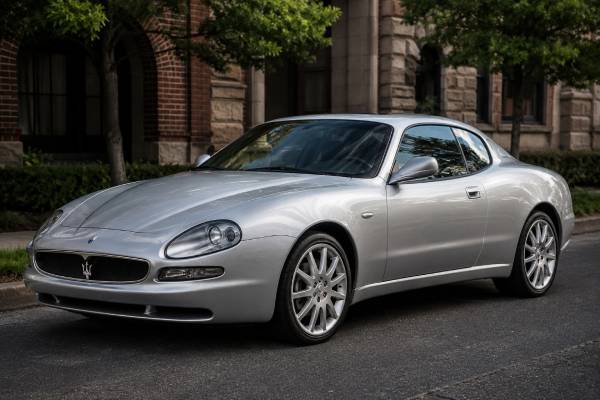
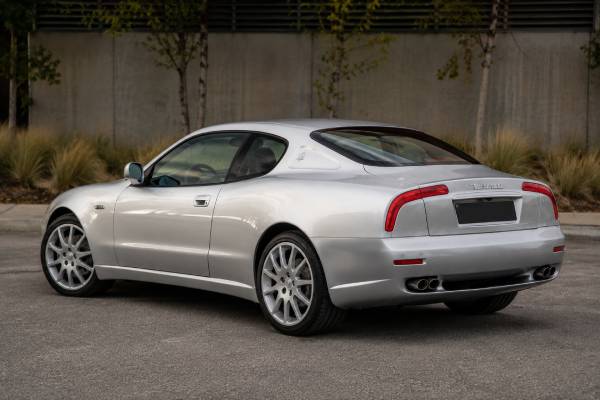
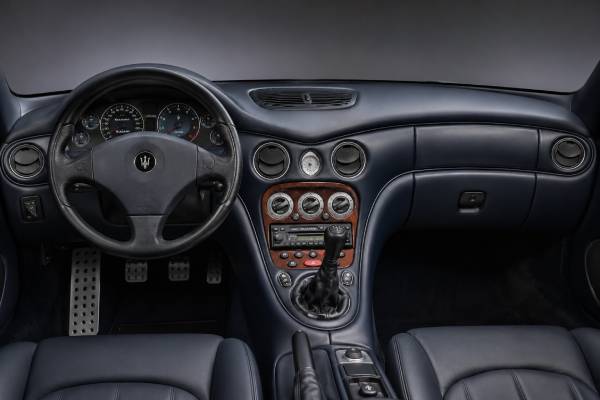
The Maserati 3200 GT is a four-seat grand tourer with the heart of an old-school Italian supercar. Its 3.2-litre AM 585 V8 uses two turbochargers to produce 370 PS, sending power to the rear wheels through a six-speed Getrag manual gearbox and limited-slip differential. Performance remains serious today, but the car’s appeal reaches beyond speed. Giorgetto Giugiaro’s flowing body, the pioneering boomerang-shaped LED rear lamps, and a leather-lined cabin give it an identity no later Maserati fully repeated.
Produced during Maserati’s transition into Ferrari-led ownership, the 3200 GT combined the company’s traditional twin-turbo engineering with improved manufacturing, modern electronics, and a more ambitious global product strategy. It can be practical enough for touring and dramatic enough for a special weekend drive, but ownership demands informed maintenance. Electronic throttle faults, ageing cooling parts, clutch wear, old tyres, suspension deterioration, and scarce trim can make a neglected example expensive. The best cars are selected by condition and documented care, not mileage alone.
Table of Contents
- The Car That Relaunched Maserati
- AM 585 V8 and Chassis Specifications
- Production Evolution, Options, and Authenticity
- Giugiaro Design and Twin-Turbo Engineering
- Manual Gearbox, Performance, and Road Feel
- Reliability, Maintenance, and Major Repair Risks
- How to Buy a Sound 3200 GT
The Car That Relaunched Maserati
The 3200 GT was the model that restored Maserati’s credibility as a maker of desirable high-performance grand tourers. It replaced the angular character of the Biturbo era with a modern four-seat coupé that combined Italian design, serious speed, and everyday usability.
Maserati announced the car in 1998 and presented it publicly at the Paris Motor Show that October. Customer deliveries began in 1999. Its development coincided with a major change inside the company. Fiat had transferred operational control to Ferrari, which began modernising the Modena factory, strengthening quality processes, and repositioning Maserati as a premium performance brand.
The project was initially associated with the historic Mistral name, but Maserati ultimately chose 3200 GT. The name created a link with the 3500 GT, the late-1950s model that transformed Maserati from a low-volume competition specialist into a successful manufacturer of refined road cars.
The new coupé had to compete with established rivals such as the Porsche 911, Jaguar XKR, Aston Martin DB7, and Mercedes-Benz CL. Maserati approached that challenge with a distinctive formula. Instead of copying the rear-engined Porsche or building a soft luxury coupé, it created a front-engined, rear-wheel-drive 2+2 with a compact twin-turbo V8 and an unusually responsive chassis.
The 3200 GT was not a completely clean break from Maserati’s recent past. Its engine belonged to the company’s long-running family of twin-turbo V8s, related to units used in the Shamal and fourth-generation Quattroporte. In AM 585 form, however, it received substantial development, electronic throttle control, intercooling, and a 370 PS output.
This connection to earlier Maseratis gives the 3200 a different character from its successor. The 2002 Maserati Coupé retained much of the same basic body shape but adopted a naturally aspirated Ferrari-derived 4.2-litre V8 and a rear transaxle layout. It was smoother, more internationally marketable, and suitable for sale in the United States, but it lost the 3200’s turbocharged power delivery and boomerang rear lights.
The standard manual 3200 GT was built from 1998 through 2001, with some cars registered later. A total of 2,689 manual examples were produced, while the broader 3200 family reached 4,795 cars when automatic GTA production is included.
The model’s reputation today rests on a mixture of strengths and risks:
- It has one of Giugiaro’s most recognisable late designs.
- Its AM 585 engine delivers dramatic twin-turbo performance.
- The six-speed manual provides direct driver involvement.
- The cabin offers genuine rear seating and useful luggage capacity.
- Later cars have improved steering and throttle calibration.
- Poor maintenance can create major electronic and mechanical costs.
- Specialist knowledge and parts access are essential.
The 3200 GT is therefore neither a conventional used luxury car nor an untouchable museum piece. It is best treated as a modern classic that benefits from regular use, careful servicing, and an owner who understands its age.
AM 585 V8 and Chassis Specifications
The 3200 GT combines a 3,217 cc twin-turbo V8 with a six-speed Getrag manual gearbox, rear-wheel drive, and a limited-slip differential. Its 370 PS output was impressive in 1998, but the sophisticated suspension and braking systems are equally important to how the car performs.
| Item | Specification |
|---|---|
| Model designation | 3200 GT |
| Type code | Tipo AA 338B32 |
| Engine code | AM 585 |
| Engine layout | Front-mounted 90-degree V8 |
| Construction | Aluminium cylinder block and heads |
| Displacement | 3,217 cc |
| Bore × stroke | 80.0 × 80.0 mm |
| Compression ratio | 8.0:1 |
| Valve gear | Double overhead camshafts, four valves per cylinder |
| Induction | Twin turbochargers with twin intercoolers |
| Fuel and throttle control | Electronic fuel injection and drive-by-wire throttle |
| Maximum output | 370 PS at 6,250 rpm |
| Maximum torque | 491 Nm at 4,500 rpm |
| Transmission | Getrag 226 six-speed manual |
| Driven wheels | Rear-wheel drive |
| Differential | Limited-slip differential |
The engine’s equal bore and stroke dimensions create a square internal layout. Each cylinder bank has two overhead camshafts operating four valves per cylinder. A cross-plane crankshaft gives the V8 a deeper and less frantic sound than a flat-plane racing engine.
Two turbochargers compress the intake air, while separate intercoolers reduce its temperature before it reaches the cylinders. Cooler, denser air improves power and helps control combustion temperatures. The arrangement is effective but creates a crowded engine bay filled with hoses, ducts, wiring, vacuum lines, heat shields, and sealing points that require careful inspection as the car ages.
The six-speed Getrag gearbox sits behind the engine in a conventional front transmission layout. Power travels through a two-piece driveshaft to the rear limited-slip differential. Unlike the later Maserati Coupé, the 3200 does not use a rear-mounted transaxle.
| Item | Specification |
|---|---|
| Body style | Two-door four-seat coupé |
| Body construction | Steel unitary structure with front and rear subframes |
| Front suspension | Independent double wishbones with aluminium components |
| Rear suspension | Independent double wishbones with aluminium components |
| Steering | Hydraulically assisted rack and pinion |
| Front brakes | Ventilated and cross-drilled discs with four-piston Brembo calipers |
| Rear brakes | Ventilated and cross-drilled discs with four-piston Brembo calipers |
| Driver aids | Four-channel ABS and Bosch ASR traction control |
| Front tyres | 235/40 ZR18 |
| Rear tyres | 265/35 ZR18 |
| Wheelbase | 2,660 mm |
| Length | 4,510 mm |
| Width | 1,822 mm |
| Height | 1,305 mm |
| Approximate kerb weight | 1,590 kg |
| Fuel capacity | 90 litres |
| 0–100 km/h | Approximately 5.2 seconds |
| Maximum speed | Approximately 280 km/h |
The unitary steel body is reinforced by separate subframes. A front tubular structure supports the engine and drivetrain, while a rear subframe carries the differential and suspension links. Double wishbones at all four corners use forged aluminium control arms and uprights to reduce unsprung mass and maintain accurate wheel control.
Maserati offered electronically controlled damping on many cars. Its Sport setting altered damper response and allowed the chassis to feel more controlled during fast driving. The system remains useful when healthy, but failed dampers, actuators, wiring, or control components can be expensive.
Period acceleration figures differ slightly by publication and test conditions. Tyre temperature, road surface, fuel, launch technique, engine condition, and weather all influence the result. The 3200’s most impressive performance is often found away from a standing start, where third- and fourth-gear boost produces very strong overtaking acceleration.
Production Evolution, Options, and Authenticity
The most important production distinction is between the sensitive early cars and the better-resolved 2001 model-year versions. Both can be rewarding, but later cars received meaningful steering and engine-management changes that improved everyday control.
The earliest examples established the 3200’s reputation for sharp reactions. The electronic accelerator could feel abrupt, the brakes required delicate pressure, and the steering reacted strongly to small inputs. Experienced drivers often found the car exciting, but smooth progress on wet or uneven roads demanded concentration.
For the 2001 model year, Maserati revised the steering rack and engine-management calibration. The steering became calmer around the centre, while the accelerator allowed the driver to introduce boost more progressively. These improvements did not remove the engine’s turbocharged character, but they made the car easier to position and balance.
Condition can matter more than production year. A correctly aligned early car with rebuilt throttle electronics, fresh tyres, and tight suspension may drive better than a neglected late example. Buyers should treat the revised specification as an advantage, not a substitute for maintenance.
Standard equipment was generous for the period. Most cars included extensive leather trim, climate control, electrically adjusted front seats, power windows and mirrors, traction control, ABS, and a premium audio system. Equipment varied by market and individual order, so each car should be checked against its build information.
The colour and trim range was broad. Dark metallic paint with tan or cream leather is common, while brighter exterior colours and unusual leather combinations can attract a premium when factory documented. Pale interiors show dirt and dye wear more readily, but careful restoration can preserve their original appearance.
| Version or period | Main features | Buying significance |
|---|---|---|
| Early manual 3200 GT | Original steering and sharper throttle calibration | Most demanding to drive; condition and updates are important |
| 2001 model-year manual | Revised steering and improved engine management | Generally easier to drive smoothly |
| 3200 GTA | Four-speed BTR automatic transmission | Smoother in traffic but less involving |
| Assetto Corsa | Lower, firmer chassis with special wheels and brake details | Rare factory performance edition requiring separate authentication |
A standard 3200 GT can be modified to resemble an Assetto Corsa, so special-edition identity should never be judged from wheels or red brake calipers alone. The same principle applies to ordinary manual cars: verify the transmission, engine type, colour, trim, and factory equipment through the VIN and documentation.
Useful authenticity checks include:
- Matching VIN markings and identification plates.
- Consistent service-book and registration details.
- Correct AM 585 engine specification.
- Original six-speed manual selector and driveline layout.
- Factory paint and interior codes.
- Correct lighting, wheels, brake hardware, and dashboard equipment.
- Invoices explaining any replacement or upgraded components.
A fully original car is attractive to collectors, but originality should not be confused with neglect. A professionally rebuilt throttle body, restored electronic dampers, repaired LED lamp, or set of modern tyres can improve safety and reliability. The quality and documentation of the work matter more than preserving a failing component.
Giugiaro Design and Twin-Turbo Engineering
The 3200 GT is distinctive because its elegant body conceals unusually aggressive engineering. Giugiaro created a refined grand tourer rather than a visually loud supercar, while Maserati installed a compact twin-turbo V8, aluminium suspension hardware, large brakes, and advanced electronic controls beneath the surface.
The exterior was designed by Italdesign under Giorgetto Giugiaro. Its proportions follow the traditional front-engined GT formula: a low nose, long hood, cabin positioned toward the rear, broad shoulders, and a short tail. The surfaces are smooth and rounded, giving the car a softer appearance than many contemporary Ferraris or Lamborghinis.
Functional details support the styling. Hood vents help release heat from the tightly packaged turbocharged engine bay. The front openings feed the radiator, intercoolers, brakes, and other cooling hardware. Missing ducts, damaged undertrays, or poorly repaired bodywork can therefore affect more than appearance.
The boomerang-shaped rear lamps are the model’s defining visual feature. Curved LED elements form separate lighting functions and create an unmistakable signature at night. The 3200 was an early production car to use LEDs for its complete rear-light arrangement.
These lamps also create an ownership challenge. Cracked housings, failed LED sections, moisture entry, damaged wiring, and poor repairs can be difficult to correct. Replacement supply varies, so a buyer should test every section and inspect both lamp assemblies carefully.
The interior was developed under Enrico Fumia and uses leather across the seats, dashboard, centre console, and door panels. It feels more like a handcrafted luxury cabin than the functional cockpit of a Porsche 911. The rear seats are usable for shorter journeys, while the luggage compartment makes long-distance touring realistic.
Packaging the engine, turbos, intercoolers, exhaust manifolds, catalysts, and cooling equipment into the nose creates substantial heat. Healthy airflow is essential, and owners should avoid ignoring damaged seals, blocked radiator surfaces, failed fans, or deteriorated hoses.
The AM 585’s sound is equally distinctive. At low engine speed it produces a subdued cross-plane V8 pulse. As load increases, intake noise, turbo whistle, mechanical texture, and exhaust tone build together. The result is less polished than the naturally aspirated engine in the later Coupé but more dramatic when boost arrives.
The six-speed manual adds another layer of character. The driver controls when the engine enters its strongest boost range, making gear selection central to the experience. This involvement also introduces clutch, hydraulic, linkage, synchro, and driveline wear that must be considered during inspection.
Manual Gearbox, Performance, and Road Feel
The manual 3200 GT feels fast, responsive, and demanding rather than effortless. Its best qualities appear when the driver uses smooth inputs, chooses gears carefully, and allows the rear tyres to settle before applying full boost.
At low engine speed, the V8 is flexible enough for ordinary traffic. The clutch can feel heavier than that of a modern performance car, but engagement should remain predictable. A healthy gearbox has a firm, mechanical action without grinding or excessive resistance.
The engine’s personality changes as boost builds. Initial response can be calm, followed by a rapid rise in torque as the turbos reach operating speed. On a dry straight road this produces memorable acceleration. During a wet corner, the same transition can challenge the rear tyres.
Early throttle calibration adds to this effect. A small accelerator movement may produce a larger response than expected, while engine torque can take a moment to fall after the driver lifts. Later calibration improves control, but every car should respond consistently and predictably.
The Bosch traction-control system provides useful protection, although it is less subtle than a current system. It may reduce power firmly when it detects rear-wheel slip. Disabling it leaves the driver responsible for managing nearly 500 Nm through a period chassis and tyres.
The limited-slip differential helps both rear wheels contribute during acceleration, but it cannot compensate for old rubber, poor alignment, or abrupt throttle use. Correct tyre type and pressure are fundamental to safe handling.
Steering feel varies with production year and mechanical condition. Early cars can react sharply around the straight-ahead position, while 2001-model-year cars are calmer. Worn ball joints, bushes, damaged wheels, poor geometry, or mismatched tyres can make either version feel nervous.
The suspension controls the car’s weight effectively. The 3200 is not light, but its low centre of gravity and double-wishbone layout allow accurate cornering. The body should settle quickly after a direction change without floating, bouncing, or striking its bump stops.
Ride quality is firm but appropriate for a sports-focused grand tourer. Smooth motorways and flowing roads suit it well. Broken urban surfaces expose the low-profile tyres and can reveal worn dampers, bushes, anti-roll-bar links, or top mounts.
The Brembo brakes deliver strong stopping ability when healthy. Early pedal calibration may feel sensitive, so smooth braking takes practice. A long pedal, vibration, pulling, or changing response indicates a fault rather than normal character.
The 3200 GT works particularly well in these settings:
- Fast open roads, where third- and fourth-gear acceleration dominates.
- Motorways, where sixth gear and the stable chassis support long-distance travel.
- Flowing mountain routes, where careful gear choice controls boost.
- Dry weekend drives, where the steering and manual gearbox feel most rewarding.
City use highlights the heavy clutch, low nose, wide body, long doors, heat output, and fuel consumption. Rear visibility is limited, and the front bumper is vulnerable on ramps and kerbs.
Track use is possible but should be approached carefully. Fresh brake fluid, healthy cooling, suitable tyres, and verified suspension are essential. The car’s age, rarity, and parts costs make controlled road use more sensible than repeated high-temperature circuit work.
Reliability, Maintenance, and Major Repair Risks
The 3200 GT can be durable when maintained proactively, but deferred work often spreads across several systems at once. The most important areas are the timing-belt drive, electronic throttle, cooling system, clutch, gearbox, suspension, brakes, tyres, electrical equipment, and model-specific trim.
Engine and Timing-Belt System
The AM 585 requires documented time-based as well as mileage-based maintenance. A low odometer reading does not protect belts, seals, hoses, tensioning parts, wiring, or fluids from age.
Timing-belt evidence should include the date, recorded mileage, parts used, and workshop. A verbal claim or visual inspection is not enough. When documentation is incomplete, buyers should assume the service is due and ask a specialist which tensioners, seals, auxiliary belts, bearings, and related components should be renewed at the same time.
Inspect the engine for:
- Oil leaks around covers, seals, turbo plumbing, and lower joints.
- Coolant staining around hoses, tanks, radiator connections, and pump areas.
- Blue smoke after idling or during acceleration.
- Persistent white smoke after the engine is fully warm.
- Uneven idle, misfires, hesitation, or weak boost.
- Unusual mechanical noise during cold and hot operation.
- Evidence of previous overheating or coolant contamination.
Turbocharger problems may produce smoke, oil consumption, noise, or reduced performance. Similar symptoms can result from split hoses, loose clamps, crankcase ventilation faults, ignition problems, or intake leaks, so diagnosis should come before expensive replacement.
Electronic Throttle and Electrical Health
The drive-by-wire throttle system is one of the 3200’s best-known weak points. It depends on the accelerator-pedal sensor, throttle body, wiring, connectors, control electronics, battery, alternator, and grounding points working together.
Common warning signs include limp mode, unstable idle, delayed response, unexpected loss of power, or warning lamps that return after being cleared. Heat can make an intermittent fault more obvious, so the car must be tested after a long drive and hot restart.
Professionally rebuilt or updated throttle components can be a positive feature when supported by invoices. Random parts replacement without a clear diagnosis is less reassuring.
Battery voltage is critical. A weak battery, poor charging output, corroded connection, or damaged ground can cause several misleading faults. Correct diagnosis should begin with voltage and wiring checks before expensive modules are condemned.
Clutch, Gearbox, and Driveline
The manual transmission adds several costly wear areas. Test the clutch from cold and hot, during gentle starts, reversing, hill starts, and full-boost acceleration in a higher gear.
Warning signs include:
- Slipping as torque rises.
- Judder when moving away.
- A changing or unusually high engagement point.
- Noise when the pedal is pressed.
- Fluid leakage or inconsistent pedal travel.
- Difficulty selecting first or reverse.
The Getrag gearbox should shift cleanly after its oil is warm. Grinding during upshifts or downshifts may indicate synchro wear, while a lever that jumps out of gear suggests a more serious internal or linkage problem.
Inspect the driveshaft, couplings, differential mounts, and rear subframe for vibration, clunks, and excessive movement. Differential whine, heavy backlash, or binding requires specialist assessment.
Cooling, Suspension, Brakes, and Tyres
Cooling-system health is essential because the engine bay operates at high temperatures. Confirm that the electric fans activate, coolant temperature stays stable in traffic, and the engine restarts normally after heat soak.
Inspect the radiator, expansion tank, thermostat behaviour, fan relays, water-pump area, hoses, and clamps. A car that overheats during the inspection should not be driven further until diagnosed.
Electronically controlled dampers can be costly. Check for leaks, warning lights, damaged wiring, uneven ride height, and inconsistent response between driving modes. Bushes, ball joints, links, wheel bearings, and mounts also deteriorate with age.
Brake inspection should cover discs, pads, hoses, fluid, calipers, ABS operation, and the parking brake. A stored car may have corroded discs or sticking calipers despite low mileage.
Tyres must be judged by manufacturing date as well as tread depth. Old rubber can look excellent but provide little wet grip. A matched set in the correct sizes and ratings is one of the most valuable improvements for safety and handling.
Body, Interior, and Parts Supply
Inspect the front bumper, hood, wheelarches, sills, jacking points, floor edges, subframe mounts, trunk seals, and window surrounds. Measure paint depth and examine panel gaps for evidence of accident repairs.
Test every electrical function, including:
- Boomerang rear lamps.
- Headlamps and fog lamps.
- Windows and central locking.
- Seat motors and mirrors.
- Climate control.
- Instruments and warning lights.
- Audio and display equipment.
- Suspension controls where fitted.
Leather can shrink around dashboard vents or lift from curved surfaces. Seat bolsters, headlining, switches, and soft-touch coatings also wear.
Mechanical service parts are generally easier to source than unique lamps, interior trim, control modules, or body panels. A complete car with cosmetic wear may be a safer purchase than an incomplete example that appears cheaper.
How to Buy a Sound 3200 GT
The best 3200 GT is the car with verified identity, continuous specialist care, correct major components, and stable behaviour when fully hot. Mileage influences value, but history and condition should determine the buying decision.
Start by obtaining the VIN, registration history, service-book photographs, and major invoices. Confirm that the car is a factory manual 3200 GT and that the engine, transmission, colour, trim, and equipment agree with its records.
Create a chronological maintenance timeline rather than counting service stamps. Look for dated evidence covering:
- Timing-belt and front-engine servicing.
- Engine oil, filters, coolant, gearbox oil, and differential oil.
- Throttle-body and accelerator-sensor repairs.
- Battery, alternator, wiring, and ground work.
- Clutch and hydraulic components.
- Cooling-system parts and fan operation.
- Dampers, suspension joints, wheel alignment, and tyres.
- Brake discs, pads, hoses, fluid, and calipers.
- Climate-control, lighting, and interior repairs.
Inspect the car with the engine completely cold. A pre-warmed engine can hide start-up smoke, weak battery performance, mechanical noise, or poor idle control. Confirm that all warning lamps illuminate during the self-test and switch off correctly after starting.
Allow the car to reach full operating temperature. Use the climate control, wait for the cooling fans, and inspect for leaks or unusual smells. The road test should include traffic, steady cruising, repeated shifts, full boost where safe, braking from several speeds, rough surfaces, tight turns, and a hot restart.
| Finding | Likely meaning | Recommended response |
|---|---|---|
| Complete specialist history and stable hot operation | Strong basis for ownership | Proceed to an independent inspection |
| Low mileage with long storage periods | Possible belt, seal, hose, tyre, brake, and electrical deterioration | Budget for comprehensive recommissioning |
| Throttle warning or intermittent limp mode | Possible sensor, throttle, wiring, voltage, or control fault | Require a specialist diagnostic report |
| Clutch slips when boost rises | Likely clutch wear or contamination | Price a complete clutch repair |
| Gearbox grinds in one or more ratios | Possible synchro, linkage, or internal wear | Obtain a gearbox-specialist assessment |
| Coolant temperature rises in traffic | Cooling or fan-control fault | Stop the test and diagnose before purchase |
| Old or mismatched tyres | Reduced grip and misleading handling behaviour | Budget for a complete matching set |
| Fresh paint without supporting records | Possible accident, corrosion, or cosmetic repair | Measure paint and inspect the structure |
A pre-purchase inspection should be performed by a workshop familiar with the 3200 GT. The technician should read stored fault codes, inspect the underside, test the charging and throttle systems, assess clutch and gearbox operation, verify cooling under load, and identify non-standard components.
Do not spend the full ownership budget on the purchase price. Keep a meaningful reserve for baseline servicing, tyres, fluids, suspension work, air-conditioning repairs, small leaks, electrical diagnosis, and hard-to-source trim.
The 3200 GT suits an owner who values design, manual involvement, turbocharged character, and rarity more than simple maintenance or modern convenience. It is less appropriate for someone expecting low running costs, instant parts supply, or trouble-free long-term storage.
Chosen carefully, it offers a combination no later Maserati exactly reproduces: Giugiaro’s original shape, boomerang LED lamps, a Maserati-developed twin-turbo V8, a six-speed manual gearbox, genuine four-seat usability, and the raw personality of the marque’s final pre-4.2-litre grand tourer.
References
- Maserati 3200 GT (Official Classic Model Page)
- Maserati 3200GT (1998 – 2002) used car review 2006
- Maserati, un coupé per stupire il mondo 1998
- Maserati, la nuova sfida riparte da una granturismo 1998
Disclaimer
This article is for informational purposes and is not a substitute for professional diagnosis, repair, or a model-specific pre-purchase inspection. Specifications, torque values, service intervals, procedures, and components can vary by VIN, market, production date, and equipment. Verify all technical work against the official service documentation for the individual vehicle.
Please share this article on Facebook, X/Twitter, or your preferred enthusiast community if it was useful. Sharing supports the continued creation of detailed vehicle guides.