
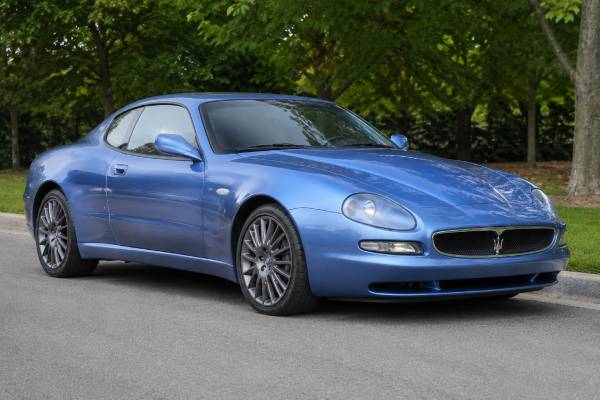
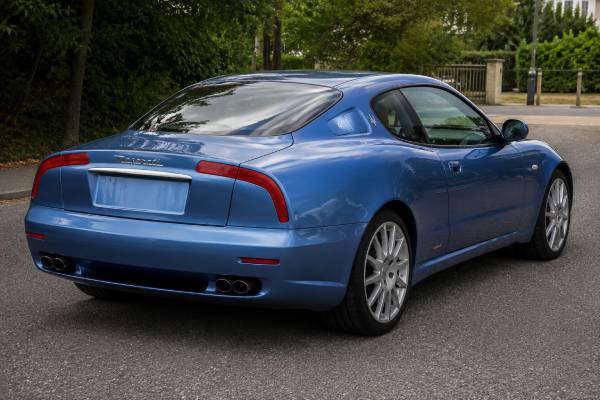
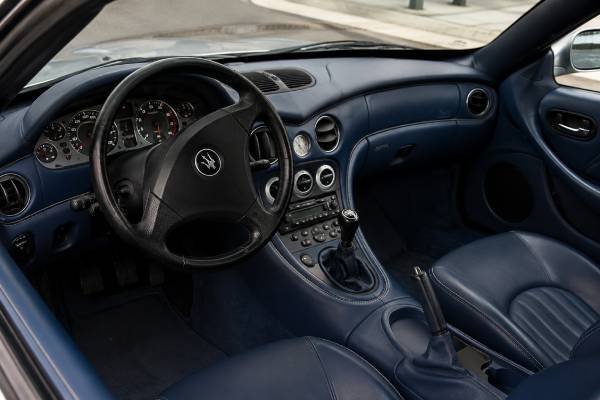
The Maserati 3200 GTA combines one of the marque’s most dramatic modern engines with the relaxed character of a traditional automatic grand tourer. Introduced in 1999, it pairs the AM 585 twin-turbocharged 3.2-litre V8 with a four-speed BTR torque-converter transmission, rear-wheel drive, and four-seat coupé bodywork by Giorgetto Giugiaro. It is slightly heavier and slower than the six-speed manual 3200 GT, yet its smoother low-speed behaviour and easier power delivery make it a compelling road car.
The GTA also occupies an important place in Maserati history. It belongs to the final generation powered by the company’s own twin-turbo V8 before the Ferrari-derived, naturally aspirated 4.2-litre era. Its boomerang LED rear lamps, leather-lined cabin, muscular boost delivery, and relatively compact proportions give it a personality no later Maserati exactly repeated. Buying one today demands careful inspection, however. Condition, specialist maintenance, heat management, throttle-system health, and transmission behaviour matter far more than mileage alone.
Table of Contents
- The Automatic 3200 in Maserati History
- Twin-Turbo V8 and Chassis Specifications
- Production Changes, Options, and Identification
- Giugiaro Style and Distinctive Engineering
- How the 3200 GTA Drives
- Reliability, Maintenance, and Ownership Costs
- Buying and Inspecting a 3200 GTA
The Automatic 3200 in Maserati History
The 3200 GTA is the automatic version of Maserati’s 1998–2002 3200 GT, introduced to make the twin-turbo coupé easier to use in traffic and on long journeys. It retained the same basic engine output as the manual car but used different transmission calibration and carried approximately 30 kg of additional weight.
Maserati revealed the original 3200 GT in 1998 during a major transition for the company. Fiat had transferred control to Ferrari, and the Modena factory was being modernised after years of inconsistent investment and quality. The new coupé had to prove that Maserati could again compete seriously with established luxury performance cars.
The 3200 GT replaced the angular visual language of the Biturbo family with a smooth, muscular design by Giorgetto Giugiaro and Italdesign. Its name referred back to the 3500 GT, the model that helped establish Maserati as a producer of refined series-built grand tourers. Beneath the elegant body, however, the 3200 remained closely connected to Maserati’s turbocharged engineering tradition.
The GTA appeared at the 1999 Geneva Motor Show. The letter “A” identified the automatic transmission, although the car was also described in some markets as the 3200 GT Automatica. Maserati selected a conventional four-speed gearbox supplied by the Australian company BTR rather than an automated manual system.
That decision suited the car’s purpose. The twin-turbo V8 produced ample torque, so the transmission did not need a large number of ratios to deliver strong acceleration. A torque converter also softened low-speed take-up and reduced the demanding clutch and throttle coordination required by early manual cars.
The automatic did not turn the 3200 into a soft luxury coupé. It retained rear-wheel drive, a limited-slip differential, double-wishbone suspension, Brembo brakes, and Bosch traction control. Its performance remained serious, with a claimed top speed of about 270 km/h and acceleration from 0 to 100 km/h in roughly 5.7 seconds.
The model became commercially important. Of the 4,795 examples in total 3200 GT production, 2,106 were automatic GTAs. This means the GTA is not an obscure prototype or extremely limited special edition, but surviving condition varies widely because the cars are now more than two decades old.
The GTA is especially significant for three historical reasons:
- It was the first automatic version of Maserati’s new-generation 3200 GT.
- It used the final development of Maserati’s own road-going twin-turbo V8 family.
- It remained in production until the 3200 was replaced by the Ferrari-powered Maserati Coupé.
The later Coupé looked related because its body evolved from the same basic design, but it was mechanically different. It used a naturally aspirated 4.2-litre V8, a rear transaxle layout, and conventional rear lamps suitable for broader international homologation. The 3200 GTA therefore represents a brief and distinctive moment between the Biturbo period and Maserati’s Ferrari-engined revival.
Twin-Turbo V8 and Chassis Specifications
The 3200 GTA uses a 3,217 cc, all-aluminium, twin-turbocharged V8 connected to a four-speed BTR M72LE automatic transmission. Its factory European rating was 370 PS, equal to 272 kW or approximately 365 bhp, with 491 Nm of torque.
| Item | Specification |
|---|---|
| Model designation | 3200 GTA |
| Type code | Tipo AA 338B32A |
| Engine code | AM 585 |
| Engine layout | Front-mounted 90-degree V8 |
| Construction | Aluminium cylinder block and heads |
| Displacement | 3,217 cc |
| Bore × stroke | 80.0 × 80.0 mm |
| Compression ratio | 8.0:1 |
| Valve gear | Double overhead camshafts, four valves per cylinder |
| Induction | Twin turbochargers with twin intercoolers |
| Fuel and throttle control | Electronic fuel injection and drive-by-wire throttle |
| Maximum output | 370 PS at 6,250 rpm |
| Maximum torque | 491 Nm at 4,500 rpm |
| Transmission | BTR M72LE four-speed torque-converter automatic |
| Driven wheels | Rear-wheel drive |
| Differential | Limited-slip differential |
The AM 585 has equal 80 mm bore and stroke dimensions, giving it a square internal layout. Each cylinder bank has two overhead camshafts, and the engine uses four valves per cylinder. Two turbochargers feed the intake through separate intercoolers, helping the relatively compact V8 produce more than 150 Nm per litre.
Its power curve differs from that of the later naturally aspirated Maserati V8. The engine provides usable torque at ordinary road speeds, but its most dramatic acceleration begins when the turbochargers build meaningful boost. The transition is less abrupt in a properly functioning GTA than in some early manual cars, partly because the torque converter smooths the initial response.
The BTR automatic was specifically calibrated for the engine. It uses only four forward ratios, but the V8’s torque allows each gear to cover a broad speed range. The transmission also provides selectable operating positions that allow the driver to hold lower ratios when descending hills or preparing to overtake.
| Item | Specification |
|---|---|
| Body style | Two-door four-seat coupé |
| Body construction | Steel unitary structure with front and rear subframes |
| Front suspension | Independent double wishbones with coil springs and anti-roll bar |
| Rear suspension | Independent double wishbones with coil springs and anti-roll bar |
| Steering | Hydraulically assisted rack and pinion |
| Front brakes | Ventilated and cross-drilled discs with four-piston Brembo calipers |
| Rear brakes | Ventilated and cross-drilled discs with four-piston Brembo calipers |
| Safety systems | Four-channel ABS and Bosch ASR traction control |
| Front tyres | 235/40 ZR18 |
| Rear tyres | 265/35 ZR18 |
| Wheelbase | 2,660 mm |
| Length | 4,510 mm |
| Width | 1,822 mm |
| Height | 1,305 mm |
| Kerb weight | Approximately 1,620 kg |
| Fuel capacity | 90 litres |
| Drag coefficient | 0.34 |
| 0–100 km/h | Approximately 5.7 seconds |
| Maximum speed | Approximately 270 km/h |
The body uses a front tubular subframe to support the engine and associated components, while a rear subframe carries the suspension links and differential. Forged aluminium suspension arms and uprights help reduce unsprung mass, meaning the weight that moves directly with each wheel.
Maserati also offered electronically controlled damping on many cars. A console-mounted Sport setting altered damper behaviour and transmission response, depending on specification. Buyers should confirm the individual car’s equipment rather than assuming every GTA was built identically.
Performance figures should be treated as representative rather than absolute. Road surface, temperature, fuel quality, transmission condition, tyre age, and testing method can produce meaningful differences. More important than a perfect launch is whether the car builds boost cleanly, shifts consistently, maintains coolant temperature, and delivers full power without warning lights.
Production Changes, Options, and Identification
The 3200 GTA was produced from 1999 until 2002, with later cars generally regarded as more polished and easier to drive. Authentication is normally straightforward, but buyers should still compare the VIN, build information, transmission, colour, trim, and equipment with the documentation.
The automatic model made its debut in March 1999 and entered production alongside the six-speed manual. It was not merely a manual car fitted with a different gearbox. Maserati adjusted the engine control and driveline calibration to suit the torque converter and wider transmission ratios.
A genuine GTA should have the four-speed BTR automatic, the correct selector assembly, and matching identification records. A conversion in either direction would be complicated, unusual, and generally undesirable from a collector’s perspective.
The most meaningful production development arrived for the 2001 model year. Maserati revised the steering and engine management to address criticism of early cars. The steering became less nervous around the straight-ahead position, while throttle response became easier to meter.
These changes do not make every late car automatically superior. An early example with excellent maintenance, correct alignment, updated components, and fresh tyres can drive better than a neglected 2001 or 2002 car. Nevertheless, the later calibration is a genuine advantage for buyers who want a more manageable road car.
The standard GTA could be ordered in a wide range of exterior colours and leather combinations. Common equipment included climate control, electrically adjustable front seats, extensive leather trim, premium audio, traction control, and electronically adjustable suspension where specified.
| Area | Expected feature | Inspection point |
|---|---|---|
| Transmission | Four-speed BTR automatic | Correct selector, prompt engagement, smooth hot shifts |
| Engine | AM 585 twin-turbo 3.2-litre V8 | Matching specification, no smoke or unstable boost |
| Rear lights | Boomerang-shaped LED assemblies | All sections illuminated, no moisture or cracks |
| Suspension | Double wishbones with optional electronic damping | No warning lights, leaks, knocks, or uneven ride height |
| Brakes | Four-piston Brembo calipers | Even braking, healthy discs, free calipers |
| Interior | Leather-trimmed four-seat cabin | Shrinkage, lifting trim, switch and climate operation |
| Documents | VIN, service book, invoices, and ownership records | Consistent dates, mileage, specification, and repairs |
The Assetto Corsa handling package appeared near the end of production and could also be ordered with the automatic transmission. A GTA Assetto Corsa is a separate, much rarer variant with lower suspension, firmer springs, special wheels, revised brake cooling, and other identifying details. Buyers should not confuse an ordinary GTA fitted with aftermarket wheels or red-painted calipers with a factory Assetto Corsa.
Modifications are common because many owners have tried to improve reliability or update the driving experience. Rebuilt throttle bodies, improved pedal sensors, restored dampers, upgraded hoses, modern audio systems, and repaired LED lamps are not automatically negative. Quality, documentation, and reversibility matter more than absolute originality on a car intended for regular use.
Giugiaro Style and Distinctive Engineering
The 3200 GTA is visually elegant but mechanically aggressive. Its most memorable features are Giugiaro’s flowing body, the boomerang LED rear lamps, the densely packaged twin-turbo V8, and a four-seat cabin trimmed more like a luxury saloon than a stripped sports car.
The exterior was designed by Italdesign under Giorgetto Giugiaro. Its proportions combine a low nose, sweeping roofline, broad rear shoulders, and short rear deck. The shape avoids the large wings, deep vents, and sharp creases used by many later performance cars.
Cooling requirements still influenced the design. The hood vents help manage heat from the turbocharged engine bay, while the front openings supply air to the radiator, intercoolers, and brakes. Their condition matters because missing ducts or badly repaired panels can disturb airflow.
The boomerang rear lamps are the car’s signature. LEDs form curved outer and inner sections that handle the braking and direction-indicator functions. The design gave the 3200 a unique night-time appearance and was among the earliest complete LED rear-light applications on a production car.
These lamps are now valuable components. Damage, failed LED sections, water entry, cracked lenses, and poor repairs can be difficult to correct. Replacement availability changes, so a buyer should test every section and examine both assemblies closely.
The passenger compartment is equally distinctive. Leather covers the seats, dashboard, console, door panels, and many smaller surfaces. The cabin provides genuine rear seating compared with many rival coupés, although access through the long front doors requires space.
The driving position is naturally suited to long journeys, and forward visibility is good. Rear visibility is more limited because of the roofline and rear pillars. The low nose and wide body also demand care around kerbs, ramps, and parking barriers.
Mechanically, the 3200 uses a sophisticated suspension layout. Double wishbones control each wheel, while aluminium arms and uprights reduce unnecessary mass. The rear limited-slip differential helps manage the V8’s torque, but it cannot overcome old tyres or abrupt inputs.
The engine produces a distinctive combination of sounds. At low speed, the cross-plane V8 has a subdued mechanical note. Under load, intake noise, turbo whistle, and exhaust tone build together. The automatic transmission reduces shift drama but allows the driver to experience the complete boost surge without interrupting it for a manual gear change.
One unusual feature is the relationship between luxury and performance. The GTA can carry four occupants and luggage, yet its claimed maximum speed is about 270 km/h. This dual role explains both its appeal and its complexity: cooling, brakes, suspension, electronics, transmission, and cabin equipment all need to work correctly.
How the 3200 GTA Drives
The 3200 GTA feels like an old-school turbocharged grand tourer rather than a modern automatic sports car. It is smooth at low speed, forceful when boost arrives, and surprisingly agile, but its four-speed transmission and period traction control require the driver to understand its timing.
The torque converter makes the GTA easier to move away from rest than the manual car. It removes clutch weight and reduces the risk of an awkward launch, which is useful in traffic, on hills, and during parking manoeuvres.
At gentle throttle openings, shifts should be smooth and unobtrusive. The gearbox uses the V8’s torque rather than changing ratio constantly. This can make the car feel calmer than its performance figures suggest.
A deeper accelerator input produces kickdown. There may be a short pause while the transmission chooses a lower ratio and the turbochargers build pressure, followed by a strong surge. A healthy car should deliver this sequence consistently, without flare, harsh impact, hesitation, or warning lights.
Because the transmission has only four ratios, each gear covers a broad speed range. This suits motorway driving and high-speed overtaking but feels less immediate than a modern six-, seven-, or eight-speed automatic. The driver can select lower positions to hold a ratio on demanding roads or steep descents.
The engine’s response depends heavily on production year and condition. Early cars can feel sensitive, especially when the electronic throttle, gearbox kickdown, and turbo boost act together. Revised management on 2001-model-year cars made the accelerator easier to modulate.
Steering is similarly dependent on age and specification. Early cars may feel nervous around the centre, while later examples use revised steering calibration. Tyre brand, pressure, alignment, wheel condition, and suspension wear can change the steering more than many owners expect.
A well-maintained GTA turns into corners with confidence and controls its weight effectively. It is not a small car, but its low centre of gravity, double-wishbone suspension, and wide rear tyres make it more agile than the luxury cabin suggests.
Rear grip requires respect. When boost builds during a corner, torque can rise quickly enough to challenge cold, wet, or aged tyres. Bosch ASR traction control helps, but it is a period system and may intervene abruptly. Disabling it removes an important safety layer.
Ride quality is firm rather than soft. The GTA can cover long distances comfortably on smooth roads, but low-profile 18-inch tyres transmit sharp impacts. Crashing, bouncing, repeated knocking, or an uneven stance normally suggests worn dampers, bushes, ball joints, mounts, damaged wheels, or incorrect replacement parts.
The Brembo brakes should provide strong, progressive stopping power. A long pedal, vibration, pulling, or sudden changes in response deserve investigation. Old fluid, sticking calipers, uneven disc deposits, corroded surfaces, and unsuitable pads can all degrade the system.
The car works best in three settings:
- Motorways, where the high-geared transmission and stable chassis suit fast touring.
- Flowing country roads, where the engine’s mid-range torque reduces the need for constant shifting.
- Urban traffic, where the automatic is easier to manage than the manual, provided the cooling system and throttle electronics are healthy.
A GTA is less well suited to tight track work. It can be used on a circuit, but its weight, automatic transmission, heat output, and rarity favour fast road use. Any track session should begin with fresh fluids, healthy tyres, verified cooling, and close brake-temperature monitoring.
Reliability, Maintenance, and Ownership Costs
The 3200 GTA is dependable only when its age-sensitive systems receive preventative maintenance. The largest risks involve the timing-belt system, electronic throttle, cooling circuit, automatic transmission, suspension dampers, brakes, electrical equipment, and model-specific trim.
Engine and Timing-Belt Service
The AM 585 can cover substantial mileage when correctly serviced, warmed before hard use, and allowed to cool after sustained boost. Low mileage is not proof of good condition because belts, seals, hoses, wiring, and fluids deteriorate with age.
Timing-belt history is critical. Require dated invoices showing what was replaced, not a verbal assurance that the belt appears healthy. When the record is unclear, treat the service as due and ask a specialist which tensioners, seals, auxiliary belts, bearings, and related parts should be renewed at the same time.
Check for oil leaks around the cam covers, front engine seals, turbo plumbing, and lower engine. Examine the coolant for contamination and look for staining around the radiator, expansion tank, hoses, water-pump area, and connections.
Smoke should be interpreted carefully. Persistent blue smoke may indicate turbocharger, valve-seal, piston-ring, or ventilation problems. White smoke after the engine is fully warm may suggest coolant entering the combustion process. A brief condensation cloud on a cold day is normal.
Throttle and Engine Management
Electronic throttle faults are among the best-known 3200 problems. The system depends on the accelerator-pedal sensor, throttle body, wiring, connectors, control modules, battery, charging system, and grounds agreeing with one another.
Warning signs include:
- Intermittent limp mode.
- Unstable or unusually high idle.
- Delayed accelerator response.
- Sudden loss of power.
- Warning lamps that return after being cleared.
- Different behaviour when the engine bay becomes hot.
Professionally rebuilt or updated components can be sensible. Documentation should identify the supplier, work performed, installation date, and diagnosis. Randomly replaced parts are less reassuring than a properly tested system.
Automatic Transmission and Driveline
The BTR automatic should be judged from cold and after a long drive. It must engage Drive and Reverse without excessive delay, move away smoothly, and change gear consistently at light and heavy throttle.
Potential warning signs include:
- Engine-speed flare during an upshift.
- A heavy impact when selecting Drive or Reverse.
- Delayed engagement after stopping.
- Slipping as boost rises.
- Burnt-smelling or heavily discoloured fluid.
- Behaviour that becomes worse when hot.
Ask for evidence of fluid and filter maintenance using the correct specification. Claims that an old automatic transmission never requires service should not replace inspection or specialist advice.
Check the propshaft, couplings, differential mounts, and rear driveline for clunks, vibration, or excessive backlash. A limited-slip differential may produce some mechanical sensation, but loud whining, heavy knocking, or binding needs investigation.
Cooling, Suspension, Brakes, and Tyres
Cooling-system health is essential because the twin-turbo V8 produces substantial heat. Confirm that the electric fans operate, coolant temperature remains stable in traffic, and the car restarts cleanly after heat soak.
Electronic or adjustable dampers can be expensive to replace. Inspect them for leakage, warning lights, wiring damage, and uneven response. Worn bushes, ball joints, anti-roll-bar links, and top mounts can produce vague steering or persistent knocks.
Brake discs, pads, hoses, calipers, and fluid all need inspection. A car stored for long periods may develop corrosion and sticking calipers even when the odometer barely changes.
Tyre age is especially important. The wide rear tyres can retain deep tread while the rubber has become hard and unsafe. All four tyres should be compatible in model, age, load rating, speed rating, and condition.
Body, Cabin, and Parts Availability
Inspect the front bumper, hood, wheelarches, sills, jacking points, floor edges, subframe mounts, trunk seals, and window surrounds. The low nose is vulnerable to impact, while blocked drains or poor repairs can trap moisture.
Test every electrical feature, including the windows, locks, mirrors, seat motors, climate control, gauges, warning lights, audio equipment, and all exterior lighting. Confirm that warning lamps illuminate during the start-up check rather than assuming their absence proves that no fault exists.
Leather can shrink around dashboard vents or lift from curved surfaces. Headlining, seat bolsters, switches, and soft-touch coatings also deteriorate. Unique interior and lighting parts may be harder to find than routine service components.
A good specialist network is therefore part of the ownership plan. The cheapest workshop is rarely the least expensive choice when incorrect diagnosis leads to unnecessary module, throttle, transmission, or suspension replacement.
Buying and Inspecting a 3200 GTA
The best 3200 GTA is a complete, correctly identified car with continuous specialist maintenance and stable behaviour when fully hot. A lower-mileage example with long periods of inactivity can be a greater financial risk than a regularly used car with detailed records.
Begin by obtaining the VIN, registration history, service-book photographs, and major invoices. Confirm that the car is a factory automatic and that its colour, trim, engine, and equipment agree with the available build information.
Create a maintenance timeline rather than simply counting stamps. Look for evidence covering:
- Timing-belt and front-engine service.
- Engine oil and coolant changes.
- Throttle-body and accelerator-sensor work.
- Battery, alternator, wiring, and ground repairs.
- Automatic-transmission fluid and filter service.
- Radiator, fan, hose, thermostat, and water-pump work.
- Dampers, bushes, ball joints, and alignment.
- Brake discs, pads, fluid, hoses, and calipers.
- Tyres with visible manufacturing-date codes.
- Climate-control, LED-lamp, and interior repairs.
Inspect the car before the engine has been started. A pre-warmed engine can hide cold-start noise, smoke, weak battery performance, or unstable idle. Confirm that all warning lamps illuminate during the start-up test and then switch off correctly.
Watch the exhaust as the engine starts and warms. Listen for abnormal mechanical noise, check idle quality, and look beneath the car for fresh fluid. Operate the climate control and every electrical feature while the vehicle remains stationary.
The road test should be long enough to bring the engine, transmission, brakes, and cabin fully to temperature. Include urban traffic, steady cruising, kickdown, low-speed manoeuvring, braking from several speeds, rough surfaces, and a hot restart.
| Finding | Likely meaning | Recommended response |
|---|---|---|
| Complete history and stable hot operation | Strong basis for ownership | Proceed to independent specialist inspection |
| Low mileage with long storage gaps | Possible age-related deterioration | Budget for full recommissioning |
| Throttle warning or limp mode | Possible sensor, wiring, voltage, or throttle fault | Require a diagnostic report before purchase |
| Delayed or harsh gear engagement | Possible fluid, control, cooling, or internal transmission problem | Obtain a transmission-specialist assessment |
| Temperature rises in traffic | Cooling-system or fan-control fault | Do not continue without diagnosis |
| Old or mismatched tyres | Compromised grip and misleading handling | Include a complete replacement set in the budget |
| Fresh paint without supporting invoices | Possible accident, corrosion, or cosmetic repair | Measure paint depth and inspect the structure |
| Failed LED lamps or damaged interior trim | Potentially difficult parts sourcing | Confirm repair options before agreeing a price |
A model-specific pre-purchase inspection is essential. The technician should read stored fault codes, inspect the underside, test the charging system, assess the throttle and transmission, check cooling under load, and identify non-standard components.
Do not spend the entire budget on the purchase price. Reserve funds for immediate baseline servicing, tyres, fluids, battery work, suspension correction, climate control, minor leaks, and unexpected electrical repairs.
The GTA suits a buyer who wants the design and turbocharged character of the 3200 without the manual car’s heavy clutch and more demanding low-speed behaviour. It is particularly effective as a long-distance GT, weekend touring car, or distinctive modern classic.
It is less suitable for an owner seeking modern fuel economy, instant parts availability, simple diagnostics, or maintenance-free storage. Regular use, careful warm-up, correct fluids, a healthy battery, and prompt fault investigation are part of responsible ownership.
A properly maintained example offers something later Maseratis do not reproduce: boomerang LED lamps, Giugiaro’s original 3200 shape, a compact Maserati-built twin-turbo V8, a conventional automatic transmission, and genuine four-seat touring ability.
References
- Maserati 3200 GT (Official Classic Model Page)
- Maserati 3200GT (1998 – 2002) used car review 2006
- Maserati, la 3200 GT è anche automatica 1999
- Cambio dolce e rapidissimo 1999
Disclaimer
This article is for informational purposes and is not a substitute for professional diagnosis, repair, or a model-specific pre-purchase inspection. Specifications, torque values, service intervals, procedures, and components can vary by VIN, market, production date, and equipment. Verify all technical work against the official service documentation for the individual vehicle.
Please share this article on Facebook, X/Twitter, or your preferred enthusiast community if it was helpful. Sharing supports the continued creation of detailed vehicle guides.