
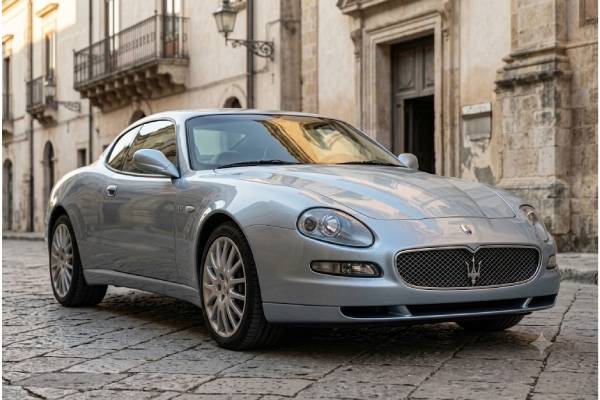
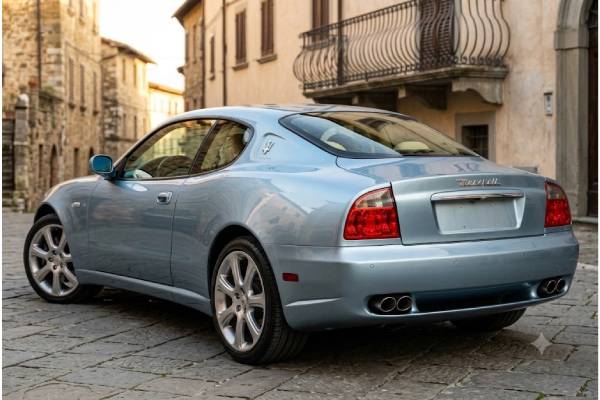
The Maserati Coupé Cambiocorsa is a four-seat grand tourer built around one of the most distinctive powertrains of the early 2000s: a 390 hp, naturally aspirated 4.2-liter V8 linked to a paddle-operated six-speed rear transaxle. Introduced for 2002, the M138 Coupé combined Giugiaro’s restrained bodywork with genuine rear seats, a useful boot, hydraulic steering, and Ferrari-era engine technology. Its Cambiocorsa transmission gives the car much of its period character, but it also creates the main buying challenge. The system uses a conventional dry clutch operated by hydraulic pressure, not a torque converter or dual-clutch unit, so low-speed use, calibration, and previous driving habits directly affect wear. A properly maintained example feels balanced, vocal, and surprisingly practical. A neglected car can need a clutch, pump, actuator, adaptive dampers, cooling-system work, and interior restoration at the same time. The best purchase is therefore the car with diagnostic evidence, detailed invoices, and coherent condition rather than the lowest mileage or most polished paint.
Table of Contents
- A Four-Seat Ferrari-Era Maserati
- V8, Transaxle, and Performance Figures
- Production Changes and Factory Choices
- Giugiaro Packaging and Cambiocorsa System
- Grand-Touring Driving Character
- Clutch, Cooling, and Chassis Maintenance
- Buying a Sorted Coupé Cambiocorsa
A Four-Seat Ferrari-Era Maserati
The Coupé Cambiocorsa is the core closed M138 model and the car that made Maserati’s new naturally aspirated V8 platform practical for four occupants. It followed the shorter Spyder and replaced the 3200 GT with a less turbocharged, more linear, and more internationally marketable formula.
Maserati introduced the Coupé for the 2002 model year. The body evolved from Giugiaro’s 3200 GT shape, but the mechanical package changed substantially. A new F136 R V8 replaced the twin-turbo 3.2-liter engine, the gearbox moved to the rear as a transaxle, and conventional rear lamps replaced the earlier boomerang-shaped LEDs.
The Cambiocorsa version used steering-column paddles and electrohydraulic controls instead of a clutch pedal. At the time, that layout looked closely connected to high-performance Ferrari road cars. It also allowed automatic operation, although the system works best when the driver understands its single-clutch design and uses manual paddle selection with mechanical sympathy.
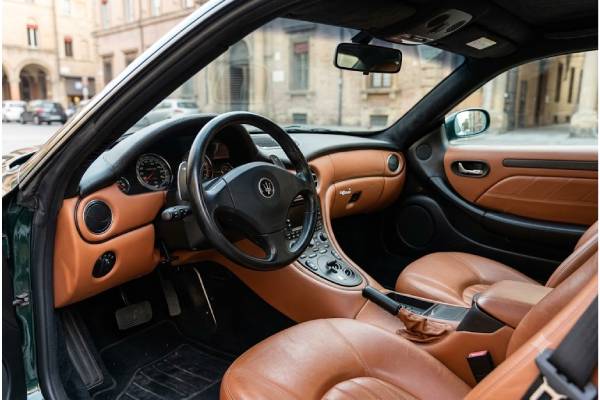
Unlike many exotic coupés, the M138 is genuinely usable. The rear seats can accommodate adults for shorter trips and children more comfortably, while the 315-liter boot handles weekend luggage. The cabin has climate control, power seats, substantial leather trim, and a comfortable touring position. This practicality helped the car serve as a daily grand tourer when new and still makes it more versatile than a two-seat sports car.
The Coupé’s reputation today is shaped by depreciation. For years, low purchase prices tempted owners who could not support specialist maintenance. As a result, surviving cars range from meticulously cared-for examples to vehicles with deferred clutch work, leaking dampers, warning lights, cheap tires, and improvised repairs. The model itself is not inherently disposable; its complex systems simply punish neglect.
Maserati records identify 5,404 M138 Coupés of all versions. That total includes manual GT and Cambiocorsa cars rather than one transmission alone. The model is uncommon enough to feel special but plentiful enough that buyers should compare several examples instead of accepting serious defects.
Its strongest qualities remain compelling: a compact body by modern standards, a naturally aspirated V8, rear-transaxle balance, hydraulic steering, and a richly finished interior. It is less raw than a sports car and less isolated than a modern luxury coupé. That middle ground defines its appeal.
V8, Transaxle, and Performance Figures
The Coupé Cambiocorsa uses the 4,244 cc F136 R V8, a six-speed electrohydraulic transaxle, and rear-wheel drive. Its official 390 hp output produces strong pace, while the rear gearbox helps distribute mass more evenly than a conventional front-mounted transmission.
| Item | Specification |
|---|---|
| Production years | 2002–2007 |
| Model code | M138 |
| Engine code | F136 R |
| Engine | 4,244 cc naturally aspirated 90-degree V8 |
| Construction | Aluminum block and heads |
| Valve gear | DOHC, 32 valves, variable intake timing |
| Lubrication | Dry sump |
| Power | 390 hp at 7,000 rpm |
| Torque | 451 Nm at 4,500 rpm |
| Transmission | Six-speed Cambiocorsa automated manual transaxle |
| Drive | Rear-wheel drive with limited-slip differential |
| Structure | Steel load-bearing body with front and rear subframes |
| Suspension | Independent double wishbones at all four wheels |
| Damping | Standard or Skyhook electronically controlled dampers, depending on equipment |
| Brakes | Ventilated steel discs with Brembo calipers |
| Tires | 235/40 ZR18 front; 265/35 ZR18 rear |
| Wheelbase | 2,660 mm |
| Length | 4,523 mm |
| Width | 1,822 mm |
| Height | Approximately 1,305 mm |
| Official dry weight | Approximately 1,570 kg |
| Top speed | Approximately 285 km/h |
| 0–100 km/h | About 4.9 seconds |
The F136 R is a short-stroke engine with a 92 mm bore and 80 mm stroke. It uses a cross-plane crankshaft, which gives it a deep, uneven-edged exhaust note rather than the sharper tone of a flat-plane Ferrari unit. Torque is useful in the middle range, but the engine’s most energetic response comes as it approaches 7,000 rpm.
Dry-sump lubrication stores oil in a separate tank and scavenges it from the crankcase. This supports oil control under sustained cornering and permits a lower engine installation. It also means the oil level must be checked according to the correct warm-engine procedure. Overfilling after a cold reading is a common avoidable mistake.
A torque tube links the front engine to the rear transaxle. The gearbox, differential, and clutch assembly concentrate weight close to the rear axle. This contributes to balanced steering response and traction, but it makes clutch replacement more involved than on a front-gearbox car.
Cambiocorsa commands the clutch and shift rails through an actuator supplied by an electric hydraulic pump and accumulator. The control unit estimates clutch position and adapts engagement. A healthy system should select gears promptly and consistently. It should not slam into first, flash the gear display, fall into neutral, or take several attempts to engage reverse.
Period test results vary with launch technique. The Coupé is capable of acceleration near five seconds to 100 km/h and a top speed around 285 km/h, but repeated maximum-effort launches are a poor way to treat an aging single clutch. Rolling performance and shift consistency provide more useful diagnostic information.
Production Changes and Factory Choices
The 2002–2007 Coupé evolved through software revisions, equipment changes, and special packages rather than a single dramatic facelift. The build date, market, option list, and service history reveal more than the registration year alone.
Early examples introduced the new powertrain and first-generation Cambiocorsa calibration. Later cars often benefited from updated transmission software, revised components, and dealer-applied improvements. A well-maintained early car with documented updates can drive better than a neglected late car.
Skyhook adaptive damping was an important choice. Sensors monitor body motion and the system varies damper force in real time. It can give the Coupé a broad operating range from comfortable touring to firmer body control. Standard fixed-rate dampers are simpler and may appeal to owners who value lower long-term complexity.
Factory personalization was extensive. Typical choices included multiple leather and carpet colors, contrast piping, dashboard trim, wood or carbon accents, xenon lamps, parking sensors, navigation, upgraded audio, heated or memory seats, wheel finishes, and colored brake calipers. Buyers should verify whether unusual combinations are original rather than later retrims.
The 90th Anniversary Edition appeared in 2004 in selected markets. Australian cars received a regional package with numbered identification, carbon details, aluminum pedals, special wheels, red calipers, parking sensors, Skyhook, and a choice of several colors. It should not be confused with the Blu Anniversary Spyder program or with a standard Coupé dressed in aftermarket parts.
The GranSport arrived as a more focused evolution. It used the 400 hp F136 RB engine, faster Cambiocorsa calibration, 19-inch wheels, lower suspension, revised aerodynamics, a louder exhaust, and a sportier interior. GranSport-look bumpers or wheels on a 390 hp Coupé do not create a factory GranSport.
What documentation should show
A strong history file includes the original sales invoice, build sheet or option data, stamped book, handbook set, keys, radio codes, repair invoices, and records of software or campaign work. Paint and trim codes should agree with the car. If major restoration occurred, photographs and invoices should explain why and how.
Mileage inconsistencies can arise when instruments are replaced or cars move between countries. Compare service dates, inspection records, tire invoices, diagnostic data, and interior wear. A coherent timeline is more persuasive than one isolated odometer reading.
Giugiaro Packaging and Cambiocorsa System
The M138 Coupé succeeds because it packages four seats and a rear transaxle within clean, compact grand-touring proportions. Its styling is understated, while the transmission technology provides the drama.
The front uses Maserati’s oval grille, a low bonnet, and softly defined fenders. The side profile has a long roof arc and short rear deck, giving rear passengers usable headroom without making the body appear tall. At the rear, conventional lamps replaced the distinctive boomerang LEDs of the 3200 GT, improving global homologation and simplifying the visual treatment.
The steel body carries front and rear subframes. Its fixed roof gives much greater torsional stiffness than the Spyder, which benefits steering precision, cabin quietness, and suspension control. Panel gaps should be even, and doors should close without dropping or requiring force. Poor alignment can signal accident repair rather than age.
Inside, the cabin emphasizes leather, oval forms, and the central analog clock. The front seats are generous, and the rear bench is more useful than many 2+2 layouts. Access requires folding the front seatbacks, so check the release cables, motors, and memory functions.
Cambiocorsa controls replace a conventional shift lever. The driver selects first or reverse with console controls and changes gear with fixed paddles. Automatic mode is available, but it cannot disguise the clutch opening and closing. Smoothness improves when the driver gives the system time and reduces throttle slightly during ordinary upshifts.
The transmission’s physical arrangement explains its strengths and weaknesses. With the gearbox at the rear, the front end avoids carrying all driveline mass. The car turns in cleanly and remains stable at speed. However, hydraulic pressure, sensor accuracy, clutch setup, and battery voltage must all be correct for the controls to work as intended.
Cooling hardware sits behind low front openings. Dirt accumulates between the radiator and condenser, reducing airflow. The undertray and ducts should be intact because they guide air and protect components. Front-end repair that omits these pieces can create recurring temperature problems.
The exhaust note is a major sensory feature. Standard systems balance touring refinement with a rich V8 sound. Aftermarket exhausts are common, but a very loud system can hide catalyst rattles, manifold leaks, or driveline noises. Verify emissions function rather than judging by volume.
Grand-Touring Driving Character
The Coupé Cambiocorsa feels best on open roads where the clutch remains engaged and the driver can use the engine’s middle and upper ranges. Its long wheelbase relative to the Spyder gives it calmer stability without making it feel remote.
Moving away smoothly requires restraint. Allow the clutch to engage rather than holding the car at a slow crawl. Use the brake on inclines and avoid reversing long distances uphill. These habits reduce heat and wear in the dry clutch.
During relaxed upshifts, a brief throttle lift softens the torque interruption. Sport mode quickens the change and alters stability-control and damping behavior on equipped cars. At high engine speed, the system feels much more decisive. Drivers accustomed to dual-clutch gearboxes must accept a visible pause between ratios.
The V8 is flexible enough for daily traffic and long journeys. It pulls cleanly from low revs, strengthens through the midrange, and becomes genuinely urgent near its power peak. The response is immediate and predictable, making it easy to meter power through a bend.
Hydraulic steering gives moderate weight and useful feedback. The car’s nose follows inputs accurately when the front tires and suspension are healthy. Excessive tramlining, nervousness, or steering kickback usually points to old tires, poor alignment, bent wheels, or worn ball joints.
The longer wheelbase and fixed roof make the Coupé more composed than the Spyder. It settles into fast sweepers, absorbs motorway distances, and allows the driver to use the rear seats and boot without turning every trip into an event. It still feels compact compared with later GranTurismo models.
Skyhook’s softer setting suits broken roads, while Sport reduces body movement on smoother surfaces. A firm ride is normal, but crashing over small bumps is not. Failed dampers, seized joints, incorrect springs, or oversized wheels can create harshness.
Braking should feel progressive and stable. Period road tests showed strong stopping distances for steel brakes. Age changes the result: old fluid, glazed pads, corroded discs, tired hoses, and sticky caliper pistons all reduce confidence.
In town, visibility is acceptable and the rear seats help carry bags, but low-speed transmission behavior demands attention. On the motorway, sixth gear, supportive seats, climate control, and a relatively quiet body make the car a genuine grand tourer. Fuel use is high, yet the tank range is reasonable when cruising.
Clutch, Cooling, and Chassis Maintenance
The main maintenance strategy is to diagnose systems before they fail completely. Transmission pressure, clutch calibration, cooling airflow, suspension play, and battery voltage can all be measured before they leave the car immobile.
Cambiocorsa clutch and hydraulics
A specialist scan should record clutch wear estimates, engagement point, hydraulic pressure, pump cycle frequency, actuator errors, and adaptation values. The displayed wear figure is calculated, so it must be interpreted alongside invoices and actual behavior.
A pump that primes constantly may indicate a tired accumulator or pressure loss. Delayed selection, flashing gear symbols, harsh engagement, inconsistent reverse, or unexpected neutral are warning signs. Check the pump relay, wiring, and battery before replacing expensive parts, but do not dismiss repeated faults as “normal.”
Clutch life varies enormously. Highway mileage can be gentle, while urban creeping and steep parking ramps can destroy a clutch quickly. Replacement work should include the release bearing, flywheel inspection, seals, mounts, and correct electronic setup afterward.
Engine, oiling, and temperature control
Inspect cam-cover gaskets, front covers, dry-sump hoses, oil-tank fittings, and the undertray for leaks. Verify that services used the proper oil and warm-level procedure. A low-mileage engine still needs annual oil changes because contamination and condensation depend on time and use pattern.
Clean the radiator and condenser stack. Test both fans, relays, thermostat, expansion tank, cap, and hoses. The gauge should remain stable in traffic with the air conditioning running. A car that only overheats at low speed often has an airflow or fan-control fault, but repeated overheating can cause much greater damage.
Misfires may come from coils, plugs, injectors, air leaks, or sensors. Unburned fuel can harm catalytic converters. Scan for pending codes and check emissions readiness so recently erased faults are not overlooked.
Suspension, brakes, and cabin
Ball joints, control-arm bushes, tie rods, anti-roll-bar links, wheel bearings, and mounts wear. Skyhook dampers can leak or trigger warning messages. A lift inspection should include the torque tube, transaxle area, exhaust hangers, brake hoses, underbody, and signs of impact.
Tire quality is critical. Fit matching premium tires in correct sizes and replace them by age as well as tread depth. Uneven wear indicates geometry or joint problems. Bent 18-inch wheels can produce vibration mistaken for driveline trouble.
Soft-touch coatings become sticky, leather shrinks near vents and airbags, headlining can sag, and seat or window mechanisms fail. Test climate control, alarm, central locking, instruments, audio, parking sensors, and every seat function. Low battery voltage can create a cluster of false warnings.
Time-based service should cover brake fluid, coolant, gearbox and differential oils, power-steering fluid, belts, filters, battery condition, and rubber hoses. Cars stored for long periods need a proper maintainer and full-temperature exercise, not repeated brief idling.
Buying a Sorted Coupé Cambiocorsa
The best Coupé Cambiocorsa is the one with a consistent service story and recent proof that its expensive systems work. Purchase price should be considered together with the first two years of likely maintenance.
Ask for the VIN, build data, clutch invoices, diagnostic reports, cooling work, suspension repairs, tire dates, and accident history before arranging a viewing. A seller who claims a recent clutch should provide the installation date, mileage, parts list, and calibration details.
A specialist pre-purchase inspection should include:
- Cold start, hot restart, leak check, and full engine scan.
- Cambiocorsa pressure, pump, clutch, actuator, and adaptation data.
- Every gear in normal and Sport modes from cold to fully hot.
- Cooling operation during stationary traffic and road load.
- Lift inspection of suspension, steering, brakes, wheels, tires, exhaust, and underbody.
- Paint-depth readings and examination of structural repair.
- Complete electrical and climate-control function test.
- Verification of options, special-edition claims, books, keys, and service chronology.
During the drive, assess low-speed take-up without excessive creep. Apply strong rolling acceleration, make both gentle and quick paddle shifts, brake firmly, and cross rough pavement. The car should maintain a straight line and stable temperature. Transmission behavior must remain consistent when hot.
Budget for baseline fluids, a battery, four tires, alignment, interior refinishing, and minor leaks even on a good car. Larger risks include clutch and actuator work, Skyhook dampers, radiator replacement, catalysts, steering or suspension joints, and air-conditioning repairs.
Originality affects collector appeal, but sensible reversible improvements can make the car easier to use. A discreet audio upgrade, documented relay update, or properly engineered replacement damper is preferable to an unusable original component. Keep all removed parts and avoid hacked wiring or nonstandard wheel offsets.
A sorted M138 Coupé Cambiocorsa is more than an inexpensive route to a V8 badge. It is a balanced, practical grand tourer with real rear seats, a distinctive engine, and a transmission that rewards understanding. Careful selection turns it from a repair project into one of the most characterful long-distance cars of its era.
References
- Coupé Model – Gran Turismo models | Maserati (Maserati Classic)
- Maserati Coupe Cambiocorsa 2002
- 2002 Maserati Coupe – Road Test & Review – Automobile Magazine 2002
- Receive the Certification of Authenticity for your car | Maserati (Maserati Classiche)
Disclaimer
This article is for informational purposes and does not replace professional inspection, diagnosis, or repair. Specifications, torque values, procedures, service intervals, and equipment vary by VIN, production date, and market; confirm them in the official service documentation for the specific car. Please share this article on Facebook, X/Twitter, or your preferred automotive community if it helped you.