
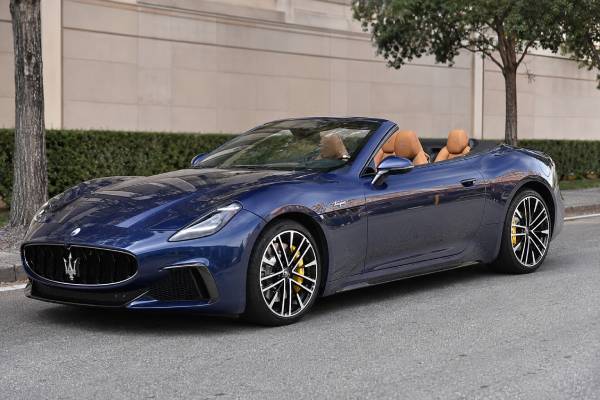
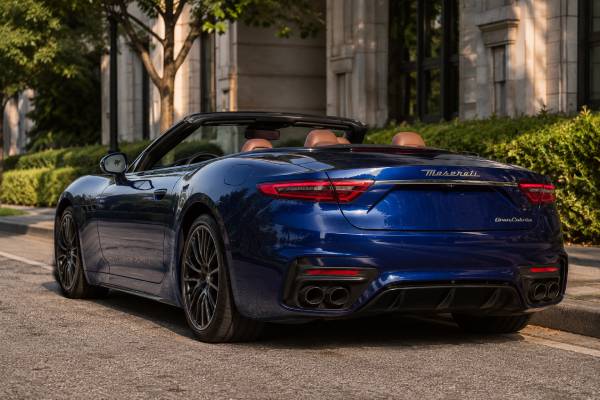
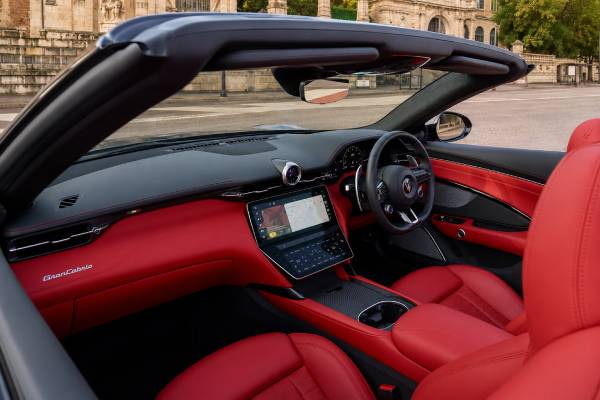
The 590 hp Maserati GranCabrio Trofeo is the updated high-performance petrol flagship of the M189 convertible range. Announced in June 2026, it raises the twin-turbo Nettuno V6 by 40 hp over the original 550 hp Trofeo and combines that output with all-wheel drive, an electronic rear limited-slip differential, adaptive air suspension, a standard sport exhaust, and four genuine seats. The change is more than an engine recalibration. Maserati also redesigned the nose, refined airflow management, introduced new wheel and interior choices, updated the steering wheel and digital controls, and revised the engine and transmission calibration for sharper response. The result remains a grand tourer rather than a stripped track car: the roof opens in about 14 seconds, the cabin offers neck warming and premium audio, and the suspension can still deliver long-distance comfort. This guide focuses only on the 590 hp 2026-onward version, explains how it differs from the earlier 550 hp car, and gives buyers a clear framework for specifications, driving, maintenance, warranty, and inspection.
Table of Contents
- The 590 hp Trofeo Explained
- Updated Nettuno and Performance Hardware
- 2026 Refresh Identity and Options
- Aerodynamics, Cabin, and Special Equipment
- Trofeo Modes, Sound, and Road Behavior
- Maintaining a New-Generation Trofeo
- Buying the 590 hp GranCabrio Trofeo
The 590 hp Trofeo Explained
The 590 hp GranCabrio Trofeo is the 2026 evolution of Maserati’s combustion convertible, replacing the original 550 hp specification at the top of the petrol range. It keeps the M189 platform and four-seat soft-top concept but adds stronger performance, sharper responses, and a redesigned visual identity.
Maserati launched the modern GranCabrio in 2024 with the 550 hp Trofeo. That car established the basic formula: a 3.0-liter Nettuno V6, eight-speed automatic, standard AWD, air springs, and a fabric roof. The 2026 update increased maximum power to 590 hp while retaining 650 Nm of torque. Official figures list 0–100 km/h in 3.6 seconds and a 316 km/h top speed for the convertible.
The Trofeo sits above the 490 hp GranCabrio and beside the electric Folgore. Its role is distinct from both. The 490 hp model favors understated touring and a softer visual treatment. The Folgore offers instant electric acceleration and 800-volt charging. The Trofeo is for buyers who want the strongest petrol performance, the widest dynamic range, and an exhaust note that remains central to the experience.
This is still a large, luxurious grand tourer. It carries four occupants, uses an insulated soft top, and includes equipment such as a neck warmer, heated steering wheel, and high-end cabin materials. Its speed should not obscure its purpose: it is designed to cross countries quickly and comfortably, then make a mountain road or fast circuit session memorable without requiring a second car for the journey home.
Because the 590 hp version is new, no meaningful high-mileage reliability record exists yet. Buyers should judge cars by build quality, software status, warranty, tire and brake condition, accident history, and dealer support. A complete first-year record will be more valuable than vague claims about future collectability.
Updated Nettuno and Performance Hardware
The headline specification is 590 hp from the 2,992 cc twin-turbo Nettuno V6, delivered through an eight-speed automatic and AWD with an electronic rear limited-slip differential. The hardware gives the Trofeo enough traction to use its output in normal road conditions while preserving a rear-biased feel.
| Item | Specification |
|---|---|
| Engine | 2,992 cc 90-degree V6, twin turbocharged |
| Combustion system | Direct injection with Maserati Twin Combustion pre-chamber technology |
| Maximum output | 590 CV, commonly presented as 590 hp |
| Maximum torque | 650 Nm |
| Transmission | Eight-speed automatic with steering-wheel paddles |
| Drivetrain | All-wheel drive with electronic rear limited-slip differential |
| Suspension | Adaptive air springs; double-wishbone front and multi-link rear |
| Standard wheels | 20-inch front and 21-inch rear forged Pegaso |
| 0–100 km/h | 3.6 seconds |
| Top speed | 316 km/h |
| Overall length | 4,975 mm |
| Seating | Four |
| Roof operation | About 14 seconds, at speeds up to approximately 50 km/h |
| Boot capacity | 172 liters with the roof closed |
Nettuno’s pre-chamber system uses a small secondary chamber and spark plug to initiate combustion through calibrated passages into the main cylinder. A conventional side spark plug supports operation when the pre-chamber strategy is not needed. The approach helps Maserati achieve high specific output and stable combustion from a compact engine.
The 2026 calibration adds 40 hp without increasing the quoted torque peak. That means the gain is concentrated higher in the rev range rather than appearing as a larger low-speed shove. Revised engine and transmission mapping makes the car respond more promptly, while cylinder deactivation can reduce fuel use under light loads. Owners should expect actual consumption to vary dramatically with roof position, speed, traffic, temperature, and drive mode.
AWD monitors wheel speed, steering, yaw, throttle, and stability-control demand to distribute torque. The front differential is packaged beside the engine to support a low center of gravity. The E-LSD at the rear can vary locking action electronically, helping the car put power down when exiting a corner and improving stability during rapid changes in load.
Air suspension changes ride height and damping according to mode and speed. In Corsa, the body can sit lower and the damping becomes more controlled. The system does not erase the car’s mass, but it lets the Trofeo combine wheel control with a ride suitable for long journeys. A driver should still slow for abrupt dips, steep ramps, and broken road edges because the front splitter and low-profile tires remain vulnerable.
The standard forged Pegaso wheels use a staggered 20-inch front and 21-inch rear format. Optional Tridente wheels widen the track; official product material lists an increase of 10 mm at the front and 14 mm at the rear, while the general launch communication describes a 10 mm increase. Buyers should use the specification for the exact wheel and market rather than assuming every optional set has identical geometry.
Brake type and tire fitment depend on configuration and market. Do not identify carbon-ceramic brakes by caliper color. Verify the order sheet, disc material, part numbers, and inspection procedure. The difference has a major effect on replacement cost and track-use planning.
2026 Refresh Identity and Options
A genuine 590 hp Trofeo should match the refreshed 2026 design and factory build record. The easiest visual clues are the new front treatment, clear rear light lenses, forged Pegaso wheels, Trofeo-specific trim, and updated cabin controls, but only VIN documentation proves the complete specification.
The redesigned front replaces the earlier softer openings with a wider, more horizontal layout. Shaped intakes include slots that draw the boundary layer away from the body, and external air curtains guide flow around the front wheels. A central splitter manages pressure under the nose and increases front downforce. These details distinguish the update from a cosmetic bumper swap.
At the rear, clear lamp lenses provide a quick model-year clue. Dedicated bumpers and diffuser treatment emphasize the Trofeo’s position. Exposed carbon-fiber details, sport exhaust outlets, and dark or body-coordinated accents vary with configuration. Any claimed factory carbon component should appear on the order sheet; aftermarket replacements may use different weave, gloss, attachment, or crash behavior.
The standard Trofeo specification includes forged Pegaso wheels, E-LSD, sport exhaust, heated steering wheel, Alcantara headlining, and the Air neck warmer. Interior themes can include red or ice leather, while Fuoriserie expands access to paint, leather, Alcantara, trim, badges, radome details, and exhaust-tip finishes.
For the first time, Maserati expanded full personalization to the soft top through its bespoke program. Roof color, stitching, materials, and exterior combinations can make two Trofeos look very different. That personalization can support value when it is tasteful and fully documented, but unusual combinations narrow the future buyer pool.
A registration year is not enough to confirm the 590 hp version. Earlier 550 hp cars can be registered during 2026, and visual parts may be retrofitted. Confirm the engine software and power specification through the VIN, factory record, model code, and authorized diagnostic system. Advertising language such as “2026 Trofeo” should never substitute for those checks.
Aerodynamics, Cabin, and Special Equipment
The refreshed Trofeo’s design changes improve airflow, control, and driver interaction rather than merely adding decoration. The most important upgrades are the functional front aero, revised steering wheel and controls, clearer digital graphics, and standard performance equipment unique to the trim.
Boundary-layer slots in the front intakes manage the slower air that clings to the body surface. The external air curtain then channels cleaner flow around the front wheel area, where turbulence normally creates drag and lift. The central splitter helps organize underbody flow and supports front grip at high speed. These systems work as a package; damage, missing fasteners, incorrect repair, or nonstandard grille inserts can disturb their effect.
The body remains based on the GranTurismo’s aluminum-intensive architecture, adapted for a convertible with reinforced sills, floor structures, and cross-members. The fabric roof avoids the bulk of a folding hardtop and keeps the silhouette low. Its rear glass and layered construction improve weather protection, but the open body will always depend on careful seal, drain, and latch maintenance.
Inside, the updated steering wheel has flat upper and lower sections, dark satin-aluminum spokes, and a choice of perforated leather or sportier Alcantara inserts. The revised Maserati Digital Clock uses an octagonal metal bezel and can display mode-change graphics. Three-dimensional metal PRND controls and new paddle functions improve tactile quality around the driver’s main contact points.
The Air neck warmer sends conditioned air toward front occupants and makes cool-weather roof-down driving more practical. The Trofeo’s Alcantara headliner is visible when the roof is raised, and the standard sport exhaust becomes part of the cabin experience when the top is lowered. Sonus faber audio can provide enough output and tuning to remain clear at motorway speed, though a buyer should test every speaker for distortion or trim resonance.
The roof control should complete a full opening or closing cycle in around 14 seconds and can operate while moving at low urban speed. The ability is useful when weather changes, but the driver should ensure clear space and avoid repeated operation on a weak 12-volt battery. Window indexing, front latch engagement, and side-flap movement should occur smoothly and without warnings.
Trofeo Modes, Sound, and Road Behavior
The 590 hp Trofeo is defined by its breadth: it can travel quietly in GT, become noticeably sharper in Sport, and deliver its most direct responses in Corsa. The modes change more than dashboard graphics, affecting engine, gearbox, exhaust, suspension, stability systems, E-LSD behavior, and ride height.
GT is the sensible default for cities and motorways. Throttle response is progressive, the gearbox seeks higher ratios, and the air suspension allows more compliance. The car remains wide and rides on low-profile tires, so it cannot ignore potholes, but it avoids the nervous low-speed behavior common in more track-focused machines.
Sport wakes the drivetrain without making the chassis unusable. The transmission holds lower gears, the active exhaust opens more readily, and the damping reduces body movement. AWD and E-LSD make full-throttle acceleration remarkably clean, particularly on cool or damp pavement. Drivers should not mistake traction for unlimited grip; braking and cornering still depend on tire temperature, surface, and speed.
Corsa is reserved for the Trofeo and gives the sharpest calibration. It reduces intervention, lowers the car, quickens shifts, and makes the powertrain more immediate. Launch control is available in Sport and Corsa when the required temperatures and conditions are met. Use it sparingly. Repeated launches create heat in the transmission, transfer hardware, differentials, tires, and brakes even when the system protects itself.
The extra 40 hp is most noticeable as speed builds. Low- and midrange torque remains strong at 650 Nm, but the revised calibration pulls harder toward the upper rev range than the 550 hp version. The official 3.6-second 0–100 km/h figure reflects AWD traction; the 316 km/h maximum shows that the Trofeo is tuned for sustained high-speed performance as well as short acceleration tests.
The sport exhaust is standard and its valves open fully in Sport or Corsa. With the roof down, the V6 sounds closer and more textured, including turbo rush and exhaust crackle during aggressive shifts. It cannot reproduce the old naturally aspirated V8’s long rising note, but it delivers a more contemporary sound tied closely to throttle load and mode.
Steering response is quick, and the optional wider-track wheels can add initial precision. The E-LSD helps the rear axle transfer torque across the road rather than spinning the unloaded inside tire. On corner exit, progressive throttle gives the electronics the best chance to build acceleration smoothly. Abrupt inputs can force stability intervention and overheat the outside tires.
Brake feel should be firm and easy to meter. Carbon-ceramic systems, where fitted, may feel different when cold and can make light noise, but vibration, pulling, a soft pedal, or visible disc damage requires inspection. Track driving demands a complete warm-up and cool-down plan, correct pressures, fresh fluid, and post-session checks. The car’s comfort does not reduce the energy its mass and speed put into tires and brakes.
With the roof raised, wind and road isolation suit long journeys. Lowering it changes the sensory balance: sound becomes stronger, rear visibility improves in some directions, and conversation depends on speed and wind management. The neck warmer and heated steering wheel extend the usable season, making the Trofeo more than a fair-weather novelty.
Maintaining a New-Generation Trofeo
The safest way to own a 590 hp Trofeo is to treat warranty, diagnostics, software, and condition records as core maintenance items. Its mechanical systems are robustly engineered for high performance, but the combination of turbos, AWD, E-LSD, air suspension, active exhaust, roof electronics, and digital controls creates expensive dependencies.
Nettuno engine and driveline
Use the exact oil grade and service parts specified for the VIN and climate. Follow both time and mileage limits because condensation, fuel dilution, and additive depletion continue on low-mileage cars. Record every service with invoice detail rather than relying on an electronic stamp alone.
Inspect for coolant or oil residue around hoses, turbo plumbing, covers, and undertrays. A cold start should settle quickly without persistent misfire, smoke, metallic noise, or warning messages. A full diagnostic scan should include stored and pending faults, misfire counts, boost control, temperature history, and software versions.
The eight-speed automatic, front drive unit, transfer components, propeller shaft, and E-LSD should operate without shudder, flare, harsh engagement, or repeated clunk. Some behavior may change after software adaptation, but hardware faults should not be dismissed as calibration. Compare with another vehicle when possible.
Cooling, exhaust, and track use
High-output turbo engines generate substantial heat. Keep radiators and coolers clear, inspect ducts and undertrays after road debris impacts, and investigate any recurring temperature warning. The active exhaust valves should move freely in all modes; rattling, binding, or one-sided sound can point to an actuator or linkage problem.
Track use should shorten inspection intervals even when the official service schedule does not change. Check oil level, brake fluid, pads, discs, tires, wheel bolts, and underbody condition before and after an event. Save tire pressure and alignment notes. Warranty treatment of track activity varies, so obtain written terms before participating.
Air suspension, wheels, and brakes
Leave the car overnight on level ground and compare ride height at all four corners. Frequent compressor operation, slow height changes, or a sinking corner can indicate leaks or sensor problems. Inspect dampers, lines, links, and the low front splitter for damage.
Examine both faces of every forged wheel. A wheel can look clean outside while the inner barrel is bent. Use four matching approved tires with similar tread depth and correct load and speed ratings. Unequal rolling circumference can affect AWD and stability control. Tire age matters even on low-mileage cars.
Measure brake wear with the correct method. Steel discs require checks for lip, cracking, corrosion, and heat spots. Carbon-ceramic discs need inspection for chips and damage plus any factory-specified wear measurement. Never assume a remaining-life percentage from appearance alone.
Roof, electronics, and software
Cycle the roof repeatedly, check front-latch engagement, inspect fabric seams, clean drains, and search the trunk and rear trim for moisture. Test side-window indexing and wind noise at speed. A small leak can damage modules before it becomes obvious in the cabin.
The 12-volt battery must remain healthy because low voltage can create multiple false or cascading faults. Use only the recommended maintainer procedure. Test keys, displays, cameras, radar, driver monitoring, head-up display, climate, audio, seats, neck warmer, lighting, app functions, and over-the-air services.
Confirm all recalls, campaigns, and software updates by VIN. Warranty coverage is especially valuable during early production. Verify its start date, mileage limit, market validity, required service network, transfer rules, and exclusions for modifications or track use.
Buying the 590 hp GranCabrio Trofeo
Buy the 590 hp Trofeo only after proving that it is the updated car, not an earlier 550 hp example registered later or fitted with cosmetic parts. VIN confirmation, the factory order sheet, software identification, and a specialist inspection should agree before money changes hands.
The first decision is whether the upgrade matters to you. The 550 hp Trofeo is already very fast and may offer better value. The 590 hp car adds stronger high-rev performance, revised calibration, functional aero, current cabin interfaces, standard Trofeo equipment, and the prestige of the newest specification. Pay for those differences only when the actual car contains them.
Compare the 490 hp model as well. It retains AWD, air suspension, four seats, the same roof concept, and abundant performance. Buyers who rarely use Corsa mode, E-LSD behavior, or the sport exhaust may prefer its quieter character and lower entry price. The Trofeo earns its premium when its sharper responses and specification are central to the purchase.
A complete pre-purchase inspection should cover:
- VIN, build date, 590 hp specification, order sheet, warranty, recalls, campaigns, and software history.
- Cold start, hot restart, full scan, boost and temperature data, and road-test fault monitoring.
- Transmission, AWD, front differential, propeller shaft, E-LSD, mounts, and underbody inspection.
- Air-suspension height retention, compressor behavior, damping changes, and mode operation.
- Wheel authenticity, runout, alignment, tire age, tread depth, and approved fitment.
- Disc and pad measurements, brake-fluid condition, and carbon-ceramic identification where relevant.
- Multiple roof cycles, seal and drain checks, window indexing, and water-entry inspection.
- Test of every display, key, camera, sensor, driver aid, climate function, audio channel, and connected service.
- Aluminum body, carbon trim, splitter, undertrays, paint depth, glass, and sensor calibration after repairs.
Ask for a long road test from cold. Use GT, Sport, and Corsa only where safe and legal. Check low-speed maneuvering, straight tracking, steering centering, shift quality, brake stability, roof noise, driveline vibration, and suspension response. Do not perform launch control on a seller’s car unless the seller, inspector, and road conditions make it appropriate.
Running costs are part of the purchase price. Obtain quotations for insurance, approved tires, forged-wheel replacement, routine servicing, brake work, paint and carbon repair, secure storage, and an extended warranty. A front-end impact can involve aerodynamic panels, cooling hardware, sensors, and calibration even when the visible damage seems small.
Avoid cars with unexplained software tuning. Additional boost or altered transmission logic can affect emissions compliance, thermal protection, driveline durability, and warranty. A louder aftermarket exhaust may also create drone or interfere with active-valve operation. Factory performance is already sufficient; originality and complete records are usually the stronger long-term choice.
The 590 hp GranCabrio Trofeo is one of the few cars that combines 316 km/h capability, four real seats, AWD traction, and a roof that disappears in seconds. That range makes it special, but it also demands disciplined ownership. Buy the specification you will use, verify every system, protect the warranty, and maintain it as a high-performance machine rather than a low-mileage ornament.
References
- New Maserati GranTurismo, GranCabrio and Grecale 2026
- Maserati GranCabrio Trofeo – 2027 Sports Convertible 2026
- Maserati GranCabrio: 2027 Luxury Convertible Versions & Specs 2026
- Debut of the New Maserati GranCabrio – The Trident’s New Spyder: Iconic Design and Open-Top Elegance 2024
- Maserati Guides & Documentation for your vehicle 2026
Disclaimer
This article is for informational purposes and is not a substitute for professional diagnosis, inspection, or repair. Specifications, torque values, service intervals, software, and procedures vary by VIN, market, and equipment. Verify all details against official service documentation for the specific vehicle. Please share this guide on Facebook, X/Twitter, or another enthusiast community if it was useful; sharing supports our work.