
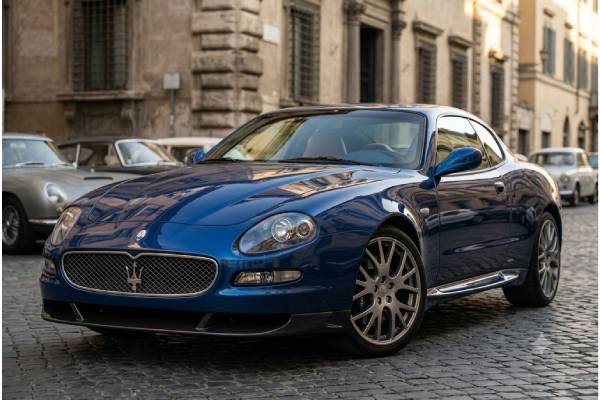
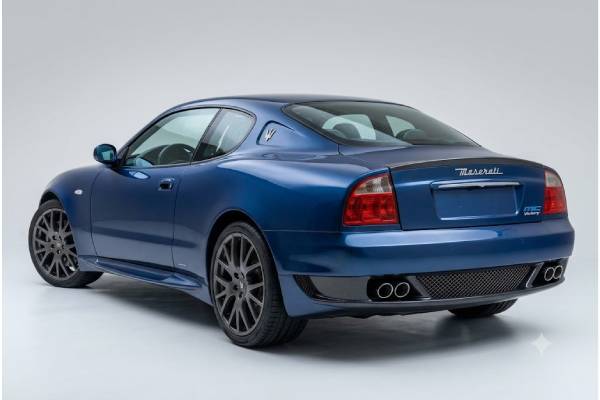
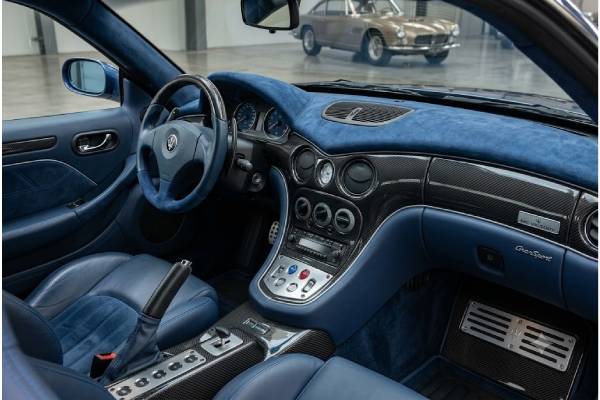
The Maserati GranSport MC Victory is the most overtly motorsport-inspired road version of the M138 coupé. Built in a numbered run of 180 cars for 2006, it celebrated Maserati’s 2005 FIA GT Manufacturers’ Cup success and borrowed visual and dynamic ideas from the MC12 race program. Beneath the special trim is the 400 hp GranSport package: a naturally aspirated 4.2-liter F136 RB V8, a faster-calibrated Cambiocorsa transaxle, firmer Skyhook suspension, larger 19-inch wheels, and revised aerodynamics. The MC Victory then adds blue-tinted carbon-fiber spoilers, a more developed front splitter, Italian flag details, Alcantara-rich trim, and distinctive carbon-shell seats. Its limited production makes authenticity and completeness essential. A missing seat, replaced carbon piece, undocumented repaint, or incomplete numbered identity can affect value far more than a minor mechanical imperfection. Mechanically, however, it remains an aging M138 and must be judged by clutch condition, hydraulic pressure, cooling health, suspension wear, electronics, and service quality rather than rarity alone.
Table of Contents
- From Race Success to Road Car
- MC Victory Mechanical Specifications
- Numbered Production and Originality
- MC12-Inspired Details
- Performance and Road Character
- Maintenance and Expensive Failure Points
- Collector Buying Checklist
From Race Success to Road Car
The MC Victory exists because Maserati wanted a road-going celebration of its successful return to international GT racing. It was announced in February 2006, shown at the Geneva Motor Show, and offered from May in a production run limited to 180 individually numbered examples.
The context matters. Maserati had re-entered top-level competition with the MC12, a dramatic homologation-derived supercar that became a winning GT racer. In 2005, Maserati secured the FIA GT Manufacturers’ Cup. The GranSport MC Victory translated that achievement into a car that existing customers could use on the road without adopting the MC12’s extreme dimensions, V12 engine, or price.
The base GranSport was already the focused member of the M138 family. Compared with the standard Coupé Cambiocorsa, it had 400 hp rather than 390 hp, quicker gearbox software, a freer exhaust, larger wheels, revised suspension calibration, and aerodynamic changes. The MC Victory did not receive a larger engine or a radically different transmission. Its importance comes from a more specific chassis and aerodynamic tune, rare competition-style components, and a direct visual connection to Maserati Corse.
This makes the MC Victory different from a simple appearance package. The redesigned front spoiler increased front downforce through a deeper lower profile and added side elements. Steering was revised for a more direct response, and high-speed stability was a stated development target. Carbon-fiber pieces and racing-style seats also changed the driver’s immediate surroundings.
The model appeals to several overlapping groups. Maserati collectors see it as a factory-numbered special. Motorsport enthusiasts value the link to the MC12 era. Drivers appreciate that it retains the compact, front-engine proportions of the GranSport while feeling more purposeful. Buyers who simply want a fast M138 must be more careful: the rarity premium is justified only when the special components and history are intact.
It also represents the end of a particular Maserati generation. The M138 platform combined hand-finished interiors, a rear transaxle, hydraulic steering, naturally aspirated power, and early paddle-shift technology. The later GranTurismo became more refined and spacious, but also larger and less compact. The MC Victory captures the earlier car at its most developed and visually assertive.
MC Victory Mechanical Specifications
The MC Victory uses the GranSport’s 4,244 cc F136 RB V8 and six-speed Cambiocorsa transaxle, with chassis changes aimed at response and stability. Its official 400 hp output is modest by current supercar standards, yet the engine’s immediacy and the car’s relatively compact footprint still create serious pace.
| Item | Specification |
|---|---|
| Model and platform | GranSport MC Victory, M138 |
| Engine code | F136 RB |
| Engine | 4,244 cc naturally aspirated 90-degree V8 |
| Construction | Aluminum block and cylinder heads |
| Lubrication | Dry sump |
| Valve gear | DOHC, 32 valves, variable intake timing |
| Maximum power | 400 hp at 7,000 rpm |
| Maximum torque | Approximately 452 Nm at 4,500 rpm |
| Transmission | Six-speed Cambiocorsa electrohydraulic transaxle |
| Drivetrain | Rear-wheel drive with limited-slip differential |
| Structure | Steel monocoque with front and rear subframes |
| Suspension | Double wishbones, Skyhook electronically controlled dampers |
| Steering | Hydraulic rack and pinion with MC Victory calibration |
| Brakes | Ventilated steel discs with Brembo calipers |
| Wheels | 19-inch GranSport alloy wheels |
| Tires | 235/35 ZR19 front; 265/30 ZR19 rear |
| Wheelbase | 2,660 mm |
| Length | Approximately 4,523 mm |
| Width | Approximately 1,822 mm |
| Official GranSport dry weight | Approximately 1,680 kg |
| Top speed | Approximately 290 km/h |
| 0–100 km/h | Approximately 4.8–4.9 seconds |
The F136 RB develops ten more horsepower than the F136 R used in the standard Coupé. Maserati achieved the difference through revisions to breathing, engine management, and exhaust flow rather than forced induction. The cross-plane crankshaft produces a deep V8 pulse, while the dry-sump oiling system supports sustained cornering and allows a relatively low engine position.
The engine sits at the front, but the gearbox and differential form a transaxle at the rear. A torque tube links the two. This arrangement moves major driveline mass rearward and contributes to balanced handling. It also makes clutch work labor intensive and carries noise or vibration through the center of the car when mounts, bearings, or couplings age.
Cambiocorsa uses hydraulic pressure to operate a conventional single dry clutch and move the six-speed gearbox. GranSport software shortens shift time compared with earlier M138 calibrations, especially in Sport mode at high throttle. It remains fundamentally different from a dual-clutch transmission. Low-speed creeping slips the clutch, and every start from rest consumes friction material.
The 19-inch wheels reduce tire sidewall depth and sharpen response, but they also make bent rims, old tires, and poor alignment more noticeable. The MC Victory’s steering and aerodynamic tuning add precision at speed; they do not remove the need for healthy ball joints, control-arm bushes, dampers, and correct geometry.
Steel brakes are easier to service than carbon-ceramic systems found on later supercars. Their condition still matters. Cracked or heavily lipped discs, seized caliper pistons, old fluid, and unsuitable pads can turn a strong system into one that vibrates or fades.
Numbered Production and Originality
Every MC Victory should be treated as a numbered special whose identity can be checked against factory and historical records. Maserati stated that only 180 units would be produced, and surviving cars normally carry an individual number within the series.
The number by itself is not enough. A buyer should establish that the VIN, production data, body color, interior specification, and plaque all belong together. Plaques can be reproduced, interiors can be retrimmed, and ordinary GranSports can receive similar spoilers or badges. The more valuable the car becomes, the more important independent verification becomes.
Most examples are associated with Blu Victory or closely related blue finishes, but market and customer specifications require VIN-level checking. The MC Victory was offered with distinctive carbon components, Alcantara and leather combinations, and special seats. Exact stitching, piping, trim color, and equipment can vary, yet a car should present a coherent factory specification rather than a collection of later additions.
Components that strongly affect authenticity
- The individually numbered identity plate and its correct location.
- Blue-weave carbon-fiber front and rear aerodynamic pieces.
- MC12-style carbon-shell seats with the correct upholstery.
- Italian flag badges on the front wings.
- Model-specific door-sill and interior trim.
- Correct steering, suspension, and aerodynamic configuration.
- Original wheels, brake finish, tools, books, and keys.
- Documentary confirmation from the build record or Maserati historical archive.
Special seats deserve close attention. They are among the most visible and difficult parts to replace. Inspect the shells for cracks, previous repairs, mounting changes, or impact damage. Check upholstery for excessive bolster wear and verify that any retrim follows the original material pattern. Standard GranSport seats substituted for damaged originals may improve comfort but reduce collector value substantially.
Carbon pieces can suffer stone chips, clear-coat clouding, ultraviolet damage, and poorly matched repairs. A specialist familiar with structural and cosmetic composite work should inspect questionable areas. Painted or wrapped parts may hide damage or indicate that scarce originals are missing.
The service file should show more than annual stamps. Invoices should identify clutch work, hydraulic components, suspension repairs, tires, cooling-system maintenance, and any paint or carbon restoration. Early ownership records and photographs help confirm that the numbered specification existed before the car became collectible.
MC12-Inspired Details
The MC Victory’s special features translate the visual language of the MC12 into the smaller GranSport body. The connection is clearest in the blue carbon fiber, competition-style seats, aerodynamic detailing, and sharper front-end response.
The front spoiler was reprofiled to generate more useful aerodynamic load. Two lateral fins and a more developed lower surface manage airflow near the nose. On a road car, the effect is not a dramatic active-aero transformation; it is a measured improvement in stability and steering confidence as speed rises. Damage to the low splitter is common because ramps, parking curbs, and transport equipment can strike it.
At the rear, a carbon-fiber lip or spoiler balances the front treatment and visually lowers the tail. The blue tint in the weave gives the material a distinctive depth under sunlight. Ordinary black carbon or painted replicas may look acceptable from a distance but do not reproduce the factory appearance.
Italian tricolor badges provide a restrained link to national identity and competition. The wheels, grille, side skirts, and exhaust outlets continue the GranSport’s more aggressive treatment compared with the standard Coupé. None of these features overwhelms the underlying Giugiaro design, which remains compact and formal rather than angular.
Inside, the carbon-shell seats are the centerpiece. Their shape references the MC12’s racing environment, holding occupants more firmly and reducing the plush feel of a normal GranSport cabin. Alcantara appears on key touch points and panels, limiting reflections and adding grip. Carbon trim replaces some of the traditional wood or glossy decorative surfaces found in less sporting Maseratis.
The driving position is low and close to the controls, although the fixed or limited-adjustment nature of special seats can make fit highly personal. A prospective owner should sit in the car for an extended period. Seat height, steering reach, pedal alignment, and helmet clearance cannot always be solved without altering rare original hardware.
The exhaust is an equally important design feature. Valves alter the gas path and sound, allowing a calmer note in ordinary use and a harder-edged voice in Sport mode. The F136 RB never sounds like the MC12’s V12, but it creates its own strong identity: deep at low rpm, metallic through the middle, and urgent near the power peak.
Cooling and airflow remain conventional for the M138. Front-mounted heat exchangers sit behind openings that collect debris. The added splitter must be fitted correctly so it does not obstruct intended flow or create loose panels. Previous accident repair around the nose should be assessed for both cosmetic accuracy and cooling function.
Performance and Road Character
The MC Victory feels more focused than a standard GranSport, but it is still a usable road coupé rather than a stripped competition car. Its strongest qualities are steering response, engine character, stable high-speed balance, and the sense of connection created by the seats and paddles.
At low speed, the transmission demands patience. First-gear engagement should be smooth and predictable, yet the driver still needs to minimize creeping. The racing-style seats can make entry awkward, visibility over the nose is limited, and the low front spoiler needs care around steep transitions.
Once moving, the V8 responds instantly. There is no turbocharger delay and no large torque spike. The engine pulls cleanly from moderate revs, then becomes increasingly forceful above 4,500 rpm. The best acceleration comes from keeping it near the upper half of the tachometer and using the faster Sport-mode shifts.
A small lift during normal upshifts makes the car smoother. At high throttle, the control software cuts torque, releases and re-engages the clutch, and selects the next gear with much greater urgency. The shift remains perceptible, which is part of the period experience. Drivers expecting uninterrupted dual-clutch acceleration may misread a normal torque break as a fault.
The steering is quick and communicates surface changes through the rim. The MC Victory’s revised setup helps the front tires respond with less delay, while aerodynamic changes support confidence on fast roads. It should not dart, tramline excessively, or require constant correction. Those behaviors usually point to tire condition, alignment, bent wheels, worn joints, or repaired accident damage.
Skyhook damping and the 19-inch wheels create a firm ride. On smooth roads, body control is excellent and the car feels tied down. On broken pavement, low-profile tires can transmit sharp impacts and expose worn suspension hardware. Selecting the softer damping setting can improve grip as well as comfort when the surface is poor.
The rear transaxle and limited-slip differential give the car a balanced, adjustable feel. Under power, the rear tires work hard, especially in cold or wet conditions. Stability control should remain active on public roads unless the driver has space and experience. Old premium-brand tires are still old tires; date codes and heat cycles matter even when tread depth looks generous.
Braking performance is progressive and confidence-inspiring when serviced. The system suits fast road use, but repeated circuit laps require suitable pads, fresh high-temperature fluid, and careful monitoring. The MC Victory’s rarity also makes track damage expensive. Owners who use the car hard should preserve detailed records and inspect the splitter, tires, wheel bearings, and brakes after events.
Long-distance ability remains better than the competition-inspired cabin suggests. The V8 is relaxed in the upper gears, climate control is effective when maintained, and the boot can handle a weekend’s luggage. Road noise, fixed seat shape, and the firm ride set the comfort limit before engine performance does.
Maintenance and Expensive Failure Points
The MC Victory shares its major mechanical risks with the GranSport, but rare trim makes accident and interior damage unusually costly. A sensible maintenance plan separates ordinary M138 service work from irreplaceable special-edition components.
Transmission and clutch system
A diagnostic session must record clutch wear estimates, the clutch closed position, engagement behavior, hydraulic pressure, pump cycling, and stored gearbox faults. A percentage shown on a scan tool is not an infallible measurement; calibration errors can distort it. Compare the reading with invoices and the way the car engages hot and cold.
The hydraulic pump, relay, accumulator, actuator, sensors, and wiring all age. Frequent priming, slow gear selection, flashing indicators, neutral drops, or sudden harshness require action. A weak battery can imitate some transmission faults, so voltage should be stabilized before diagnosis.
Clutch replacement should include inspection of the release bearing, flywheel, seals, mounts, and any accessible wear items. The system then needs correct setup and calibration. Cheap work without specialist software often leaves a new clutch shifting worse than the old one.
Engine, cooling, and exhaust
The F136 RB responds well to regular oil changes and proper warm-up. Inspect cam covers, front covers, dry-sump hoses, oil reservoir connections, and the undertray for leaks. The oil level must be checked using the specified warm procedure; an incorrect reading can lead to overfilling.
Radiators and condensers accumulate leaves, grit, and corrosion between their fins. Confirm fan operation at the correct temperatures, inspect relays and wiring, and look for stains around the expansion tank and hose connections. A stable temperature during a short road test does not prove that the system will cope with traffic and hot weather.
Exhaust valves can seize, rattle, or stop responding. Catalysts and oxygen sensors suffer from heat and age. Misfires must be resolved quickly because unburned fuel can overheat the catalysts. Check readiness monitors as well as current fault codes to detect a recently cleared warning light.
Suspension, structure, and special parts
Skyhook dampers can leak or fail electronically. Ball joints and control-arm bushes wear, while 19-inch wheels are vulnerable to bends and cracks. Uneven tire wear often signals more than a simple alignment issue. Examine the rear subframe area, torque tube, mounts, and underside for impact or corrosion damage.
The low MC Victory front spoiler is a priority. Inspect its mounting points, finish, and symmetry. Look behind it for repaired brackets or distorted cooling ducts. Check all blue-carbon pieces under strong light and compare weave and tint across panels.
Interior soft-touch coatings can become sticky, leather can shrink, and Alcantara can mat. Those are manageable compared with cracked seat shells or missing MC-specific trim. Test the seat mounts, belts, airbags, windows, climate system, audio, alarm, parking sensors, and instrument display.
Annual inspection is appropriate even at low mileage. Brake fluid, coolant, gearbox and differential oils, power-steering fluid, filters, belts, battery condition, tire age, and rubber hoses all respond to time. Storage should include a quality battery maintainer, dry ventilation, and periodic operation that brings the drivetrain fully to temperature.
Collector Buying Checklist
The right MC Victory is the car with proven identity, complete special equipment, and recent mechanical care. Paying a premium for rarity while accepting missing carbon, substitute seats, or an uncertain plaque defeats the reason to buy this version.
Begin with the VIN and build information. Confirm the individual production number, delivered colors, equipment, first market, and ownership chain. Cross-check plaque details against factory or recognized historical documentation. Photograph every special component before negotiating.
Essential pre-purchase checks
- Start the engine from cold and inspect smoke, noises, warning lights, and fluid behavior.
- Scan all modules and document clutch, hydraulic, emissions, suspension, and airbag data.
- Test every gear and mode from cold through full operating temperature.
- Inspect the underside, splitter, carbon trim, seat shells, wheels, and chassis on a lift.
- Verify cooling fans, air conditioning, exhaust valves, Skyhook operation, and battery charging.
- Measure paint depth and investigate repairs around the low nose and rear corners.
- Review invoices for clutch calibration, oil procedure, coolant work, tires, and suspension repairs.
- Confirm books, tools, keys, numbered documentation, and retained original parts.
A compression or leak-down test is reasonable if the engine shows uneven running, smoke, questionable history, or unusually low output. It is not a replacement for a complete inspection. Oil analysis can add useful trend information when repeated over time, but one clean sample cannot erase years of missing records.
Road testing should include slow maneuvering, open-road acceleration, high-gear load, firm braking, rough surfaces, and a hot restart. The car should hold a straight line and maintain temperature. Gear engagement should remain consistent after the hydraulic system is hot.
Create a post-purchase reserve. Baseline fluids and minor cosmetic correction are predictable. A clutch and actuator service, four correct tires, Skyhook dampers, catalyst work, carbon restoration, or seat repair can quickly exceed the apparent saving on a cheaper car.
Choose reversible improvements. A modern audio interface, improved battery support, or carefully sourced service upgrade may help usability. Keep every original part and record the change. Avoid wheel-size changes, generic seats, nonstandard steering wheels, or body modifications that obscure what makes the MC Victory unique.
The MC Victory rewards a buyer who values both provenance and driving. It carries a clear historical story, but it should not become a static display object. Used sympathetically and serviced by an M138 specialist, it delivers the sound, steering, and compactness of the GranSport with a stronger connection to Maserati’s modern racing revival.
References
- The World Prémière of the Maserati GranSport MC Victory | Maserati | Stellantis Media 2006
- GranSport, GranSport Spyder – Gran Turismo models | Maserati (Maserati Classic)
- Maserati GranSport 2004
- Receive the Certification of Authenticity for your car | Maserati (Maserati Classiche)
Disclaimer
This article is for informational purposes and is not a substitute for professional diagnosis, inspection, or repair. Specifications, torque values, service intervals, procedures, and equipment vary by VIN and market; verify all work against the official service documentation for the individual car. Please share this article on Facebook, X/Twitter, or your preferred automotive community if it was helpful.