
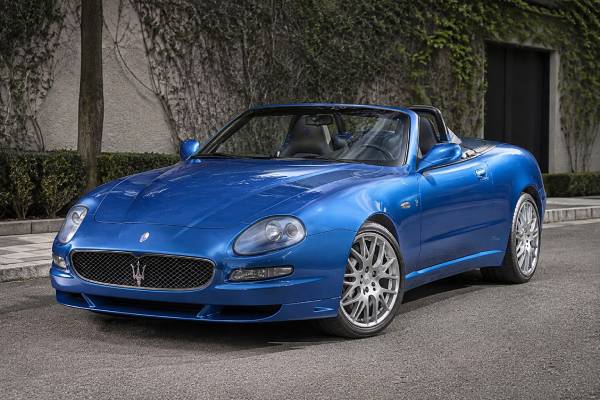
The Maserati Spyder Cambiocorsa 90th Anniversary pairs a commemorative specification with the transmission that defined many Ferrari-era Maseratis. Its 390 hp, naturally aspirated 4.2-liter V8 drives the rear wheels through a six-speed transaxle whose clutch and gear selection are operated electrohydraulically. Steering-column paddles replace a manual lever, but the hardware remains a single-clutch automated manual rather than a modern dual-clutch gearbox. That distinction shapes how the car drives, wears its clutch, and should be inspected. The anniversary version adds Blu Anniversary paint, special exterior accents, carbon-fiber details, and model-specific cabin trim to the compact two-seat M138 Spyder. Production records are not perfectly consistent across markets, so authentication should rely on the VIN, build documentation, and correct equipment instead of one advertised number. A sorted example is dramatic, fast enough to feel special, and unusually intimate. A neglected one can turn roof, transmission, suspension, and electrical faults into a costly restoration project.
Table of Contents
- The Commemorative Paddle-Shift Spyder
- F136 Powertrain and Chassis Data
- Build Numbers, Versions, and Proof
- Special Finish and Technical Layout
- Cambiocorsa Road Manners
- Clutch, Roof, and Service Reality
- Inspection and Purchase Strategy
The Commemorative Paddle-Shift Spyder
This model is best viewed as a special-edition M138 Spyder whose character depends as much on its Cambiocorsa system as on its anniversary trim. It marked Maserati’s 90th year while showcasing the type of paddle-controlled transmission that had moved from racing and supercars into luxury grand tourers.
Maserati launched the M138 Spyder in 2001 as the first production model of its renewed North American era. Italdesign shortened the architecture used for the later Coupé, removed the rear seats, and created a compact open two-seater with a powered fabric roof. The car replaced the twin-turbo V8 and conventional front gearbox of the 3200 GT family with a new naturally aspirated engine and rear-mounted transaxle.
The 90th Anniversary edition was presented during 2004 and appears in records as a 2004 or 2005 car depending on production date, registration practice, and market. It retained the standard Spyder Cambiocorsa’s core mechanical package. The special series therefore did not chase a higher horsepower figure; it celebrated Maserati through color, materials, badges, and a carefully coordinated specification.
For an owner, the model has three separate layers of appeal:
- It is a scarce anniversary derivative with recognizable factory details.
- It is a short-wheelbase, open V8 car with more immediacy than the four-seat Coupé.
- It uses an early electrohydraulic transmission whose behavior demands active driver technique.
That last point is essential. Cambiocorsa means “racing shift,” but it does not behave like a torque-converter automatic. A computer commands hydraulic valves that disengage the clutch, select a gear, and re-engage the clutch. The driver can improve smoothness and clutch life by easing the accelerator slightly during ordinary upshifts and avoiding prolonged low-speed creep.
The car’s current reputation is divided. Some enthusiasts prefer a manual GT because it has three pedals and fewer hydraulic components. Others value Cambiocorsa because the paddles suit the engine’s rising power delivery and give the car period-correct theater. Condition matters more than ideology. A calibrated, healthy system can shift cleanly and quickly for its era; a worn or poorly adjusted one feels hesitant, slams into gear, overheats its clutch, or refuses to select a ratio.
The anniversary model is also increasingly viewed as a collector car rather than simply an inexpensive used exotic. Original trim, unbroken provenance, factory tools and books, and accurate service records affect desirability. At the same time, it must remain usable. Long storage without exercise is not preservation when seals dry, batteries fail, roof mechanisms stiffen, and clutch readings become uncertain.
F136 Powertrain and Chassis Data
The mechanical specification centers on Maserati’s 4,244 cc F136 R V8 and a six-speed Cambiocorsa rear transaxle. The layout gives the Spyder strong acceleration, a rearward concentration of driveline mass, and a distinctive combination of grand-touring comfort and short-wheelbase agility.
| Category | Specification |
|---|---|
| Model code | M138 |
| Engine code | F136 R |
| Engine layout | Front-mounted 90-degree V8 |
| Displacement | 4,244 cc |
| Induction | Naturally aspirated |
| Lubrication | Dry sump |
| Valve train | Dual overhead camshafts, 32 valves, variable intake timing |
| Power | 390 hp at 7,000 rpm |
| Torque | 451 Nm at 4,500 rpm |
| Transmission | Six-speed electrohydraulic automated manual transaxle |
| Drive | Rear-wheel drive, limited-slip differential |
| Body structure | Load-bearing steel body with front and rear subframes |
| Suspension | Independent double wishbones; electronically variable Skyhook damping where fitted |
| Steering | Hydraulically assisted rack and pinion |
| Brakes | Ventilated steel discs with Brembo calipers |
| Wheel and tire sizes | 18-inch wheels; 235/40 ZR18 front, 265/35 ZR18 rear |
| Wheelbase | 2,440 mm |
| Overall length | 4,303 mm |
| Overall width | 1,822 mm |
| Official dry weight | Approximately 1,630 kg |
| Top speed | Approximately 285 km/h |
| 0–100 km/h | About 5 seconds under favorable conditions |
The all-aluminum V8 uses a cross-plane crankshaft and chain-driven camshafts. Its dry-sump system carries oil in a separate tank, helping maintain pressure during cornering and allowing a lower engine position. Peak power arrives high in the rev range, yet 451 Nm of torque gives the car useful flexibility before the engine reaches its most vocal upper range.
A rigid torque tube connects the engine to the rear transaxle. Concentrating the gearbox and differential near the rear axle helps distribute weight more evenly than a conventional front gearbox. The short Spyder wheelbase makes that balance easy to feel, especially during quick direction changes.
The Cambiocorsa unit uses a conventional dry clutch internally. An electric pump pressurizes hydraulic fluid; an accumulator stores pressure; an actuator moves the clutch and shift mechanism; and a control unit considers throttle position, engine speed, road speed, selected mode, and other inputs. The system’s health cannot be judged only by whether the car moves. Clutch wear index, self-calibrated engagement point, pump run time, stored faults, and shift quality all provide important evidence.
Skyhook adaptive dampers were widely specified. Sensors monitor body movement, while valves alter damping force. The system can make the car comfortable over long distances, then reduce pitch and roll in Sport mode. It cannot compensate for worn bushings, old tires, weak ball joints, or leaking dampers.
Performance figures should be treated as period benchmarks rather than guarantees. Road tests often recorded strong sub-five-second 0–60 mph times, but repeated hard launches accelerate clutch wear. For an older Cambiocorsa car, a clean rolling acceleration test tells more about engine and transmission health than an abusive standing start.
Build Numbers, Versions, and Proof
Authenticity requires a complete picture: anniversary equipment, transmission type, VIN-based history, and market specification must agree. The special series has been described with different totals because contemporary announcements, regional allocations, and later registry counts do not always use the same definition.
The often-repeated “90 cars” figure reflects the anniversary theme and early publicity. Later enthusiast records frequently cite approximately 180 production examples, sometimes 181 when a prototype or an additional recorded chassis is included. North American and other-market allocations may have been counted separately. There is no universally published, factory-endorsed split showing exactly how many were Cambiocorsa and how many were manual GT cars.
The assignment’s 2004–2005 span is reasonable because cars were unveiled in 2004 and some were built, titled, or delivered as 2005 models. A registration document alone does not establish the precise build sequence. The chassis number, factory production data, date codes, and first-delivery paperwork are more informative.
A globally specified anniversary Spyder is normally associated with:
- Blu Anniversary metallic paint.
- Gray headlamp surrounds.
- Anniversary side identification.
- Carbon-fiber aerodynamic fairings behind the rollover hoops.
- Titanium-tone brake calipers.
- A blue-and-gray cabin treatment with special materials and finishes.
- Correct 18-inch wheels and original exterior hardware.
Regional anniversary programs can differ. In Australia, Maserati offered commemorative Coupé and Spyder configurations in several colors and with their own option package. A car from that market may be legitimate despite not matching the Blu Anniversary formula used elsewhere. This makes documentation more reliable than internet image matching.
Records worth obtaining
The strongest file includes the original invoice, build specification, stamped service book, handbook pack, radio information, warranty records, and dated repair invoices. A Maserati historical or authenticity inquiry can help establish the delivered color, trim, and equipment. Old photographs can confirm that rare carbon and badge details were present before restoration.
Check whether the wheels have been refinished in the correct color and profile. Inspect the calipers for evidence of repainting. Confirm that carbon parts are genuine woven composite rather than dipped plastic. If the interior has been retrimmed, compare stitch pattern, perforation, color breaks, and material type with documented original cars from the same market.
Modifications do not automatically make a car bad, but they change its collector standing. An aftermarket exhaust, modern audio unit, or suspension substitute may improve use. Irreversible body alterations, missing special trim, improvised transmission wiring, or an undocumented color change require a price adjustment and a clear plan for correction.
Special Finish and Technical Layout
The anniversary treatment works because it emphasizes the Spyder’s clean proportions instead of disguising them. The special color and technical accents make the car more vivid, while the basic Giugiaro shape remains elegant and uncluttered.
The M138 nose is defined by an oval grille, low bonnet, and wide-set headlamps. Its surfaces are softer than those of the later GranSport Spyder. Gray lamp surrounds on the commemorative model create a deliberate contrast with the blue paint, and the titanium calipers repeat the cool metallic theme.
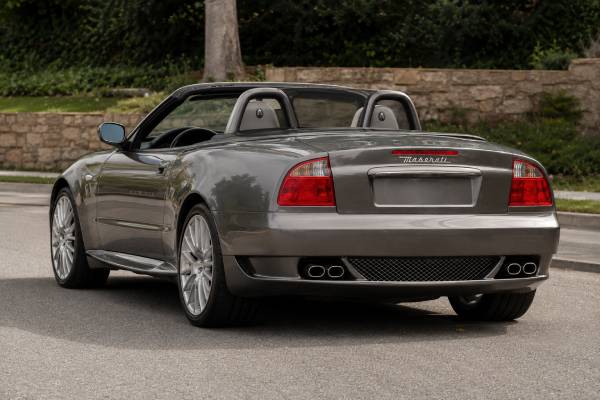
Behind the occupants, fixed rollover hoops provide protection and a strong visual break between cabin and rear deck. Anniversary-specific carbon fairings extend behind them, making the open car look more purposeful. These pieces are important during inspection because damage, ultraviolet degradation, poor refinishing, or substitution can be expensive to correct.
The roof folds under a flush cover, preserving the rear profile when open. It uses a hydraulic pump, cylinders, mechanical links, elastic tensioning elements, latches, and multiple switches. Packaging the system in a compact body leaves little room for error. Alignment problems can affect the seals, rear cover, and sequence, so forcing a stalled roof by hand can create further damage.
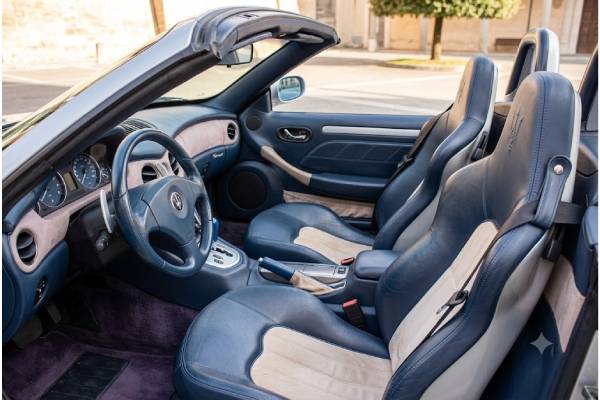
Inside, Maserati mixed traditional craftsmanship with early-2000s electronics. Leather extends across the dashboard and doors, an analog clock occupies a central position, and oval vents echo the grille. The Cambiocorsa selector area has buttons for forward, reverse, automatic operation, and driving modes rather than a conventional shift gate. Fixed paddles remain accessible as the steering wheel turns only through moderate angles, though tight urban maneuvers can make their position less intuitive.
The compact cabin suits two occupants but offers limited storage. The driving position places the pedals and steering wheel in a relationship that some drivers find slightly offset. Seat adjustment should be tested carefully, especially for taller owners, because roof-up headroom and rollover-hoop clearance can influence comfort.
A valve-controlled exhaust and the absence of a fixed roof make sound central to the design. In normal use the car can cruise without constant drone. Under load, particularly in Sport mode, the exhaust opens into a deeper and more urgent note. The soundtrack is not an added effect; it is a direct consequence of the cross-plane V8, short exhaust path, and open cabin.
Cambiocorsa Road Manners
A good Cambiocorsa Spyder feels alert, theatrical, and surprisingly fluid once the driver stops treating it like a conventional automatic. Smooth driving comes from anticipating each shift and managing the accelerator so the clutch can complete its work without fighting engine torque.
In ordinary traffic, select first gear positively and allow the clutch to engage with minimal creeping. Holding the car on a hill with throttle overheats the clutch; use the brake instead. Repeated parking maneuvers, reversing uphill, or inching through congestion create more wear than steady open-road mileage.
During an upshift, a small lift of the accelerator reduces head movement and driveline shock. In Sport mode at higher engine speed and throttle opening, the system shifts faster and can feel much more decisive. Low-speed automatic mode is convenient in theory but often produces less predictable clutch use than thoughtful manual paddle control.
The V8 is flexible below 4,000 rpm and exciting above it. Throttle response is immediate compared with a turbocharged engine, and the power builds without a sudden step. Keeping the engine in its middle range makes the car rapid and relaxed; using the final third of the tachometer turns it into a much louder, harder-edged machine.
Steering is quick and moderately weighted, with useful information through the rim. The rear transaxle helps the front end respond willingly, while the limited-slip differential provides traction on corner exit. The short wheelbase also means the car reacts quickly to poor inputs. Stability control is valuable on wet roads, and old tires can make the rear break away more abruptly than the power figure suggests.
The structure is not as rigid as a modern aluminum or carbon convertible. Some shake through the steering column and windscreen frame can appear over broken pavement. Excessive rattles, diagonal movement, or a vague rear end are not characteristics to accept without inspection; they may indicate worn suspension, loose bracing, collision repair, or tired body hardware.
With Skyhook in its softer mode, the Spyder covers uneven roads with reasonable compliance. Sport firms the damping and changes transmission and stability-control behavior. The best setting depends on surface quality. A harsh car may have incorrect replacement dampers, overinflated tires, seized joints, or aged rubber rather than “race-bred” suspension.
The steel brakes are progressive and adequate for enthusiastic road use. Fresh fluid and quality pads are essential before mountain driving. Owners planning circuit use should remember that the convertible’s weight, road pads, and cooling were not designed for endless high-speed laps.
Clutch, Roof, and Service Reality
Ownership success depends on preventive work and correct diagnosis. The Cambiocorsa clutch and hydraulic system receive the most attention, but cooling, roof operation, adaptive dampers, electrical voltage, and age-related trim can produce equally significant bills.
Cambiocorsa health
A specialist diagnostic scan should report clutch wear or remaining life, clutch engagement parameters, stored transmission errors, and pump behavior. The displayed wear percentage is an estimate derived from calibration, not a direct measurement of friction material. Treat it alongside shift quality, service history, and physical symptoms.
Listen when the driver’s door opens: the pump often primes the system. Very frequent cycling can suggest a weak accumulator, internal pressure loss, or another hydraulic problem. Delayed selection, flashing gear indicators, neutral appearing unexpectedly, harsh engagement, or refusal to select reverse require investigation.
Clutch life varies enormously. Open-road use with clean paddle shifts can be gentle; city crawling and steep reversing can consume it quickly. When replacement becomes necessary, inspect the release bearing, flywheel surface, seals, actuator setup, and related hardware. Correct post-installation calibration is as important as the parts themselves.
Engine and thermal systems
Look for oil around cam covers, front covers, dry-sump pipes, and tank connections. Check service invoices for the correct oil quantity and procedure. The engine should start promptly, idle evenly, and pull without misfire. Smoke after long idling, persistent tapping, low oil-pressure warnings, or metallic debris in service records deserve expert analysis.
Inspect radiators and air-conditioning condensers through the front openings. Leaves and road debris can trap moisture and restrict airflow. Verify both fans, the thermostat, relays, expansion tank, cap, and hoses. A car that maintains temperature at speed but heats in traffic often has an airflow or fan-control problem.
Catalysts, oxygen sensors, exhaust joints, and manifolds age under substantial heat. Warning lamps may also arise from ignition coils, plugs, air leaks, or low voltage. Read fault memory and check whether emissions readiness monitors have completed after any code clearing.
Convertible and chassis concerns
Run the roof from fully closed to fully open and back several times. Watch the cover, fabric folds, rear window, latches, and side-glass sealing. Hydraulic seepage, tired straps, microswitch faults, and low pump pressure can interrupt the cycle. Inspect carpets and electronic areas for moisture caused by blocked drains or failed seals.
Lift the car to examine ball joints, control-arm bushes, anti-roll-bar links, steering ends, wheel bearings, dampers, brake hoses, discs, exhaust mounts, and underbody impact damage. Skyhook warning lights and leaking dampers should be costed before purchase. Uneven tire wear can reveal poor alignment or worn joints.
Cabin problems are often visible but labor intensive. Soft-touch coatings become sticky, leather shrinks near vents and the passenger airbag, and headlining or trim adhesive can release. Test windows, seat motors, climate control, central locking, alarm, parking sensors, instruments, and every roof-related switch.
A strong battery and correct charging voltage are basic maintenance items. These cars can produce multiple spurious warnings after low voltage. Keep the battery supported during storage, but do not use a charger to mask an aging battery or unexplained parasitic drain.
Inspection and Purchase Strategy
The safest purchase is a correctly identified anniversary car with recent use, detailed invoices, and no deferred major systems. Mileage should influence value less than mechanical evidence, because a dormant low-mileage car may need more recommissioning than a regularly driven example.
First verify what is being sold. Match the VIN on the body, documents, and diagnostic report. Confirm original paint and trim codes, transmission designation, anniversary equipment, and first market. Ask for documentary support if the seller quotes a build number or claims an especially rare allocation.
A thorough inspection should include:
- A cold start followed by a fully warm road test and hot restart.
- Complete diagnostic scans before and after driving.
- Cambiocorsa pressure, pump, clutch, and calibration assessment.
- Repeated roof cycles and a search for water ingress.
- Cooling-system function in traffic and after hard use.
- Lift inspection of suspension, steering, brakes, leaks, underbody, and exhaust.
- Paint-depth readings and close examination of carbon anniversary parts.
- Date-code checks on tires, battery, belts, hoses, and service fluids.
During the drive, use every forward gear and reverse. The car should engage promptly, shift consistently, track straight, brake without vibration, and hold temperature. Test both normal and Sport modes. A single smooth demonstration on a flat road is not enough to reveal hill-start behavior, hot hydraulic faults, or worn suspension.
Set aside a repair reserve after purchase. Even a sound car may need baseline fluids, tires, alignment, battery, sticky-control refinishing, and small roof adjustments. A clutch service, hydraulic actuator problem, set of adaptive dampers, cooling-system overhaul, or catalyst replacement can each be substantial.
Collector value depends on originality, but safety and function come first. Properly matched modern tires, improved relays, reversible audio connectivity, or carefully sourced replacement dampers can make sense. Keep original components and record every change. Avoid improvisation in the transmission wiring, roof hydraulics, or emissions systems.
The ideal owner understands the car’s rhythm. It should not be left unused for months, driven only in congested traffic, or launched repeatedly for entertainment. Regular heat cycles, open-road mileage, a maintained battery, annual inspection, and prompt attention to small leaks preserve the systems better.
A verified Spyder Cambiocorsa 90th Anniversary offers a rare blend of commemorative detail and early paddle-shift drama. It is neither a modern automatic nor a carefree roadster, but a well-sorted example rewards mechanical sympathy with direct steering, open-air V8 sound, and a strong sense of occasion.
References
- Model Spyder – Gran Turismo models | Maserati (Maserati Classic)
- 2004 Maserati Spyder 90th Anniversary 2004
- Maserati Spyder 90th Anniversary (2004) – pictures, information & specs 2004
- Receive the Certification of Authenticity for your car | Maserati (Maserati Classiche)
Disclaimer
This article is for informational purposes only and does not replace professional diagnosis, inspection, or repair. Specifications, torque values, maintenance intervals, procedures, and equipment differ by VIN, market, and build date; confirm them in the vehicle’s official service documentation. Please share this article on Facebook, X/Twitter, or another enthusiast platform if you found it useful.