

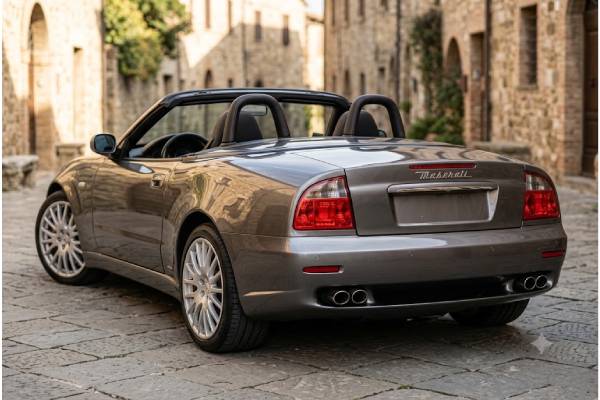
The Maserati Spyder Cambiocorsa was the open car that brought the Trident back to the United States and introduced a new generation of naturally aspirated V8 road cars. Launched in 2001, the two-seat M138 combined Giugiaro styling, a compact 2,440 mm wheelbase, a powered fabric roof, and a 390 hp 4.2-liter engine with paddle-operated single-clutch transmission. It feels more intimate and reactive than the related four-seat Coupé, but its character depends heavily on condition and driver technique. Cambiocorsa is not a conventional automatic: hydraulic hardware operates a dry clutch and six-speed transaxle, so creeping and poor calibration accelerate wear. The roof adds another network of pumps, cylinders, switches, and seals that must work correctly. Well-kept cars deliver immediate throttle response, direct steering, and one of the most memorable V8 soundtracks of the early 2000s. Cheap, neglected examples can require simultaneous transmission, cooling, suspension, roof, and interior work, making a specialist inspection essential.
Table of Contents
- Maserati’s Returning Open Tourer
- Engine, Transaxle, and Dimensions
- Model Years, Options, and Editions
- Compact Body and Paddle-Shift Engineering
- Everyday and Fast-Road Behavior
- Ownership Faults and Service Needs
- Selecting a Sound Cambiocorsa Spyder
Maserati’s Returning Open Tourer
The Spyder Cambiocorsa is historically important because it began Maserati’s modern comeback in a form that was both glamorous and technically ambitious. It debuted before the M138 Coupé and became the first new Maserati sold officially in the United States after a long absence.
Its name revived a traditional Maserati body style, but the underlying car broke with the recent past. The preceding 3200 GT used a twin-turbo V8 and a conventional gearbox near the engine. The Spyder introduced the Ferrari-associated F136 R V8, dry-sump lubrication, a torque tube, and a rear transaxle. The change replaced turbocharged thrust with linear response and moved driveline mass toward the rear.
Italdesign, led by Giorgetto Giugiaro, created the body. The Spyder is not merely a Coupé with its roof removed. Its wheelbase is 220 mm shorter, it has only two seats, and its rear structure accommodates a folding fabric top. Those changes make it look compact and give it quicker reactions, although they also reduce luggage space and structural rigidity.
Cambiocorsa was central to the sales pitch. Fixed paddles behind the steering wheel let the driver request shifts without operating a clutch pedal. For the period, the system felt exotic and connected Maserati’s road cars with racing-derived technology. By modern standards, its torque interruption and low-speed manner are obvious. Understanding that behavior is the difference between enjoying the car and fighting it.
Across its 2001–2007 production life, the Spyder gained detail improvements, updated software, revised equipment, and special versions. The core formula remained consistent: 390 hp, rear-wheel drive, double-wishbone suspension, steel brakes, and a power roof. Maserati records list 3,889 Spyders of all versions, making the model uncommon but not so scarce that buyers must accept the first available car.
The Spyder’s current appeal is broader than its performance figures. It offers a small footprint, hydraulic steering, naturally aspirated response, leather-rich craftsmanship, and open-air sound. It also comes from a period when exotic-car electronics were becoming complex without yet being fully integrated or inexpensive to diagnose. That mix creates both its charm and its ownership risk.
A healthy car can serve as a weekend tourer, a scenic-route companion, or an occasional long-distance machine. It is less suited to dense stop-start commuting because repeated clutch slip is costly. Owners who use it on open roads and maintain it by time rather than mileage generally experience the model at its best.
Engine, Transaxle, and Dimensions
The Spyder Cambiocorsa’s defining hardware is a front-mounted 4.2-liter V8 connected to a rear six-speed transaxle. This layout gives the open Maserati balanced handling and strong performance, while the short wheelbase makes it more responsive than the longer Coupé.
| Category | Data |
|---|---|
| Production years | 2001–2007 |
| Model code | M138 |
| Engine code | F136 R |
| Engine type | 90-degree, naturally aspirated V8 |
| Displacement | 4,244 cc |
| Bore and stroke | 92 mm × 80 mm |
| Valve train | DOHC, 32 valves, variable intake timing |
| Lubrication | Dry sump |
| Maximum power | 390 hp at 7,000 rpm |
| Maximum torque | 451 Nm at 4,500 rpm |
| Gearbox | Six-speed Cambiocorsa electrohydraulic automated manual |
| Final drive | Rear transaxle with limited-slip differential |
| Suspension | Independent double wishbones front and rear |
| Damping | Conventional or Skyhook electronically controlled dampers, depending on specification |
| Brakes | Ventilated steel discs, about 330 mm front and 310 mm rear |
| Tires | 235/40 ZR18 front; 265/35 ZR18 rear |
| Wheelbase | 2,440 mm |
| Length | 4,303 mm |
| Width | 1,822 mm |
| Height | Approximately 1,305 mm |
| Official dry weight | Approximately 1,630 kg |
| Top speed | Approximately 285 km/h |
| 0–100 km/h | Roughly 5.0 seconds |
The F136 R uses aluminum for its block and heads. A cross-plane crankshaft gives the engine its deep exhaust cadence, while four overhead camshafts operate four valves per cylinder. Variable timing on the intake side improves flexibility. The engine is chain driven, so it does not have a routine timing-belt replacement, but that does not eliminate the need to inspect auxiliary belts, tensioners, seals, and oiling components.
Dry-sump lubrication stores oil in a separate reservoir. The system protects oil supply under cornering and allows a shallower lower engine profile. It also holds a large oil quantity and requires the level to be checked at the specified temperature and running condition. A careless cold reading can lead to overfilling.
The Cambiocorsa gearbox is mechanically related to the manual six-speed transaxle. An electrohydraulic actuator replaces the driver’s hand and left foot. An electric pump generates pressure, an accumulator smooths demand, and a control unit manages clutch movement and gear selection. The clutch is a wear item, not a fluid coupling.
Weight distribution benefits from putting the gearbox at the rear. The steering therefore feels less nose-heavy than the engine’s location might suggest. A limited-slip differential helps the rear tires apply torque, but it can also reveal tire mismatch or worn mounts through abrupt behavior.
Period road tests produced varying acceleration figures, with some 0–60 mph runs in the high-four-second range. The practical benchmark is consistent performance rather than a launch number. A car that hesitates, flares engine speed between shifts, or loses gear under load needs diagnosis.
Model Years, Options, and Editions
The basic Spyder Cambiocorsa changed gradually rather than through one complete mid-cycle redesign. Buyers should identify the actual build date, market specification, software level, and option content instead of relying only on the year printed on the registration document.
Early cars established the 390 hp engine and paddle-shift format. Later production benefited from factory updates, service campaigns, and improved calibrations applied during maintenance. Changes can include transmission software, interior electronics, trim, wheel finishes, and option packaging. Not every market received equipment at the same time.
Skyhook adaptive damping was one of the most significant options. Its control unit varies damper force using body-motion sensors. Cars without it are mechanically simpler, while functioning Skyhook cars offer a broader comfort-to-control range. Replacement cost and parts availability should influence the value of a car showing suspension warnings.
Other equipment commonly encountered includes xenon lamps, power seats, leather in many colors, navigation and audio systems, rear parking assistance, wind deflectors, heated seats in some markets, and multiple wheel or brake-caliper finishes. Maserati’s personalization culture means two apparently similar Spyders may have very different cabins.
The 90th Anniversary Spyder is the most recognizable special series. It is associated in many markets with Blu Anniversary paint, gray lamp surrounds, carbon fairings behind the rollover hoops, titanium-tone calipers, and specific interior trim. Regional anniversary packages may differ, so documentation is required before paying a premium.
Some cars have been updated with GranSport-style wheels, exhausts, grilles, or interior pieces. These modifications can be attractive, but they do not turn a standard Spyder into a GranSport Spyder. The later model used a 400 hp F136 RB engine, different transmission calibration, 19-inch wheels, and broader chassis and aerodynamic changes.
How to identify the original configuration
Use the VIN, factory build information, original invoice, option-code data, paint label, trim label, and early service records. Check whether the current wheels, caliper color, audio system, exhaust, and upholstery match the delivered specification. A consistent car is easier to value and usually easier to resell.
Production totals should also be interpreted carefully. Maserati’s 3,889 figure covers all M138 Spyder versions rather than only Cambiocorsa cars. Market-specific registrations may use different model-year boundaries. Claims such as “one of only a few” should be supported by a defined market and reliable records.
Compact Body and Paddle-Shift Engineering
The Spyder’s most distinctive engineering decision is the combination of a shortened chassis and rear transaxle beneath a fully powered convertible body. This makes the car visually compact and dynamically lively, but it also concentrates service-sensitive systems in a small package.
Giugiaro’s design uses an oval Maserati grille, a low bonnet, gently swollen fenders, and a short rounded tail. Conventional rear lamps replaced the boomerang LEDs of the 3200 GT. The shape is restrained, with few decorative lines, so poor panel alignment or mismatched paint is easy to notice.
The roof folds beneath a body-colored tonneau panel. Its sequence depends on latches, position switches, elastic straps, hydraulic pressure, and correct window operation. The system should move smoothly without the owner pushing the frame or pulling fabric away from a hinge. A roof that works only when assisted is already faulty.
The steel body uses front and rear subframes. Removing the fixed roof inevitably reduces torsional stiffness, and the Spyder can show mild steering-column shake over rough roads. That does not make severe rattles, door movement, or an unsettled rear structure normal. Worn braces, suspension components, roof fittings, or crash repairs can amplify movement.
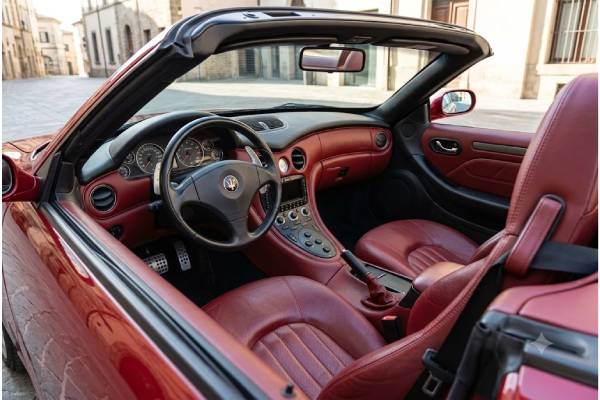
Inside, the car mixes traditional materials with period electronics. Leather covers large surfaces, oval instruments and vents echo the exterior, and the central analog clock supplies a classic focal point. Cambiocorsa controls occupy the console, while fixed paddles sit behind the steering wheel. Some drivers prefer fixed paddles because their position is always known; others find them less convenient in hairpins.
The exhaust system is designed to give the V8 a broad range of sound. Sport settings can alter valve behavior and transmission response on equipped cars. Aftermarket exhausts are common. A louder system may mask rattling catalysts, cracked joints, or poor low-speed calibration, so sound alone is not proof of health.
Cooling hardware sits low in the nose. Dirt and leaves collect between radiators and condensers, restricting airflow and encouraging corrosion. Front-end impact repair must preserve ducts and mounting positions. A cosmetically straight bumper can still conceal bent brackets or compromised heat exchangers.
Everyday and Fast-Road Behavior
The Spyder Cambiocorsa is most satisfying on flowing roads where the clutch is fully engaged and the driver can use the paddles deliberately. It is least comfortable in situations that demand repeated inching, reversing uphill, or abrupt low-speed changes of direction.
From rest, the clutch should take up progressively. The driver should release the brake, apply measured throttle, and let the system complete engagement rather than holding the car at a crawl. On a slope, the service brake or handbrake should support the car; balancing it on the clutch creates heat.
Upshifts become smoother when the accelerator is relaxed slightly in normal driving. At higher revs and larger throttle openings, Sport mode commands quicker changes. Each shift still includes a clear break in torque. That pause is part of a single-clutch system and should not be confused with the continuous pull of a modern dual-clutch gearbox.
The V8 is the reward. It accepts low-rev cruising, develops strong middle-range torque, and becomes much more urgent as it approaches 7,000 rpm. Throttle response is immediate, making it easy to adjust the car’s line with small inputs. With the roof down, intake and exhaust sound fill the cabin without electronic enhancement.
The short wheelbase gives quick turn-in and a sense that the rear axle is close to the driver. Steering weight is natural, and the hydraulic rack sends useful surface information through the wheel. The car is not tiny in width, so accurate placement still matters on narrow roads.
Ride quality depends greatly on dampers and tires. Skyhook in its comfort setting can absorb broad undulations well, but short sharp bumps pass through the structure. A car that crashes over every imperfection may have failed dampers, seized bushes, oversized wheels, or excessive tire pressure.
Rear grip is strong on fresh matched tires. Cold, hardened, or mismatched rubber makes the chassis less predictable, especially in rain. Stability control is valuable because the combination of instant throttle response and a short wheelbase can produce a quick slide.
The brakes have good pedal progression and adequate thermal capacity for road driving. A long pedal, steering shake, or pull under braking is not normal. Fluid age, disc condition, caliper movement, wheel balance, and suspension play all affect the result.
On the motorway, the car is stable and the engine relaxed in sixth gear. Roof-up wind noise and limited rear visibility remind the driver of its age. Around town, a low nose, wide doors, dated parking aids, and the transmission’s dislike of creeping demand concentration. As a weekend car, these compromises become part of its personality rather than daily irritation.
Ownership Faults and Service Needs
The main ownership lesson is that several medium-size faults can cost more than one dramatic failure. A car needing a clutch, roof repair, suspension refresh, tires, sticky-button restoration, and cooling work can absorb a large budget even if its engine is healthy.
Cambiocorsa system
Have a specialist read clutch wear parameters, engagement position, hydraulic pressure, pump cycling, stored errors, and adaptation values. The wear percentage is calculated from setup data and can be misleading after poor calibration. Combine it with invoices, driving symptoms, and physical inspection.
A pump that runs very often may indicate a weak accumulator or pressure loss. Slow engagement, flashing gear display, unexpected neutral, inconsistent reverse, or harsh hot shifts point to problems involving the pump, relay, actuator, sensors, clutch, or electrical supply.
Clutch life varies with use. Open-road mileage can be relatively kind, while parking ramps and congested city driving can be destructive. When replacing the clutch, assess the flywheel, release bearing, seals, mounts, and torque-tube-related components. Calibration after assembly is mandatory.
Engine and cooling
Oil can seep from cam covers, front covers, dry-sump lines, and reservoir connections. Inspect the underside after a full warm-up. Ask how the oil level was checked and what product was used. Regular service is more important than very low annual mileage.
Cooling concerns include blocked radiator fins, weak fans, failed relays, thermostat issues, brittle expansion tanks, old hoses, and coolant leaks. Watch temperature in traffic with the air conditioning operating. Repeated overheating can affect head gaskets, catalysts, wiring, and surrounding plastics.
Ignition coils, spark plugs, oxygen sensors, airflow faults, and catalysts can trigger misfires or warning lamps. A scan should include pending codes and emissions readiness. Recently erased fault memory without completed monitors deserves explanation.
Roof, chassis, and cabin
Cycle the roof repeatedly and inspect hydraulic cylinders, pump area, fabric, rear window, latches, straps, drains, and seals. Damp carpet, a musty odor, corroded connectors, or fogged lamps suggest water entry. Roof adjustment should be handled by someone familiar with the sequence.
Check Skyhook dampers for leaks and warnings. Ball joints, control-arm bushes, anti-roll-bar links, tie rods, mounts, and wheel bearings wear with age. A lift inspection is necessary because road noise can hide play. Bent 18-inch wheels and old tires are common after years of urban use.
Soft-touch coatings become sticky, leather shrinks near vents and airbags, window regulators slow, and seat motors or climate controls may fail. Test every switch. Battery voltage should be stable before concluding that multiple control modules are defective.
Time-based maintenance should include brake fluid, coolant, transmission and differential oils, filters, belts, battery assessment, tire age, and rubber hoses. Cars stored for winter benefit from a proper maintainer, dry surroundings, and periodic full-temperature use rather than short starts.
Selecting a Sound Cambiocorsa Spyder
Buy on evidence of care, not on odometer reading or polished paint. A regularly exercised 60,000-mile car with a recent clutch, cooling overhaul, and suspension work can be safer than a 15,000-mile example sitting on original tires and old hydraulic components.
Before viewing, request the VIN, service invoices, clutch history, roof repairs, accident information, and current warning-light status. Ask for photographs of the underbody, roof storage area, tire date codes, engine bay, and dashboard with the ignition on.
Use an M138 specialist for the pre-purchase inspection. The minimum scope should include:
- Full-module diagnostics and a printed Cambiocorsa data report.
- Cold start, warm road test, traffic-temperature check, and hot restart.
- Several complete roof cycles and moisture inspection.
- Lift examination of oil leaks, cooling hardware, suspension, brakes, wheels, and exhaust.
- Paint-depth measurement and structural checks around the nose, sills, and rear quarters.
- Verification of all electrical equipment, air conditioning, windows, seats, locks, and alarm.
- Review of tire age, battery health, fluids, belts, hoses, and recent invoices.
During the drive, test gentle and rapid shifts in both normal and Sport modes. Reverse on level ground and, where safe, on a mild incline. There should be no burning-clutch smell, delayed gear selection, or sudden fallback to neutral. Use firm acceleration in several gears and brake progressively from speed.
Estimate the first two years of work before agreeing on price. Baseline service, four quality tires, alignment, battery, interior refinishing, and small leaks are common. Larger contingencies include a clutch, hydraulic actuator, Skyhook dampers, catalysts, radiator work, and roof cylinders.
Originality matters, but upgrades can be sensible when they are documented and reversible. Modern audio connectivity, improved relay solutions, or serviceable replacement dampers may increase usability. Avoid hacked wiring, generic wheels, deleted emissions hardware, or roof modifications that leave future specialists guessing.
A sound Spyder Cambiocorsa should feel cohesive: clean gear engagement, stable temperature, tight steering, a smooth roof cycle, dry carpets, and a strong engine. When those systems agree, the car offers an experience that newer convertibles rarely duplicate—compact proportions, open-air V8 sound, and early paddle-shift involvement without excessive speed being necessary.
References
- Model Spyder – Gran Turismo models | Maserati (Maserati Classic)
- 2002 Maserati Spyder Cambiocorsa Tested, the Brand’s Comeback Car 2002
- Maserati Spyder – First Drive – Motor Trend 2001
- Receive the Certification of Authenticity for your car | Maserati (Maserati Classiche)
Disclaimer
This article is provided for informational purposes and does not replace professional diagnosis, inspection, or repair. Specifications, torque values, procedures, equipment, and service intervals can differ by VIN, production date, and market; verify them with the official service information for the specific vehicle. Please share this guide on Facebook, X/Twitter, or another automotive community if it helped you.