

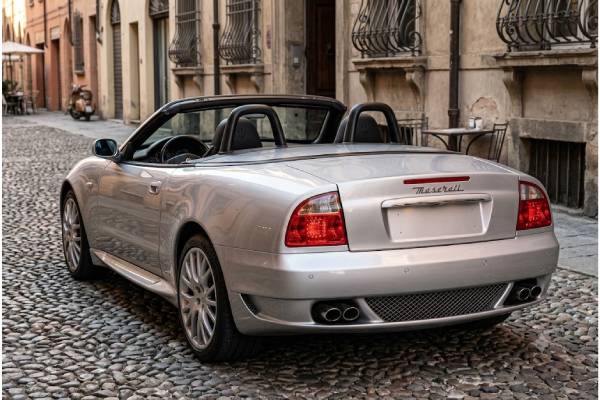
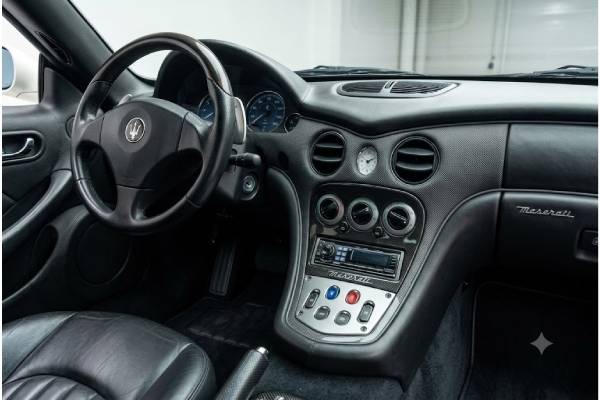
The Maserati Spyder GT is the three-pedal version of the compact M138 roadster and one of the most direct modern Maseratis. Its 4.2-liter F136 R V8 sends 390 hp through a conventional six-speed manual transaxle, while a shortened two-seat chassis and powered fabric roof create a very different experience from the related Coupé. The GT avoids the hydraulic pump, actuator, and software behavior of the Cambiocorsa model, but it is not mechanically simple. Clutch replacement remains labor intensive, gearbox synchronizers and linkage can wear, the roof has its own hydraulic and electrical sequence, and aging Skyhook suspension can be expensive. What makes the car special is the blend of open-air V8 sound, hydraulic steering, rear-transaxle balance, and a manual shift that asks the driver to set the rhythm. The best examples feel compact, supple, and alive. Poor ones feel loose, hot, heavy-clutched, and electrically temperamental, so history and specialist inspection matter more than a low advertised price.
Table of Contents
- A Three-Pedal Maserati Roadster
- Manual V8 Specification
- Production Development and Options
- Short-Wheelbase Design
- The Manual Driving Experience
- Mechanical and Convertible Care
- Buying the Best Spyder GT
A Three-Pedal Maserati Roadster
The Spyder GT’s main distinction is its conventional clutch pedal and manual gear lever. That hardware turns the M138 into a more traditional driver’s car and makes it particularly appealing now that naturally aspirated V8 convertibles with manual transmissions have become rare.
Maserati revealed the Spyder in 2001 as the first model in the company’s new Ferrari-influenced era. It also carried the brand back into the United States after years away. Although its appearance resembles the later Coupé, the Spyder came first and uses a much shorter wheelbase with only two seats.
The “GT” suffix separates the manual car from the Cambiocorsa. Both versions share the same basic six-speed rear transaxle, but the GT relies on the driver’s foot and hand rather than an electrohydraulic actuator. That change removes several expensive electronic-hydraulic components and gives the driver direct control over clutch slip. It does not remove the clutch, flywheel, release system, torque tube, gearbox, or differential from the maintenance equation.
Giorgetto Giugiaro and Italdesign shaped the body. The proportions are compact: a longish bonnet, cabin pushed rearward, short tail, and folding roof hidden beneath a rigid cover. The result looks more like a purpose-designed roadster than a roofless four-seat grand tourer.
The model’s historical value comes from its transition between two Maserati identities. It left behind the 3200 GT’s twin-turbo engine and introduced the naturally aspirated F136 family that would define Maserati road cars for years. It also retained features that later cars gradually lost, including hydraulic steering, a small body, and a manual transmission option.
For current buyers, the GT has several advantages. It is easier to understand at low speed than Cambiocorsa, it cannot consume its clutch through automated creeping logic, and its resale audience includes dedicated manual enthusiasts. Its disadvantages are a relatively heavy pedal, a shift action that may feel deliberate rather than delicate, and the possibility that scarce manual-specific parts or worn synchronizers will require specialist work.
The car works best as an actively used touring roadster. Regular open-road miles keep seals exercised, fluids hot, and controls moving through their full travel. Repeated short starts or years of storage can create more age-related work than a higher-mileage car with continuous care.
Manual V8 Specification
The Spyder GT combines the 390 hp F136 R V8 with a six-speed manual transaxle and rear-wheel drive. Its official performance is close to the Cambiocorsa model, but the driver’s clutch technique has a greater effect on acceleration and smoothness.
| Item | Specification |
|---|---|
| Production period | 2001–2007 |
| Platform | M138 |
| Engine code | F136 R |
| Engine configuration | 90-degree naturally aspirated V8 |
| Capacity | 4,244 cc |
| Bore × stroke | 92 mm × 80 mm |
| Construction | Aluminum block and cylinder heads |
| Valve system | DOHC, 32 valves, variable intake timing |
| Oil system | Dry sump |
| Power | 390 hp at 7,000 rpm |
| Torque | 451 Nm at 4,500 rpm |
| Transmission | Six-speed manual rear transaxle |
| Differential | Limited slip |
| Body | Steel load-bearing structure with subframes |
| Suspension | Double wishbone front and rear |
| Dampers | Fixed-rate or optional Skyhook adaptive units |
| Brakes | Ventilated steel discs with four-piston front calipers |
| Standard tire sizes | 235/40 ZR18 front; 265/35 ZR18 rear |
| Wheelbase | 2,440 mm |
| Length | 4,303 mm |
| Width | 1,822 mm |
| Dry weight | Approximately 1,620 kg |
| Top speed | Approximately 285 km/h |
| 0–100 km/h | About 5.0 seconds |
The V8 uses no turbochargers and responds immediately to accelerator movement. Its cross-plane crankshaft gives the exhaust a deep pulse, while the short-stroke dimensions encourage revs. Maximum power arrives at 7,000 rpm, but the engine does not need constant high-speed use because its torque peak sits at 4,500 rpm.
The oil system is more sophisticated than a normal wet sump. A separate tank and scavenge pumps circulate a large oil quantity. This improves oil control during cornering and helps package the engine low, yet it makes correct level checks and leak inspection essential. Dry-sump hoses and joints are expensive places to ignore seepage.
The manual gearbox sits at the rear with the differential. A torque tube carries drive from the engine and ties the powertrain together. This architecture improves mass distribution and steering response, but clutch access is not as straightforward as on a common front-engine, front-gearbox car.
Pedal effort should be firm but consistent. A clutch that engages at an extreme point, slips under high load, judders when warm, or returns slowly may have disc, pressure-plate, release-bearing, flywheel, or hydraulic issues. The shift lever should select every gear cleanly after the oil is warm. Some cold stiffness can be characteristic; persistent crunching is not.
The suspension geometry gives accurate wheel control, and the optional Skyhook system varies damping according to sensor input. Standard dampers appeal to owners who favor simplicity, while Skyhook can produce better touring comfort and body control when it is functioning properly.
Published acceleration depends heavily on launch technique. Abusing the clutch to match a magazine figure is not useful on a collectible roadster. Strong, clean acceleration once fully engaged is a better health test.
Production Development and Options
The Spyder GT was produced throughout the M138 Spyder’s 2001–2007 life, though manual cars are less common than Cambiocorsa examples in many markets. Exact annual transmission splits are not consistently published, so individual documentation carries more weight than broad rarity claims.
Early cars introduced the key mechanical package and the first generation of interior electronics. Later examples may have revised software, updated components, different trim combinations, and factory or dealer improvements applied during servicing. Model-year registration can differ from build date, especially for low-volume imports.
Maserati offered a wide palette of paint, leather, carpets, stitching, roof colors, wheel finishes, and caliper colors. Buyers could also specify equipment such as:
- Skyhook electronically adjustable damping.
- Xenon headlamps.
- Power and heated seating, depending on market.
- Navigation and premium audio systems.
- Rear parking sensors.
- Wind deflector and touring accessories.
- Contrasting piping, dashboard leather, and personalized interior trim.
The manual GT also appeared within anniversary-related programs. The 90th Anniversary Spyder was offered in manual form in some markets, with special color and trim. Australia received a regional anniversary program that did not necessarily match the Blu Anniversary specification seen elsewhere. Any special-edition claim should be checked against factory data.
Because the GT is now sought for its transmission, some ordinary cars have received badges, wheels, or trim from rarer derivatives. A manual conversion from Cambiocorsa would be complex because pedals, hydraulics, controls, wiring, coding, and interior components differ. A buyer should not pay a factory-manual premium without VIN and build confirmation.
Originality versus useful upgrades
A completely original car has strong collector appeal, but some updates can improve regular use. Modern tire compounds in factory sizes, a concealed audio interface, improved battery support, and carefully documented replacement dampers are reasonable. Poorly spliced wiring, nonstandard wheel offsets, excessively loud exhausts, and cut interior panels reduce confidence.
Keep removed original parts. A period navigation unit may be outdated, yet retaining it preserves the dashboard’s correct appearance. Reversible changes are easier to accept and easier for a future owner to undo.
Maserati’s total of 3,889 Spyders includes both transmissions and special versions. That number makes the body style uncommon, while the manual subset is scarcer. Condition still determines value more reliably than an unsupported production claim.
Short-Wheelbase Design
The Spyder’s 2,440 mm wheelbase defines both its appearance and its handling. It is significantly shorter than the Coupé, giving the car a compact cabin, quick reactions, and a roof package designed around two occupants rather than four.
The front view centers on Maserati’s oval grille and Trident. The bonnet sits low between rounded fenders, and the side surfaces use simple curves instead of heavy creases. At the rear, conventional lamps and a neat deck create a restrained finish. The design has aged well because it depends on proportion rather than decoration.
The powered fabric roof folds behind the seats under a solid cover. When down, it leaves a clean beltline and exposes the twin rollover hoops. When raised, it provides reasonable weather protection but restricts rear visibility. The fabric, frame, seals, hydraulic cylinders, pump, microswitches, tension straps, latches, windows, and cover all need to complete a timed sequence.
The body is made primarily from steel and reinforced to compensate for the absent fixed roof. Some flex over broken surfaces is inherent, but a good car does not feel as though the front and rear halves are moving independently. Door fit, windscreen movement, underbody bracing, and prior structural repair should be examined if shake seems excessive.
The cockpit uses leather generously. The instrument binnacle, oval vents, analog clock, and flowing console give the cabin a handcrafted atmosphere. Age can expose the limits of the materials: leather shrinks around vents and airbags, adhesives release, and soft-touch coatings become sticky.
Manual controls simplify the center console compared with the Cambiocorsa car. The gear lever sits naturally to hand, and the clutch pedal completes a traditional sports-car layout. Pedal spacing supports heel-and-toe downshifts for many drivers, though the footwell and seating relationship should be tested because body size and driving position can affect comfort.
The rear transaxle shapes the tunnel and luggage space. The boot is adequate for soft weekend bags rather than large cases. Owners planning tours should test the actual luggage they intend to carry, especially when a wind deflector or tool kit occupies space.
Cooling airflow passes through low-mounted front heat exchangers. Their position makes them vulnerable to debris, corrosion, and impact. Correct ducting after bumper repair is important because poor airflow can cause temperature problems that are mistakenly blamed on the engine.
The Manual Driving Experience
The GT’s three-pedal control gives the driver a continuous role in every phase of the journey. The car is not effortless, but its weight, clutch, steering, and engine response combine into a satisfying rhythm when the mechanical systems are healthy.
Starting from rest requires a little throttle and a measured clutch release. The engine’s rotating character makes it less likely to surge than a turbocharged unit, yet the clutch is not especially light. A clean car should move away without chatter or driveline clunk.
The shift action has a solid, mechanical feel. It may not be as short or delicate as a lightweight sports car’s, but it should be positive. Second gear often reveals wear first. Test it cold and hot, during gentle selection and a faster shift. Grinding, blocking, or lever movement under load needs specialist assessment.
The engine can cruise quietly below 3,000 rpm, making the Spyder usable on long routes. From the middle range, throttle response is crisp and torque builds evenly. Near the red line, the sound becomes harder and the acceleration stronger. Choosing the shift point personally makes the upper range more rewarding than in an automated car.
Hydraulic steering adds texture. The front end turns readily because the gearbox mass is behind the driver rather than next to the engine. The short wheelbase makes direction changes quick and gives the rear axle an immediate presence. Smooth steering and progressive throttle are important, particularly on damp roads.
Skyhook cars offer a useful contrast between comfort and Sport settings. Comfort can work better on uneven roads because it lets the tires follow the surface. Sport reduces roll and pitch on smoother routes. A car that bounces after a bump or feels uncontrolled may have worn dampers, not an unsuitable mode.
The open roof magnifies the engine and exhaust. It also exposes the driver to wind, heat, and surrounding traffic, which can make moderate speeds feel more vivid. Roof-up refinement is acceptable for the era, but fabric noise and blind spots remain.
The brakes communicate clearly through a conventional hydraulic pedal. They should stop the car straight and repeatedly without vibration. Old fluid, uneven pad deposits, seized calipers, or worn front joints can all spoil confidence.
Urban use is possible, but the heavy clutch, low bumper, wide doors, and restricted rear visibility demand patience. The car is far more natural on a quiet road where second, third, and fourth gears can be used without constant stopping.
Mechanical and Convertible Care
The manual GT removes Cambiocorsa’s actuator system, yet ownership still requires specialist attention. The major cost areas are the clutch and transaxle, oil and cooling systems, roof mechanism, suspension, brakes, and age-related electronics.
Clutch, hydraulics, and gearbox
Check for slip by applying full throttle in a high gear at moderate rpm. Engine speed should not rise without matching road speed. Assess engagement for judder, noise, or a very high bite point. Inspect the clutch master and slave circuits for leakage and confirm that the pedal returns consistently.
Listen for release-bearing noise with the pedal down and driveline rattle during load changes. A clutch job should include inspection of the flywheel, pressure plate, bearing, seals, mounts, and related hardware. Labor is significant because of the transaxle arrangement.
Gear oil condition and correct specification matter. Worn synchros, linkage bushes, or mounts can each create poor shift quality. A general workshop may replace the wrong component if it has no experience with the torque-tube layout.
Engine and cooling system
The F136 R is durable when kept full of clean oil and protected from overheating. Look for leaks at cam covers, front covers, dry-sump lines, and reservoir fittings. Confirm how the oil level was measured. Persistent smoke, misfire, unusual tapping, or warning messages deserve diagnosis before purchase.
Clean the radiator and condenser faces and the space between them. Verify fan operation, relays, thermostat behavior, expansion tank integrity, cap condition, and hose age. The temperature gauge should remain stable in traffic and after a hard drive.
Spark plugs, ignition coils, oxygen sensors, catalysts, and intake leaks can cause warning lamps. Read current, pending, and historic codes. Incomplete emissions monitors may show that codes were cleared just before sale.
Roof, suspension, and interior
Operate the top several times. It should unlatch, fold, stow, raise, and seal without hand assistance. Inspect hydraulic fluid, cylinders, pump, fabric wear, rear window, straps, drains, and carpet moisture. A stalled roof can result from one sensor, but diagnosis may require tracing the entire sequence.
On a lift, inspect ball joints, control-arm bushes, anti-roll-bar links, tie rods, wheel bearings, damper bodies, brake hoses, and underbody bracing. Skyhook components should be checked for leaks and electronic faults. Tire date codes and matching models on both axles are critical for balanced handling.
Test every cabin function. Sticky switches, shrunken leather, slow windows, failed seat motors, weak air conditioning, alarm faults, and aged audio units are common. Battery health and alternator output should be established before replacing control modules.
Even low-mileage cars need annual inspection and time-based fluid service. Brake fluid, coolant, transmission and differential oils, filters, belts, and flexible hoses do not remain new because the odometer is still low.
Buying the Best Spyder GT
The strongest purchase is a manual car with uninterrupted history, recent exercise, and evidence that expensive age-related work has already been addressed. A low price rarely compensates for several neglected systems.
Confirm the car is a factory GT. Match VINs, review build data, inspect the pedal box and interior hardware, and check the original invoice. A seller’s description or a manual gear lever is not enough when conversions and replacement trim are possible.
Arrange a pre-purchase inspection with an M138 specialist. It should cover:
- Cold-start behavior, fluid leaks, smoke, and engine diagnostics.
- Clutch slip, pedal hydraulics, gearbox synchros, linkage, and driveline mounts.
- Cooling performance at idle, in traffic, and after load.
- Full roof operation and water-ingress inspection.
- Suspension, steering, wheel, tire, brake, and underbody condition on a lift.
- Paint-depth readings and checks for structural repair.
- Every electrical accessory, climate function, window, lock, and warning lamp.
- Service-history comparison against actual component condition.
Drive the car from cold until completely warm. Use every gear, test a high-load pull, brake firmly, cross uneven pavement, and restart it hot. A brief passenger ride chosen by the seller will not expose clutch, gearbox, temperature, or roof issues.
Build a realistic reserve. Baseline fluids, battery, tires, alignment, and cosmetic interior work are common first steps. A clutch and flywheel service, gearbox repair, adaptive dampers, cooling overhaul, catalytic converters, or roof hydraulics can be far more expensive.
Do not reject a car only because it has sensible reversible updates. An owner who fitted correct modern tires, documented suspension alternatives, and a discreet audio connection may have prioritized use. More serious concerns are missing records, improvised wiring, incorrect wheels, deleted emissions equipment, or a roof that was permanently disabled.
The manual Spyder GT rewards patience in both buying and driving. A properly sorted car feels unusual at any speed because it combines an open cabin, compact chassis, rear transaxle, free-revving V8, and a physical gear change. Those qualities make it one of the most engaging cars of Maserati’s early-2000s revival.
References
- Model Spyder – Gran Turismo models | Maserati (Maserati Classic)
- Maserati Spyder – First Drive – Motor Trend 2001
- 2002 Maserati Spyder Cambiocorsa Tested, the Brand’s Comeback Car 2002
- Receive the Certification of Authenticity for your car | Maserati (Maserati Classiche)
Disclaimer
This article is for informational purposes only and is not a substitute for professional inspection, diagnosis, or repair. Specifications, torque values, service intervals, procedures, and installed equipment can vary by VIN, production date, and market; verify them in the official service documentation for the individual vehicle. Please share this article on Facebook, X/Twitter, or your preferred enthusiast community if it proved useful.