
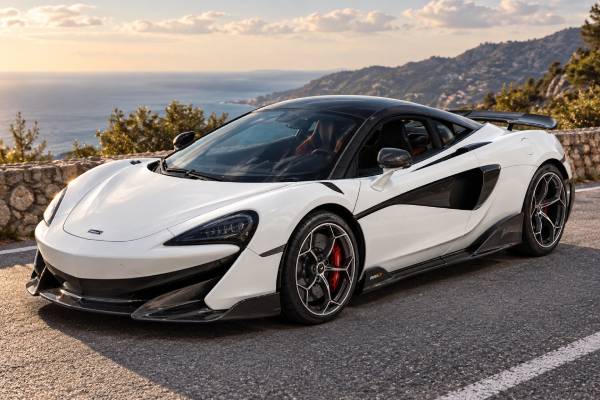
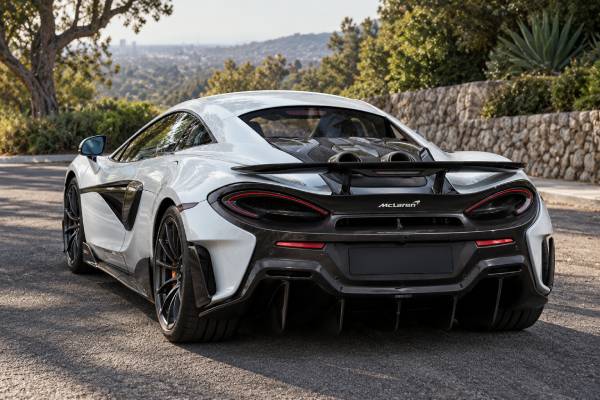
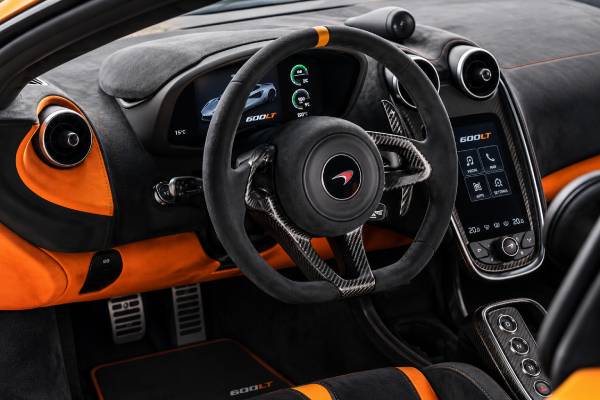
The McLaren 600LT Coupé is the Sports Series model for drivers who want less insulation and more precision, not simply more power. Its 3.8-liter twin-turbo V8 makes 600 PS (592 bhp), but the bigger story is the way McLaren cut mass, sharpened the chassis, added serious aerodynamic work, and moved the exhaust outlets to the top of the rear deck. The result is a road-legal car with a clear track bias and a minimum dry weight of just 1,247 kg (2,749 lb). It reaches 100 km/h in 2.9 seconds and 200 km/h in 8.2 seconds, yet those numbers explain only part of its appeal. For an owner or buyer, condition matters as much as specification: carbon-ceramic brakes, low ground clearance, track-oriented tires, heat exposure, battery care, and recall completion can all change the quality of a particular example. This guide covers the 2018–2019 600LT Coupé with practical attention to both engineering and ownership.
Table of Contents
- What Makes the 600LT a Longtail
- 600LT Coupé Technical Data
- Speed, Braking, and Driver Feel
- Lightweight Engineering, Aero, and Chassis
- Maintenance and Track-Use Priorities
- Recalls and Condition Checks
- How to Buy the Right 600LT Coupé
What Makes the 600LT a Longtail
The 600LT is not a 570S with a power upgrade; McLaren changed the car around the Longtail priorities of lower weight, greater downforce, faster responses, and stronger driver involvement. That distinction is important when deciding whether its compromises make sense for road use.
The Coupé uses the carbon-fiber MonoCell II structure shared with the Sports Series family, but the LT treatment changes the character around it. McLaren revised bodywork for aerodynamic performance, used lightweight components throughout the car, fitted a fixed rear wing, and created the highly visible top-exit exhaust system. The standard specification also reflects a more aggressive mission, with carbon-ceramic brakes and a chassis calibration aimed at harder driving.
The engine is the M838TE 3.8-liter twin-turbo V8 mounted longitudinally behind the cabin. Output rises to 600 PS, or 592 bhp, and 620 Nm (457 lb-ft). It drives only the rear wheels through McLaren’s seven-speed Seamless Shift Gearbox. An open differential works with Brake Steer, which can brake an inside rear wheel to help the car rotate rather than relying on a conventional mechanical limited-slip differential.
The power increase is useful, but mass reduction changes more than straight-line pace. A lighter car asks less of its brakes and tires during every acceleration, braking zone, and direction change. McLaren quoted a minimum dry weight of 1,247 kg when lightweight options are fitted, compared with a 1,261 kg base dry figure in the technical guide. The DIN kerb figure, which includes fluids and 90% fuel, is 1,356 kg. Buyers should therefore be cautious when comparing advertisements that use the word “weight” without stating which definition applies.
The same point applies to options. A heavily optioned car may be more desirable to one buyer but not necessarily the lightest possible specification. Carbon-fiber exterior parts, lightweight seats, air-conditioning deletion or retention, audio equipment, and wheel choices can affect both experience and collectability. The right specification is the one that matches how the car will actually be used.
For primarily road mileage, air conditioning, a nose-lift system, and a cabin specification you can tolerate for several hours may be more valuable than chasing the theoretical lightest build. For repeated circuit use, seat support, tire choice, brake condition, alignment, and evidence of careful heat-cycle management deserve more attention than decorative options.
600LT Coupé Technical Data
The 600LT Coupé is a conventional gasoline ICE supercar: a mid-mounted twin-turbo V8, seven-speed dual-clutch-style SSG, and rear-wheel drive with no hybrid system. Its engineering priorities are low mass, high thermal capacity, strong braking, and fast response rather than comfort or fuel economy.
| Specification | Value |
|---|---|
| Engine | M838TE 90-degree V8 |
| Displacement | 3,799 cc (3.8 L) |
| Induction | Twin turbochargers |
| Lubrication | Dry-sump |
| Maximum power | 600 PS (592 bhp / 441 kW) at 7,500 rpm |
| Maximum torque | 620 Nm (457 lb-ft) at 5,500–6,500 rpm |
| Maximum engine speed | 8,500 rpm |
| Transmission | 7-speed Seamless Shift Gearbox (SSG) |
| Drive layout | Longitudinal mid-engine, rear-wheel drive |
| Differential strategy | Open differential with Brake Steer |
| Measure | Official figure |
|---|---|
| 0–60 mph | 2.8 seconds |
| 0–100 km/h (0–62 mph) | 2.9 seconds |
| 0–200 km/h (0–124 mph) | 8.2 seconds |
| 0–300 km/h (0–186 mph) | 24.9 seconds |
| 400 m (quarter mile) | 10.4 seconds |
| Top speed | 328 km/h (204 mph) |
| 100–0 km/h braking | 31 m (102 ft) |
| 200–0 km/h braking | 117 m (384 ft) |
| Specification | Value or test standard |
|---|---|
| Minimum dry weight | 1,247 kg (2,749 lb), with lightweight options |
| Base dry weight | 1,261 kg (2,780 lb) |
| DIN kerb weight | 1,356 kg (2,989 lb), fluids plus 90% fuel |
| Weight distribution | 42.5% front / 57.5% rear |
| Fuel-tank capacity | 72 L (15.8 UK gal / 19.0 US gal) |
| WLTP combined fuel use | 12.2 L/100 km |
| WLTP combined CO₂ | 276–277 g/km, depending on published specification source |
| EPA fuel economy | 15 mpg city / 23 mpg highway / 18 mpg combined |
| Dimension | Value |
|---|---|
| Body style | 2-door fixed-roof Coupé |
| Length | 4,604 mm (181.3 in) |
| Width including mirrors | 2,095 mm (82.5 in) |
| Width with mirrors folded | 2,045 mm (80.5 in) |
| Height | 1,194 mm (47.0 in) |
| Wheelbase | 2,670 mm (105.1 in) |
| Front / rear overhang | 1,102 / 825 mm (43.4 / 32.5 in) |
| Ground clearance | 92 mm (3.6 in) |
| Turning circle | 12.1 m (39.7 ft) |
| Front luggage capacity | 150 L (5.3 cu ft) |
| Component | Factory specification |
|---|---|
| Structure | Carbon-fiber MonoCell II |
| Suspension | Independent double wishbones with adaptive dampers |
| Steering | Electro-hydraulic power assistance |
| Front brakes | 390 mm carbon-ceramic discs, 6-piston aluminum calipers |
| Rear brakes | 380 mm carbon-ceramic discs, 4-piston aluminum calipers |
| Front wheels | 19 × 8.0J |
| Rear wheels | 20 × 11.0J |
| Front tires | 225/35 R19 |
| Rear tires | 285/35 R20 |
| Item | McLaren guidance |
|---|---|
| Routine service interval | Every 15,000 km (10,000 mi) or 12 months, whichever comes first |
| Recommended engine oil viscosity | 0W-40 |
| Engine-oil capacity | 9.0 L |
| Recommended petrol | 98 RON / 88 MON unleaded meeting EN 228 |
| Minimum petrol if recommended grade is unavailable | 95 RON / 85 MON |
| Normal cold tire pressure | 2.0 bar (29 psi) front; 2.2 bar (32 psi) rear |
| Battery type | Lithium-ion; use a compatible lithium-ion charger |
Two specification details deserve context. First, McLaren documents from different dates can show 276 or 277 g/km for WLTP combined CO₂; this is a documentation or homologation detail, not evidence that one car makes materially different emissions because of that one-unit spread. Second, the owner handbook and the options guide use slightly different torque-rpm wording. The technical options guide gives the peak 620 Nm band as 5,500–6,500 rpm, while handbook data can show a 5,000–6,500 rpm rated range. For purchase or servicing, the VIN-specific technical documentation should be treated as final.
Speed, Braking, and Driver Feel
The 600LT’s defining performance trait is not its 204-mph maximum; it is how quickly the car changes state between acceleration, braking, and corner entry. Low mass, immediate steering, strong carbon-ceramic brakes, and a tightly controlled rear axle make it feel busy and alive at speeds where a softer supercar can feel distant.
The engine’s 592 bhp arrives at 7,500 rpm, so the upper half of the rev range matters. The 620 Nm torque plateau supplies enough midrange force to make the car fast without waiting for the final few thousand rpm, but the LT still rewards holding gears and using the paddle shifts. Normal, Sport, and Track powertrain modes change the gearbox strategy and response, allowing the car to be calmer in traffic or more urgent during hard use.
Traction from a standing start is helped by launch control and the rear-engine load distribution, which is one reason 0–100 km/h takes only 2.9 seconds. The 8.2-second 0–200 km/h time is more revealing because it shows the car continuing to accelerate hard after the launch phase. On a circuit, though, braking consistency and tire condition can matter more than another tenth in a straight line.
The factory 31 m stop from 100 km/h is achieved with a very serious brake package. Carbon-ceramic discs tolerate high temperatures well, reduce unsprung mass compared with equivalent iron hardware, and suit repeated performance use. They are not maintenance-free. A buyer should inspect disc surfaces for damage, obtain measured wear information where possible, and verify pad life. Replacement costs make a casual visual inspection inadequate.
Tires are equally important. The 600LT was homologated around staggered 19-inch front and 20-inch rear fitments, and McLaren documentation specifically associates its quickest acceleration figures with P Zero Trofeo R tires. A tire with generous tread depth can still be a poor performance tire if it is old, heat-cycled, unevenly worn, or the wrong approved specification. Check date codes, inner shoulders, sidewalls, and whether all four tires are a coherent set.
The steering deserves separate mention because the 600LT uses electro-hydraulic assistance rather than a fully electric rack. That setup contributes to the detailed road texture for which this generation of McLaren became known. It also means alignment matters. A car that wanders, has an off-center wheel, or wears one front tire heavily should not simply be dismissed as “track-car behavior.” Those symptoms deserve a geometry and suspension inspection.
Lightweight Engineering, Aero, and Chassis
The 600LT’s chassis hardware is most useful when viewed as a system: mass reduction, fixed aerodynamics, adaptive damping, stiff carbon structure, and large brakes all work together. That is why an undamaged, correctly aligned car on the right tires is more valuable dynamically than one with impressive cosmetic options but neglected fundamentals.
The MonoCell II carbon tub provides the rigid central structure. Aluminum body panels and composite aerodynamic pieces shape the airflow around it. Unlike a road car that relies on a large active wing to change personality, the 600LT’s principal aerodynamic specification is static. The long rear body treatment, fixed wing, front aero work, and underbody management are part of a package intended to add stability and useful load at speed without asking the driver to select an aero mode.
The top-exit exhausts are functional as well as theatrical. Moving the outlet location shortens the exhaust path and contributes to the LT’s weight-saving effort. It also concentrates heat around the upper rear bodywork. Owners should keep the area clean, respect cooling-down needs after severe use, and examine nearby finishes during a pre-purchase inspection. Heat discoloration by itself is not a diagnosis, but damaged trim, poor repairs, or signs of unusual thermal exposure deserve explanation.
Ground clearance is only 92 mm in the published specification. That makes the nose, underbody, and aero edges vulnerable to ramps, steep driveways, transport loading, and road debris. A nose-lift-equipped car can be easier to live with, but the presence of a lift system should never substitute for checking the underside. Inspect the front splitter from below, not only from standing height, and look for cracked mounting points rather than accepting superficial scuffing as the whole story.
The 42.5:57.5 front-to-rear weight distribution helps put traction over the driven wheels, while the double-wishbone suspension gives McLaren control over wheel movement and geometry. Adaptive dampers allow a useful range of behavior, but worn joints, damaged wheels, leaking dampers, or poor alignment can undermine the design. A pre-purchase drive should include smooth roads, rougher surfaces, low-speed steering, and a straight-line braking check rather than only a high-speed demonstration.
For track use, treat setup as a consumable process. Record cold and hot tire pressures, monitor wear across the tread, and have geometry checked if the car has hit curbing hard. After a circuit day, look at brake condition, wheel surfaces, tire shoulders, underbody panels, coolant level when safely cold, and any new fluid residue. Preventive inspection is cheaper than assuming the warning system will identify every developing issue.
Maintenance and Track-Use Priorities
A low-mileage 600LT still needs time-based maintenance; storing one is not the same as preserving it. Annual servicing, battery management, fluid condition, tires, seals, and cooling-system health matter even when the odometer moves slowly.
McLaren specified service every 10,000 miles (15,000 km) or 12 months, whichever arrives first. For collector-type cars, the annual side of that rule usually controls. A continuous history is valuable because it shows the car was attended to even during periods of little use. Missing annual entries deserve a direct explanation rather than being excused by low mileage.
The M838TE uses a dry-sump lubrication system, and the owner handbook specifies 0W-40 oil with a 9.0-liter listed capacity. Oil level checking follows McLaren’s procedure and should not be treated like a conventional dipstick check on a cold commuter car. The handbook also notes that oil consumption can occur and instructs owners to top up carefully in small increments. If a car requires unusually frequent additions, the cause should be diagnosed rather than normalized as “a supercar thing.”
Fuel quality also matters. The handbook calls for 98 RON/88 MON unleaded meeting EN 228, with 95 RON/85 MON as a minimum fallback where the recommended grade is unavailable. The car is not intended for E85 or fuel with more than the permitted ethanol content. If a car has been stored for long periods, ask how fuel age was managed.
Battery care can determine whether ownership starts with confidence or warning messages. The car uses a lithium-ion battery, and McLaren specifies a compatible lithium-ion charger. For a vehicle that sits between drives, a proper maintainer and healthy charging system are far preferable to repeated deep discharge and jump-start cycles. During inspection, test every electrical function after the car has been allowed to sit, not only immediately after a seller has charged it.
Cooling is especially important because the 600LT can generate significant heat during track running. Radiators and inlets should be inspected for debris and damage. Coolant odor, residue, level changes, or evidence of leaks need investigation. This point became even more important after the later U.S. safety recall involving a right-hand radiator hose and temperature-sensor housing joint on certain 2019–2020 cars.
A sensible owner routine is simple:
- Keep annual services current even if mileage is low.
- Use the specified fuel and engine oil rather than substituting based on convenience.
- Maintain the lithium-ion battery correctly during storage.
- Check tire pressures and condition regularly, especially before high-speed or track driving.
- Inspect carbon-ceramic brakes by condition and measured wear, not mileage alone.
- Clear debris from cooling openings and investigate any coolant smell or residue promptly.
- Add a post-track inspection to normal servicing after unusually severe use.
The service display is useful, but records are better. Keep invoices showing dates, mileage, brake and tire measurements, alignment work, recall completion, and significant repairs. That file can materially improve a future buyer’s confidence because it separates documented care from a polished presentation.
Recalls and Condition Checks
Recall status must be checked by VIN, because the model name and model year alone do not prove that a specific 600LT is affected. Two U.S. recall records illustrate why a precise VIN check is better than broad claims about “all 600LTs.”
The more important 600LT-specific campaign is NHTSA recall 23V-484. It covers a population of 2019–2020 600LT Coupé and Spider vehicles produced from July 4, 2019 through July 16, 2020. The issue concerns inadequate sealing at the outboard right-hand radiator joint between a temperature-sensor housing and hose. Coolant can leak near hot engine components, creating a fire risk. The remedy replaces the relevant coolant hose, temperature-sensor housing, and clamp arrangement. For a 2018–2019 Coupé search, this means some later 2019 cars may fall in the population while earlier cars do not.
Recall 21V-561 is very different. It concerned improperly manufactured brake banjo bolts across a small group of McLaren vehicles, and the 600LT involvement was highly VIN-specific rather than a broad model-wide defect. An affected bolt could restrict hydraulic pressure to one brake corner and cause the car to pull under braking. Its existence is a reminder to run the VIN through the applicable national recall database, not a reason to assume every 600LT needs that repair.
A proper condition inspection should also go beyond recalls. Focus on systems that are expensive, exposed, or central to the car’s purpose:
- Carbon structure and accident history: Examine the tub, mounting areas, underbody, and repair documentation. Cosmetic panel replacement is not the same as structural damage, so determine what was actually repaired.
- Front splitter and floor: Look for cracking, loose hardware, impact marks, and poor previous repairs caused by low ground clearance.
- Cooling system: Inspect radiators, hoses, joints, and dried residue. Confirm recall status where applicable.
- Brakes: Measure pad life and assess carbon-ceramic discs for chips, cracks outside accepted limits, or abnormal wear.
- Wheels and tires: Check for bends, repairs, inner-edge wear, aged rubber, and mixed tire specifications.
- Suspension and steering: Listen for knocks and check damper condition, ride-height behavior, alignment, and steering-center accuracy.
- Exhaust-area trim: Inspect around the top-exit system for heat-related damage, poor refinishing, or nonstandard modifications.
- Electrics and battery: Test keyless entry, windows, lift system if fitted, displays, climate functions, lighting, and battery behavior.
A specialist inspection is particularly worthwhile if the car has track history. Track use is not automatically a negative on a 600LT; the car was designed for it. Undocumented or poorly maintained track use is the concern. A car with honest circuit mileage, fresh fluids, strong brakes, correct tires, and documented inspections can be a better purchase than a garage-kept car with old tires, repeated flat batteries, and gaps in servicing.
How to Buy the Right 600LT Coupé
Buy on condition, documentation, and specification before buying on odometer reading. A 600LT is expensive enough that evidence of correct care should carry more weight than a few thousand miles either way.
Start by confirming identity. Match the VIN across the car and paperwork, then check model year, registration history, title or finance status where applicable, theft records, and open safety recalls. Request the complete service file rather than a stamped summary. A detailed invoice can show whether a visit was routine, whether advisories were deferred, and which consumables were measured or replaced.
Next, decide what type of 600LT you want. The most track-focused factory configuration is not automatically the best road car. Lightweight fixed-back seats can improve support and reduce mass but may be less convenient for frequent touring. A nose lift can be extremely valuable in areas with steep ramps. Air conditioning matters in real use even though deletion may interest a purist. Carbon-fiber option content can influence desirability, but condition of the underlying car still comes first.
Then price the consumables that are on the car now, not the ones a seller says it will need “eventually.” Four suitable tires, carbon-ceramic brake work, damaged wheels, overdue service, alignment, and aging batteries can turn a seemingly cheaper example into the expensive one. Ask for remaining tire tread, tire age, brake measurements, latest service date, and any forthcoming maintenance before negotiating.
Track history should be discussed directly. Useful questions include how many events the car attended, which tires were used, whether the car ran in open-pit-lane sessions, how brakes were monitored, whether alignment changed for track days, and what post-event inspections were done. There is no need to treat circuit use as a confession. You are trying to understand the thermal and mechanical workload and whether maintenance matched it.
Dealer provenance can reduce some uncertainty. McLaren’s Qualified Pre-Owned program describes a manufacturer-backed inspection process, provenance checks available in the market, genuine parts fitted by trained technicians, at least 12 months of Qualified warranty in participating markets, and completion of servicing due within three months of handover. Those benefits have value, but program terms vary by country and do not remove the need to read the actual warranty coverage and inspect the individual car.
For a private or independent-dealer purchase, a McLaren-specialist pre-purchase inspection is the best substitute. Ask for diagnostic scanning, underside inspection, brake and tire measurements, suspension checks, cooling-system inspection, confirmation of software or campaign status, and a road test from cold. A cold start is useful because a fully warmed car can hide behaviors that only appear after sitting.
Finally, leave an ownership reserve. The 600LT can be robust when maintained properly, but it is still a low-volume carbon-structured supercar with specialized brakes, tires, body parts, and electronics. Insurance, transport, storage, annual servicing, and consumables should be budgeted before purchase. The goal is not to make the car cheap to own; it is to avoid buying one that prevents you from using it.
When the right example is found, the Coupé’s case is unusually clear. It combines a fixed roof, very low mass, a mechanical-feeling steering system, serious brake hardware, and a 592-bhp V8 in a package that was deliberately engineered around driver feedback. Preserve the maintenance history, keep the battery and cooling system healthy, and treat brakes and tires as performance equipment rather than ordinary consumables. That approach does more for the ownership experience than chasing the lowest mileage or the longest option list.
References
- McLaren 600LT – Fast & Light Road-Legal Track-Day Supercar | McLaren Automotive 2018 (Manufacturer Specifications)
- 600LT Sports Series Standard specifications and Options Guide 2018 (Technical Guide)
- p13.book 2019 (Owner’s Manual)
- Part 573 Safety Recall Report 23V-484 2023 (Recall Database)
- Part 573 Safety Recall Report 21V-561 2021 (Recall Database)
- McLaren 600LT – Search Used McLaren Qualified Cars For Sale 2026 (Manufacturer Pre-Owned Program)
Disclaimer
This article is for informational purposes only and is not a substitute for professional diagnosis, inspection, or repair. Specifications, torque values, service intervals, recall applicability, and procedures can vary by VIN, market, production date, and equipment; always verify them against the vehicle’s official service documentation and applicable recall database.
If this guide helped, please consider sharing it on Facebook, X/Twitter, or another enthusiast community to support our work.