


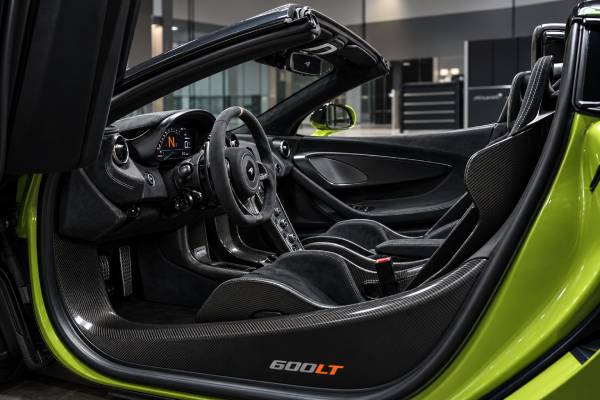
The McLaren 600LT Spider combines the 600LT’s track-focused chassis and 592 hp twin-turbo V8 with a retractable hard-top, yet it avoids the usual convertible penalty of needing major structural reinforcement. McLaren’s carbon-fiber MonoCell II already provides the required stiffness, so the open car is only 50 kg (110 lb) heavier than the corresponding minimum-dry-weight Coupé. That matters because the Spider still accelerates from 0–100 km/h (0–62 mph) in 2.9 seconds while adding the option of driving with the roof open. The tradeoffs are more specific than “convertible versus coupe”: the roof mechanism, seals, drainage paths, extra rear luggage space, exhaust heat around the rear deck, and condition of lightweight components all deserve attention. For owners, correct fluids, battery care, tire condition, and annual servicing are especially important on cars that may cover few road miles but see hard use. For buyers, a VIN-based recall check and a specialist pre-purchase inspection are essential parts of evaluating any 2019–2020 example.
Table of Contents
- How the Spider Preserves the Longtail Idea
- McLaren 600LT Spider Technical Specifications
- Retractable Roof, Cabin, and Practical Use
- Performance on Road and Track
- Service, Storage, and Consumables
- Recalls and Inspection Points
- A Used 600LT Spider Buying Checklist
How the Spider Preserves the Longtail Idea
The 600LT Spider is not simply a 570S Spider with more power. Its defining changes are lower mass, stronger aerodynamic loading, a more focused chassis calibration, and the 600 PS (592 bhp) M838TE engine tune, all while retaining the folding hard-top.
The crucial engineering detail is the MonoCell II carbon-fiber passenger cell. Because the tub was designed with enough torsional rigidity for an open-roof body, McLaren states that the Spider does not require extra structural strengthening when its roof is removed. The roof hardware still has a weight cost, but the minimum dry figure is 1,297 kg (2,859 lb), exactly 50 kg above the 1,247 kg minimum dry figure published for the 600LT Coupé. That is a much more useful comparison than mixing dry, DIN, and curb-weight figures from different sources.
The Longtail treatment also changes how the car communicates speed. The exhaust outlets exit high on the rear deck, shortening the exhaust path and placing the sound close to the occupants when the roof is down. A fixed rear wing, extended bodywork, front splitter, side features, and rear diffuser contribute to the car’s aerodynamic package. The visual drama serves a purpose: the 600LT was developed around reduced mass and greater track capability rather than around luxury additions.
McLaren offered extensive lightweight options, so two Spiders can differ meaningfully in specification. Carbon-fiber exterior parts, lightweight seats, wheel choices, audio equipment, and other options can move an individual car away from the brochure’s minimum dry-weight number. That published minimum is therefore a reference configuration, not a promise that every registered car weighs 1,297 kg.
There is also an important ownership consequence to the Longtail philosophy. A car with thin, expensive body panels, exposed carbon-fiber pieces, low ground clearance, carbon-ceramic brakes, and performance tires can accumulate costly cosmetic or consumable damage without having suffered a major mechanical failure. Condition should be assessed component by component rather than reduced to mileage alone.
McLaren 600LT Spider Technical Specifications
The 2019–2020 600LT Spider is a rear-wheel-drive gasoline car powered by McLaren’s 3.8-liter M838TE twin-turbocharged V8 and a 7-speed Seamless Shift Gearbox (SSG). Its most useful specification numbers are the ones that connect performance with ownership: output, weight definition, tire and brake sizes, service fluids, and the packaging created by the retractable hard-top.
| Specification | Value |
|---|---|
| Engine | M838TE 3.8-liter 90-degree twin-turbo V8 |
| Displacement | 3,799 cc |
| Maximum power | 441 kW / 600 PS / 592 bhp at 7,500 rpm |
| Maximum torque | 620 Nm (457 lb-ft) at 5,500–6,500 rpm |
| Maximum engine speed | 8,500 rpm |
| Fuel type | Gasoline/petrol |
| Recommended fuel | 98 RON / 88 MON meeting EN 228; 95 RON / 85 MON minimum where necessary |
| Fuel tank | 72 L (19.0 US gal) |
| Specification | Value |
|---|---|
| Transmission | 7-speed Seamless Shift Gearbox (SSG) |
| Drive layout | Rear-wheel drive |
| Differential | Open differential with Brake Steer |
| Chassis structure | Carbon-fiber MonoCell II |
| Front suspension | Independent double wishbones with adaptive dampers |
| Rear suspension | Independent double wishbones with adaptive dampers |
| Measure | McLaren figure |
|---|---|
| 0–100 km/h (0–62 mph) | 2.9 seconds |
| 0–200 km/h (0–124 mph) | 8.4 seconds |
| Standing quarter mile | 10.5 seconds |
| Top speed | 324 km/h (201 mph) |
| 100–0 km/h braking | 32 m (105 ft) |
| 200–0 km/h braking | 121 m (397 ft) |
| Specification | Value | Notes |
|---|---|---|
| Length | 4,604 mm (181.3 in) | 600LT body length |
| Width | 2,095 mm (82.5 in) | Published vehicle width |
| Height | 1,194 mm (47.0 in) | Published vehicle height |
| Wheelbase | 2,670 mm (105.1 in) | Sports Series platform |
| Minimum dry weight | 1,297 kg (2,859 lb) | Lightest published Spider configuration |
| DIN weight | 1,404 kg (3,095 lb) | Different measurement basis from dry weight |
| Front luggage capacity | 150 L (5.3 cu ft) | Front compartment |
| Rear luggage capacity | 52 L (1.8 cu ft) | Available according to roof/stowage use |
| Specification | Front | Rear |
|---|---|---|
| Wheel size | 19 × 8 in | 20 × 11 in |
| Tire size | 225/35 R19 | 285/35 R20 |
| Normal cold tire pressure | 2.0 bar (29 psi) | 2.2 bar (32 psi) |
| Brake type | Carbon-ceramic disc | Carbon-ceramic disc |
| Brake disc diameter | 390 mm (15.4 in) | 380 mm (15.0 in) |
| Item | Published reference |
|---|---|
| Routine service interval | 10,000 miles (15,000 km) or 12 months, whichever comes first |
| Engine-oil viscosity | SAE 0W-40 |
| Engine-oil capacity | 9.0 L (9.5 US qt) |
| 12-volt battery type | Lithium-ion system; use a compatible McLaren-approved/appropriate charger as specified |
| Roof operating speed | Up to 40 km/h (25 mph) |
| Combined fuel consumption | 12.2 L/100 km WLTP |
| Combined CO2 | 277 g/km WLTP |
Weight figures need careful interpretation. “Minimum dry” excludes operating fluids and reflects a light specification, while DIN weight uses a different convention; neither should be casually compared with a dealer’s curb-weight claim. Likewise, acceleration and braking numbers are manufacturer performance figures obtained under controlled conditions. Tire temperature, surface, load, weather, and tire age can materially change what a privately owned car achieves.
Retractable Roof, Cabin, and Practical Use
The folding roof is the Spider’s biggest usability difference, and it deserves to be treated as a mechanical system rather than a novelty. McLaren permits roof operation at speeds up to 40 km/h (25 mph), but the mechanism still depends on clear stowage space, correctly functioning sensors, seals, latches, and moving panels.
The retractable hard-top transforms the car without requiring a fabric roof or a permanent targa panel. Roof-up, it provides the weather protection expected from a fixed panel. Roof-down, the short top-exit exhaust and exposed cabin make the powertrain far more present. That sensory change is arguably the strongest reason to choose this version over the Coupé, because straight-line performance remains extremely close.
Practicality changes with the roof position. The front luggage compartment is the primary 150-liter storage area, while McLaren also publishes 52 liters of rear luggage capacity. Owners should follow the handbook’s restrictions for rear stowage because luggage or a stowage bag can interfere with roof movement. A roof that seems slow, pauses unexpectedly, displays warnings, or needs manual encouragement should not be dismissed as normal behavior.
A careful inspection should include several full roof cycles with the car stationary and, where appropriate, under the conditions allowed by the handbook. Watch the panel alignment as the mechanism starts and finishes. Check the rubber seals for cuts, flattening, contamination, or evidence of repeated adjustment. Examine the cabin and rear storage area for water staining or damp odors. A pressure wash is not a substitute for a controlled leak check, and aggressive water jets can create problems that normal rainfall does not.
The low nose and extended aerodynamic surfaces also affect everyday use. Driveway ramps, parking stops, steep garage entries, and road debris can damage the splitter or underside before a driver hears a dramatic impact. A used car should be viewed from below on a lift so that cosmetic repairs, fastener damage, and cracks are visible. Surface perfection from standing height tells little about the parts most exposed to the road.
Cabin options matter because many 600LTs were configured as enthusiast cars rather than identically equipped luxury cars. Seat type, harness-related equipment, infotainment/audio choices, carbon trim, and convenience equipment can differ. Buyers should compare the physical car and its option documentation rather than assuming features from an advertisement or another example.
Performance on Road and Track
The Spider gives away very little measurable acceleration to gain its open roof: 0–100 km/h remains 2.9 seconds, while the official 0–200 km/h figure is 8.4 seconds. What matters more in use is whether the tires, brakes, fluids, and driver inputs are ready for the speed the car can repeatedly generate.
The 620 Nm torque peak spans 5,500–6,500 rpm, and maximum power arrives at 7,500 rpm. That makes the engine feel different from a low-revving turbo road car that delivers its strongest shove early and then fades. The seven-speed SSG can keep the V8 in its working range, while the 8,500 rpm maximum engine speed leaves useful space above the power peak. On public roads, that also means full-throttle acceleration can reach illegal speeds almost immediately; the performance figures are context, not targets for road driving.
Carbon-ceramic brakes reduce mass and tolerate high temperatures, but they are not maintenance-free. Disc condition should be judged using the manufacturer’s inspection criteria rather than by looking only for a conventional iron-disc wear lip. Chips, impact damage, pad condition, hardware, and any warning indicators all deserve attention. Replacement costs can be substantial, so a specialist inspection has financial value even when the pedal feels normal during a short road test.
Tires are equally important. The factory fitment is staggered—225/35 R19 front and 285/35 R20 rear—and the handbook gives normal cold pressures of 2.0 bar front and 2.2 bar rear. Those values are a starting reference for the specified setup, not permission to apply the same pressure blindly to every track session, replacement tire, load, or temperature. Pressure rises with heat; track use can change it quickly.
For a car that has seen circuit use, inspect evidence rather than treating track mileage as automatically bad. A well-managed track car may have frequent fluid changes, properly monitored brake wear, and fresh tires. A low-mileage road car can still suffer from old tires, discharged batteries, long service gaps, curb strikes, or deferred maintenance. Useful clues include:
- Tire date codes, tread condition, shoulder wear, and signs of heat cycling.
- Wheel inner barrels and rims for bends, cracks, repairs, or repeated mounting damage.
- Carbon-ceramic discs and pads for condition consistent with mileage and claimed use.
- Underbody aero pieces and mounting points for contact damage.
- Cooling-system condition and any record of leaks or heat-related repairs.
- Service invoices that show dates, mileage, and the work actually performed.
The Spider’s aerodynamics and chassis work as a system. Replacing a damaged aero piece with an incorrect part, fitting unsuitable tires, or running poor alignment can change a car that was engineered around precise responses. Before altering ride height, alignment, wheel fitment, or tire specification, establish a sound factory baseline.
Service, Storage, and Consumables
A 600LT Spider should be serviced by time as well as distance: the published interval is 10,000 miles (15,000 km) or 12 months, whichever comes first. This is particularly relevant because collector and weekend cars often reach their annual date long before they reach the mileage threshold.
The owner information specifies SAE 0W-40 engine oil and a 9.0-liter oil capacity. Those figures are useful references, but fluid brand/specification, fill procedure, checking conditions, and any market-specific update should come from current service information for the actual VIN. A mid-engined dry-sump performance car is not a good place to improvise a fill based on a generic capacity chart.
Fuel quality matters too. McLaren identifies 98 RON / 88 MON fuel meeting EN 228 as the recommended grade and gives 95 RON / 85 MON as the minimum where necessary. Regional pump labels differ, so owners should match the handbook’s octane method rather than compare the number on a pump without understanding whether it is RON, MON, or AKI.
Low-use cars need deliberate battery management. The 600LT uses a lithium-ion 12-volt system, so a charger must be suitable for that battery chemistry and the vehicle’s instructions. A generic lead-acid trickle charger is not automatically interchangeable. Repeated deep discharge can also create misleading electrical symptoms or leave a car unable to complete normal control-system checks.
Storage is more than plugging in a charger. Before a long layup, clean and dry the car, make sure drainage areas are clear, avoid putting the parking situation or tires under unnecessary long-term stress, and follow McLaren guidance for the battery and vehicle. When returning the car to use, inspect pressures and tires cold, check fluid levels as directed, look underneath for leakage, and verify warning messages before driving hard.
Mileage should not be used as a service shortcut. A car that has covered only 1,000 miles since its last annual service may still be overdue by date. Conversely, a car that has covered significant mileage in a short period may require scheduled work sooner. For a prospective purchase, a service record is strongest when invoices confirm the dates, odometer readings, dealer or specialist identity, and parts or fluids used.
Owners planning track days should build additional checks around the normal schedule. Tire and brake inspections before and after the event, fluid checks, wheel condition, and attention to cooling or leakage are sensible because a track session compresses heavy braking, acceleration, and heat cycles into a short period. The annual schedule remains the baseline; severe use can justify closer inspection.
Recalls and Inspection Points
Recall status must be checked by VIN, because a model-year label alone cannot show whether a particular 600LT Spider is involved or whether the remedy has been completed. Two U.S. NHTSA campaigns are especially relevant to the 2019–2020 600LT population and to later records that can include individual 600LT vehicles.
NHTSA recall 23V-484 covers 652 model-year 2019–2020 McLaren 600LT Coupé and Spider vehicles in the stated U.S. population. The concern is the joint between the engine coolant radiator temperature sensor housing and the hose. Heat and pressure cycling can allow the connection to loosen, which can lead to coolant leakage. Because leaked coolant can contact hot components, the report identifies a potential fire risk. The remedy involves the affected hose/housing connection and a constant-pressure clamp. A buyer should confirm completion through the VIN rather than relying on a verbal statement that “all recalls were done.”
A separate 2025 NHTSA campaign, 25V-216, concerns a small multi-model group of McLaren vehicles and includes the 600LT among the listed models. It addresses the possibility that rear brake pipes were connected to incorrect ports at the ABS/ESP unit, potentially causing braking at the opposite rear wheel from the one intended by the stability-control system. The report covers only a limited population, so it should not be represented as a defect present in every 2020 Spider. Again, VIN lookup is the correct test.
Beyond formal campaigns, a pre-purchase inspection should be specific to the car’s construction and use. Ask the technician to inspect:
- The cooling system for leakage, dried residue, damaged hoses, and evidence of prior work.
- The retractable roof through complete cycles, including warning messages and panel alignment.
- Roof and window seals, water-management areas, and the cabin for evidence of moisture.
- Front splitter, floor, diffuser, carbon panels, and mounting points from underneath.
- Wheels, tires, brake discs, pads, and suspension components for track or impact wear.
- Top-exit exhaust surroundings and adjacent trim for damage or abnormal deterioration.
- Diagnostic fault history and current control-module warnings.
- Service records against elapsed time, not only odometer mileage.
Accident and paint history deserve extra care because carbon structures and panels require specialist assessment. A clean-looking repair is not proof that underlying mounting points or the carbon tub were unaffected. If damage is suspected, use a shop familiar with McLaren construction and repair methods rather than relying only on a generic paint-depth walkaround.
Recall databases also differ by country. A U.S. campaign number is useful evidence about a known issue, but a car registered elsewhere should be checked through the relevant national system and McLaren network. Imported cars deserve both checks because their registration market can differ from their original delivery market.
A Used 600LT Spider Buying Checklist
The safest way to buy a 600LT Spider is to verify identity, history, condition, and expensive consumables before discussing cosmetic perfection or rarity. A strong example should make its story easy to document: correct VIN and specification, consistent service history, completed applicable recalls, a healthy roof, and an inspection that explains wear rather than hiding it.
Start with the VIN and build outward. Confirm the model year, original market, option specification, and recall status. Review dated invoices, not just stamped service entries. Ask whether the car has been tracked, repaired, repainted, wrapped, stored for long periods, or modified. None of those facts automatically disqualifies a car, but each changes what should be inspected.
Then concentrate on the Spider-specific hardware. Run the roof more than once. Confirm that the stowage areas are clear and that the mechanism completes its cycle without warnings, hesitation, or contact between panels. Check glass operation and sealing. Inspect for water evidence after the roof has been closed, and make sure any rear luggage arrangement is compatible with roof operation. A functioning roof on the day of sale is only the starting point; the service history should also show how faults or adjustments were handled.
An open-roof road test can reveal a different set of noises from a roof-up test, but interpretation matters. The absence of extra convertible bracing does not mean every creak proves tub damage, and a removable weather seal can make ordinary trim sounds more noticeable. Compare roof-up and roof-down behavior on the same road, then investigate sharp changes, persistent rattles, wind noise concentrated at one seal, or visible panel misalignment. If the car has had roof work, ask for the repair order and the reason for the adjustment. That is more informative than guessing from sound alone.
Next, price the wear items that can turn a seemingly attractive purchase into an expensive first year. Tire age matters even when tread remains. Carbon-ceramic brake condition matters even when there is no dashboard warning. Wheel damage, underbody contact, splitter damage, and compromised carbon trim can all be costly. Obtain estimates for anything questionable before agreeing on value.
A McLaren Qualified car can reduce some uncertainty where the program is offered. McLaren describes Qualified vehicles as receiving inspection and provenance checks, with qualifying cars receiving a minimum 12-month warranty and roadside assistance in participating markets; servicing due within the stated near-term window is also addressed under the program terms. That does not make an independent inspection pointless, but it provides a defined manufacturer-backed framework that a private or non-specialist sale may not have.
For any car outside that program, commission a McLaren-experienced pre-purchase inspection with diagnostic access and a lift. Give the inspector the VIN and the recall items you want confirmed. Ask for photographs of the underside, brake condition, tire date codes, fluid leaks, and any repaired carbon or bodywork. A written report is more useful than a brief “looks good” message.
Finally, judge the car as a complete ownership proposition. Purchase price is only one line. Allow for annual servicing, age-sensitive tires, possible brake expenditure, insurance, correct battery support, and any cosmetic work you genuinely care about. The best 600LT Spider for regular use is not necessarily the lowest-mileage example; it is the one whose mechanical condition, roof operation, history, specification, and future maintenance needs are understood before money changes hands.
References
- McLaren 600LT Spider Specs – Top Speed, 0-100, Weight, BHP | McLaren Automotive 2019 (Manufacturer Specifications)
- McLaren 600LT Spider – Fast & Light Convertible Supercar | McLaren Automotive 2019 (Manufacturer Overview)
- 600LT Sports Series Standard specifications and Options Guide 2019 (Technical Guide)
- McLaren Ownership – Owner’s Handbooks | McLaren Automotive 2019 (Owner’s Handbook)
- Part 573 Safety Recall Report 23V-484 2023 (Recall Report)
- Part 573 Safety Recall Report 25V216 2025 (Recall Report)
Disclaimer
Use this guide as a research reference, not as repair instructions or a replacement for professional diagnosis. The correct specifications, torque settings, maintenance intervals, and procedures for an individual 600LT Spider can differ with its VIN, market, production details, and fitted equipment, so confirm technical work against the official service documentation for that specific car.
If this guide was useful, please consider sharing it on Facebook, X/Twitter, or another community you use; sharing helps support further research-driven vehicle guides.