
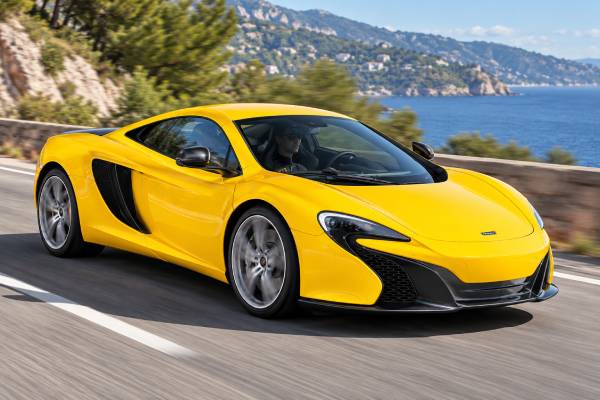
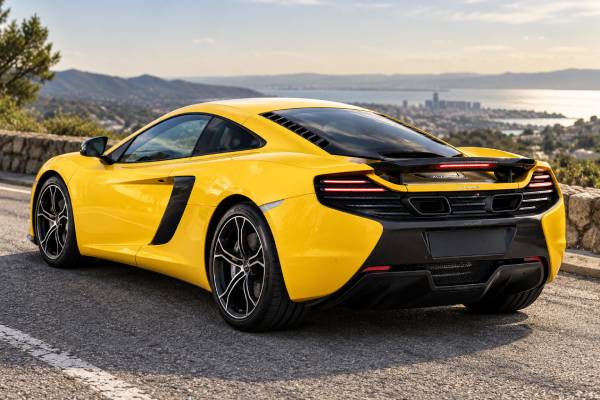
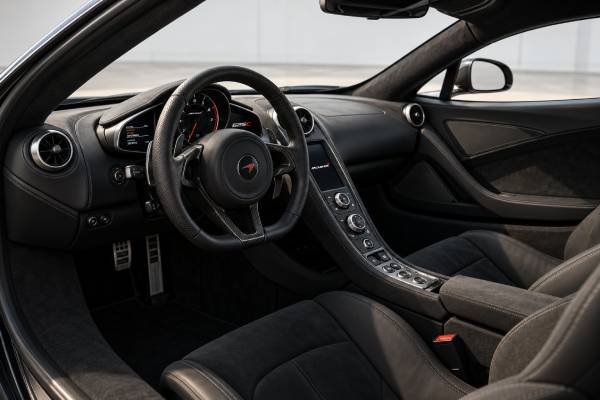
The McLaren 625C Coupe is the quieter-spoken member of the P11-era Super Series, but it is not a detuned afterthought. McLaren created it for selected Asia-Pacific markets by taking the 650S formula and shifting the balance toward daily usability: 625 PS from the 3.8-liter twin-turbo V8, revised dampers, softer rear springing, and standard cast-iron brakes. The result still delivers supercar numbers—0–100 km/h in 3.1 seconds with the specified Corsa tires and a claimed 333 km/h top speed—while placing more emphasis on compliance in Normal chassis mode. That unusual brief makes the 625C Coupe interesting today. It combines the carbon-fiber MonoCell, hydraulic ProActive Chassis Control, seven-speed dual-clutch transmission, and active airbrake associated with early modern McLarens, yet it was sold in relatively limited regional channels. For a buyer, condition and documentation matter more than rarity alone: software campaigns, coolant-system work, tires, brakes, hydraulic chassis health, and market-specific recall completion deserve close attention.
Table of Contents
- What the 625C Coupe Was Built to Do
- 625C Coupe Specifications and Technical Data
- M838T Engine, SSG Gearbox, and Performance
- Chassis Calibration, Steering, and Braking
- Maintenance Priorities and Service Campaigns
- How to Inspect a Used 625C Coupe
- Ownership Fit, Provenance, and Long-Term Value
What the 625C Coupe Was Built to Do
The 625C Coupe was designed to preserve McLaren’s core P11 performance while making the car more forgiving in everyday use. It debuted as McLaren’s first regionally tailored model, initially for Hong Kong and then selected Asia-Pacific markets, with the “C” standing for “Club.”
That context matters because the 625C can be misunderstood when it is viewed only as a lower-output 650S. The headline reduction—from 650 PS to 625 PS—was only one part of the change. McLaren also revised damper calibration and mechanical balance, including a softer rear spring rate, so the car would ride more comfortably in its Normal chassis setting. Sport and Track modes remained part of the ProActive Chassis Control system, so the car did not abandon the adjustable character that made the P11 platform distinctive.
The Coupe is also the lighter of the two 625C body styles. McLaren quoted a 1,336 kg dry weight for the Coupe, 40 kg below the Spider’s published dry figure. That difference does not turn the Coupe into a separate mechanical species, but it reinforces its role as the simpler, closed-body choice for an owner who values maximum structural simplicity and does not need an opening roof.
There is another important distinction from the contemporary 650S: the 625C’s standard brake specification used cast-iron discs with forged aluminum hubs rather than treating carbon-ceramic discs as the defining default. For road use, iron brakes can be a practical advantage because they are easier to assess and generally less intimidating to replace than large carbon-ceramic rotors. A used car may have a different configuration because McLaren options and later changes can complicate individual examples, so a physical inspection and build record should always decide what is actually fitted.
The 625C also sits in an interesting point in McLaren’s history. It uses the original-generation carbon-fiber MonoCell architecture and the M838T engine family that underpinned the 12C and 650S. Its exterior design is closely related to the 650S, but the suspension brief was explicitly more relaxed. That makes the car less about chasing a specification-sheet hierarchy and more about finding a particular balance of speed, steering feel, ride quality, and regional rarity.
625C Coupe Specifications and Technical Data
The 625C Coupe is a conventional gasoline ICE supercar with a longitudinal mid-mounted 3,799 cc twin-turbo V8 driving the rear wheels through a seven-speed Seamless Shift Gearbox. Its key engineering features are the carbon-fiber MonoCell, ProActive Chassis Control, active airbrake, staggered 19/20-inch wheels, and the softer 625C-specific chassis calibration.
| Specification | Value |
|---|---|
| Engine | McLaren M838T, 90-degree twin-turbo V8 |
| Displacement | 3,799 cc (3.8 L) |
| Maximum output | 625 PS (616 hp / about 460 kW) at 7,250 rpm |
| Maximum torque | 610 Nm (450 lb-ft) from 3,000–7,000 rpm |
| Engine position | Longitudinal, mid-mounted |
| Transmission | 7-speed SSG dual-clutch transmission |
| Drive | Rear-wheel drive |
| Specification | Value or condition |
|---|---|
| 0–100 km/h (0–62 mph) | 3.1 seconds with optional Pirelli P Zero Corsa tires |
| 0–200 km/h (0–124 mph) | 8.8 seconds with optional Pirelli P Zero Corsa tires |
| 0–300 km/h (0–186 mph) | 26.7 seconds with optional Pirelli P Zero Corsa tires |
| 400 m / quarter mile | 10.6 seconds at 136 mph with optional Pirelli P Zero Corsa tires |
| Maximum speed | 333 km/h (207 mph) |
| Combined fuel consumption | About 11.7 L/100 km (24.2 mpg UK) |
| CO₂ emissions | 275 g/km |
| Specification | Value |
|---|---|
| Body style | 2-door, 2-seat coupe |
| Structure | Carbon-fiber MonoCell with aluminum front and rear frames |
| Length | 4,512 mm (177.6 in) |
| Width excluding mirrors | 1,908 mm (75.1 in) |
| Width including mirrors | 2,093 mm (82.4 in) |
| Height | 1,199 mm (47.2 in) |
| Wheelbase | 2,670 mm (105.1 in) |
| Dry weight | 1,336 kg (2,945 lb) |
| Specification | Value |
|---|---|
| Suspension system | McLaren ProActive Chassis Control |
| Chassis modes | Normal / Sport / Track |
| Powertrain modes | Winter / Normal / Sport / Track |
| Front brakes | 370 mm cast-iron discs with forged aluminum hubs |
| Rear brakes | 350 mm cast-iron discs with forged aluminum hubs |
| Active aerodynamics | McLaren Airbrake |
| Front / rear track | 1,656 / 1,583 mm (65.2 / 62.3 in) |
| Position | Wheel | Tire |
|---|---|---|
| Front | 19 × 8.5J | 235/35 R19 Pirelli P Zero |
| Rear | 20 × 11J | 305/30 R20 Pirelli P Zero |
These figures describe the factory 625C Coupe specification published at launch. They should not be mixed with 650S data simply because the cars share a platform; the 625C’s output, torque, spring calibration, brake specification, and some market equipment were intentionally different.
M838T Engine, SSG Gearbox, and Performance
The 625C is still extremely fast by road-car standards, and its 25 PS reduction from the 650S does little to change the way a driver should approach its performance. The more meaningful difference is how McLaren delivered that speed: broad turbocharged torque, rapid dual-clutch shifts, rear-wheel drive, and electronic modes that let the car move from calm traffic behavior to much sharper responses.
The M838T is a compact twin-turbocharged V8 mounted behind the cabin. In 625C tune, peak torque is 610 Nm and is available across a wide 3,000–7,000 rpm range. That broad plateau means the engine does not require constant high-rpm operation to feel urgent. On a road, the usable character comes from strong midrange acceleration and the transmission’s ability to keep the engine in its productive zone.
McLaren’s seven-speed SSG is a dual-clutch gearbox. One clutch handles one set of ratios while the second prepares the next, allowing shifts with far less interruption than a traditional single-clutch automated manual. In normal use, that makes the car easier to manage in traffic. In manual mode, the paddles give the driver direct control without a clutch pedal. A prospective buyer should test both low-speed smoothness and full-temperature operation; a transmission that behaves acceptably cold but produces warnings, harsh engagement, or abnormal noises once hot deserves specialist diagnosis.
The performance numbers also show why tire specification is not a minor detail. McLaren attached an asterisk to its headline acceleration figures because those times were achieved with optional Pirelli P Zero Corsa tires. A used car on touring-oriented rubber, mismatched tires, old compounds, or poor alignment should not be expected to reproduce launch data. More importantly, it may not deliver the braking, steering, and stability behavior the chassis was calibrated around.
Top speed is a less useful ownership measure than thermal condition and drivability. A healthy 625C should build boost cleanly, pull consistently, and maintain stable coolant and oil temperatures under normal operation. Hesitation, persistent smoke, fluid smells, warning messages, or boost-related fault behavior matter far more in a pre-purchase test than whether the car can theoretically reach its 333 km/h claim.
Fuel consumption was quoted at about 11.7 L/100 km on the applicable combined test cycle. Real use can be substantially worse when the car is driven in dense traffic or with frequent boost. That is not a defect; it is a reminder that the official number belongs to a standardized procedure, not a guarantee of day-to-day economy.
Chassis Calibration, Steering, and Braking
The 625C Coupe’s defining engineering change is the chassis tune, not the engine output. McLaren revised the dampers and softened the rear spring rate to increase compliance in Normal mode while retaining Sport and Track selections.
ProActive Chassis Control is central to how the P11 platform feels. Rather than relying on conventional anti-roll bars as the main way to resist body roll, the system hydraulically interconnects dampers and manages body movement while allowing individual wheels to respond to bumps. The practical benefit is the combination McLaren was chasing from the beginning: relatively supple vertical wheel movement on a rough road without allowing the body to become loose in a fast corner.
On the 625C, that philosophy was pushed further toward comfort. The car should therefore not be judged by the assumption that “softer” means vague. The system still uses separate chassis modes, and McLaren specifically positioned the revisions as a way to improve Normal mode without sacrificing the sharper settings. When test-driving a used example, mode changes should be consistent and warning-free. A chassis warning, an obvious corner-to-corner ride-height mismatch, persistent knocking, or unusually bouncy behavior requires investigation rather than being dismissed as part of the softer calibration.
The steering is another reason to inspect the car dynamically. Early McLarens are known for hydraulic assistance that transmits more texture than many later electrically assisted systems. What matters on an individual car is that assistance remains consistent, the wheel self-centers normally, and there is no pulling that could indicate alignment, tire, suspension, or prior-impact problems.
The standard iron brakes are substantial: 370 mm at the front and 350 mm at the rear. Iron rotors can show visible surface corrosion after storage, but light film rust should clear with use. Deep lips, cracking, severe scoring, vibration, or uneven pad deposits are different issues. Ask for measurements rather than relying on visual impressions alone. Replacement costs for a supercar braking system remain meaningful even when the discs are not carbon ceramic.
The active airbrake should also be treated as a functioning system, not decoration. Its operation is integrated with the car’s dynamic controls. During inspection, verify that there are no related warning messages, that the panel sits correctly when stowed, and that there is no evidence of collision repair around hinges, supports, or rear bodywork. Later McLaren technical information continues to address airbrake diagnostics across P11 cars, so electronic diagnosis should be part of a serious pre-purchase inspection.
Maintenance Priorities and Service Campaigns
A strong 625C ownership experience depends on documented preventive maintenance and proof that applicable service campaigns were completed. Because this model was regionally distributed, the VIN and selling market are especially important when checking campaign and recall history.
Three areas deserve specific attention. First is the cooling and clutch-oil-cooler circuit. McLaren issued a service campaign for certain 650S and 625C Coupe and Spider cars covering a clutch oil cooler return hose that could split under pressure and heat, causing coolant loss. A related campaign addressed both the clutch oil cooler and return hose on affected vehicles. For a buyer, the useful question is simple: was the relevant campaign applicable to this VIN, and if so, is there retailer documentation showing completion?
Second is software. McLaren released multiple software updates for the 625C, including an IRIS infotainment update intended to improve stability and reverse-camera behavior and a later Platform 9.5 campaign that updated several modules. These are not merely historical trivia. A car with old module software can present nuisance faults, poor Bluetooth behavior, infotainment freezes, or inconsistent module communication. Ask a McLaren specialist to scan the complete vehicle, record current software levels, and check whether outstanding campaigns remain.
Third is age-related condition. A 2015–2016 625C is now old enough that calendar time matters as much as mileage. Rubber hoses, seals, tires, battery condition, damper hydraulics, coolant quality, brake fluid, air-conditioning performance, and corrosion on fasteners or ancillary metalwork can deteriorate even on a low-mileage example. Cars that sit for long periods can develop their own problems, including flat-spotted tires, weak batteries, sticky brake surfaces, and dried or hardened seals.
A sensible maintenance review should include:
- complete service invoices, not only stamped book entries;
- date codes and remaining condition of all four tires, with matching axle specifications;
- evidence of cooling-system campaign work where applicable;
- a full diagnostic scan for current, stored, and historical faults;
- inspection for engine, transmission, coolant, and hydraulic leaks;
- brake-disc thickness and condition plus pad life;
- battery health and charging-system performance;
- correct operation of air conditioning, lift functions, door electronics, parking brake, cameras, and infotainment;
- verification that scheduled maintenance matches the car’s VIN, market, and official service documentation.
Do not assume that a recently detailed car is a recently serviced car. Supercars often receive cosmetic preparation before sale, while expensive mechanical work can remain deferred. A specialist invoice showing exactly what was inspected and replaced is more useful than general claims such as “fully maintained.”
Recall status deserves its own check. Official notices in China and Taiwan have included the 625C in passenger-airbag campaigns associated with Takata inflators. Coverage depends on market and VIN; a car imported from one country to another can be especially easy to lose in normal dealer-contact systems. Confirm completion using the VIN with an authorized McLaren retailer or the relevant market authority rather than assuming that an old recall no longer matters.
Maintenance records should also show how faults were resolved, not just that the car visited a workshop. Repeated battery replacements, recurring coolant top-ups, the same warning code appearing over several services, or frequent alignment corrections can reveal an unresolved root cause. Conversely, a documented repair followed by clean diagnostics and normal operation is often more reassuring than a supposedly flawless car with almost no invoices. On a 625C, the quality of the history is part of the mechanical condition.
How to Inspect a Used 625C Coupe
The best 625C Coupe is the one with traceable provenance, correct mechanical condition, and evidence of specialist care—not necessarily the car with the lowest odometer reading. Because the model is uncommon, buyers should resist treating rarity as a substitute for inspection.
Start with identity. Confirm that the VIN, market documentation, build information, and body style all agree. The 625C was built for selected Asian markets, so cars appearing elsewhere may be imports. Imported status is not inherently bad, but it can affect registration, emissions compliance, recall handling, warranty history, infotainment region settings, and resale documentation.
Next, inspect the carbon and aluminum structure with someone who understands McLaren construction. The carbon MonoCell is extremely strong, but accident repair around bonded or bolted aluminum structures, suspension mounting areas, underbody panels, and carbon surfaces should be evaluated carefully. Uneven panel gaps, mismatched paint texture, overspray, distorted fasteners, poorly fitted undertrays, or missing factory labels can justify a deeper body-history investigation.
Use the test drive methodically rather than chasing speed. A useful sequence is:
- Start the engine from fully cold and listen for abnormal mechanical noise after the initial flare settles.
- Watch the instrument cluster for persistent warnings and confirm that the car reaches normal operating temperature cleanly.
- Test the transmission in gentle automatic driving before using manual shifts under load.
- Cycle the chassis and powertrain modes and verify that the responses change without faults.
- Check steering on a flat road for pull, vibration, unusual free play, or inconsistent assistance.
- Brake progressively from several speeds and feel for judder, pedal inconsistency, or pulling.
- After the drive, inspect again for fresh coolant, oil, gearbox-fluid, or hydraulic leakage.
Tires deserve special scrutiny because they can make a sound chassis feel wrong. The 625C uses a heavily staggered setup with much wider rear rubber. Compare brand, model, date code, tread depth, shoulder wear, and pressure. Uneven inside-edge wear can indicate alignment issues that are easy to miss when looking only at the outside face.
Check the cabin as a system. Operate both dihedral doors repeatedly, every switch, seat adjustment, window, mirror, climate function, parking sensor, camera, infotainment control, and audio source. Confirm that warning lamps illuminate and then extinguish normally during startup. An intermittent electrical issue can be more time-consuming to diagnose than a visibly worn trim piece.
Finally, put the car on a lift. Underbody condition often tells the truth that a polished exterior hides. Look for impact damage to the front underside, cracked panels, missing fasteners, fluid residue, damaged jacking points, tire contact marks, and evidence of hurried prior work. A low supercar can scrape even in careful ownership; the concern is not cosmetic wear itself but whether an impact has affected structural, cooling, suspension, or aerodynamic components.
Ask about non-factory tuning before agreeing a price. ECU software, exhaust changes, altered suspension settings, wheel spacers, and aftermarket wheels can change heat management, emissions compliance, tire clearance, and diagnostic behavior. A modification is not automatically harmful, but it should be identifiable, reversible where practical, and supported by invoices. If the seller cannot explain what software is installed or which original parts remain, budget for a specialist to return the car to a known baseline.
Ownership Fit, Provenance, and Long-Term Value
The 625C Coupe suits an owner who wants the P11 McLaren experience with a road-biased factory chassis setup and accepts the responsibilities of a low-volume, aging supercar. Its appeal comes from the combination of regional rarity, carbon construction, hydraulic chassis technology, and performance that remains serious without requiring the hardest-edged specification.
For regular use, the Coupe has a few advantages over the Spider. There is no retractable roof mechanism to inspect or maintain, the published dry weight is lower, and the fixed roof simplifies weather sealing. Owners who live in hot or wet climates may also appreciate having fewer moving roof seals and drains to monitor. Those are practical differences, not reasons to assume every Coupe is automatically the safer purchase; a neglected Coupe can still be far more expensive than a carefully maintained Spider.
Provenance is unusually important because the model’s regional history can complicate the paper trail. Keep copies of original market documents, service invoices, campaign records, diagnostic reports, paintwork records, spare keys, manuals, and any import paperwork. If the car has been modified, retain the original parts and obtain documentation for software or exhaust changes. Buyers of uncommon variants generally value a clear story more than a collection of unsupported claims about rarity.
Do not rely on an advertised production number unless it can be substantiated. Publicly accessible records do not provide a definitive total for 625C Coupe production, and small regional runs are easy to exaggerate in sales listings. It is accurate to describe the model as uncommon; it is less responsible to assign a precise rarity ranking without factory evidence.
The most rational ownership budget includes a reserve for unscheduled work. A clean inspection reduces risk but cannot eliminate it on a complex supercar with hydraulic chassis systems, turbocharging, active aerodynamics, a dual-clutch gearbox, and numerous electronic modules. The cost of specialist labor and genuine parts can be significant even when the underlying fault is small.
That does not make the 625C a poor ownership proposition. It simply changes what “good value” means. A cheaper car with overdue tires, uncertain campaign history, warning lights, neglected cooling-system work, or accident questions can quickly consume the difference between asking prices. A more expensive example with transparent history, current service, correct tires, strong diagnostics, and documented recall status may be the more economical car to own.
For enthusiasts who understand that distinction, the 625C Coupe occupies a compelling niche. It delivers the carbon-tub architecture and hydraulic character of McLaren’s first modern Super Series generation while preserving a specific factory brief: high performance with more compliance for daily roads. Buy the condition and documentation first; let rarity be the bonus rather than the justification.
References
- McLaren presents 625C – AllCarIndex 2014
- Clutch Oil Cooler Return Hose Replacement 2015 (Service Campaign Bulletin)
- AIS Infotainment IRIS Software Update to Platform 8.5 2014 (Service Campaign Bulletin)
- Vehicle Software Update to Platform 9.5 2016 (Service Campaign Bulletin)
- 迈凯伦汽车销售(上海)有限公司召回部分进口迈凯伦汽车 2021 (Recall Notice)
Disclaimer
This article is for informational purposes and is not a substitute for professional diagnosis or repair. Specifications, torque values, service intervals, campaign applicability, and procedures can vary by VIN, market, equipment, and later updates; verify all work against the vehicle’s official McLaren service documentation. If this guide was useful, please consider sharing it on Facebook, X/Twitter, or another platform to support our work.