
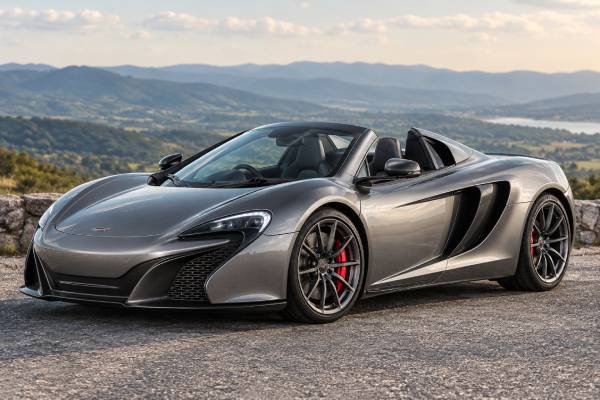

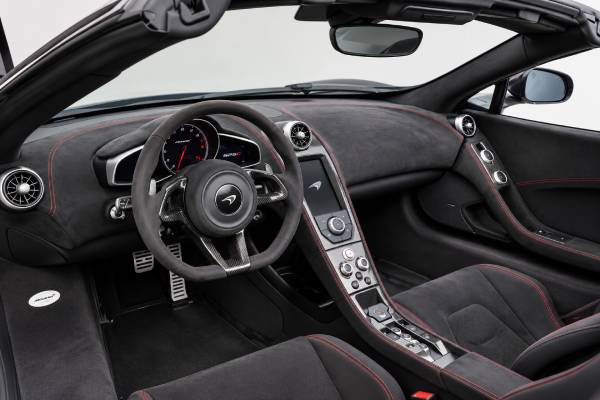
The McLaren 625C Spider is an unusual open-top supercar because its softer character was engineered into the chassis rather than created by turning the car into a conventional grand tourer. Built for selected Asia-Pacific markets, it combines the P11 carbon-fiber MonoCell, a retractable roof system, hydraulic ProActive Chassis Control, and McLaren’s 3.8-liter twin-turbo M838T V8 in 625 PS tune. The Spider carries 40 kg more published dry weight than the Coupe, yet McLaren still claimed 0–100 km/h in 3.1 seconds on the specified Corsa tires and 329 km/h at the top end. Its real distinction is not outright speed. The 625C calibration used new dampers and softer rear springing to make Normal mode more compliant while preserving Sport and Track settings. As these cars age, the buying priorities are equally specific: roof operation, seals and drains, cooling-system campaigns, software status, tires, brakes, chassis hydraulics, and recall completion all deserve evidence rather than assumptions.
Table of Contents
- Why the 625C Spider Is More Than a Convertible 650S
- Roof, Carbon Structure, and Open-Top Packaging
- 625C Spider Technical Specifications
- Power Delivery, Chassis Modes, and Road Performance
- Roof-System and Age-Related Maintenance
- Used 625C Spider Inspection Checklist
- What Ownership Demands and Who the Spider Suits
Why the 625C Spider Is More Than a Convertible 650S
The 625C Spider was created around a regional comfort brief, not simply by removing power from a 650S Spider. McLaren paired its 625 PS engine tune with revised dampers, a less stiff rear spring rate, and a calibration intended to make everyday roads less punishing in Normal mode.
That distinction explains the model name. The “625” refers to metric horsepower, while the “C” stands for “Club,” signaling a less extreme character. McLaren initially announced the car for Hong Kong before extending availability to selected Asia-Pacific markets. Both Coupe and Spider versions were offered from launch, making the open car part of the original 625C concept rather than a later derivative.
The Spider keeps the essential P11 engineering that makes this generation of McLaren distinctive. The engine is mounted longitudinally behind the cabin, drive goes to the rear wheels, and a seven-speed dual-clutch Seamless Shift Gearbox handles transmission duties. The suspension is built around ProActive Chassis Control, a hydraulically linked system designed to control body movement without relying on a conventional anti-roll-bar setup in the usual way. An active rear airbrake is also part of the package.
Where the Spider differs most clearly is mass and complexity. McLaren quoted a 1,376 kg dry weight, 40 kg above the Coupe. That increase is modest for an open-top supercar, but the roof adds motors, sensors, latches, seals, wiring, moving panels, and control logic that a fixed-roof car does not need. Those components are not reasons to avoid the Spider; they are reasons to inspect it as a Spider rather than treating it as a Coupe with one extra switch.
The 625C’s standard brake specification is another part of its more road-oriented identity. McLaren listed cast-iron discs with forged aluminum hubs—370 mm front and 350 mm rear—rather than making carbon ceramics the central specification. The combination suits the car’s day-to-day positioning while still providing serious brake hardware for a 616 hp machine.
Roof, Carbon Structure, and Open-Top Packaging
The Spider’s carbon-fiber MonoCell is the reason McLaren could create an open version without reinventing the entire chassis. The tub carries the core structural loads, while aluminum structures are attached at the front and rear, allowing the roof mechanism to be added without depending on a steel roof panel as the primary source of body stiffness.
For an owner, that architecture changes the inspection priorities. A conventional convertible may invite questions about weakened sills or extra underbody reinforcement. On the 625C Spider, the carbon tub is the central structural element, so the critical task is to confirm that the tub, bonded interfaces, aluminum frames, and mounting points have not suffered accident damage or poor repair. Carbon does not behave like stamped steel: damage can be localized yet expensive, and cosmetic finishing can hide evidence that deserves specialist assessment.
The retractable roof system brings a separate set of practical concerns. It should run through a complete open-and-close cycle smoothly, with consistent motor speed, synchronized panel movement, clean latching, and no warning messages. The windows should index correctly as the system operates. Any hesitation, repeated need for switch input, asymmetric movement, scraping sound, or failure to complete a cycle should be diagnosed rather than attributed to age.
Weather sealing matters just as much as motion. Inspect the roof seals for flattening, tears, shrinkage, poor seating, or signs of repeated treatment with unsuitable products. Look for water marks around the upper door openings, rear cabin trim, storage areas, and carpets. Dampness can create electrical problems long after the original leak appears, particularly in a car with numerous control modules and low-mounted wiring.
Drainage paths should be checked for blockage or evidence of previous overflow. Owners in humid or dusty climates should be especially diligent because debris can accumulate even when the roof is rarely lowered. A car that has spent years in covered storage is not automatically safe; seals can harden and drainage systems can still clog from dust or detailing residue.
A water test is useful only when performed carefully. The goal is to confirm sealing and drainage, not to blast high-pressure water directly at joints that are never exposed to that force in normal rain. After wetting the roof naturally, check the header rail, upper door seals, rear trim, carpets, and luggage areas with good lighting. Moisture hidden beneath trim can be more important than a visible drip because it may have been present long enough to affect connectors or control units.
Open-top operation also changes the way cabin condition should be judged. Sun exposure can accelerate wear on leather, Alcantara, plastics, and switchgear. Compare the top surfaces of the dashboard, seat bolsters, door trims, and rear deck with less exposed areas. Uneven fading, sticky coatings, lifting trim, or brittle seals can reveal how the car was stored and used.
625C Spider Technical Specifications
The 625C Spider is a gasoline-only, rear-wheel-drive ICE model with a mid-mounted 3,799 cc twin-turbo V8 and seven-speed dual-clutch transmission. Its factory figures closely track the Coupe’s at lower speeds, while the added roof hardware contributes to a higher dry weight and slightly lower maximum speed.
| Specification | Value |
|---|---|
| Engine family | McLaren M838T twin-turbo V8 |
| Displacement | 3,799 cc (3.8 L) |
| Maximum power | 625 PS (616 hp / about 460 kW) at 7,250 rpm |
| Peak torque | 610 Nm (450 lb-ft) from 3,000–7,000 rpm |
| Layout | Longitudinal mid-engine |
| Gearbox | 7-speed SSG dual-clutch transmission |
| Driven wheels | Rear |
| Specification | Published figure |
|---|---|
| 0–100 km/h (0–62 mph) | 3.1 seconds with optional Pirelli P Zero Corsa tires |
| 0–200 km/h (0–124 mph) | 9.0 seconds with optional Pirelli P Zero Corsa tires |
| 0–300 km/h (0–186 mph) | 27.7 seconds with optional Pirelli P Zero Corsa tires |
| 400 m / quarter mile | 10.8 seconds at 134 mph with optional Pirelli P Zero Corsa tires |
| Maximum speed | 329 km/h (204 mph) |
| Combined fuel consumption | About 11.7 L/100 km (24.2 mpg UK) |
| CO₂ emissions | 275 g/km |
| Specification | Value |
|---|---|
| Body style | 2-door, 2-seat retractable-roof Spider |
| Main structure | Carbon-fiber MonoCell with aluminum front and rear frames |
| Length | 4,512 mm (177.6 in) |
| Width excluding mirrors | 1,908 mm (75.1 in) |
| Width including mirrors | 2,093 mm (82.4 in) |
| Wheelbase | 2,670 mm (105.1 in) |
| Dry weight | 1,376 kg (3,034 lb) |
| Specification | Value |
|---|---|
| Suspension | ProActive Chassis Control |
| Chassis selections | Normal / Sport / Track |
| Powertrain selections | Winter / Normal / Sport / Track |
| Front brake discs | 370 mm cast iron with forged aluminum hubs |
| Rear brake discs | 350 mm cast iron with forged aluminum hubs |
| Active aerodynamic device | McLaren Airbrake |
| Front / rear track | 1,656 / 1,583 mm (65.2 / 62.3 in) |
| Axle | Wheel size | Tire size |
|---|---|---|
| Front | 19 × 8.5J | 235/35 R19 |
| Rear | 20 × 11J | 305/30 R20 |
These are 625C Spider figures, not generic 650S specifications. That distinction is important when ordering parts, comparing performance, evaluating brakes, or checking whether an advertised car actually matches its claimed model.
Power Delivery, Chassis Modes, and Road Performance
The Spider’s extra 40 kg barely affects its 0–100 km/h claim, but the difference becomes clearer as speed rises. McLaren quoted 9.0 seconds to 200 km/h and 329 km/h maximum speed, compared with 8.8 seconds and 333 km/h for the Coupe.
Those numbers are useful for identification, but they are not the best way to judge a used car. What matters more is whether the M838T delivers clean, repeatable thrust, the gearbox selects ratios consistently, and the chassis changes character properly between modes. A car that feels strong once but produces a warning on the next pull has not passed a meaningful test.
The torque curve explains much of the Spider’s real-world speed. With 610 Nm available from 3,000 to 7,000 rpm, the engine has a broad working range. The seven-speed SSG can therefore keep the V8 on boost without demanding constant high-rev operation. In traffic, the gearbox should manage creep and low-speed shifts without excessive harshness. On a faster road, manual paddle shifts should be decisive and free of flares or delayed engagement.
The 625C suspension tune is especially relevant to the Spider because open-top buyers often prioritize road use over repeated circuit work. In Normal mode, the revised dampers and softer rear springing were intended to make the car more settled over imperfect surfaces. Sport and Track remain available when firmer control is wanted. The useful test-drive question is not “Is it soft?” but “Do the modes feel coherent, and does the car remain controlled?”
Listen for knocks from suspension joints and watch for chassis-system warnings. Uneven ride height, one corner that feels unusually stiff, or a car that continues to float after a bump may indicate a fault rather than factory tuning. Because the ProActive Chassis Control system uses hydraulics and electronic control, a generic workshop may not have the equipment or experience to interpret every symptom correctly.
Brake feel should be equally consistent. The iron discs are large enough that a healthy car should stop with confidence and a stable pedal. A light surface film after storage is normal; repeated vibration, deep rotor lips, cracks, severe corrosion, or pad material breaking down are not. Tire age and condition can also mimic chassis faults, especially on a car with wide rear tires and substantial torque.
The active airbrake is part of the dynamic system and should be inspected for correct stowage, unobstructed movement, panel alignment, and diagnostic faults. Damage to the rear bodywork can interfere with its operation even if the panel looks acceptable at rest.
Roof-System and Age-Related Maintenance
Spider maintenance has two layers: everything required by the 625C powertrain and chassis, plus the care demanded by the convertible-roof mechanism. Skipping either side can turn an apparently low-mileage car into an expensive project.
Begin with the roof because faults are easy to demonstrate before purchase. Operate it more than once, preferably after the car has been driven and electrical voltage is stable. Watch the entire sequence instead of standing only at the driver’s door. Check that panel gaps return to the same positions after closing and that the header rail seals evenly across the windscreen frame. Any warning should be recorded and scanned rather than cleared for the test drive.
Keep seals clean and use products appropriate for the material. Petroleum-based dressings or aggressive cleaners can swell, dry, or contaminate sealing surfaces. Drainage areas should be kept free of leaves, polishing compound, and debris. If the cabin smells damp, investigate before replacing trim deodorants or assuming the odor comes from storage.
The rest of the car requires equally disciplined care. McLaren issued a service campaign for certain 625C Coupe and Spider vehicles covering the clutch oil cooler return hose, which could split and cause coolant loss. Another campaign addressed the clutch oil cooler and return hose on affected cars. Evidence that a campaign existed is not evidence that a specific VIN was repaired, so completion should be verified in the service record.
Software history also matters. A 2014 IRIS campaign addressed infotainment and reverse-camera stability, while a 2016 Platform 9.5 campaign updated numerous modules and listed separate instrument-cluster software for the 625C Spider and Coupe. An aging Spider with intermittent electronics should therefore be evaluated both as a hardware problem and as a software/configuration problem.
Battery condition can influence diagnosis. Complex cars may generate cascades of low-voltage warnings when the battery is weak, especially after storage. A proper test should include battery health and charging performance before expensive modules are condemned. That does not mean every warning is “just the battery”; it means voltage should be eliminated as a basic cause before deeper troubleshooting.
Storage practice deserves attention on a Spider that is used seasonally. The car should be kept dry, with the roof fully latched, the battery maintained correctly, and the tires protected from long stationary periods. Before a long drive after storage, inspect pressures and fluid levels and cycle the roof only after confirming healthy electrical voltage. A slow roof caused by weak voltage can be misdiagnosed as a mechanical fault, while repeatedly operating a genuinely binding mechanism can make an existing problem worse.
Tires should be replaced for age and condition, not just tread depth. The Spider’s performance depends on consistent rubber across each axle. Check sidewalls for cracking, inner shoulders for hidden wear, and the manufacturing date for long-stored examples. If the car has non-original tire sizes, obtain a clear reason and verify that wheel clearances and electronic systems have not been compromised.
Routine service intervals, fluids, torque values, and procedures should be taken from the correct official documentation for the VIN and market. The 625C was regionally tailored, and owners should avoid assuming that every 650S handbook line automatically applies to every 625C configuration.
Used 625C Spider Inspection Checklist
A serious pre-purchase inspection should be structured around the Spider’s expensive systems rather than a generic used-car checklist. The roof, carbon structure, hydraulic chassis, cooling circuit, electronics, tires, brakes, and market history all deserve separate evidence.
First confirm the car’s identity and paperwork. Match the VIN across the body, registration records, service invoices, and any import documents. A 625C found outside its original market may be perfectly legitimate, but the buyer should understand how the car was imported and whether local authorities recognize its original emissions, lighting, and safety configuration.
Then inspect the roof and cabin before the test drive. With the car dry, look for staining, lifted trim, corrosion on small fasteners, damp carpet, or residue around drains. Run the roof fully open and closed. Confirm correct window indexing and listen for binding or unequal motor effort. Repeat the process after the drive, when heat may reveal marginal sensors or latches.
Next assess structural and cosmetic condition. Pay attention to the nose, lower splitter, side sills, undertrays, rear diffuser area, and wheel arches. Low cars collect underbody damage, but the location and severity matter. Scrapes on a sacrificial surface are different from cracked mounting points, distorted aluminum structures, or repair evidence near the carbon tub.
During the drive, use a repeatable sequence:
- Begin from a genuine cold start and note warning messages before moving.
- Drive gently until temperatures stabilize; test low-speed gearbox behavior and steering assistance.
- Use each chassis mode on the same stretch of road to compare responses.
- Apply moderate and then firmer braking, checking for vibration or pull.
- Use manual shifts through several gears under load, then return to automatic mode.
- Test climate control, cameras, audio, parking functions, lift functions, and all steering-wheel controls.
- After stopping, inspect the engine bay and underside for fresh fluid traces or coolant smell.
A diagnostic scan should follow the road test, not precede it only. That helps identify faults that become active under temperature, load, or roof operation. Ask for the actual scan report rather than a verbal “no codes” statement.
Recall completion needs market-specific verification. Chinese and Taiwanese authorities have published 625C-related passenger-airbag recall information involving Takata inflators. If the car has moved between markets, do not assume a dealer in its current country will automatically know whether the original recall action was completed. Check by VIN with an authorized retailer and the relevant recall authority.
Finally, inspect the history for long gaps. A car that covered only a few hundred kilometers between services may still need age-sensitive maintenance. Storage conditions, battery tender use, tire dates, fluid changes, and periodic exercise can be more revealing than annual mileage alone.
The final negotiation should be based on a written defect list. Separate immediate safety or reliability work from cosmetic items and future maintenance, then price each category using a McLaren-capable workshop rather than generic estimates. Roof faults, hydraulic chassis faults, carbon or aluminum accident repairs, and unresolved cooling issues deserve more weight than worn seat bolsters or stone chips. This keeps a rare-car purchase from becoming an emotional decision driven by color, mileage, or scarcity.
What Ownership Demands and Who the Spider Suits
The 625C Spider is best for an owner who values open-top access to the P11 driving experience and is willing to maintain the roof mechanism with the same seriousness as the engine and chassis. It is not a low-maintenance route into McLaren ownership, but neither is the extra complexity automatically a liability when the car has been cared for properly.
Its appeal is unusually specific. The 625C was deliberately calibrated for greater road comfort, while the Spider adds the sensory benefit of an opening roof. That pairing makes sense for drivers who want to use the car on road trips, evening drives, or urban routes where the ultimate advantage of a stiffer setup matters less than compliance and atmosphere.
The tradeoff is inspection burden. A fixed-roof Coupe removes several potential failure points, while the Spider requires attention to latches, motors, sensors, seals, drains, trim exposure, and water management. That should influence the purchase budget. A buyer choosing between two similarly priced cars should not treat a flawlessly working roof as a bonus; it is part of the baseline condition the Spider must meet.
Preserve documentation from the first day of ownership. Keep service invoices, diagnostic reports, software campaign records, recall completion evidence, tire invoices, alignment reports, roof repairs, paintwork records, and import documents together. On a low-volume regional model, those records help the next specialist or buyer understand what the car actually is and what has already been addressed.
Be cautious with rarity claims. The 625C is uncommon, but publicly available sources do not establish a definitive production total for every body style and market. A seller’s claim that a car is “one of” a precise number should be supported by credible factory or registry evidence before it influences price.
Running-cost planning should include a contingency fund. Even a good car can require a battery, tires, brake work, hydraulic repairs, cooling-system service, roof diagnosis, or electronic troubleshooting with little warning. The correct response is not to avoid every car with a repair history; it is to prefer repairs that were diagnosed properly, completed with appropriate parts, and documented clearly.
A sorted example rewards that discipline. The 625C Spider combines a carbon tub, hydraulic chassis control, active aerodynamics, a broad-torque twin-turbo V8, and a retractable roof in a specification tuned specifically for more compliant road use. Its value as an ownership experience comes from that combination, not from winning a power-output contest against the 650S. Choose the car whose condition, records, roof behavior, diagnostics, and recall status stand up to scrutiny, and the Spider’s regional story becomes an interesting extra rather than a risk factor.
References
- McLaren presents 625C – AllCarIndex 2014
- AIS Infotainment IRIS Software Update to Platform 8.5 2014 (Service Campaign Bulletin)
- Clutch Oil Cooler Return Hose Replacement 2015 (Service Campaign Bulletin)
- Vehicle Software Update to Platform 9.5 2016 (Service Campaign Bulletin)
- 迈凯伦汽车销售(上海)有限公司召回部分进口迈凯伦汽车 2021 (Recall Notice)
Disclaimer
This article is for informational purposes and is not a substitute for professional diagnosis or repair. Specifications, torque values, service intervals, campaign coverage, and repair procedures can differ by VIN, market, equipment, and later technical updates; confirm them with the official McLaren service documentation for the specific car. If you found this guide helpful, please share it on Facebook, X/Twitter, or another platform to support our work.