


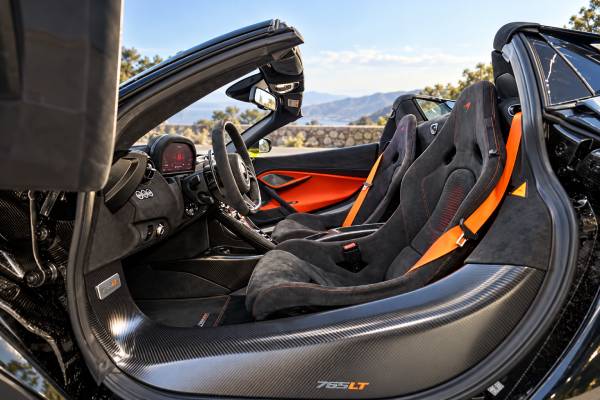
The McLaren 765LT Spider is unusual because its open roof changes the experience far more than it changes the underlying car. It keeps the 765LT’s 755 hp twin-turbo V8, shortened gearing, carbon-intensive bodywork, track-focused suspension, and active aerodynamics, yet adds a one-piece retractable hard top that can disappear in 11 seconds. McLaren engineered the Spider around the carbon-fiber MonoCage II-S, so it did not need the heavy structural bracing that often dulls a convertible supercar. The result is still a very light, very fast rear-wheel-drive Longtail: 1,388 kg at DIN kerb weight, 0–100 km/h in 2.8 seconds, and a 330 km/h top speed in its launch-era specification. For an owner or used-car shopper, however, the roof mechanism, powered rear glass, dihedral doors, active rear wing, cooling hardware, carbon-ceramic brakes, and Trofeo R tires all deserve as much attention as the engine. This guide focuses on the 2021–2022 P14RS Spider and separates its roof-specific engineering from the closely related coupe.
Table of Contents
- Carbon Roof and Structure: Why the Spider Stays an LT
- McLaren 765LT Spider Technical Specifications
- Powertrain and Open-Air Performance
- Aerodynamics, Chassis, and Roof-Down Behavior
- Ownership Care and Service Items
- Used 765LT Spider Inspection and Buying Priorities
Carbon Roof and Structure: Why the Spider Stays an LT
The key engineering fact about the 765LT Spider is that the roof conversion did not require conventional extra chassis bracing. Its MonoCage II-S carbon-fiber monocoque was developed with the open-top body style in mind, preserving the stiffness needed for an LT while keeping the weight penalty to 49 kg versus the 765LT coupe.
McLaren bonded carbon-fiber structural supports into the rear of the chassis for rollover protection, while the windscreen surround is part of the carbon structure. That matters because many convertibles begin with a coupe shell and then add mass low in the body to recover stiffness after the roof is removed. The 765LT Spider takes a different route: the carbon tub carries the structural load, leaving the retractable roof to do its job without becoming a substitute chassis member.
The roof itself is a one-piece carbon-fiber Retractable Hard Top. It raises or lowers in 11 seconds and can operate at vehicle speeds up to 50 km/h (31 mph). When closed, its carbon frame and outer panel form a rigid shell over the cabin. Because there is no center roof joint, McLaren also gained useful headroom compared with a multi-piece design. The powered rear window can be lowered independently, so the exhaust can be heard more directly even when the hard top remains in place.
Those details explain why the Spider should not be viewed simply as the softer 765LT. At 1,388 kg DIN, it is 80 kg lighter than the 720S Spider despite carrying substantially more aerodynamic, cooling, braking, and performance hardware. McLaren quoted a lightest dry weight of 1,278 kg and a power-to-weight ratio of 598 PS per tonne at that dry figure.
There is still a practical tradeoff. The roof mechanism occupies space behind the occupants, leaving 58 liters of storage under the tonneau in addition to the 150-liter front luggage compartment. More importantly for a used example, the Spider introduces moving roof parts, seals, sensors, the rear-glass mechanism, and roof-specific body interfaces that the coupe simply does not have. A prospective buyer should therefore treat a complete roof-cycle test as a fundamental part of the inspection rather than a convenience check.
Production was deliberately scarce. McLaren announced 765 customer cars worldwide, matching the numbered coupe total, and said 2021 production was already sold when the Spider was revealed in July 2021. For the 2021–2022 cars covered here, specification and provenance can materially affect desirability, but condition and correct operation should take priority over unusual paint or option combinations.
McLaren 765LT Spider Technical Specifications
The 765LT Spider is an ICE-only, longitudinal mid-engined, rear-wheel-drive supercar using McLaren’s M840T 4.0-liter twin-turbo V8 and seven-speed Seamless Shift Gearbox. Its defining technical combination is 755 bhp with very low mass, a carbon MonoCage II-S structure, a retractable carbon roof, and chassis hardware tuned specifically for the Spider rather than copied unchanged from the coupe.
Launch-era McLaren data are the most useful baseline for this 2021–2022 version because they describe the car as introduced, including its 1,278 kg lightest dry weight, 1,388 kg DIN weight, 7.2-second 0–200 km/h time, and 330 km/h maximum speed.
| Item | Specification |
|---|---|
| Engine code | M840T |
| Engine type | 90-degree V8, gasoline |
| Displacement | 4.0 L (3,994 cc) |
| Induction | Twin electrically actuated twin-scroll turbochargers |
| Lubrication | Dry sump |
| Valvetrain | 32-valve DOHC with variable valve timing |
| Maximum engine speed | 8,500 rpm |
| Maximum power | 765 PS (755 bhp / 563 kW) at 7,500 rpm |
| Maximum torque | 800 Nm (590 lb-ft) at 5,500 rpm |
| Transmission | 7-speed plus reverse Seamless Shift Gearbox (SSG) |
| Drive | Rear-wheel drive |
| Differential strategy | Open differential with Brake Steer |
| Measure | Factory figure |
|---|---|
| 0–60 mph | 2.7 seconds |
| 0–100 km/h (0–62 mph) | 2.8 seconds |
| 0–200 km/h (0–124 mph) | 7.2 seconds |
| 400 m (quarter mile) | 10.0 seconds |
| Maximum speed | 330 km/h (205 mph) |
| 100–0 km/h (62–0 mph) | 29.5 m (96.8 ft) |
| 200–0 km/h (124–0 mph) | 108 m (354 ft) |
| Item | Specification |
|---|---|
| Chassis | Carbon-fiber MonoCage II-S with aluminum front and rear crash structures |
| Suspension | Dual aluminum wishbones, adaptive dampers, Proactive Chassis Control II |
| Steering | Electro-hydraulic power assistance |
| Front brakes | 390 mm carbon-ceramic discs, 6-piston forged aluminum monobloc calipers |
| Rear brakes | 380 mm carbon-ceramic discs, 4-piston forged aluminum calipers |
| Front wheels | 9J × 19 in |
| Rear wheels | 11J × 20 in |
| Front tires | Pirelli P Zero Trofeo R, 245/35 R19 93Y XL |
| Rear tires | Pirelli P Zero Trofeo R, 305/30 R20 103Y XL |
| Item | Specification |
|---|---|
| Body style | Two-seat Spider with one-piece carbon-fiber retractable hard top |
| Roof operation | 11 seconds; operable up to 50 km/h (31 mph) |
| Length | 4,600 mm (181 in) |
| Wheelbase | 2,670 mm (105 in) |
| Height | 1,193 mm (47 in) |
| Width with mirrors | 2,161 mm (85 in) |
| Width without mirrors | 1,930 mm (76 in) |
| Front / rear track | 1,659 / 1,617 mm (65.2 / 64 in) |
| Lightest dry weight | 1,278 kg (2,818 lb) |
| DIN kerb weight | 1,388 kg (3,060 lb) |
| Ramp angle | 6.93 degrees; 8.88 degrees with vehicle lift |
| Item | Specification |
|---|---|
| Fuel tank capacity | 72 L (15.8 UK gal / 19.0 US gal) |
| Combined WLTP fuel consumption | 12.3 L/100 km |
| Combined WLTP CO₂ emissions | 280 g/km |
| Front luggage capacity | 150 L |
| Storage under tonneau | 58 L |
Published figures describe a factory configuration and test method, not a promise that every used car will reproduce them. Tire age and temperature, alignment, fuel load, options, road surface, atmospheric conditions, and vehicle condition all influence acceleration, braking, consumption, and measured weight.
Powertrain and Open-Air Performance
The Spider’s powertrain is essentially the full 765LT proposition rather than a detuned convertible package: 755 bhp, 590 lb-ft, rear-wheel drive, and shorter performance-oriented gearing. What the open body changes most is the sensory experience, especially when the roof or powered rear window exposes the cabin to the quad-exit titanium exhaust.
The M840T reaches peak power at 7,500 rpm and peak torque at 5,500 rpm, but the headline numbers tell only part of the story. McLaren revised the transmission ratios for stronger response and said in-gear acceleration was 15 percent quicker than in the 720S Spider. That matters on road and track because a driver spends far more time accelerating from an existing speed than repeating standing starts.
The seven-speed SSG remains a dual-clutch-style automated transmission with Comfort, Sport, and Track modes. In ordinary driving, the important ownership point is not how fast it can shift at full load but whether it behaves consistently when hot and cold, engages cleanly, and shows no persistent warnings. A pre-purchase drive should include low-speed maneuvering, steady cruising, repeated moderate acceleration, and a fully warmed drivetrain rather than one dramatic full-throttle run.
At the other end of the performance envelope, the factory 2.8-second 0–100 km/h figure shows how effectively the electronics and rear tires can deploy power, but the car is traction-limited enough that tire condition is critical. The bespoke Trofeo R is a track-oriented road tire. Tread depth alone does not establish whether a set is healthy: age, heat cycling, puncture repairs, uneven wear, storage conditions, and sidewall or shoulder damage matter on a car capable of 205 mph.
The titanium exhaust is part of the LT weight strategy rather than merely an acoustic option. McLaren said it is about 40 percent lighter than a steel equivalent, while thinner glass and lightweight transmission materials reduce mass elsewhere. Air conditioning and the audio system were omitted from the standard lightweight specification but could be added at no extra charge, so two apparently similar Spiders can have different equipment and weight.
That variability makes the build specification worth obtaining. It helps explain whether a car was intentionally configured as a minimal track-focused example or with more comfort equipment, and it prevents a buyer from assuming a missing feature is a fault. Factory paperwork, option records, and a VIN-specific retailer printout are more useful than trying to infer original equipment from photographs.
Aerodynamics, Chassis, and Roof-Down Behavior
Roof-up and roof-down driving were treated as distinct aerodynamic conditions, not as an afterthought. McLaren recalibrated the active rear wing for both roof positions and stated that the 765LT Spider generates 25 percent more downforce than the 720S Spider.
The fixed carbon-fiber aerodynamic package includes the front splitter and front-floor elements, side skirts, bumper aero surfaces, and rear diffuser. The active rear wing then changes angle according to operating conditions and also acts as an airbrake. Because the roof alters airflow over the upper body, its calibration is specific to the Spider’s roof state. That is why a wing warning or inconsistent movement deserves diagnosis rather than being dismissed as cosmetic.
Chassis tuning follows the same principle. The Spider uses LT-specific springs and dampers, an increased front track, a lower front ride height, and Proactive Chassis Control II with linked-hydraulic control. McLaren recalibrated the dampers for the Spider’s modest mass increase instead of simply transferring the coupe settings. The electro-hydraulic steering is also important to the car’s character because it retains hydraulic assistance rather than relying on a fully electric rack.
The braking package is equally serious: 390 mm front and 380 mm rear carbon-ceramic discs with six-piston front and four-piston rear calipers. On a used car, the visual appearance of carbon-ceramic discs can be misleading. A specialist inspection should assess disc condition using the manufacturer’s accepted method and check pads, calipers, fluid history, tire condition, and evidence of overheating as a system. Replacing worn carbon-ceramic components can be a major expense, so a generic “brakes look fine” inspection is not enough.
Roof-down driving adds enjoyment but also changes what the driver notices. With the roof stowed, wind and exhaust sound can mask minor rattles or mechanical noise. A thorough test should therefore include roof-up driving on a rough but safe road as well as roof-down operation. Listen for abnormal trim movement, wind noise that suggests seal or alignment problems, and any warning associated with the roof, rear glass, or active aero.
The 765LT Spider is capable of track use, but prior track use is not automatically a reason to reject one. The more useful question is whether the car was maintained in proportion to that use. Consistent tire replacement, documented brake checks, correct fluid servicing, clean underbody aero surfaces, sound suspension joints, and a fault-free cooling system are more informative than mileage alone.
Ownership Care and Service Items
A 765LT Spider rewards preventive, condition-based care because several expensive systems depend on correct adjustment and unobstructed movement. The roof, doors, active rear wing, cooling circuit, tires, brakes, battery, and low-clearance carbon bodywork deserve routine observation even when no warning light is present.
Start with the retractable roof. Cycle it fully during periodic checks and before a long trip after the car has been stored, watching for hesitation, asymmetry, unexpected pauses, warning messages, unusual motor or latch noises, or seals that fold incorrectly. Inspect the sealing surfaces and drainage areas for contamination and look for water staining in the cabin after washing or rain. Do not treat a roof that “usually works” as normal; intermittent behavior is precisely the type of fault that should be documented before it becomes harder to reproduce.
The dihedral doors deserve similar attention. McLaren later issued a knowledge article covering the 765LT Spider because door gas-strut springs can corrode in certain environments, potentially making the opening action rough, noisy, heavy, or ultimately allowing the spring to fail. That document instructs retailer technicians to check opening and closing effort and listen for abnormal noise. For an owner, the practical lesson is simple: a change in door effort or a crunching sound is worth reporting rather than compensating for by pulling harder.
Cooling-system condition also matters. A later McLaren service campaign for affected 765LT vehicles addressed variable clearance between the water-charge-air-cooler inlet pipe and the top hose, calling for pipe protectors and a clip. The campaign identifies affected vehicles through retailer records rather than implying every 765LT needs the work. Ask an authorized retailer to check the VIN and verify any outstanding campaign action instead of assuming a bulletin either definitely applies or definitely does not.
Active-aero warnings need the same disciplined approach. McLaren service information includes 765LT Spider-specific diagnostic paths for airbrake movement faults. That is useful evidence that the system should be diagnosed with proper fault data and position checks, not repeatedly cleared and ignored. During an inspection, the rear wing should sit evenly, move without visible binding, and complete its commanded functions without warning messages.
Battery condition can affect modern supercars in ways that look unrelated to the battery itself. A car that spends long periods parked should be maintained with the correct approved charging equipment and stored according to the owner documentation. Before buying a rarely driven example, review how it was stored and whether repeated low-voltage events appear in the history.
Finally, separate maintenance records from cosmetic presentation. A freshly detailed engine bay cannot prove fluid age, software status, campaign completion, roof adjustment, brake condition, or suspension health. The strongest file is chronological: invoices, date-and-mileage entries, tire dates, documented inspections, repair orders, and evidence that concerns were actually resolved.
Used 765LT Spider Inspection and Buying Priorities
The best 765LT Spider to buy is the one whose structure, roof systems, chassis, and service history withstand a specialist inspection; low mileage and rare paint are secondary. Because only 765 were offered globally, buyers may feel pressure to accept compromises, but the cost of correcting neglected carbon, roof, brake, or active-aero faults can quickly outweigh a seemingly attractive purchase price.
Begin with identity and provenance. Confirm the VIN, model designation, market specification, build number where documented, original options, and service history. Compare the current car with its factory configuration, paying particular attention to wheels, seats, aero parts, exhaust components, comfort equipment, and any MSO content. Modifications are not automatically undesirable, but they should be disclosed, competently installed, reversible where appropriate, and supported by original parts or paperwork when value depends on originality.
Next, inspect the carbon body and underside in good light. Look for cracks, impact marks, repaired edges, distorted panel gaps, scraped aero surfaces, or fresh finish that merits a closer explanation. The low splitter and floor can meet ramps or curbs, while track debris can mark exposed surfaces. A specialist who understands McLaren carbon construction is better placed than a general body shop to distinguish cosmetic damage from something structurally important.
Give the roof its own test sequence. Operate it more than once, including the powered rear window, and confirm that the cycle completes cleanly with no warning. Check the header area, seals, tonneau interfaces, nearby trim, and storage compartment for signs of water entry or interference. Drive with the roof closed and listen for unexpected movement or wind noise. A roof that needs alignment is very different from one with a sensor, latch, hydraulic, or structural problem, so insist on diagnosis rather than a seller’s guess.
The doors should rise and settle smoothly with similar effort on both sides. Any roughness, crunching, reluctance to stay supported, or obvious difference side to side deserves investigation in light of McLaren’s later gas-strut service guidance. Check the active rear wing for alignment and warning-free operation, and scan all control modules with suitable diagnostic equipment rather than relying only on the absence of a dashboard light.
Then assess the consumables as high-performance components, not routine used-car items:
- Verify tire size, specification, date codes, tread condition, and even wear across each axle.
- Have the carbon-ceramic discs and pads measured or assessed by a McLaren-experienced specialist.
- Check wheel rims for bends, repairs, cracks, and damage around the bead seat.
- Inspect suspension joints, dampers, hydraulic lines, and ride-height operation for leaks or faults.
- Look for cooling-system leaks, hose contact, staining, or evidence of overheating.
- Confirm the transmission, engine, steering, lift system, roof, and active aero behave correctly from cold start through full operating temperature.
One useful Spider-specific clarification concerns a later U.S. recall that is sometimes associated broadly with the “765LT.” NHTSA recall 24V-901 covers certain 2021 765LT coupes for a rear polycarbonate panel that could debond. The recall report explicitly says the Spider is not affected because it does not use that coupe-only panel. That does not mean a Spider has no campaigns or service actions; it means a buyer should check the VIN rather than transferring coupe recall information to the convertible.
A proper road test should be progressive. Start with low-speed steering, brake feel, gearbox engagement, roof-up cabin behavior, and normal engine temperature. Move to stronger acceleration only after the car is fully warm and conditions are safe. Watch for steering pull, vibration, inconsistent brake response, boost or cooling warnings, transmission messages, suspension faults, and airbrake alerts. After the drive, inspect again for fluid leaks, hot smells, or new warnings.
The final decision should be based on the cost and certainty of resolving every known issue. A documented, regularly used car with fresh tires, healthy brakes, completed campaigns, a fault-free roof, and transparent history can be a stronger prospect than a lower-mileage car that has spent years sitting with deferred maintenance. For this McLaren, condition is not just a matter of resale value; it is what allows the lightweight engineering, open-air drama, and exceptional performance to work as intended.
References
- The McLaren 765LT Spider: extreme performance and new heights of driver engagement from McLaren’s most powerful-ever convertible supercar 2021 (McLaren Automotive Media Release)
- McLaren 765LT Spider – Light & Extreme Convertible Supercar 2021 (Manufacturer Model Page)
- McLaren 765LT Spider – Technical Specification 2021 (Archived McLaren Technical Specification)
- McLaren 720S Spider, 765LT Spider and 750S Spider Door Gas Strut Rough or Noisy During Operation 2024 (McLaren Knowledge Article)
- Pipe Protector and Clip Installation 2025 (Service Campaign)
- Part 573 Safety Recall Report 24V-901 2025 (Recall Report)
Disclaimer
Use this article as general information, not as a replacement for qualified diagnosis or repair. Vehicle-specific specifications, tightening torques, maintenance intervals, and workshop procedures may differ with VIN, destination market, fitted equipment, and document revision; check the official service information that applies to the exact car before carrying out work.
Found the guide useful? Sharing it with a McLaren community on Facebook, X/Twitter, or another platform helps support further technical coverage.