
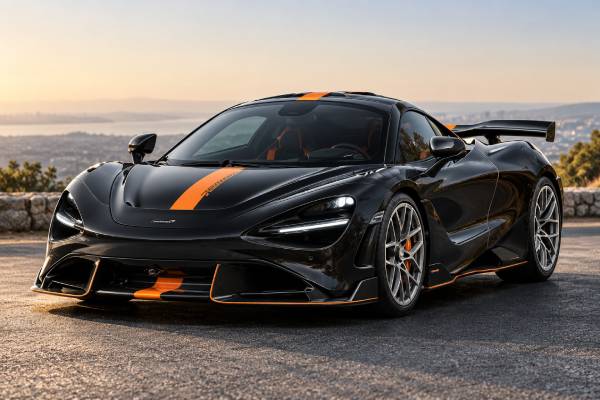
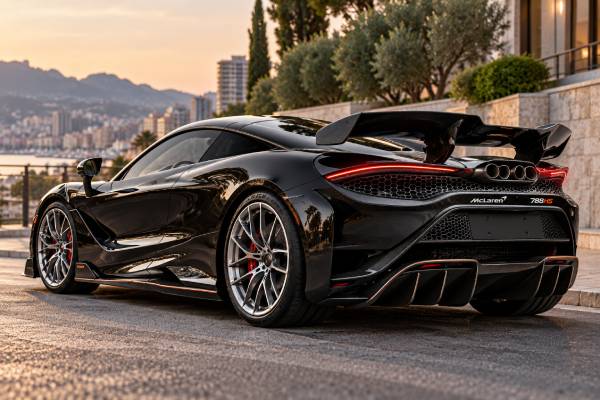
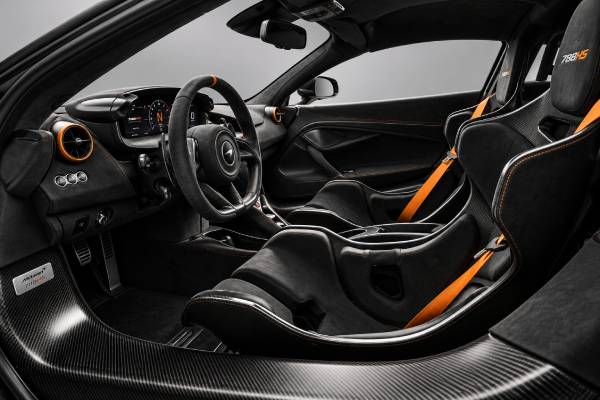
The McLaren 788HS is the final, most focused evolution of the V8 supercar line that began with the 720S, passed through the 765LT and 750S, and now closes with a 200-car limited run. Its name refers to 788 PS, which equals about 777 bhp rather than 788 SAE horsepower, and that distinction matters when comparing published figures. The familiar 4.0-liter M840T twin-turbo V8 is heavily developed rather than replaced, while the rest of the car receives a more aggressive carbon-fiber aero package, a model-specific chassis calibration, Senna-derived braking hardware, center-lock wheels, and weight-saving measures. Production is split evenly between 100 coupés and 100 Spiders, all to be individually curated through McLaren Special Operations. For buyers, the 788HS is less a conventional new model than a factory-built capstone: a rare, road-legal, track-capable version of an established architecture with unusually little real-world ownership history yet.
Table of Contents
- What makes the 788HS different
- 788HS specifications and technical data
- Engine, aerodynamics, and straight-line performance
- Chassis, brakes, wheels, and driver feedback
- Maintenance and track-use care
- Buying, ordering, and collectibility
- Who the 788HS is for
What makes the 788HS different
The 788HS is essentially McLaren’s most concentrated road-and-track interpretation of the 720S-derived supercar formula, not a clean-sheet successor. It takes the 750S foundation and adds more power, less mass, more downforce, stronger braking hardware, a sharper chassis tune, and much greater scarcity.
The HS suffix means High Sport, a designation McLaren has used sparingly. The 788HS is only the third McLaren to carry it, following the MP4-12C HS and the later MSO HS. That background explains why the car is positioned differently from a normal trim level: it is meant to be a definitive factory special rather than simply the next step in a continuous range.
Production is capped at 200 cars worldwide, divided into 100 coupés and 100 Spiders. Every example is handled through McLaren Special Operations, so paint, exposed-carbon treatments, cabin finishes, and other personal choices can make individual cars materially different. That is important for future buyers because two cars with the same basic mechanical specification can have very different original invoices, appearance, desirability, and replacement costs.
The biggest mechanical change is the output of the M840T V8. McLaren rates the engine at 788 PS, or roughly 777 bhp, with 800 Nm of torque. The extra output comes with lightweight forged pistons, ultra-low-inertia twin-scroll turbochargers, twin fuel pumps, revised engine mounting, and a new quad-exit titanium exhaust. The engine still sends power only to the rear wheels through a seven-speed Seamless Shift Gearbox.
The aerodynamic work is just as important as the power increase. A multi-zone front splitter, S-duct bonnet, raised active rear spoiler, louvred under-wing panel, and Formula 1-inspired rear diffuser are designed as one package. McLaren says the result is 10 percent more downforce than the already aggressive 765LT. That does not mean 10 percent more downforce in every road situation; aerodynamic load depends on speed and the position of active elements. It does mean the 788HS was developed to remain more settled and usable as cornering and braking speeds rise.
For a potential buyer, the key point is that the 788HS is not just a 750S with an ECU tune. The engine, exhaust, aero, brakes, suspension calibration, ride height, wheels, and visual identity all contribute to its purpose. Those changes are also the areas that deserve the closest inspection later in the car’s life.
788HS specifications and technical data
The 788HS is a gasoline-only, rear-mid-engined ICE supercar. It uses McLaren’s 3,994 cc M840T twin-turbocharged V8, a seven-speed dual-clutch SSG, rear-wheel drive, and a two-seat carbon-fiber structure; there is no hybrid motor, traction battery, or external charging system to account for.
| Specification | Value |
|---|---|
| Engine | M840T 4.0-liter twin-turbocharged V8 |
| Displacement | 3,994 cc |
| Fuel | Gasoline/petrol |
| Maximum power | 788 PS at 7,500 rpm; about 777 bhp |
| Maximum torque | 800 Nm (590 lb-ft) |
| Maximum engine speed | 8,500 rpm |
| Induction | Twin turbochargers; ultra-low-inertia twin-scroll design |
| Key engine changes | Lightweight forged pistons and twin fuel pumps |
| Exhaust | Quad-exit titanium system |
| Specification | Value |
|---|---|
| Transmission | 7-speed Seamless Shift Gearbox (dual-clutch) |
| Drive type | Rear-wheel drive |
| Engine position | Rear-mid, longitudinal |
| Chassis family | Carbon-fiber monocoque architecture derived from the 720S/750S supercar line |
| Seating | 2 |
| Body style | 2-door coupé |
| Specification | Manufacturer claim |
|---|---|
| 0–100 km/h (0–62 mph) | 2.8 seconds |
| 0–200 km/h (0–124 mph) | 7.0 seconds |
| Top speed | 330 km/h (205 mph) |
| Lightest dry weight | 1,265 kg (2,789 lb) |
| Power-to-weight ratio | 623 PS per tonne |
| Specification | Value |
|---|---|
| Suspension system | Proactive Chassis Control III linked-hydraulic suspension |
| Suspension calibration | Bespoke 788HS tuning |
| Front ride height | 5 mm lower than the 750S |
| Front brakes | Senna-derived carbon-ceramic discs with six-piston forged aluminum monoblock calipers |
| Brake cooling | Integrated racing-inspired cooling ducts |
| Wheel fastening | Center-lock; first use in this McLaren supercar series |
| Wheels | Super Lightweight Forged Alloy design |
| Common tire sizing | 245/35 ZR19 front; 305/30 ZR20 rear |
| Specification | Value |
|---|---|
| Aero construction | Carbon-fiber package |
| Front treatment | Multi-zone splitter and S-duct bonnet |
| Rear treatment | Raised active spoiler and Formula 1-inspired diffuser |
| Under-wing detail | Louvred panel supporting cooling and aerodynamic efficiency |
| Downforce claim | 10% increase versus McLaren 765LT |
| Coupé-specific feature | Gloss-black roof scoop; full Visual Carbon Fibre bodywork available |
The figures above are best read as factory specifications for a very new limited-production car. Independent instrumented testing, long-term reliability data, depreciation history, and model-specific service information remain much thinner than for older McLarens, so owners should resist filling gaps with 750S or 765LT data unless McLaren explicitly confirms compatibility.
Engine, aerodynamics, and straight-line performance
The 788HS gains its character from how the upgraded V8 and aero package work together, not from a huge change in the headline 0–100 km/h time. It matches the 750S’s claimed 2.8-second sprint to 100 km/h, then pulls harder as speed builds, reaching 200 km/h in 7.0 seconds.
That pattern makes sense for a rear-wheel-drive supercar already operating near the traction limits of road tires from a standing start. Adding power does not automatically produce a dramatically quicker launch because the rear tires still have to transmit the available torque. Once the car is moving and aerodynamic stability becomes more important, the extra output can be used more effectively.
The engine revisions are substantial enough to matter beyond the number on the badge. Lightweight forged pistons reduce reciprocating mass, low-inertia twin-scroll turbochargers are intended to sharpen response, and twin fuel pumps support the higher output. Peak power arrives at 7,500 rpm and the engine can spin to 8,500 rpm, so the 788HS remains a high-revving turbocharged V8 rather than relying only on a broad wall of low-rpm boost.
The quad-exit titanium exhaust changes both weight and sound. McLaren also revised its induction and exhaust sound-symposer systems, so more of the engine’s character reaches the cabin. This is worth understanding before buying: the 788HS is deliberately more intense than the already fast 750S, and its exhaust presentation is part of the product rather than a minor cosmetic change.
Aerodynamics are equally central. The S-duct routes air through the front bodywork to manage pressure and airflow, while the multi-zone splitter shapes the flow entering and passing under the car. At the rear, the raised active spoiler and large diffuser work to control wake and generate load. The louvred under-wing panel also helps with powertrain cooling. These parts are not independent styling add-ons; damage, incorrect repair, misalignment, or non-original replacement can affect both value and function.
The quoted 330 km/h top speed shows that McLaren did not sacrifice high-speed capability simply to chase maximum downforce. A high-downforce car can create enough drag to reduce top speed substantially, so the 788HS package reflects a road-car compromise: more aerodynamic authority than a 765LT while preserving very high maximum speed.
Owners planning regular track use should also remember that the factory acceleration and top-speed figures are controlled-condition claims, not promises for every day. Tire temperature, surface condition, fuel load, ambient temperature, elevation, alignment, and the condition of the engine and gearbox all influence actual performance. The most useful benchmark is not whether every launch reproduces a brochure number, but whether the car operates consistently and free of warnings, misfires, overheating, or unusual driveline behavior.
Chassis, brakes, wheels, and driver feedback
The 788HS chassis changes are aimed at making the car more immediate and stable without turning it into a trailer-only track special. Its Proactive Chassis Control III suspension receives model-specific tuning, the front ride height is 5 mm lower than the 750S, and the engine mounts are recalibrated to transmit more connection without abandoning long-distance usability.
McLaren’s linked-hydraulic suspension is important to the feel of this platform. Instead of relying on conventional anti-roll bars alone to control body movement, the hydraulic network helps manage roll and heave while allowing each wheel to respond to road inputs. In practical terms, that gives engineers another way to combine body control with compliance. The 788HS tune is intended to move that balance toward precision.
The braking system is one of the clearest hardware upgrades. McLaren uses carbon-ceramic discs derived from the Senna, paired at the front with six-piston forged aluminum monoblock calipers and dedicated cooling ducts. Carbon ceramics can offer excellent heat resistance and low unsprung mass, but they also deserve careful ownership habits. A chipped disc edge, impact damage, abnormal surface condition, or heavily worn pad set can be expensive. Anyone inspecting a used 788HS should have the brake system assessed by a technician familiar with McLaren carbon-ceramic components rather than judging disc condition by appearance alone.
The center-lock wheels are another meaningful change because the 788HS is the first member of this supercar series to use that fastening system. Center locks are common in racing and high-end track cars because they reduce the wheel to a single primary fastener, but they require correct tools, procedures, torque specifications, and locking checks. This is not an area for generic wheel-shop habits. Documentation of proper wheel service becomes part of a sensible ownership file.
Tire choice matters just as much as wheel hardware. The reported 19-inch front and 20-inch rear fitment preserves the staggered layout familiar to the platform, with 245/35 front and 305/30 rear sizing commonly listed. Because this car’s steering, braking, traction control, and aero were developed around specific performance targets, owners should treat tire brand, model, load rating, speed rating, age, and axle matching as engineering choices rather than cosmetic options.
For road use, the best way to understand the 788HS is not to assume that “more focused” means “always harsher.” McLaren explicitly kept long-distance usability in the brief. The likely difference is that the car communicates more of what the powertrain and chassis are doing while carrying greater aerodynamic and braking capability for high-speed use. That combination is a major reason the car may appeal to collectors who actually drive their cars rather than store them permanently.
The rear-wheel-drive layout also keeps the 788HS mechanically different from many newer performance cars that use all-wheel drive to improve launch traction. That choice puts more responsibility on rear-tire condition and electronic control, especially on cold or damp roads. Published technical reporting describes an open rear differential working with McLaren Brake Steer, which can selectively brake an inside rear wheel to help the car rotate. For an owner, the practical lesson is simple: matching rear tires and healthy brake hardware affect more than stopping distance. They are part of how the car deploys power and changes direction.
Ride height deserves similar respect. A front end 5 mm lower than a 750S is meaningful when the splitter and underbody are expensive carbon-fiber aerodynamic parts. Steep ramps, parking stops, trailer angles, and road debris can produce damage long before a driver notices a change in handling. A pre-drive walkaround and sensible approach angles are cheap habits on a car where a small impact may involve both cosmetic repair and aerodynamic alignment.
Maintenance and track-use care
A 788HS should be maintained as a low-volume, high-output McLaren with expensive carbon, brake, aero, and center-lock hardware, not as a normal 750S with a different badge. Model-specific procedures should come from the car’s VIN-linked McLaren documentation and authorized service information, especially because public service data is still limited.
There is no benefit in inventing oil capacities, fluid specifications, service intervals, wheel-center-lock torque, or alignment values from related models. The M840T family is familiar, but the 788HS has its own calibration and hardware. Use the exact factory procedure for the car in front of you.
A practical ownership routine should focus on condition as well as mileage:
- Before spirited or track driving: inspect tire pressure and condition, wheel security, brake pads and discs, fluid levels, warning messages, underbody panels, and the visible aero surfaces.
- After track use: look for tire pickup, cuts, heat cycling, pad consumption, stone damage, diffuser or splitter contact, and any change in pedal feel or steering behavior.
- For long storage: keep the 12-volt system supported with equipment approved for the vehicle, maintain correct tire pressures, control moisture, and avoid letting fuel and fluids age indefinitely.
- For carbon bodywork: document any damage immediately. Cosmetic-looking impacts around the splitter, diffuser, wheel arch, or underbody can be more expensive than they appear.
- For the titanium exhaust: investigate new rattles, contact marks, or misalignment rather than assuming noise is normal because the system is intentionally loud.
- For the active rear aero: verify smooth operation and absence of warning messages. Body repair near active components should be treated as functional work, not merely paintwork.
Track use increases thermal and mechanical stress even when the car is designed for it. Brake fluid, pads, tires, and alignment can deteriorate much faster under repeated high-energy stops and sustained cornering than in normal road driving. Service decisions therefore need to reflect how the car is used, not only the calendar or odometer.
The 788HS is also too new for a meaningful catalogue of model-specific chronic faults. That is a reason for disciplined inspection, not a reason to assume problems. Watch for patterns in factory campaigns, software updates, service communications, and early owner reports, but separate verified trends from isolated anecdotes. On an ultra-low-volume model, a handful of online complaints can look statistically important even when the sample is tiny.
Keep every invoice, inspection sheet, software update record, tire purchase, alignment report, and track-service record. For a 100-unit body style, a complete history can be particularly valuable because future buyers will have very few comparable cars against which to judge condition.
Buying, ordering, and collectibility
Buying a 788HS is mainly about provenance, specification quality, condition, and access to support; the normal “pick the best trim” advice does not apply because there is only one highly specialized mechanical specification. With only 100 coupés planned, individual configuration and history matter more than they would on a mass-produced supercar.
For a new allocation, the MSO specification deserves more thought than simply maximizing options. A distinctive commission can make the car special, but a coherent color and material combination is easier to appreciate and may be easier to resell than a car built around short-lived fashion. Full Visual Carbon Fibre bodywork is especially significant because it changes both appearance and replacement cost. Ask for a complete copy of the original build specification, paint and trim codes, option list, and MSO documentation.
For a pre-owned car, verify the identity and paperwork first. The 788HS should have a dedication plaque and clear evidence of its limited-production status. Match the VIN, service records, original order documentation, and invoices. A car advertised with unusual carbon, wheel, or interior parts should be checked against its original specification rather than assumed to be factory-authentic.
A specialist pre-purchase inspection should concentrate on several expensive areas:
- carbon-fiber body panels, splitter, S-duct bonnet, underbody and diffuser;
- active rear spoiler operation and alignment;
- center-lock wheel condition and evidence of correct servicing;
- carbon-ceramic brake disc and pad condition;
- tire age, matching, heat history, and track wear;
- suspension leaks, ride-height behavior, and chassis warnings;
- engine, turbocharger, fuel-system, gearbox, and exhaust fault history;
- evidence of paintwork, structural repair, track incidents, or curb contact;
- software status, diagnostic trouble codes, and open service campaigns;
- completeness of keys, manuals, charger/support equipment, tools, and MSO records.
Do not assume that ultra-low mileage is automatically better. A car that has been stored poorly, run only for short periods, left with an unsupported battery, or kept on aging tires can need more recommissioning than a carefully used example with regular professional maintenance. Conversely, repeated track use is not automatically disqualifying if it is documented and supported by appropriate service work. Condition and evidence matter more than a single odometer number.
Collectibility is plausible because the 788HS combines rarity, the HS badge, a final-edition narrative, a non-hybrid V8, and the end of the 720S-derived line. None of that guarantees appreciation. Transaction prices can be distorted by launch excitement, taxes, MSO option values, regional allocation, and the small number of cars offered publicly. A buyer should treat investment potential as secondary to wanting the car itself.
The closest internal comparisons are the 765LT and 750S. The 765LT has its own Longtail identity and established reputation; the 750S is less rare and more accessible; the 788HS combines more power, stronger aero, rare-production status, and the final High Sport story. Those differences may matter to collectors, but they also make replacement parts and body repairs more specialized.
Who the 788HS is for
The 788HS suits a buyer who wants the most developed version of McLaren’s second-generation V8 supercar architecture and is prepared to manage the costs and responsibilities that come with rarity. It is especially compelling for someone who values steering and chassis feedback, high-speed aero, a non-hybrid powertrain, and the historical significance of the final 720S/750S-line derivative.
It is less logical for a buyer who mainly wants the easiest McLaren to use, the lowest operating cost, or the broadest choice of cars on the market. A 750S delivers much of the same core architecture with greater availability. An Artura offers a different, newer hybrid approach. The 788HS exists for a narrower reason: to push a familiar formula to its end point.
For ownership, three priorities matter most. First, protect originality where it affects function and value, especially the carbon aero, center-lock wheels, brakes, and MSO-specific trim. Second, service the car according to its actual use and factory information rather than assumptions borrowed from related models. Third, keep unusually complete documentation from day one.
Because the model was only introduced in 2026, later evidence may change what buyers should inspect and how the market values particular specifications. The safest current approach is to buy on condition, provenance, correct factory configuration, and access to expert McLaren support. The 788HS has the ingredients of a memorable final-series car, but its long-term reputation will be built by how these 200 examples are driven, maintained, repaired, and preserved.
References
- McLaren 788HS – McLaren Newport Beach 2026
- New McLaren 788HS – the last pure V8 McLaren? 2026
- The McLaren 788HS Takes the Mid-Engine V-8 Supercar to the Extreme 2026
- The new 788HS is the first ‘new’ McLaren for almost two years 2026
- Limited-run McLaren 788HS is the last of an iconic supercar generation 2026
- The McLaren 788HS Is the Ultimate Evolution of the 750S 2026
Disclaimer
This article is for informational purposes only and is not a substitute for professional diagnosis, maintenance, or repair. Specifications, torque values, service intervals, fluids, and procedures can vary by VIN, market, software level, and equipment; always verify them against current official McLaren service documentation for the exact vehicle.
If you found this guide useful, please consider sharing it on Facebook, X/Twitter, or another platform to support our work.