
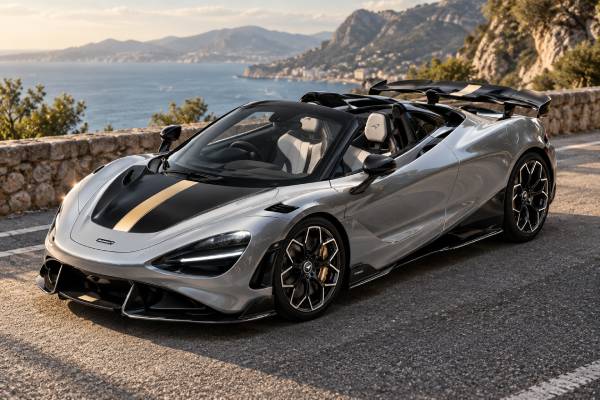
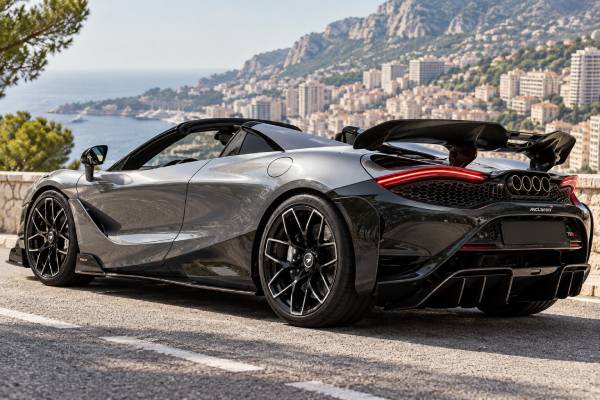
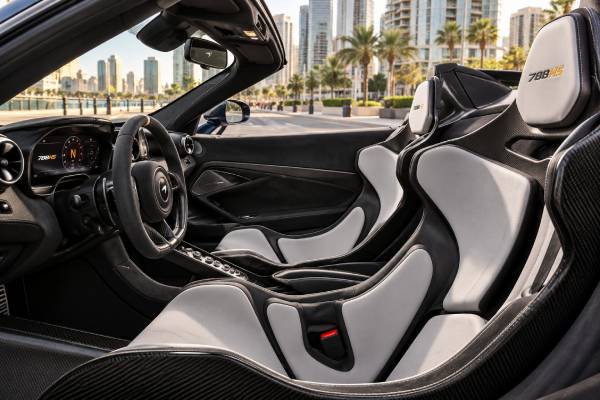
A 788HS Spider is not simply the roof-down answer to the 788HS Coupé. It is one of only 100 open-top cars in McLaren’s 200-unit High Sport finale, combining a retractable hardtop with the most developed version of the marque’s 4.0-liter, non-hybrid V8 Super Series formula. The engine produces 788 PS—about 777 hp—and 800 Nm, while McLaren quotes 0–100 km/h in 2.8 seconds, 0–200 km/h in 7.0 seconds, and 330 km/h. The folding-roof hardware adds a reported 49 kg compared with the coupé, yet the announced acceleration and maximum-speed figures are unchanged. For owners and buyers, the Spider also creates concerns a fixed-roof car does not have: roof operation, seals, water management, moving-panel alignment, and the need to verify body-style-specific parts. This guide focuses on those differences while also covering the M840T powertrain, aerodynamic package, hydraulic suspension, carbon-ceramic brakes, center-lock wheels, service priorities, and the documentation that matters on an individually specified MSO car.
Table of Contents
- The Open-Top Version of High Sport
- How the V8 Performance Package Translates to the Spider
- The Roof, Carbon Body, and Weather Exposure
- Verified 788HS Spider Technical Data
- What the Chassis, Aero, and Brakes Mean on the Road
- Inspection, Service, and Repair Priorities
- Using and Preserving One of 100 Spiders
The Open-Top Version of High Sport
The 788HS Spider is the rarer-feeling, open-air expression of the same High Sport program that closes McLaren’s 720S/765LT/750S era. Its defining trade is easy to state: a retractable hardtop adds 49 kg of reported dry mass, but it also gives the car a driving experience the fixed-roof version cannot reproduce.
McLaren uses the HS initials for “High Sport,” a label reserved for especially focused, limited series-production cars. The 788HS became only the third McLaren to use that designation. Global production is limited to 200 examples divided evenly between 100 Coupés and 100 Spiders, and McLaren Special Operations is involved in every allocation. That makes the Spider both a performance derivative and a highly individualized object; two cars can share the same mechanical specification while differing dramatically in color, carbon treatment, trim, stitching, and other MSO details.
The retractable roof is not the only visual distinction. McLaren’s launch material specifically identifies the roof scoop as a Coupé feature. A Spider should therefore be judged against Spider reference material, not against a fixed-roof 788HS photographed with the scoop. This sounds obvious, but it matters in a market where dealer listings, generic configurator images, and social posts can mix the two body styles.
Weight provides another clear separator. Published Spider reporting gives a 1,314 kg dry figure, versus the 1,265 kg lightest-dry figure announced for the Coupé. The 49 kg difference is attributed to the folding-roof mechanism. It is a meaningful increase on such a light car, yet it does not turn the Spider into a soft grand tourer. The same High Sport suspension concept, carbon aerodynamic hardware, braking package, engine tune, and rear-wheel-drive layout remain central to its character.
For a buyer, the open-top hardware also changes what “original condition” means. A perfect engine history cannot compensate for a roof that is misaligned, intermittently faults, has damaged seals, or has been repaired without documentation. Likewise, pristine paint is not enough if carbon aero components or the roof structure have hidden impact damage. The Spider should be evaluated as a complete system: powertrain, chassis, roof, carbon body, electronics, and the record showing how all of them have been maintained.
How the V8 Performance Package Translates to the Spider
The Spider receives the full 788HS engine specification: the M840T 3,994 cc twin-turbo V8 produces 788 PS at 7,500 rpm and 800 Nm at 5,500 rpm, with an 8,500-rpm maximum engine speed. In conventional horsepower terms the output is about 777 hp, which is why describing the car simply as “788 hp” can be misleading outside metric-PS usage.
There is no electric traction motor in the 788HS Spider: every unit of propulsion comes from the V8 and reaches the rear axle through McLaren’s seven-speed Seamless Shift Gearbox. The development work is aimed at extracting more from that established combustion layout while changing its response and sound, rather than adding hybrid assistance. Internal engine upgrades and the titanium four-outlet exhaust are detailed in the technical-data section below.
McLaren also gave the engine mounts a specific calibration intended to increase the sense of connection without making the car unsuitable for longer road use. The induction and exhaust sound symposer systems are physical acoustic devices rather than speaker-generated imitation. In the Spider, those choices gain extra relevance because lowering the roof exposes the occupants to more of the engine, exhaust, tire, and airflow soundtrack. The roof does not create more power, but it changes how the powertrain is perceived.
Officially announced straight-line numbers remain formidable despite the added roof hardware: 2.8 seconds to 100 km/h, 7.0 seconds to 200 km/h, and 330 km/h maximum speed. Those figures describe the model under manufacturer test conditions. They should not be treated as repeatable targets on ordinary roads. Surface temperature, tire condition, weather, fuel load, and driver input can all change acceleration, and real-world braking distance still depends on available grip.
The more relevant road-use lesson is how quickly speed builds. Eight hundred newton-metres sent through two driven tires can produce large changes in vehicle attitude when grip is poor. Cold tires, standing water, rough pavement, painted road markings, or an abrupt throttle request can reduce the margin available to the stability systems. Owners new to high-output rear-wheel-drive cars should learn the car progressively instead of treating a quoted 0–100 figure as an invitation to use launch control at every opportunity.
There is one specification trap worth avoiding: the 788HS Spider is related to the 750S Spider, but that does not make every 750S roof or operating value transferable. Public launch material did not establish every roof-cycle parameter for the 788HS. A roof opening time, moving-operation speed, calibration sequence, tire pressure, service torque, or fluid quantity should be taken from the exact 788HS Spider documentation rather than copied from another McLaren because it appears mechanically similar.
The Roof, Carbon Body, and Weather Exposure
The retractable hardtop is the Spider component most likely to create ownership questions that do not exist on the Coupé. Routine care should focus on smooth operation, correct panel seating, clean seals and channels, and early investigation of any water trace or fault message.
A roof mechanism combines moving panels, latches, sensors, actuators, seals, window coordination, and control logic. That means an intermittent problem can have several causes, and repeatedly cycling the roof is not a sound diagnostic method. If movement becomes abnormal, one side appears to lag, a latch fails to confirm, or the system stops with a warning, the sensible response is to stop operating it and have the fault checked using the proper diagnostic procedure.
Owners can still do useful visual checks without attempting repairs. Look along the roof and window interfaces for even gaps when closed. Check rubber seals for cuts, pinching, flattening, dirt, or product residue. Remove leaves and grit from visible channels by safe, non-abrasive methods. After rain or washing, inspect the cabin and accessible luggage areas for unexpected moisture. A musty smell or recurring condensation deserves attention even when no obvious drip is visible.
Cleaning products matter because the Spider brings several sensitive materials together. Aggressive solvent can harm seal material or finishes; careless pressure washing can drive water where normal rain would not; abrasive polishing can damage exposed-carbon clearcoat. Follow the material-specific care instructions supplied for the car, especially if it has the optional full visual-carbon body. On a limited MSO build, preserving the original finish can be as important as achieving a showroom shine.
Carbon-fiber damage also requires different thinking from a dent in a steel panel. The visible mark may be in clearcoat, but an impact can also affect the laminate, edge, bracket, or hidden mounting point. Splitters and lower aero pieces are particularly exposed to ramp strikes and road debris. If an impact is substantial enough to crack a component or change panel alignment, inspection by a composite-capable McLaren specialist is more valuable than cosmetic touch-up alone.
Storage is part of roof care, but generic convertible advice can be misleading. Do not assume the correct long-term roof position, battery-maintainer connection, or cycling frequency from another model. Use the 788HS Spider manual and current McLaren service guidance. The same principle applies if the car is transported: loading angle, tie-down procedure, alarm settings, and roof state should be chosen for this vehicle, not improvised at the transporter door.
A simple ownership habit helps here: photograph the roof seams, lower carbon aero, wheel faces, and exposed-carbon surfaces periodically under consistent lighting. That record will not replace a professional inspection, but it makes gradual changes and new damage easier to spot and gives future buyers better evidence of how the car was kept.
Verified 788HS Spider Technical Data
The 788HS Spider is a gasoline ICE supercar with a rear-mid-mounted V8, seven-speed dual-clutch transmission, rear-wheel drive, two-seat open-top body, and retractable hardtop. The tables below prioritize values published specifically for the 788HS or clearly reported for the Spider, while leaving out unconfirmed roof, service, and fitment figures.
| Specification | Value |
|---|---|
| Engine family | M840T |
| Configuration | 4.0-liter twin-turbocharged V8 |
| Displacement | 3,994 cc |
| Maximum power | 788 PS (about 777 hp) at 7,500 rpm |
| Maximum torque | 800 Nm (590 lb-ft) at 5,500 rpm |
| Maximum engine speed | 8,500 rpm |
| Engine hardware | Lightweight forged pistons, ultra-low-inertia twin-scroll turbochargers, twin fuel pumps |
| Transmission | 7-speed Seamless Shift Gearbox, dual clutch |
| Drive type | Rear-wheel drive |
| Exhaust | Quad-exit titanium |
| Specification | Value | Context |
|---|---|---|
| 0–100 km/h | 2.8 seconds | McLaren-quoted 788HS performance |
| 0–200 km/h | 7.0 seconds | McLaren-quoted 788HS performance |
| Maximum speed | 330 km/h (205 mph) | McLaren-quoted 788HS performance |
| Spider dry weight | 1,314 kg (2,897 lb) | Published Spider figure |
| Spider weight increase | 49 kg (108 lb) | Versus 1,265 kg Coupé lightest-dry figure |
| Roof type | Retractable hardtop | Spider-specific body configuration |
| Specification | Configuration |
|---|---|
| Suspension | Proactive Chassis Control III linked-hydraulic system |
| Damping | Adaptive dampers with bespoke 788HS calibration |
| Front ride height | 5 mm lower than 750S |
| Brake discs | Carbon ceramic, derived from McLaren Senna |
| Front brake calipers | Six-piston forged-aluminum monoblock |
| Brake cooling | Integrated racing-inspired cooling ducts |
| Wheel design | Super Lightweight Forged Alloy |
| Wheel fastening | Center lock; first application in this McLaren supercar series |
| Specification | 788HS detail |
|---|---|
| Primary structure | Carbon-fiber monocoque architecture |
| Front splitter | Multi-zone carbon-fiber design |
| Bonnet | S-duct aerodynamic layout |
| Rear spoiler | Raised active design |
| Under-wing area | Louvred panel supporting airflow and cooling |
| Rear diffuser | Formula 1-inspired design |
| Downforce | 10% higher than McLaren 765LT |
| Roof scoop | Specified for Coupé derivatives, not the Spider roof arrangement |
| Specification | Value or feature |
|---|---|
| Introduction | 2026 |
| Total 788HS production | 200 vehicles worldwide |
| Spider allocation | 100 vehicles worldwide |
| Coupé allocation | 100 vehicles worldwide |
| Personalization program | McLaren Special Operations involvement for every example |
| Seating | Two seats |
| Center console | Lightweight carbon-fiber design |
| Driver interface | Steering-column instrument binnacle with Powertrain and Handling controls within reach |
| Infotainment | McLaren Infotainment System II |
The omissions are intentional. No roof-cycle time, roof operating-speed limit, center-lock torque, service-fluid capacity, or maintenance interval appears here unless it has been confirmed for the 788HS Spider. Those values belong in VIN- and market-correct owner or workshop information, not in a table completed by analogy.
What the Chassis, Aero, and Brakes Mean on the Road
The 788HS hardware is designed to make the car more precise under load, not merely more dramatic to look at. On the Spider, the important question is how the aero, hydraulic suspension, braking system, and low-mass structure work together despite the additional roof mechanism.
Start with the suspension. Proactive Chassis Control III hydraulically links the dampers to control roll and heave while retaining adaptive behavior. The 788HS receives its own calibration and sits 5 mm lower at the front than the 750S. On a smooth road or circuit, that supports sharper responses and body control. In ordinary driving, it also reduces the clearance available to the front aero, so steep parking entrances and abrupt road crests become practical hazards rather than abstract geometry.
The aerodynamic package builds load through several areas of the body. The front splitter and S-duct manage the air arriving at the nose and moving through the upper body; the raised active rear spoiler, under-wing louvres, and rear diffuser manage the flow farther back and support stability and cooling. McLaren states that the combined package creates 10% more downforce than the 765LT. The useful ownership point is that these parts have designed relationships. A damaged lower element or incorrectly fitted replacement is not just a cosmetic imperfection on an expensive car.
Braking hardware follows the same high-performance logic. The Senna-derived carbon-ceramic discs, six-piston forged-aluminum front calipers, and dedicated cooling are intended to maintain stopping performance under sustained use. Carbon ceramics are durable in the right conditions but costly to replace, and their health should be assessed with the correct inspection method. A quick glance through a wheel does not establish remaining service life after repeated high-temperature use.
Center-lock wheels require special discipline as well. Their appeal is obvious on a car with a racing-influenced brief, but installation is safety critical. The correct fastener condition, lubrication rules if specified, tool, tightening procedure, locking process, and torque must all come from current McLaren instructions. A torque number remembered from another model is not “close enough.” If tire or brake work is performed away from a McLaren specialist, confirm beforehand that the workshop has the correct equipment and documentation.
For track use, preparation should focus less on chasing a lap-time claim and more on condition. Tires need adequate tread, correct pressure strategy, and no age or damage concerns. Brake condition, fluid, wheel security, underbody integrity, and active-aero function should be checked. Afterward, another inspection can catch heat-related wear, debris damage, or a minor splitter strike before the next road trip. Track use itself is not inconsistent with the car’s engineering; neglect after track use is the larger concern.
Inspection, Service, and Repair Priorities
A pre-purchase inspection for a 788HS Spider should verify four categories separately: identity and provenance, roof and body condition, mechanical/electronic health, and evidence of correct specialist servicing. Low mileage alone answers none of those questions.
Begin with the records. Match the VIN across the car, registration or title documents, service history, and factory/MSO build information. Because every 788HS could be highly personalized, the original specification is especially valuable. It can confirm whether visual-carbon panels, paint, upholstery, stitching, plaques, and other details belong to the car rather than being later additions.
Next, inspect the retractable roof under the exact operating procedure. Watch for even movement and correct window indexing, then check the final panel fit from both sides. Look for seal damage, water staining, repaired trim, roof-control warnings, and stored diagnostic faults. If the car has had roof work, ask what was replaced or adjusted and who performed the calibration. A mechanism that happens to complete one cycle during a viewing is not the same as a clean diagnostic history.
The carbon body and underside deserve bright light and a lift. Pay attention to the splitter, sill region, diffuser, wheel-arch areas, mounting points, and any exposed-carbon finish. Ask whether paint-protection film has been installed or removed and whether panels have been refinished. For any structural or composite repair, documentation of the method and parts used is more useful than a verbal assurance that the damage was “only cosmetic.”
Mechanical checks should include the M840T engine, seven-speed gearbox, cooling system, hydraulic suspension, adaptive damping, carbon-ceramic brakes, center-lock hardware, tires, and electronic systems. A diagnostic scan can reveal stored faults that may not appear during a short drive. Inspect for fluid leaks and impact marks, and establish the condition of consumables before negotiating price. On a low-volume model, small deferred jobs can become expensive when special-order parts or MSO finishes are involved.
Service history should be judged by correctness, not simply by the number of stamps. The 788HS was introduced in 2026, so current technical information can evolve as McLaren issues updated procedures or software. Exact service intervals, fluid specifications, capacities, wheel fastening data, roof calibration, and repair instructions should be checked against the latest documentation for the VIN and market at the time the work is performed.
Modifications need a separate conversation. ECU software, exhaust changes, non-original wheels, altered suspension, aftermarket carbon, or electrical accessories can affect drivability, warranty treatment, diagnostic behavior, originality, and resale. If changes are reversible, obtaining the original parts and documentation is preferable. A heavily personalized factory build is not the same thing as an undocumented aftermarket modification.
Using and Preserving One of 100 Spiders
The best ownership plan for a 788HS Spider balances use with evidence-based care. Its limited production makes provenance important, but mechanical systems, roof seals, brakes, tires, fluids, and batteries still benefit from correct operation and servicing rather than indefinite inactivity.
On the road, the car asks for awareness more than ritual. Allow tires and the drivetrain to reach useful operating condition before demanding maximum response. Approach steep ramps slowly and at a suitable angle where permitted. Leave extra margin in cold or wet weather, because the engine can deliver 800 Nm to the rear wheels and no aerodynamic claim can create low-speed grip where the road surface does not provide it.
Roof-down trips add a few simple disciplines. Secure loose objects in the cabin. Check weather before committing to a route where stopping may be difficult. Learn the roof’s approved operating conditions from the car’s manual before you need them. If a track event is planned, confirm both McLaren’s instructions and the organizer’s roof/helmet rules; an electrically retractable hardtop does not automatically satisfy every circuit’s convertible policy.
After a demanding drive, give the car a quick condition check instead of putting it straight under a cover. Look for new splitter or diffuser marks, tire damage, brake debris, fluid traces, and wheel damage. After circuit running, specialist inspection is sensible because heat and high loads can accelerate wear that is invisible from the driver’s seat. Keeping invoices with measured brake condition, software work, tire replacement dates, and any carbon repair creates a more useful history than a folder containing only annual mileage records.
Long-term storage should follow McLaren guidance for battery support, tires, fuel, ventilation, alarm systems, and roof position. Use compatible charging equipment and avoid unsupported assumptions about how often the roof should be cycled while the car is laid up. If climate control is available in the storage space, stability and dryness are more important than turning the garage into an extreme-temperature showcase.
Keep everything that establishes the car’s identity: MSO specification sheets, factory accessories, removed original parts, keys, manuals, service invoices, transport records, and repair photographs. If paint-protection film or a coating is installed, document the product and date. If a chip in an exposed-carbon panel is repaired, keep before-and-after images and the specialist invoice. These details help a later buyer distinguish careful preservation from cosmetic preparation immediately before sale.
Collector demand is impossible to guarantee. The 100-car Spider run, High Sport badge, pure-V8 layout, and place at the end of a long McLaren supercar lineage give the model clear historical context, but future prices will still respond to condition, specification, provenance, mileage, market sentiment, and the quality of available examples. That is a reason to buy carefully, not a reason to treat the car as a guaranteed financial return.
The Spider’s case ultimately rests on a specific experience: it accepts 49 kg of roof hardware in exchange for open-air access to a 777-hp, 8,500-rpm-capable V8 supercar whose performance claims remain unchanged from the fixed-roof model. Someone seeking the lowest dry mass or the Coupé’s roof scoop has an obvious alternative. Someone who values the retractable roof should make that feature central to both the buying inspection and the ownership routine. On a car this scarce, the most convincing example will be the one whose condition, MSO specification, roof operation, and service history all tell the same coherent story.
References
- New McLaren 788HS: The pinnacle of an era-defining series of supercars 2026
- McLaren 788HS Specs and Performance 2026
- New McLaren 788HS – the last pure V8 McLaren? 2026
- The McLaren 788HS Takes the Mid-Engine V-8 Supercar to the Extreme 2026
- Η McLaren 788HS Spider είναι συλλεκτική με 788 ίππους 2026
- Extreme McLaren 788HS debuts at Goodwood Festival of Speed 2026
Disclaimer
This article is for informational purposes only and does not replace professional diagnosis, inspection, maintenance, or repair. Specifications, torque values, service intervals, operating limits, and procedures can differ by VIN, market, equipment, and technical update, so verify them against the current official McLaren owner and service documentation for the specific car.
If you found this guide useful, please share it on Facebook, X/Twitter, or an automotive community you use to help support our work.