


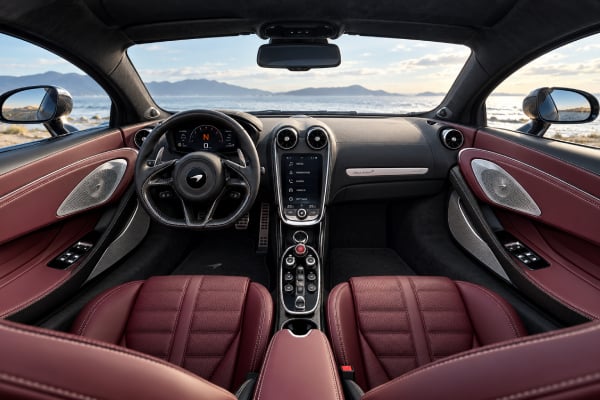
The McLaren GTS is the more powerful, lighter, and subtly more usable successor to the GT, built for drivers who want genuine mid-engined supercar responses without giving up the ability to travel with luggage. Introduced for 2024, it keeps the familiar 4.0-liter twin-turbo M840TE V8 and seven-speed Seamless Shift Gearbox but raises output to 626 bhp, trims mass, sharpens the chassis calibration, and improves details such as the front-axle lift. Its unusual appeal is not simply straight-line speed. A carbon-fibre MonoCell II-T structure, hydraulic steering, adaptive dampers, standard carbon-ceramic brakes, and 570 litres of combined storage give it a blend few conventional grand tourers can match. That combination also makes ownership decisions more nuanced: specification choices, tyre condition, carbon-ceramic brake wear, service history, battery care, and market-specific warranty coverage all matter. For 2024, 2025, and 2026 cars, the best approach is to judge the GTS as both a high-performance McLaren and a long-distance road car.
Table of Contents
- What Changed from GT to GTS
- How the GTS Drives on Road
- McLaren GTS Specifications and Technical Data
- Daily Use: Luggage, Lift, and Cabin
- Service, Warranty, and Care
- Used GTS Inspection and Buying Checks
- Model-Year, VIN, and Market Details
What Changed from GT to GTS
The GTS is not a clean-sheet replacement for the GT; it is a focused evolution of the same core concept. The important changes are more power, slightly less weight, revised chassis calibration, quicker vehicle-lift operation, refreshed styling, and a higher standard equipment level rather than a fundamentally different platform.
McLaren introduced the GTS as the GT’s successor for 2024 delivery. The M840TE twin-turbo V8 gained 15 PS, taking maximum output to 635 PS, which McLaren also quotes as 626 bhp. DIN weight fell by 10 kg to 1,520 kg. Those two changes lift the power-to-weight ratio to 418 PS per tonne and cut the claimed 0–200 km/h time to 8.9 seconds. The 0–100 km/h figure remains 3.2 seconds, while maximum speed is 326 km/h, or 203 mph.
The power increase is modest on paper, but the engineering detail matters. McLaren attributed the extra output to increased crankshaft torque made possible by more aggressive combustion phasing and revised ignition timing. The result is still the same basic 3,994 cc high-performance McLaren V8 architecture associated with the GT family rather than a new engine generation. Rear-wheel drive and the seven-speed dual-clutch Seamless Shift Gearbox also continue, so the GTS preserves the mechanical character of its predecessor.
The body changes are functional as well as cosmetic. A revised lower front bumper uses more pronounced air intakes, while taller rear-fender scoops feed the engine bay. Gloss-black exhaust finishers, mirror caps, and window surrounds became part of the standard visual treatment. McLaren also introduced a Turbine forged wheel design and additional personalization choices, including launch-specific Lava Grey paint.
More meaningful for frequent road use is the revised lift system. Normal underbody clearance is about 110 mm; activating the lift raises the nose to approximately 130 mm. McLaren says the GTS can complete that operation in four seconds, less than half the time required by the previous GT system. For owners who routinely encounter steep driveways, parking ramps, speed humps, or ferry approaches, that improvement is more useful than the small acceleration gain.
Weight reduction did not come from deleting the GT’s touring features. The GTS keeps the rear luggage area created by the carbon-fibre rear upper structure and retains the large front trunk. McLaren instead uses details such as a recycled-carbon-fibre roof panel and other lightweight components to maintain the car’s low mass. That is central to the model’s identity: the GTS is meant to gain performance without surrendering the packaging that makes it viable for longer trips.
How the GTS Drives on Road
The GTS is engineered to feel like a McLaren first and a grand tourer second, but its controls and suspension have enough range for everyday roads. Its strongest dynamic traits are low mass, hydraulic steering, adaptive damping, strong carbon-ceramic brakes, and a powertrain that can move from relaxed cruising to full performance without changing the car’s basic character.
The suspension uses aluminium double wishbones with continuously variable twin-valve hydraulic dampers and Proactive Damping Control. Comfort, Sport, and Track modes change the damper behavior, while the steering retains electro-hydraulic assistance rather than moving to a fully electric rack. That matters because steering effort and surface feedback remain unusually direct for a modern high-performance car. Assistance increases at low speeds, which helps when parking, but the system still communicates front-tyre loading clearly once speed rises.
The GTS also benefits from being relatively light for a car with this much performance and luggage space. A 1,520 kg DIN kerb weight means the suspension, brakes, and tyres do not need to manage the mass of a large front-engine luxury GT. Direction changes therefore feel more immediate, and the car can use comparatively modest tyre widths for its output. The mid-engine layout keeps the mass concentrated near the center of the chassis, helping the GTS rotate predictably without requiring an aggressive setup.
Comfort mode is the sensible default for normal roads. It keeps the gearbox smooth and the dampers comparatively compliant, which is important on broken surfaces where very stiff calibration would reduce both comfort and tyre contact. Sport mode adds more urgency and uses a momentary ignition spark cut to create faster, more dramatic shifts. Track mode prioritizes response and minimizes torque interruption further. Manual shifting is available in every mode through the steering-wheel-mounted paddles.
The standard carbon-ceramic braking system is another defining feature. Front discs measure 390 mm with six-piston aluminium calipers, while the rear uses 380 mm discs with four-piston calipers. McLaren quotes 32 metres for braking from 100 km/h to zero. On the road, the practical benefit is not merely maximum stopping distance: carbon-ceramic hardware also provides substantial thermal capacity during repeated hard use. The trade-off is replacement cost, which makes inspection of disc condition important on a used car.
Traction is managed through rear-wheel drive and an open differential, with the vehicle’s electronic systems working alongside the chassis rather than a mechanical limited-slip differential. The power delivery is forceful but not defined by a single dramatic boost event. Maximum torque of 630 Nm gives the car strong mid-range acceleration, while the engine’s 635 PS peak at 7,500 rpm rewards using the upper part of the rev range.
A driver considering the GTS specifically for touring should pay attention to road noise, tyre choice, seating position, and suspension mode during the test drive. The car is more civilized than McLaren’s track-focused models, but it is still a low, mid-engined supercar on 20- and 21-inch wheels. A well-specified GTS can cover long distances comfortably; it should not be expected to isolate occupants like a heavy luxury coupe.
McLaren GTS Specifications and Technical Data
The 2024–2026 McLaren GTS is a gasoline-only, mid-engined, rear-wheel-drive two-seat coupe using the 3,994 cc M840TE twin-turbo V8 and a seven-speed Seamless Shift Gearbox. The figures below describe the standard GTS rather than the Japan-only Signature Collection or an individually modified MSO car, and market equipment can vary.
| Specification | McLaren GTS |
|---|---|
| Powertrain type | Gasoline internal-combustion engine |
| Engine | M840TE 4.0-litre twin-turbocharged V8 |
| Displacement | 3,994 cc |
| Maximum power | 635 PS / 626 bhp at 7,500 rpm |
| Maximum torque | 630 Nm / 465 lb-ft |
| Transmission | 7-speed + reverse Seamless Shift Gearbox |
| Drive | Rear-wheel drive |
| Differential | Open differential |
| Measure | Factory figure |
|---|---|
| 0–100 km/h | 3.2 seconds |
| 0–200 km/h | 8.9 seconds |
| Quarter mile | 11.0 seconds |
| Maximum speed | 326 km/h / 203 mph |
| 100–0 km/h braking | 32 m |
| 200–0 km/h braking | 127 m |
| Power-to-weight ratio | 418 PS per tonne |
| Component | Specification |
|---|---|
| Body structure | Carbon-fibre MonoCell II-T monocoque with carbon-fibre rear upper structure |
| Crash structures | Aluminium, front and rear |
| Suspension | Double aluminium wishbones with independent adaptive dampers |
| Damping system | Proactive Damping Control; Comfort, Sport, and Track modes |
| Steering | Electro-hydraulic power assistance |
| Front brakes | 390 mm carbon-ceramic discs, 6-piston aluminium calipers |
| Rear brakes | 380 mm carbon-ceramic discs, 4-piston calipers |
| Measure | Specification |
|---|---|
| Lightest dry weight | 1,466 kg / 3,232 lb |
| DIN kerb weight | 1,520 kg / 3,351 lb |
| Length | Approximately 4,683 mm / 184.4 in |
| Wheelbase | Approximately 2,675 mm / 105.3 in |
| Height | Approximately 1,213 mm / 47.8 in |
| Normal underbody clearance | 110 mm |
| Clearance with vehicle lift | 130 mm |
| Front luggage capacity | 150 litres |
| Rear luggage capacity | 420 litres |
| Total luggage capacity | 570 litres |
| Position | Specification |
|---|---|
| Front wheel diameter | 20 inches |
| Rear wheel diameter | 21 inches |
| Front tyre size | 225/35 R20 |
| Rear tyre size | 295/30 R21 |
| Tyre family | GTS-specific Pirelli P Zero fitment |
| Wheel designs | Standard 10-twin-spoke forged wheel; optional Turbine forged wheel |
| Item | Published information |
|---|---|
| Fuel tank | 72 litres / 19 US gallons |
| EU WLTP combined fuel consumption | 11.9 L/100 km / 23.7 mpg UK |
| EU WLTP combined CO2 | 270 g/km |
| New-vehicle warranty | 3 years, unlimited mileage |
| Paint warranty | 3 years |
| Anti-perforation warranty | 10 years |
| Factory service interval | 12 months or 9,000 miles / 15,000 km, whichever comes first |
| Included factory service plan | Up to 3 years or 27,000 miles / 45,000 km, subject to plan terms and market eligibility |
These numbers need context when comparing advertisements. McLaren distinguishes “lightest dry” weight from DIN kerb weight, so a listing that quotes 1,466 kg is not contradicting one that quotes about 1,520 kg; they are using different definitions. Similarly, UK-style imperial mpg should not be compared directly with US mpg because the gallon sizes differ. For purchase decisions, use the measurement standard printed in the relevant market documentation.
Daily Use: Luggage, Lift, and Cabin
The GTS is unusually practical for a mid-engined supercar because it offers two real luggage areas, good outward visibility for the class, a fast nose-lift system, and a cabin designed for longer journeys. Those features make the difference between a car that can merely tolerate a road trip and one that can be planned around regular travel.
The rear luggage compartment is the most distinctive packaging feature. McLaren’s carbon-fibre rear upper structure allows a 420-litre space beneath the large glass tailgate, while the front compartment adds another 150 litres. The rear bay is long and shaped differently from a conventional trunk, so soft bags generally make better use of it than rigid rectangular suitcases. Before a long trip, owners should test-pack the actual luggage rather than relying only on the headline capacity.
Heat is another practical consideration. The rear cargo area sits close to the engine, so temperature-sensitive items deserve more thought than they would in a front-engine sedan. Electronics, medication, chocolate, cosmetics, or other heat-sensitive goods are better placed in the front compartment when conditions are hot. Keeping loose items secured also prevents them from moving during hard acceleration or braking.
Visibility is better than the low roofline suggests. The glass tailgate, glazed C-pillars, and rear quarter windows help rearward sight lines, while the nose falls away enough to make the front corners manageable once the driver becomes familiar with the car. Parking cameras and sensors remain valuable, particularly because wheel and bodywork damage can be expensive to correct. Buyers should verify the exact assistance equipment fitted to a particular car rather than assuming every market or option package is identical.
The lift system deserves to be tested as part of normal ownership, not saved for emergencies. Raising the front from roughly 110 to 130 mm can prevent contact on ramps that would otherwise threaten the splitter or underbody. Four-second operation means it can be used without causing a long queue at a garage entrance. Even with the lift raised, approach angles still matter, so crossing a steep change in gradient diagonally and at low speed remains sensible.
Inside, a 10.25-inch digital instrument display sits directly ahead of the driver, while the central portrait touchscreen measures 7 inches. Navigation, Bluetooth connectivity, media streaming, and digital radio functions depend partly on market specification. Buyers coming from newer mainstream luxury cars may find the infotainment interface less central to the experience; the GTS places more emphasis on the physical driving controls and instrument display.
Seat specification can alter long-distance comfort substantially. Standard Comfort seats use Nappa leather, while Performance and TechLux themes change materials and appearance. Power-adjustable heated memory Comfort Seats were associated with some higher interior specifications. A test drive should therefore include enough time to assess hip position, shoulder support, pedal alignment, and entry/exit.
Service, Warranty, and Care
The safest maintenance strategy is to follow McLaren’s time-or-distance schedule exactly and keep complete records, even when annual mileage is very low. For the factory service plan, McLaren specifies service every 12 months or 9,000 miles/15,000 km, whichever comes first, with market and vehicle terms governing what is included.
The published factory plan identifies three scheduled services during the first three years. Service 1 includes engine oil and filter, cabin filter, and engine air filter. Service 2 adds brake fluid and key-fob batteries to the scheduled items, while Service 3 returns to the core oil and filter work. McLaren notes that components and inclusions can vary by model, climate, region, and later service information, so an owner should treat the plan booklet and the car’s service indicator as the controlling references.
Time matters on a lightly used GTS. A car that covers only a few thousand kilometres per year still sees oil age, brake-fluid moisture absorption, battery cycling, tyre aging, and seal exposure to temperature changes. Skipping a service because the odometer has barely moved can create a gap in history and may conflict with warranty or service-plan conditions. On a car whose resale value depends heavily on provenance, a complete dated record is valuable in its own right.
Battery support is particularly important for cars that sit between drives. Modern McLarens have significant standby electrical loads, and low system voltage can produce warnings or inconvenience even when the underlying components are healthy. If the car will be parked for extended periods, use the charging or maintenance equipment specified for the vehicle and follow the handbook rather than improvising with an incompatible charger.
Tyres should be checked for more than remaining tread. The GTS combines a 225/35 R20 front with a 295/30 R21 rear fitment, and its performance depends on correct construction, load/speed specification, pressure, and axle matching. Inspect the inner shoulders, which can be harder to see, and note the tyre manufacturing dates. A car with low mileage can still need tyres because of age, flat spotting, cracking, or heat-cycle history.
Carbon-ceramic brakes also deserve informed care. They resist fade and corrosion differently from conventional iron discs, but they are not maintenance-free. Look for chips, impact damage, abnormal surface condition, vibration, and pad wear. A specialist can assess disc condition and remaining service life more reliably than appearance alone. Because replacement costs are high, brake inspection should be part of both routine servicing and any pre-purchase inspection.
McLaren’s launch information for the GTS states a three-year unlimited-mileage vehicle warranty, three-year paint warranty, and ten-year anti-perforation warranty. Extended coverage can be available under McLaren programs, but eligibility, terms, geographic availability, inspection requirements, and exclusions vary. Confirm the exact status against the VIN and the supplying retailer instead of assuming coverage transfers automatically.
Used GTS Inspection and Buying Checks
A used or nearly new GTS should be judged first on condition, provenance, and specification—not simply mileage or paint color. The most valuable inspection targets are service history, diagnostic status, underbody and carbon structure, wheels and tyres, carbon-ceramic brakes, lift operation, electronics, and evidence of previous paint or accident repair.
Start with documentation. Match the VIN on the car to registration and service records, review invoices rather than relying only on a stamped history, and confirm that scheduled work was completed within the appropriate time and mileage windows. Ask whether the car was a demonstrator, press vehicle, rental, track-use car, or personal road car. None of those categories automatically makes a car unsuitable, but the answer changes what should be inspected closely.
A diagnostic scan by a McLaren-trained or genuinely experienced independent specialist is worthwhile. It can reveal stored faults and help distinguish a transient low-voltage message from a persistent system problem. The inspection should also confirm that software updates and applicable campaigns have been addressed. Warning lights that are dismissed as “just a battery issue” should be demonstrated to be resolved rather than accepted on trust.
Inspect the underside with the car raised. A low supercar can collect scrapes around the front splitter, floor edges, jacking areas, diffuser, and suspension components even when the upper body looks perfect. Cosmetic marks are different from structural damage, so the examiner should understand the MonoCell II-T architecture and know where evidence of repair is significant. Carbon-fibre repairs require specialized assessment; visible weave alone is not enough to judge integrity.
Operate the vehicle lift repeatedly and check that movement is prompt and even. Test the glass tailgate, soft-close function, windows, mirrors, seat controls, climate system, touchscreen, instrument display, cameras, parking sensors, lighting, key functions, and charging or maintainer equipment supplied with the car. Small electrical faults are easier to negotiate before purchase than after handover.
Wheels deserve careful inspection because low-profile tyres provide limited protection from potholes. Look for bends, cracks, poorly refinished surfaces, missing or incorrect fasteners, and uneven tyre wear. Verify that tyre sizes and specifications are appropriate for the GTS and that all four tyres form a sensible matched set. A fresh-looking outer shoulder does not prove the inner tread is healthy.
During the test drive, start with the car cold if possible. Listen for abnormal noises, confirm stable idle, check gearbox behavior at low speed, and allow the engine and fluids to reach operating temperature before using heavy load. Try Comfort, Sport, and Track settings where lawful and appropriate, but focus more on consistency than drama. Steering should track cleanly, brakes should operate without unexpected vibration, and suspension responses should be even from side to side.
McLaren’s Certified Pre-Owned program can reduce some uncertainty because Certified cars receive factory-trained inspection, diagnostic checks, history review, minimum warranty coverage, and other market-dependent benefits. That does not eliminate the need to read the contract. Program names, warranty durations, roadside assistance, tyre standards, and eligibility can differ by country, so compare the written benefits with the specific car being offered.
Model-Year, VIN, and Market Details
For 2024–2026 GTS shopping, the VIN and market specification are more reliable than assumptions based only on registration year or advertisement wording. The GTS entered the range for 2024 delivery and remains a current model in 2026, but equipment, homologation figures, warranty terms, and even the way a model year is described can vary by country.
A late-registered car may have been built to an earlier model-year specification, while a dealer may advertise a vehicle by first-registration year. Ask for the build information and confirm model year directly from the retailer or official documentation. This is especially useful when comparing cars across borders, because taxes, emissions certification, lighting, navigation, radio standards, speedometer calibration, and warranty regions can differ.
The same caution applies to power figures. McLaren’s 635 PS converts to approximately 626 bhp, and US listings may use “hp” in ways that do not always distinguish metric horsepower from brake horsepower. The assignment figure of 626 hp identifies the standard GTS output in common English-language use, but the factory’s own technical presentation commonly shows 635 PS alongside 626 bhp. That is a unit-label issue, not evidence that one car has a different engine tune.
Recall checking should also be VIN-specific. In the United States, NHTSA’s lookup can show unrepaired safety recalls for many vehicles, but NHTSA itself notes limitations, including coverage differences for some small-volume manufacturers and recently announced campaigns. Owners in other countries should use the relevant national authority and McLaren retailer network. A clean generic model search is not a substitute for checking the actual VIN and retailer campaign status.
If importing a GTS, confirm service-plan region, warranty eligibility, recall completion, emissions conformity, and any required local modifications before purchase. McLaren’s factory service-plan terms state that plan coverage is region-based and that moving a vehicle between regions can require approval and modifications. A lower purchase price in another country can be offset by taxes, transport, registration work, unavailable warranty coverage, or future resale complications.
For a 2024, 2025, or 2026 example, specification should finally be weighed against intended use. Frequent touring favors comfortable seats, useful driver-assistance equipment, front lift, sensible luggage planning, and documented maintenance. Occasional weekend driving places more emphasis on visual options and condition preservation. In either case, the best GTS is the one whose identity, service status, tyre and brake condition, body integrity, and market eligibility are all verified before money changes hands.
References
- McLaren GTS – Interior, Specs, Top Speed, HP, 0-60, Engine — McLaren Automotive, accessed 2026.
- Stunning Performance: The New McLaren GTS — Eurokars Group / McLaren Singapore, 2023.
- Factory Service Plan — McLaren Automotive, accessed 2026.
- Official Authorized McLaren | Certified Pre Owned CPO — McLaren Automotive, accessed 2026.
- Check for Recalls: Vehicle, Car Seat, Tire, Equipment | NHTSA — National Highway Traffic Safety Administration, accessed 2026.
- 2025 McLaren GTS Specs, Dimensions & Colors | Cars.com — Cars.com, accessed 2026.
Disclaimer
This article is general informational material, not professional mechanical diagnosis, repair instruction, legal advice, or a substitute for inspection by a qualified technician. Specifications, software, torque values, service intervals, maintenance procedures, warranty terms, equipment, campaigns, and parts can vary by VIN, model year, market, options, and later manufacturer updates. Always verify the exact vehicle against current McLaren documentation, the owner’s handbook, an authorized retailer, and applicable local recall information before servicing, modifying, or purchasing it. If this guide helped you understand the McLaren GTS, please consider sharing it with another owner or buyer who may find it useful.