
The 2019 McLaren Senna Can-Am is one of the hardest Senna derivatives to document properly because it was not a normal catalog model. McLaren Special Operations built only three examples as a road-legal tribute to the 1969 McLaren M8B Can-Am racers, combining the Senna family’s carbon structure and twin-turbo V8 with GTR-level output and a dense layer of bespoke heritage details. That scarcity creates a research trap: figures for the standard Senna and track-only Senna GTR are often copied onto the Can-Am even when no Can-Am-specific source supports them. The safest way to understand the car is therefore to separate what is documented for the three-car MSO run from what belongs only to its relatives. This guide does exactly that. It explains the verified 814 hp powertrain, the M8B-inspired exterior and cabin specification, the road-versus-GTR identity, the records needed to authenticate a genuine example, and the maintenance and inspection priorities that matter when a car is both an extreme machine and a one-of-three collectible.
Table of Contents
- A three-car tribute to McLaren’s 1969 Can-Am sweep
- What is actually documented in the Can-Am technical data
- How the M8B story was built into the car
- Road-legal GTR ancestry without borrowed specifications
- Maintaining and inspecting a one-of-three MSO build
- Authenticity, provenance, and the purchase decision
A three-car tribute to McLaren’s 1969 Can-Am sweep
The Senna Can-Am exists because 1969 was one of the defining seasons in McLaren’s early racing history. Bruce McLaren and Denny Hulme drove the M8B in a campaign so dominant that McLaren won every round of the Can-Am season, and the modern three-car MSO project turned that history into a road-legal collector car rather than simply applying a commemorative badge to a standard Senna.
Can-Am was the Canadian-American Challenge Cup, a sports-racing series remembered for loose technical restrictions, enormous power, dramatic aerodynamics, and rapid engineering development. McLaren’s factory team became its dominant force. McLaren Racing’s current heritage record credits the marque with 43 Can-Am wins and five consecutive constructors’ championships from 1967 through 1971. In 1969, the M8B was the visual and competitive symbol of that success.
The modern Can-Am edition was built 50 years later. Period sales descriptions for the cars identify just three examples and describe them as factory-built, street-legal Senna GTR derivatives created by McLaren Special Operations. That wording is significant. The project was not simply one of the 500 standard Sennas wearing an MSO paint theme, nor should it be treated as an ordinary 75-car Senna GTR with plates added later by a third party. The surviving listings document a distinct, tiny MSO program with dedicated production-number plaques and a long list of bespoke features.
The three-car count also has a historical echo. Accounts of the project connect the number to McLaren’s Can-Am practice of preparing an additional car around the two-driver works effort, but the strongest point for a buyer is simpler: each genuine Can-Am should have documentation tying it directly to the MSO build and to its individual number within the three-car series.
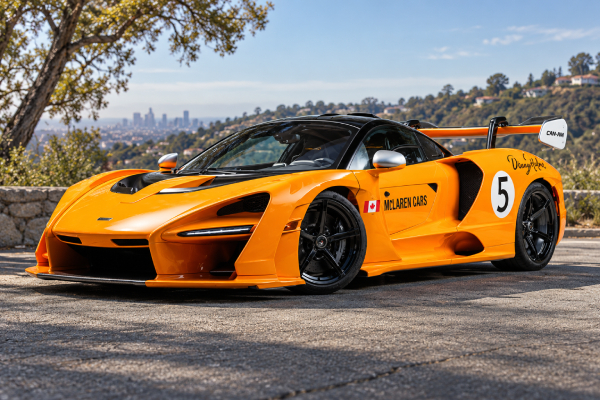
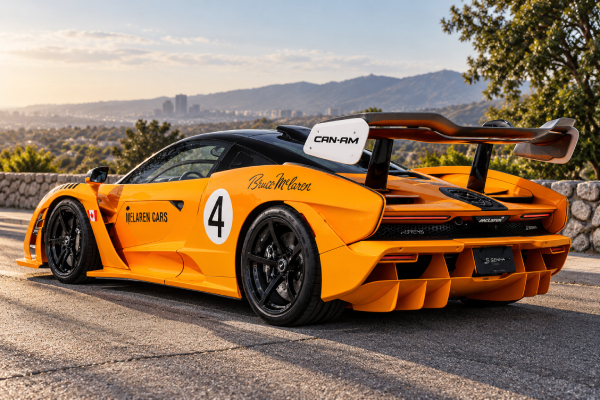
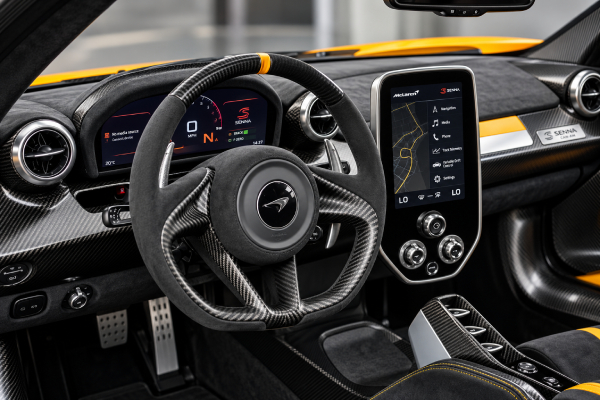
The specification theme is anchored in McLaren Orange. Bruce McLaren’s signature and race number 4 are applied to one side, while Denny Hulme’s signature and number 5 appear on the other. Vintage McLaren Cars and Speedy Kiwi graphics, a Canadian flag detail, silver aerodynamic accents, special wheel treatment, and a gold heat shield continue the historical reference. Inside, the theme extends to embroidered headrests, painted door sills, an etched accelerator pedal, orange-accented harnesses, and the numbered Can-Am dedication plaque.
That depth is why authenticity is so important. On a regular production car, a replaced wheel or repainted panel may be mainly a condition issue. On a three-car MSO project, the exact graphics, finishes, plaques, unique trim pieces, and documented original configuration are part of the identity. Restoring those details incorrectly could reduce historical confidence even if the car remains mechanically excellent.
What is actually documented in the Can-Am technical data
The dependable Can-Am specification is narrower than the specification for a standard Senna or factory-published GTR. The variant is consistently documented with a 4.0-liter twin-turbocharged M840TR V8 producing 814 hp, a 25 hp increase over the road Senna, but dedicated Can-Am acceleration, top-speed, braking, weight, and downforce figures were not published in the same comprehensive way.
| Specification | Verified Can-Am detail |
|---|---|
| Model year | 2019 |
| Program | McLaren Special Operations Can-Am edition |
| Production | 3 examples |
| Body style | Two-seat coupe |
| Road status | Factory-built street-legal derivative |
| Heritage theme | 1969 McLaren M8B Can-Am program |
| Signature color | McLaren Orange |
| Specification | Verified Can-Am detail |
|---|---|
| Engine code | M840TR |
| Engine configuration | 4.0 L twin-turbocharged V8 |
| Displacement family | 3,994 cc |
| Maximum power | 814 hp (607 kW / 825 PS) |
| Power increase over standard Senna | 25 hp |
| Transmission type | 7-speed dual-clutch transmission |
| Driven wheels | Rear-wheel drive |
| Feature | Can-Am treatment |
|---|---|
| Exterior paint | McLaren Orange |
| Front fenders | Unique louvered design |
| Engine surround | Carbon fiber with MSO logo |
| Exhaust finishers | Unique four-exit arrangement |
| Wheels | Unique five-spoke design with racing center locks |
| Rear air brake | Gloss/Liquid Silver with white end plates |
| Wing mirrors | Liquid Silver finish |
| Engine-bay heat shielding | 24-carat gold |
| Heritage graphics | Driver signatures, race numbers, vintage McLaren graphics, Canadian flag |
| Feature | Can-Am treatment |
|---|---|
| Primary cabin trim | Bespoke Black Alcantara |
| Headrests | Can-Am embroidery |
| Door sills | Extended carbon fiber with bespoke race-victory artwork |
| Accelerator pedal | Black anodized and etched with Can-Am logo |
| Harnesses | MSO six-point harnesses in black with orange pads |
| Door pulls | McLaren Orange straps |
| Build identification | Numbered Can-Am dedication badge |
| Brightwork | Zircon finish with Liquid Silver door struts |
| Program | Power | Production | Intended status |
|---|---|---|---|
| Standard McLaren Senna | 789 bhp | 500 cars | Road legal, track focused |
| Senna GTR | 825 PS (about 814 bhp) | 75 cars | Track only |
| Senna Can-Am | 814 hp | 3 cars | Factory-built street-legal special edition |
The comparison table is deliberately limited. The factory GTR is documented with more than 1,000 kg of peak downforce and GT3-derived suspension, while the standard road Senna has its own published acceleration, braking, mass, and aero figures. Those figures should not be copied into a Can-Am data sheet unless the individual Can-Am’s factory documentation explicitly says they apply. The same caution applies to dimensions, suspension geometry, tire sizes, fuel capacity, and service-fluid quantities.
This matters because several secondary descriptions use broad phrases such as “Senna GTR chassis” or “street-legal Senna GTR,” yet photos and contemporary reporting also show that the Can-Am does not simply duplicate every GTR exterior or aerodynamic component. The correct editorial approach is to report the Can-Am facts that can be tied to the three cars and use standard-Senna or GTR figures only as clearly labeled context.
How the M8B story was built into the car
The Can-Am edition’s strongest claim to individuality is not its extra 25 hp; it is the way MSO translated a specific 1969 race program into physical details. A genuine example should read almost like a historical document when the exterior, engine bay, and cabin are examined together.
Start with the asymmetric driver references. Bruce McLaren and Denny Hulme were not reduced to a generic team logo. Their signatures and race numbers appear on different sides of the body, turning the car into a dual tribute to the two works drivers. Vintage McLaren Cars and Speedy Kiwi graphics add period flavor, while the Canadian flag on the front aero area acknowledges the Canadian-American identity of the championship.
Silver is the second important color. The rear air brake is described in period listings as Liquid or Gloss Silver with white end plates, echoing the M8B’s visual treatment. Wing mirrors and wheel-center details continue the silver theme. On a car this rare, those finishes should be inspected for evidence of repainting and then cross-checked with original delivery photographs, because a later cosmetic restoration can look attractive while no longer matching the precise MSO specification.
The unique louvered fenders and four-exit exhaust finishers create a more obvious physical distinction. These are especially important to document because body and exhaust components can be damaged, replaced, or altered during ownership. A buyer should not rely on a general statement that a replacement part is “factory style.” Ask whether the component carries appropriate McLaren identification, whether the original damaged part remains with the car, and whether the repair invoice records the correct Can-Am-specific part or finish.
The engine bay contains one of McLaren’s most recognizable high-performance traditions: reflective gold heat shielding. In the Can-Am, period sales material specifically calls out 24-carat gold heat shielding and a carbon-fiber engine surround with an MSO logo. Gold foil is functional around intense radiant heat, but on this edition its presence is also a visible piece of the bespoke specification. Condition, adhesion, prior heat damage, and replacement history are therefore worth documenting photographically.
Inside, the details become even more valuable as authenticity markers. Can-Am embroidery in the headrests, painted carbon door sills showing Canadian victories, the etched accelerator pedal, orange harness pads, orange door pulls, and the dedication plaque should all correspond to the individual build. These parts are not generic wear items that can be substituted casually without affecting collector confidence.
The numbered plaque is particularly important because there are only three cars. Its number should agree with MSO documentation, the car’s VIN, historic listings, delivery records, and any known period photographs. Number 3 has been advertised with an additional hand-painted 50th Anniversary commemorative badge on the right flank, so buyers should not assume that every detail seen on one Can-Am automatically belongs on the other two.
Road-legal GTR ancestry without borrowed specifications
The useful way to describe the Can-Am is as a factory MSO road car with close Senna GTR ancestry, not as a GTR whose entire specification can be assumed unchanged. That distinction prevents the most common factual error surrounding the model: importing track-only GTR data into a road-legal Can-Am without proof.
The factory Senna GTR was freed from road-car regulations. McLaren produced 75 examples, raised output to 825 PS, developed much more aggressive aero, and used suspension concepts derived from its GT3 program. The GTR also dispensed with road-oriented equipment that was unnecessary for a circuit-only machine. Its 1,000 kg-plus downforce figure belongs to that package.
The Can-Am, by contrast, was advertised as street legal. That status necessarily changes what equipment, calibration, lighting, safety systems, glazing, emissions hardware, ride-height behavior, tires, and other details may need to be present. Public descriptions of the three cars do not provide a complete homologation dossier, so the car itself and its factory paperwork become the authoritative evidence.
This is particularly important if a seller uses the phrase “road-legal GTR.” Ask what market the road registration applies to and what documentation supports it. A vehicle can be road registrable in one jurisdiction under a special process while requiring different compliance in another. Factory construction, historic registration, and current legal eligibility are related but not identical questions.
The 814 hp figure is less ambiguous. Multiple period descriptions of the Can-Am state a 25 hp increase over the standard Senna, bringing output to the same broad level as the GTR. That power increase is credible within the M840TR family and is a core part of the assignment specification. What should not follow automatically are GTR acceleration figures, aerodynamic loads, dry weight, spring rates, track width, or tire fitments.
For owners, this disciplined separation has a practical benefit. Service parts should be identified by VIN rather than chosen because they fit a standard Senna or appear in a GTR parts discussion. Software and calibration should be treated the same way. A one-of-three MSO car may contain a combination of components or coding that a technician will not encounter on ordinary workshop traffic.
The safest service path is therefore a McLaren retailer or independent specialist with genuine Ultimate Series experience and access to correct diagnostic and parts information. Before any major repair, photograph the existing installation, record part numbers and software versions where possible, and preserve removed original components. That process helps protect both mechanical correctness and provenance.
Maintaining and inspecting a one-of-three MSO build
The Can-Am should be maintained as both a high-load Senna-family car and a bespoke historical object. Mechanical neglect can make it unsafe or expensive; careless cosmetic work can erase the details that distinguish it from every other Senna.
A pre-use inspection should begin with age-sensitive items. Low mileage does not stop tires, seals, fluids, batteries, or rubber components from aging. Several Can-Am examples have appeared for sale with very low odometer readings, which makes storage history especially important. Ask how the car was supported electrically, how often it was exercised, whether fluids were changed by time as well as mileage, and whether the tires are original display pieces or suitable for actual driving.
The engine and transmission require the same careful warm-up, fluid control, and diagnostic attention expected of the Senna family, but the unique calibration raises the value of complete records. A generic invoice that says “annual service” is less useful than one listing fluid specifications, software campaigns, fault scans, inspection findings, and any work performed on cooling, induction, turbocharger controls, or the exhaust system.
Heat management deserves a visual check. Inspect the gold shielding for lifting, tears, discoloration, or evidence that surrounding components have been removed. Examine the four-exit exhaust finishers for cracking, impact damage, poor alignment, or non-original fabrication. Carbon around the engine compartment should be checked for heat distress and for finish differences suggesting repair.
Suspension, brakes, active aerodynamics, and underbody carbon should be assessed on a lift. Even a low-mileage car may have scraped a splitter, contacted a ramp, or suffered tire pickup and debris damage during a single circuit outing. Check wheel rims and center-lock areas carefully, then verify that the distinctive Can-Am wheels are the correct items rather than a visually similar replacement set.
Body inspection requires more patience than on a standard Senna. Photograph both sides and compare the signature graphics, numbers, logos, silver finishes, wing end plates, flags, and paint boundaries with archival images of that exact chassis. Paint-meter readings are less straightforward on carbon composite than on steel, so inspection should combine visual clues, panel fit, fastener condition, repair invoices, and specialist knowledge.
The cabin should be treated in the same forensic way. Alcantara wear, harness date and condition, sill artwork, pedal etching, embroidery, pull straps, brightwork, and the dedication badge all deserve attention. If any piece was replaced because of wear, ask whether the original item accompanies the car. Original parts can remain historically useful even when a fresh component is fitted for safe operation.
Track preparation should never be inferred from the Can-Am name. If the car will be driven hard, obtain a current inspection for tires, brakes, fluids, cooling, fasteners, aero operation, suspension, and diagnostic faults. The fact that its lineage includes the GTR does not remove the need to prepare a road-legal special edition correctly for circuit use.
Storage also needs an active plan. Keep the car in a stable, dry environment; use the correct battery-maintenance equipment; avoid leaving the tires loaded in one position for excessive periods; and exercise systems according to professional guidance. Preserve covers, tools, chargers, manuals, keys, delivery accessories, and MSO documentation together. With a three-car production run, missing ancillary items can be disproportionately difficult to replace or authenticate later.
Authenticity, provenance, and the purchase decision
Buying a Senna Can-Am is fundamentally an authentication exercise before it becomes a price negotiation. The car is too rare for a buyer to rely on a generic model description, and each example has enough individual detail that the exact chassis history matters more than broad market averages.
First, establish a documentary chain. The VIN should match title and registration records, McLaren or MSO documentation, service invoices, the numbered dedication plaque, historic advertisements, and delivery photographs. Because only three cars exist, prior public listings can be unusually useful for tracing appearance and mileage over time. Save those records as part of the ownership file rather than treating them as temporary sales material.
Second, confirm the build specification against the exact chassis. A credible file should explain the McLaren Orange paint, driver signatures and race numbers, vintage graphics, louvered fenders, silver aero treatment, unique wheels, four-exit exhaust, gold heat shielding, cabin embroidery, sill artwork, harnesses, pedal, door pulls, and numbered plaque. If an element differs, determine whether it is an individual factory variation, a later McLaren change, accident repair, or owner modification.
Third, separate condition from originality. An untouched original component can be historically valuable but no longer suitable for high-speed use; an expertly replaced safety-critical component can be mechanically desirable but should be documented. Tires are the clearest example. Original-date tires may help a concours display file, yet fresh approved tires are the sensible choice for driving. The ideal transaction records both facts rather than pretending one goal solves the other.
Fourth, inspect for accident and track history. A circuit outing is not inherently inappropriate for a Senna-family car, but any off-track event, splitter impact, wheel damage, carbon repair, or suspension alignment issue needs to be understood. Ask for photographs before and after repairs and verify that work was performed with correct materials, procedures, and parts. On unique MSO body pieces, the quality and traceability of repair can be as important as whether a repair occurred.
Fifth, confirm legal status for the buyer’s jurisdiction before money changes hands. Historic registration in another state or country is evidence, not a guarantee of future registration elsewhere. Import rules, emissions requirements, lighting standards, and special-construction provisions can differ. For a car marketed as a factory-built street-legal derivative of a track program, this is too important to leave to assumption.
Valuation is inevitably thin because three examples cannot create a deep, liquid market. Asking prices from past advertisements show that sellers place a substantial premium on the Can-Am’s rarity, but an asking price is not a completed transaction and one chassis can differ meaningfully from another. A rational valuation discussion should therefore consider exact build number, mileage, originality, condition, documentation, ownership history, geographic legality, recent service, and whether all unique MSO parts and accessories remain with the car.
The best Can-Am purchase is the one that survives scrutiny at three levels at once. It should be mechanically healthy enough to function as the 814 hp McLaren it is, historically coherent enough to prove its place among the three MSO builds, and legally documented enough to be used as the buyer intends. That standard is demanding, but so is the car’s reason for existing: it compresses one of McLaren’s most dominant racing seasons into an extraordinarily small modern production run.
References
- McLaren Heritage 2025
- McLaren Senna GTR – Unparalleled Track Only Hypercar | McLaren Automotive 2026
- McLaren Senna – Our Fastest Track-Focused Road Hypercar | McLaren Automotive 2026
- 2019 McLaren Senna for Sale | ClassicCars.com | CC-1491506 2021
- 2019 McLaren Senna Can-Am – collectorscarworld 2021
- MCLAREN SENNA CAN-AM – The Experience Auto Group – United States – For sale on LuxuryPulse. 2026
Disclaimer
This article is informational and does not replace professional inspection, diagnosis, maintenance, repair, registration, or import advice. A one-of-three MSO car may contain chassis-specific hardware and documentation, and specifications, fluids, torques, software, service procedures, road-legal status, and replacement parts can vary by VIN and market. Verify the exact Can-Am with current McLaren information and qualified specialists before servicing, driving, importing, or purchasing it. To support our work, consider passing this guide along on Facebook, X/Twitter, or a McLaren collector community.