
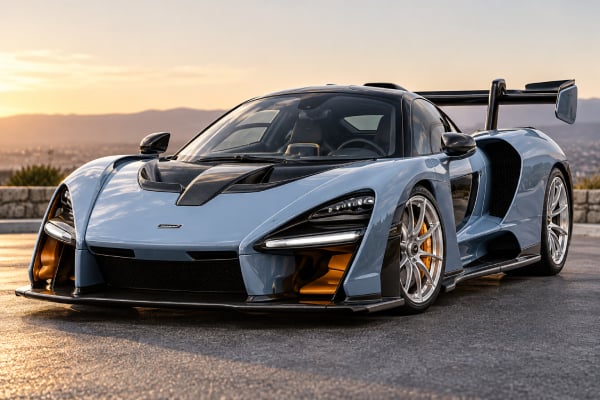

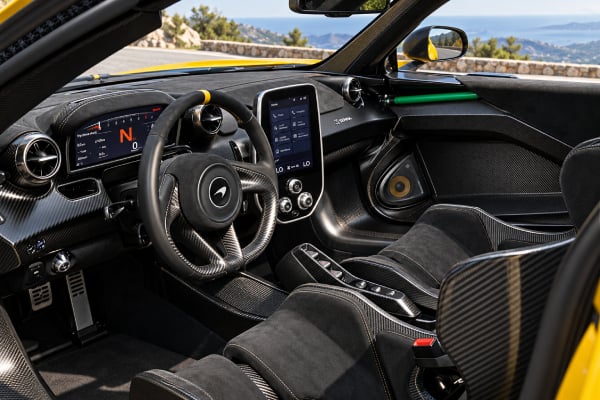
The McLaren Senna is a road-legal track car in the literal sense: almost every major engineering choice serves braking, cornering, cooling, aero control, or driver feedback before comfort. Its 4.0-liter M840TR twin-turbo V8 produces 800 PS, or 789 bhp, while the lightest dry specification is just 1,198 kg. The headline numbers are extraordinary, but the car’s character comes from how its carbon structure, active aerodynamics, hydraulic suspension, brakes, tires, and powertrain work as one system. That focus also changes how a used Senna should be evaluated. Track history is not automatically a negative, low mileage is not automatically reassuring, and documentation matters far more than it does on an ordinary performance car. This guide covers the 2018–2019 Senna as a complete engineering and ownership proposition, with verified specifications, an explanation of the systems that define it, practical maintenance priorities, known recall checks, and the evidence a buyer should demand before committing to one.
Table of Contents
- Built around lap time, not luxury
- McLaren Senna specifications and technical data
- Why active aero and RaceActive Chassis Control matter
- Performance beyond the acceleration numbers
- Maintenance priorities for road and track use
- Recalls, age, and condition checks
- Buying a McLaren Senna: provenance over mileage
Built around lap time, not luxury
The Senna was engineered to be McLaren’s most circuit-focused road car of its era, and its specification makes sense only when viewed through that brief. It sacrifices the usual hypercar balance of speed, refinement, theater, and touring ability in favor of low mass, high downforce, braking stability, and a very direct connection between the driver and the chassis.
McLaren limited production to 500 cars and assembled each one at the McLaren Production Centre in Woking. The company said the build process took about 300 hours per car, and the allocation was already spoken for before the model reached customers. That scarcity matters in the collector market, but it is not the main reason the Senna is technically significant. The car pushed McLaren’s road-car carbon construction, active aerodynamics, and interconnected hydraulic suspension toward a much more aggressive track calibration than the contemporary Super Series.
The structure is the MonoCage III carbon-fiber monocoque. McLaren described it at launch as its strongest road-car carbon monocoque to that point, with a double-walled rear structure that also contributes to rollover protection. Carbon body panels help keep mass down, while the dramatic glazed lower door sections are functional as well as theatrical: they improve sight lines toward the front corners and apexes.
The engine is the M840TR, a development of McLaren’s 4.0-liter twin-turbo V8 family. Senna-specific parts include lightweight internal components, camshaft and piston changes, low-inertia twin-scroll turbochargers, electronically controlled wastegates, external dump valves, dry-sump lubrication, and individual-cylinder ion sensing. The result is 800 PS at 7,250 rpm and 800 Nm of torque, sent to the rear wheels through a seven-speed Seamless Shift Gearbox dual-clutch transmission.
What separates the Senna from a conventional high-output supercar is that its powertrain is only one part of the performance equation. McLaren quoted up to 800 kg of downforce at 250 km/h. The active front aero elements and large rear wing continuously alter aerodynamic balance and load, while the suspension and brake systems are designed to exploit that load rather than merely tolerate it. The car therefore rewards an owner who understands the whole package, not just the engine output.
McLaren Senna specifications and technical data
The key Senna figures show a tightly integrated lightweight ICE hypercar rather than a power-first design. McLaren’s current published specification lists 335 km/h top speed, 800 PS, 800 Nm, and a 1,198 kg lightest dry weight; launch material published a higher 340 km/h figure, so the current factory specification is the safer figure to use when comparing cars today.
| Specification | McLaren Senna |
|---|---|
| Engine code | M840TR |
| Engine type | 90-degree V8, twin-turbocharged gasoline |
| Displacement | 3,994 cc (4.0 L) |
| Lubrication | Dry sump |
| Turbocharger system | Twin electrically actuated twin-scroll turbochargers |
| Maximum power | 800 PS (789 bhp / 588 kW) at 7,250 rpm |
| Maximum torque | 800 Nm (590 lb-ft) at 5,500–6,700 rpm |
| Maximum engine speed | 8,500 rpm |
| Specification | McLaren Senna |
|---|---|
| Transmission | 7-speed Seamless Shift Gearbox dual-clutch transmission |
| Drive layout | Rear-wheel drive |
| Differential strategy | Open differential with Brake Steer |
| Launch control | Standard |
| Handling controls | Comfort, Sport, Track; separate Race mode |
| Measure | Factory figure |
|---|---|
| 0–100 km/h (0–62 mph) | 2.8 seconds |
| 0–200 km/h (0–124 mph) | 6.8 seconds |
| 0–60 mph | 2.7 seconds |
| Standing quarter mile | 9.9 seconds |
| Maximum speed | 335 km/h (208 mph) |
| 100–0 km/h braking distance | 29.5 m (97 ft) |
| 200–0 km/h braking distance | 100 m (328 ft) |
| Specification | McLaren Senna |
|---|---|
| Passenger cell | MonoCage III carbon-fiber monocoque |
| Body panels | Carbon fiber |
| Lightest dry weight | 1,198 kg (2,641 lb) |
| DIN kerb weight | 1,309 kg (2,886 lb) |
| Length | 4,744 mm |
| Maximum body width | 2,153 mm |
| Height, doors closed | 1,195 mm |
| Specification | McLaren Senna |
|---|---|
| Suspension layout | Double wishbones with adaptive dampers |
| Suspension control | RaceActive Chassis Control II |
| Front wheel | 19 × 8 in, center-lock |
| Rear wheel | 20 × 10 in, center-lock |
| Front tire | Pirelli P Zero Trofeo R 245/35 ZR19 |
| Rear tire | Pirelli P Zero Trofeo R 315/30 ZR20 |
| Peak quoted downforce | 800 kg at 250 km/h (155 mph) |
| Aerodynamic control | Active front elements and active rear wing |
| Specification | McLaren Senna |
|---|---|
| WLTP combined fuel consumption | 12.4 L/100 km |
| WLTP combined CO2 emissions | 280 g/km |
| Fuel tank capacity | 72 L |
| Preferred fuel | 99 RON / 88 MON unleaded gasoline meeting EN 228 |
| Minimum fuel rating | 95 RON / 85 MON |
| Engine oil capacity | 9.0 L |
| Specified engine oil | Mobil 1 FS 0W-40 |
The numbers need context. Dry weight and DIN kerb weight are different measurement conditions, so they should not be mixed in power-to-weight comparisons. Likewise, the 800 kg downforce figure is an aerodynamic load at speed, not added static vehicle mass. For fluids, tire pressures, wheel fastener procedures, and service operations, the handbook and current McLaren service information for the specific VIN take priority over general tables.
Why active aero and RaceActive Chassis Control matter
The Senna’s defining engineering feature is not simply that it creates a lot of downforce; it is that the car actively manages aerodynamic load and chassis attitude together. That lets it generate very high cornering and braking forces without relying on a fixed aero setup that would create unnecessary drag everywhere.
At the front, active aero blades help control the airflow and balance the car against the enormous rear wing. The rear wing changes angle according to what the car is doing. It can increase load when the driver needs grip, reduce drag when appropriate, and contribute to aerodynamic braking. McLaren’s launch engineering material explains that above 250 km/h the active aero trims to keep peak loads within the intended operating range instead of allowing downforce to continue rising unchecked with speed.
RaceActive Chassis Control II is equally important. Rather than using conventional anti-roll bars as the primary way to control body roll, McLaren links hydraulic elements across the suspension. The system can support the body under heavy cornering and braking while allowing each wheel to respond to road or track surface changes. In Race mode the Senna also lowers its ride height and adopts a more circuit-focused posture, helping the underbody and wings work in their intended aero window.
This is why a Senna cannot be judged only by whether the engine pulls strongly and the transmission shifts cleanly. Ride-height behavior, adaptive damping, hydraulic integrity, aero actuator operation, wing movement, sensor status, and alignment all influence whether the car is performing as designed. A fault in one subsystem can change how the rest of the package feels.
The tires are also part of the design rather than a generic consumable. The bespoke Pirelli P Zero Trofeo R fitment is road legal but biased toward dry-track performance. Age, heat cycles, storage conditions, and tread condition can matter as much as visible tread depth. A car that has accumulated little road mileage can still have tires that are no longer appropriate for serious use simply because they are old or have seen repeated high-temperature track sessions.
The practical lesson is simple: the Senna’s sophistication increases the importance of system-level inspection. A pre-purchase check should include the aero functions, suspension hydraulics, dampers, ride-height operation, wheel and tire condition, brake condition, and diagnostic history in addition to the usual engine and transmission assessment.
Performance beyond the acceleration numbers
The Senna is exceptionally quick in a straight line, but its more revealing factory figures are the braking distances and aerodynamic load. A 2.8-second 0–100 km/h time places it firmly in hypercar territory; 29.5 meters from 100 km/h to rest and the ability to produce hundreds of kilograms of downforce explain why it feels purpose-built for repeated high-speed deceleration and direction changes.
Its 800 PS output does not make it the most powerful McLaren of every era, and the 335 km/h current factory top-speed figure is not the highest among Ultimate Series cars. That is intentional. A large rear wing, aggressive cooling requirements, and high-downforce bodywork create drag. McLaren accepted that trade because lap time depends on how late the car can brake, how much speed it can carry through a corner, how quickly it can settle in a transition, and how confidently the driver can place it.
The carbon-ceramic braking system deserves particular attention in ownership. McLaren developed a new generation of brake disc for the Senna, with an unusually intensive production process intended to deliver high thermal performance. On track, the active rear wing can also act as an air brake, shifting aerodynamic load during deceleration. The driver therefore experiences braking as a combination of mechanical tire grip, carbon-ceramic braking, aero load, and chassis control.
This also explains why road driving may never reveal whether a particular car is truly healthy. At ordinary speeds, a marginal aero actuator or a setup issue can remain hidden. A poorly stored set of Trofeo Rs may feel merely firm or noisy until asked to work hard. Brake discs can look visually impressive yet deserve measured inspection for wear, surface condition, or previous thermal abuse. Track use itself should not automatically disqualify a Senna. The vehicle was explicitly designed for circuit driving. More useful questions are whether track use was managed correctly, whether consumables were replaced at the right point, whether the car was allowed proper warm-up and cool-down routines, whether any off-track excursions occurred, and whether subsequent repairs were documented to McLaren standards. A well-supported car that has been used as intended can be a better prospect than an ultra-low-mile example that has sat for years without disciplined storage and fluid maintenance.
Maintenance priorities for road and track use
Maintaining a Senna is largely about preserving the condition of interdependent high-load systems, not simply changing oil on schedule. Factory service history is valuable, but an owner who drives on circuit should also track age, heat cycles, wear measurements, and event-specific inspections.
Start with fluids and temperature control. The dry-sump V8 depends on the correct oil specification and a proper oil-level checking procedure. Because the measurement process is vehicle-specific, topping up casually from a cold reading is a poor approach. Follow the handbook procedure and use the correct oil grade; if the car is being prepared for track use, ask a McLaren retailer or qualified specialist about any event inspection requirements and whether the service history supports the intended workload.
Cooling deserves similar discipline. Inspect for evidence of leakage around the cooling circuit, charge-cooling components, hoses, joints, and underbody areas. Track debris can accumulate in exposed heat exchangers, and any reduction in airflow matters more in a car that regularly operates at high thermal load. Warning messages, fluctuating temperatures, or repeated fluid top-ups deserve diagnosis rather than normalization.
Brakes and tires are the largest obvious consumable risk. Carbon-ceramic components are expensive, so obtain objective measurements instead of relying on appearance. Ask for disc condition data, pad life, and evidence of replacement where applicable. Inspect wheels carefully for damage and confirm that center-lock work has been carried out with the correct procedures and equipment. Tires should match the approved fitment, be within an appropriate age window, and show no signs of flat spotting, overheating, cracking, or track-related damage.
The hydraulic suspension and active-aero systems should operate without warnings, unusual noises, or inconsistent behavior. Look for leaks, damaged lines, actuator faults, or signs that alignment has been repeatedly corrected after impacts. Underbody carbon pieces, splitters, diffusers, and aero surfaces are vulnerable to kerbs, steep ramps, debris, and off-track excursions. Scraping is not necessarily catastrophic, but cracked carbon, poor repairs, or replaced panels without supporting records should be investigated.
Battery support is another practical concern for a low-use collector car. Long periods parked without the correct maintenance strategy can create low-voltage faults that complicate diagnosis. Confirm that the vehicle’s charging equipment is present, that the battery system behaves normally, and that stored diagnostic codes have been reviewed rather than simply cleared before sale.
Finally, keep every service invoice, inspection sheet, tire invoice, geometry report, recall completion record, and repair photograph. On a limited-production Ultimate Series McLaren, the maintenance file is part of the car. It helps the next technician understand what has happened, gives a future buyer evidence of responsible ownership, and can distinguish normal track consumable replacement from unexplained repair history.
Recalls, age, and condition checks
A Senna purchase should include a VIN-specific recall check because at least two U.S. safety campaigns covered portions of the 2018–2019 population. The important point is not to assume every car was affected, but to verify whether the specific VIN fell within each campaign and whether the remedy was completed.
NHTSA campaign 19V-613 concerned an engine wiring harness that could contact a metal link-pipe heat shield. The resulting chafing could damage wiring and, in the worst case, lead to reduced engine power or an engine stall. The remedy involved changing the harness routing and fastening so it would not contact the heat shield. The U.S. campaign listed 129 potentially affected 2018–2019 Sennas.
NHTSA campaign 20V-231 included 157 model-year 2019 Sennas equipped with an NVH foam pad. Because campaign applicability depends on how a specific car was built, a seller’s statement that “the recall was done” is not enough. Obtain the VIN, check the relevant market’s official recall database, and ask for completion documentation from McLaren.
Age now matters independently of mileage. Even a car with a four-digit odometer can have years-old tires, aging rubber seals, batteries that have spent long periods on support, stale fluids, cosmetic deterioration in exposed carbon, or corrosion on hardware in areas that have seen moisture. Storage environment and exercise routine can therefore be more informative than mileage alone.
Examine the car in strong, even lighting and then inspect it underneath on a lift. Look for paint and carbon mismatch, disturbed fasteners, repaired aero elements, splitter damage, floor impacts, wheel repairs, evidence of tire pickup from track use, and heat effects around the exhaust area. Door glazing, seals, hinges, roof controls, cameras, sensors, lighting, and the folding driver display should all be tested. Complex low-volume cars can accumulate small electronic faults that are easy to dismiss but expensive to trace.
Diagnostic scanning should be performed by someone who understands McLaren systems and can interpret stored or historic faults. A cleared dashboard is not equivalent to a clean diagnostic history. Ask whether fault codes return after a proper drive cycle, whether software campaigns are current, and whether any intermittent suspension, aero, transmission, or engine-control messages have been recorded.
Buying a McLaren Senna: provenance over mileage
The best Senna is the one whose identity, condition, and history can be explained without gaps. Mileage is still relevant, but provenance, repair quality, specification authenticity, recall status, and evidence of disciplined maintenance are stronger indicators of what the next owner is actually buying.
Begin with identity. Confirm the VIN against the title or registration, service records, invoices, factory specification, and any McLaren documentation supplied with the car. Because MSO customization can be extensive, distinguish genuine factory or MSO features from later changes. Retain original parts where modifications have been made, and do not assume an unusual color, trim combination, or aero detail is original without documentation.
Then build a chronological history rather than collecting isolated invoices. A coherent file should show where the car lived, when it was serviced, how mileage accumulated, whether it attended track events, when tires and brakes were replaced, what recalls or campaigns were completed, and whether body or carbon work was performed. Gaps do not automatically mean a problem, but they create questions that should be answered before purchase.
A specialist pre-purchase inspection should be specific to the Senna. It should cover engine and gearbox operation, fluid condition, cooling, diagnostic logs, suspension hydraulics, active aero, wheel and tire age and condition, carbon-ceramic brake measurements, center-lock wheels, alignment, underbody carbon, crash or paintwork evidence, battery health, and all cabin electronics. If there is any suggestion of significant repair, request repair invoices and images showing the structure before and during the work.
Ownership plans also influence which car makes sense. Someone intending regular circuit use may prefer a mechanically fresh example with recent tires, measured brake life, complete track preparation, and a transparent history even if the odometer is higher. A collector prioritizing originality may care more about factory paint, matching original components, complete accessories, delivery items, and untouched MSO specification. Neither goal makes the other car objectively better; the evidence simply needs to match the intended use.
Budgeting should extend beyond the purchase price. Tires, carbon-ceramic brakes, carbon bodywork, hydraulic suspension components, specialized diagnostics, transport, insurance, and authorized or specialist labor can all carry hypercar-level costs. The Senna is most convincing when treated as the engineered system McLaren intended. Its value is not only that 500 were built or that it wears Ayrton Senna’s name. It is the unusual combination of low mass, active aero, powerful braking, hydraulically controlled chassis behavior, and a high-output rear-drive V8. Preserve those systems correctly, verify the history carefully, and the car’s extreme focus becomes an asset rather than an ownership surprise.
References
- McLaren Senna – Our Fastest Track-Focused Road Hypercar | McLaren Automotive 2026
- New facts, figures and a shade of grey revealed for McLaren Senna ahead of Geneva International Motor Show 2018
- McLaren Owners 2026
- McLaren Senna Car Owner’s Handbook 2018
- U.S. Department of Transportation 2019
- Part 573 Safety Recall Report 20V-231 2020
Disclaimer
This article is for general informational purposes and is not a substitute for professional diagnosis, inspection, maintenance, or repair. Specifications, fluids, torque settings, service intervals, recall applicability, and procedures can vary by VIN, market, equipment, software level, and later factory updates. Verify the exact vehicle against current McLaren documentation and qualified service information before making technical or purchasing decisions. If this guide helped, sharing it on Facebook, X/Twitter, or your preferred enthusiast forum is a simple way to support our work.