

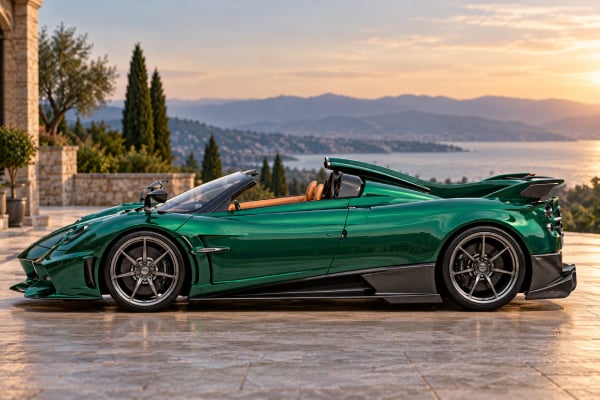
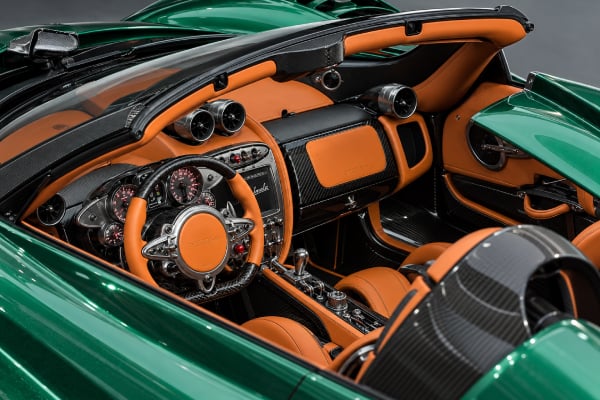
The Pagani Imola Roadster is an eight-car open-top hypercar built around a very different brief from simply removing the roof from the Imola coupé. Pagani combined technology associated with the Huayra Roadster BC with aerodynamic ideas influenced by the track-only Huayra R, then developed a 5,980 cc twin-turbo V12 producing 850 hp and 1,100 Nm. The result weighs 1,260 kg dry, is electronically limited to 350 km/h, and was designed to generate 600 kg of downforce at 280 km/h. Those figures make heat control, tire condition, aero function, and suspension calibration central to safe ownership. The Roadster is also a Grandi Complicazioni project, so individual finishes and details can be highly bespoke. This guide separates published technical facts from assumptions, explains how its airflow and chassis systems work, outlines sensible road and track preparation, and shows what to verify when maintaining or buying one of these exceptionally scarce cars.
Table of Contents
- Imola Roadster Verified Specifications and Technical Data
- Why the Roadster Is a Separate Engineering Project
- How Downforce, Cooling, and Airflow Share the Same Bodywork
- Road and Track Preparation for the Open-Cockpit Imola
- Service, Storage, and Preservation Priorities
- Buying and Verifying One of Eight Imola Roadsters
Imola Roadster Verified Specifications and Technical Data
The Imola Roadster is a rear-wheel-drive gasoline hypercar with a mid-mounted, 5,980 cc twin-turbo V12 and a seven-speed transverse Xtrac automated manual gearbox. Its published data is unusually specific for such a tiny production run, including engine-speed conditions, downforce, lateral-load claims, braking hardware, tire sizes, dry weight, and a governed maximum speed.
| Specification | Published value |
|---|---|
| Engine | Pagani-specification Mercedes-AMG 60-degree V12 |
| Displacement | 5,980 cc (6.0 L) |
| Induction | Twin turbochargers |
| Maximum power | 850 hp at 5,600 rpm, published at 18 °C |
| Maximum torque | 1,100 Nm (811 lb-ft) from 3,600 to 5,600 rpm |
| Fuel type | Gasoline/petrol |
| Exhaust | Six-outlet titanium system with ceramic coating applied by plasma-fusion process |
| Specification | Value |
|---|---|
| Gearbox | Pagani by Xtrac seven-speed transverse sequential AMT |
| Operating modes | Automated or driver-selected manual shifting |
| Differential | Electro-mechanical differential |
| Drive type | Rear-wheel drive |
| Maximum speed | 350 km/h (217.5 mph), electronically limited |
| Specification | Published value or system |
|---|---|
| Downforce | 600 kg (1,323 lbf) at 280 km/h (174 mph) |
| Continuous lateral acceleration | 2.0 g |
| Peak lateral acceleration | 2.2 g |
| Longitudinal deceleration | 2.2 g |
| Active aerodynamics | Four independently controlled flaps |
| Active-aero function | Works with suspension control to manage pitch, roll, and stability |
| Specification | Value |
|---|---|
| Central structure | Carbo-Titanium HP62-G2 and Carbo-Triax HP62 |
| Subframes | Front and rear tubular chrome-molybdenum steel |
| Suspension | Forged aluminum-alloy independent double wishbones |
| Springs and dampers | Coil springs with electronically controlled shock absorbers |
| Official dry weight | 1,260 kg (2,777 lb) |
| Paint technology | Acquarello Light, with a claimed 5 kg (11 lb) weight saving |
| Specification | Value |
|---|---|
| Front brakes | Brembo ventilated carbon-ceramic discs, 398 x 36 mm, 6-piston monolithic calipers |
| Rear brakes | Brembo ventilated carbon-ceramic discs, 380 x 34 mm, 4-piston monolithic calipers |
| Wheel construction | APP seven-spoke forged monolithic aluminum-alloy wheels |
| Front tires | Pirelli P Zero Trofeo R, 265/30 R20 |
| Rear tires | Pirelli P Zero Trofeo R, 355/25 R21 |
| Specification | Value |
|---|---|
| Production | Eight examples |
| Road homologation | Pagani states all eight are homologated for road use worldwide |
| Project division | Pagani Grandi Complicazioni |
| Seats | Carbon-fiber monocoque construction |
| Seat belts | Four-point racing-style belts |
| Audio | Seven-channel system with bass reflex in the door panels |
One published specification needs special caution. Pagani’s English technical sheet lists 21-inch front and 22-inch rear wheels, while the same sheet lists tires sized R20 at the front and R21 at the rear. Pirelli also publishes the Roadster tire sizes as 265/30 R20 and 355/25 R21. Because wheel and tire bead diameters must match, the public lines are internally inconsistent. Rather than silently choosing one value, owners and buyers should confirm the markings on the actual wheels and tires and obtain chassis-specific clarification from Pagani.
Why the Roadster Is a Separate Engineering Project
The Imola Roadster should not be understood as the five-car Imola with its roof removed. Pagani says that was the early concept, but the development direction changed: the team combined the Huayra Roadster BC’s technical base with design and aerodynamic principles associated with the Huayra R track car.
That change of direction explains the Roadster’s most visible features. The roof-mounted air scoop, tall center fin, rear-wing supports integrated with the rear hood, enlarged front openings, wheel-arch extraction, and deep rear diffuser are functional parts of an airflow system rather than decorative references to the coupé. The extra engine output also increased cooling demand, so the body had to move more air through radiators, around the front axle, and out of hot wheel-arch areas without giving away aerodynamic stability.
The Grandi Complicazioni context matters too. Pagani uses the term for highly complex, ultra-limited projects that can be customized closely with their clients. With only eight Roadsters, colors, finishes, trim materials, exposed-composite treatments, and other details can differ substantially from chassis to chassis. A generic online equipment list therefore cannot describe the exact physical specification of a car offered for sale. The factory build record carries more weight than assumptions based on photographs of another example.
Structurally, an open car also asks different questions from a closed one. Roof removal changes load paths and can reduce stiffness if the chassis is not designed around it. Pagani’s use of Carbo-Titanium HP62-G2 and Carbo-Triax HP62 is intended to provide a very stiff central structure while keeping dry weight to 1,260 kg. That figure is only 14 kg above the published dry weight of the earlier Imola coupé, despite the Roadster’s open body, higher output, enlarged cooling needs, and newer aerodynamic package. It is a strong indication of how aggressively Pagani controlled mass, but it should still be read as dry weight rather than ready-to-drive weight.
The six-pipe exhaust illustrates the same integrated thinking. It is titanium, coated with ceramic through a plasma-fusion process, and designed to control heat as well as mass and sound. In a tightly packaged mid-engine car, exhaust temperature influences surrounding bodywork, wiring, fluids, and airflow. A heat-control detail is therefore also a durability detail.
How Downforce, Cooling, and Airflow Share the Same Bodywork
The Roadster’s headline aerodynamic figure is 600 kg of downforce at 280 km/h, but the useful engineering lesson is how many tasks the same airflow must perform. Air has to create load, feed the V12, cool radiators and brakes, reduce pressure in the wheel arches, and leave the car without destabilizing the rear bodywork.
At the front, Pagani enlarged the main air intakes to support the higher-output engine’s thermal needs. Heated air is then given controlled exit paths, including outlets around the wheel-arch and bumper area. Venting the wheel arch is especially valuable because rotating tires and incoming air can build pressure under the front body. Extracting that air can reduce lift while also directing cleaner flow toward surfaces farther rearward.
The scoop above the cabin supplies intake air, while the central fin helps stabilize the flow approaching the rear of the car. At the back, vents around the tail-light area remove hot air from the rear wheel arches, which helps rear-brake cooling and can also contribute to aerodynamic performance. The diffuser and rear bodywork then manage the low-pressure flow under and behind the car. These functions are connected: blocking a duct, damaging a vent, or altering an aero edge may affect temperature as well as balance.
The four active flaps add another layer. Pagani says they move independently and work with active suspension control to counter pitch under braking and roll in corners. That does not mean the flaps physically replace suspension movement. It means the control system can alter aerodynamic contribution as the dampers manage the body platform, helping keep the car stable while load transfers from one axle or side to another.
The published 2.0 g continuous lateral, 2.2 g peak lateral, and 2.2 g deceleration figures describe the scale of forces the complete car can generate under suitable conditions. They are not targets for road driving or a promise for old tires, cold asphalt, wet surfaces, incorrect alignment, or a car with aero or suspension faults. At these levels, driver seating position, belt adjustment, neck fatigue, and concentration become practical safety considerations. The higher the available grip, the more important it is to build pace gradually and confirm that the car is behaving consistently before approaching its limits.
For maintenance, the takeaway is simple: bodywork condition is mechanical condition. A cracked splitter, loose wing support, damaged floor edge, blocked extraction opening, failed flap actuator, or displaced duct should not be dismissed as cosmetic if it changes how the car manages air or heat.
Road and Track Preparation for the Open-Cockpit Imola
The Imola Roadster needs more preparation than a normal high-performance road car because it combines track-oriented tires, carbon-ceramic brakes, active systems, extreme aero load, and an exposed cockpit. A disciplined pre-drive routine reduces the chance that a small issue becomes expensive at speed.
Before a demanding road or track session, inspect the tires for age, cuts, flat spots, shoulder damage, and correct pressures; check the wheels and visible brake hardware; examine the splitter, floor edges, diffuser, wing supports, air scoop, and active flaps; and review the instrument display for suspension, aero, engine, gearbox, or differential warnings. Secure loose cabin items and confirm the four-point belts are adjusted correctly for both occupants.
The P Zero Trofeo R fitment deserves special attention. Pirelli developed the Roadster tires specifically for this application and highlights consistency in dry use as well as road homologation. That does not make them all-weather touring tires. Temperature, standing water, tread condition, and driver inputs still matter greatly. Cold semi-slick-style tires can offer much less grip than expected, while deep water can overwhelm a wide performance tire quickly. If rain is possible, the conservative choice is to reduce speed substantially and reassess whether the conditions suit the car and fitted tires at all.
On track, the first laps should be used to establish steering feel, brake response, fluid temperatures, and tire behavior. Increase load progressively rather than chasing the car’s published g figures. Hot pressures should be recorded and adjusted only using the procedure appropriate to the exact tire and event. Between sessions, inspect for pickup, cuts, cords, unusual wear, fluid seepage, brake changes, or fresh contact on the floor and aero surfaces.
The automated manual gearbox also benefits from mechanical sympathy. At parking speed, avoid long periods of clutch slip and do not hold the car on an incline with throttle. During hard running, pay attention to changes in shift timing, clutch engagement, or warning behavior. A shift that suddenly becomes inconsistent may be a driveline symptom, a temperature issue, or part of a wider electronic problem, so repeated high-load operation is not the right diagnostic method.
Managing the exposed cockpit
Open-air driving adds human factors that matter more as speed rises. Before a fast road drive or circuit session, both occupants should have a stable seating position, properly adjusted four-point belts, secure eyewear or helmet equipment where appropriate, and no loose objects that can lift into the airflow. Phones, camera mounts, hats, paperwork, and small tools can become hazards if they are not secured. Passenger comfort also deserves planning: strong buffeting, heat, noise, and sustained cornering load can fatigue someone who is not accustomed to a car with this level of performance.
Weather decisions should be made before the car is exposed unnecessarily. The Roadster’s cabin materials are highly finished rather than designed like a stripped competition cockpit, so sudden rain creates both a driving problem and a preservation problem. Check the forecast, identify a dry shelter or transport option, and avoid treating road homologation as evidence that the car is suited to every weather condition. If the cabin does become wet, dry belts, seams, switches, trim junctions, and floor areas thoroughly before storage. Do not trap moisture beneath a cover.
Communication on track should also be simplified. Agree hand signals or pit procedures in advance and avoid trying to diagnose a warning while continuing at speed. If a dashboard alert, unusual vibration, or sudden change in steering or braking appears, reduce load and return to the pits for inspection.
Open-cockpit noise can mask early warning signs. Wind, intake sound, exhaust, helmet turbulence, and tire noise may make a faint rubbing sound or new whistle difficult to hear. Data review, dashboard warnings, and pit inspections therefore become more important. After the final session, use a controlled cool-down, allow hot components to stabilize, and record any anomaly while it is still fresh rather than trying to remember it at the next event.
Service, Storage, and Preservation Priorities
For this car, the useful workshop question is not “what does an M158 usually need?” but “what does this chassis require now?” The answer lives in the factory record for the individual Roadster. Public specifications identify the major hardware; they do not authorize a fluid choice, a fastener setting, a wear decision, a software action, or a repair method. Those jobs should be based on Pagani’s documentation for the specific VIN and carried out with the diagnostic equipment and training appropriate to it.
A Roadster that spends most of its life in a collection still needs active preservation. Long stationary periods can age consumables, discharge batteries, mark tires, allow moisture to remain in hidden areas, and postpone faults until the next drive. What matters is continuity: dated annual maintenance, documented battery care, tire-age records, storage history, and notes from every meaningful road or circuit outing. A very small odometer reading is useful context, but it cannot replace evidence that the car has been kept ready to operate.
The open cockpit adds preservation work that the coupé does not face in the same way. Keep leather, carbo-wood, switchgear, belts, seat seams, and audio components dry. After washing or an unexpected rain shower, inspect drainage areas and do not store the car while moisture remains trapped in the cabin. Extended ultraviolet exposure can also age leather, finishes, and plastics, so use suitable indoor storage and manufacturer-approved cleaning products rather than aggressive dressings.
Battery support deserves discipline because voltage instability can create misleading faults across networked control units. Use the equipment and connection procedure specified for the chassis. When bringing the car out of storage, perform a visual inspection before starting, let systems complete their checks, warm the engine and driveline progressively, and recheck for leaks or warnings before applying significant load.
Track use should create a service event even when no fault appears. Log the tire set and heat cycles, inspect the brake system with the proper specialist method, check suspension joints and dampers, inspect the underbody and aero surfaces for debris or curb contact, and review diagnostics if the car displayed any warning or unusual behavior. Carbon-ceramic disc condition should not be judged by appearance alone; use the measurement and assessment process specified for the car.
For provenance work, Pagani Puro is useful because it connects the physical car with information retained by the manufacturer. The program can draw on serial numbers, photographs, component history, and more than 400 checks. On an eight-car Grandi Complicazioni model, that archive can help distinguish original bespoke specification from later work and can give a future owner a clearer documentary chain than a collection of third-party invoices alone.
Buying and Verifying One of Eight Imola Roadsters
A credible Imola Roadster purchase starts with confirming that the seller, the chassis, and the transaction are all genuine. Eight-car scarcity makes documentation more important, not less, because there are too few comparable cars for buyers to rely on ordinary market patterns.
First establish exactly what is being offered. It may be a completed and titled car, a car awaiting delivery, or a contractual interest connected to an allocation. Ask for the chassis identity, factory build confirmation, title or equivalent ownership evidence, delivery status, tax position, export eligibility, and any restrictions on transfer. Pagani’s 2025 official statement warned about unauthorized parties claiming to sell vehicles or provide aftersales services and advised clients to verify the official dealer network. That warning belongs at the start of due diligence for a transaction of this size.
For a physical car, compare the factory specification with the actual object. Grandi Complicazioni allows extensive bespoke work, so record the paint, exposed-carbon treatment, interior leather, carbo-wood, stitching, seat and belt configuration, wheels, tires, aero components, and supplied accessories. Confirm whether later changes were carried out or approved by Pagani and retain documentation for replaced original parts.
The physical inspection should follow the evidence left by load and heat. Start underneath and around the body: look at the floor, splitter, extraction openings, diffuser, wing supports, scoop, fin, and composite surfaces for fresh contact, repair boundaries, cracks, distorted mounts, or finish changes that deserve a factory-appropriate composite assessment. Exercise the four active flaps and note whether their self-checks and diagnostic status agree with what can be seen mechanically.
Then trace the thermal path through the car. Radiators, ducts, wheel-arch exits, brake-cooling passages, heat shields, hoses, the titanium exhaust area, and surrounding bodywork can reveal blockage, overheating, or debris damage. From there move into the running gear: review alignment records, wheel condition, damper behavior, steering, carbon-ceramic brake measurements, pedal consistency, and any recorded curb strike or off-track excursion.
Finish with a cold-to-warm driveline and electronic review performed by a qualified Pagani technician. Clutch take-up, shift quality, differential behavior, fluid leaks, operating temperatures, stored faults, software status, and warning history should tell a consistent story. Cross-check that story against dated tire records, battery support, annual services, transport documents, track notes, warranty work, and any Puro material. The aim is not to produce a long checklist; it is to see whether the car’s physical condition and documentary history describe the same life.
The wheel-and-tire publication mismatch should be closed out during this process rather than repeated as if both lines can be correct. Photograph the wheel-size markings and tire sidewalls on the actual chassis. Compare them with the build sheet and invoices, then ask Pagani or the authorized dealer to confirm the correct combination. The key point is not to guess which public line contains the error.
Build the financial case around the specific transaction rather than around a headline asking price. With only eight bespoke cars, two sales can differ radically because one chassis has a notable configuration, different delivery status, stronger factory records, recent service work, or a simpler registration path in the buyer’s country. Put the purchase agreement, taxes, cross-border costs, inspection, insurance, transport, registration, and any immediate Pagani work into one acquisition budget before comparing it with another car. That makes the comparison about what the buyer will actually own and spend, not about two numbers taken from advertisements.
Finally, verify logistics before money and car move. Use a transporter experienced with very low Paganis, agree loading geometry and approved restraint points, document the car photographically at collection, and confirm insurance limits for the full journey. The best transaction is the one in which the factory recognizes the chassis and its specification, the seller’s authority is clear, the physical inspection supports the history, and every deviation from original build is explained with evidence rather than sales language.
References
- IMOLA ROADSTER 2023 (Official Model Page)
- PAGANI IMOLA ROADSTER, HIGH-PERFORMANCE ON THE OPEN-ROAD 2023 (Official Press Release)
- PAGANI AUTOMOBILI AT THE GOODWOOD FESTIVAL OF SPEED 2024 WITH THE MOST EXTENSIVE LINEUP IN THE HISTORY OF ITS PARTICIPATION 2024 (Official Press Release)
- Imola Roadster, the most powerful Pagani “discovery” of the brand 2023 (Tire and Vehicle Engineering)
- Pagani Puro 2021 (Authenticity and Warranty Program)
- OFFICIAL STATEMENT 2025 (Authorized Sales and Aftersales)
Disclaimer
Use this guide as general information, not as a substitute for diagnosis, servicing, or repair by qualified professionals. The correct specifications, torque values, maintenance intervals, software instructions, and repair procedures depend on the VIN, market, homologation, and fitted equipment, so confirm them in the official documentation supplied for the individual car.
If you found the guide helpful, sharing it on Facebook, X/Twitter, or in a relevant automotive community is a simple way to support our work.