
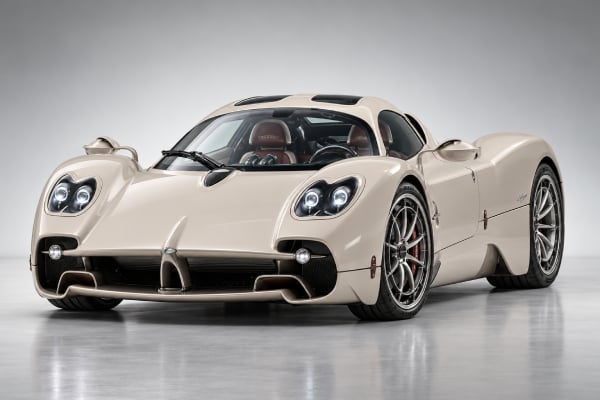
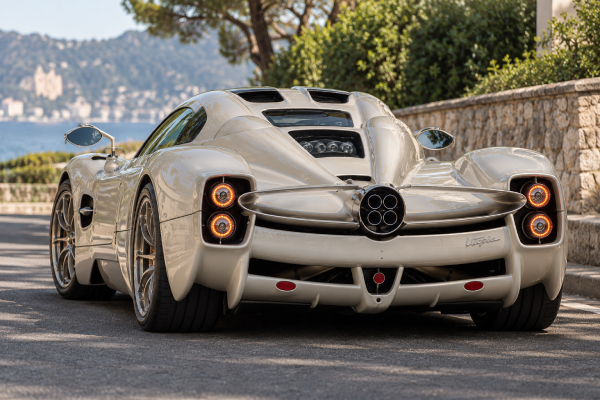
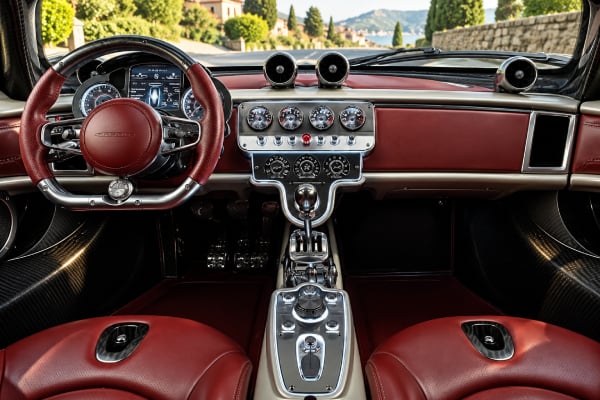
The Pagani Utopia coupé is built around a choice that has become unusual in modern hypercars: mechanical involvement takes priority over electrification and maximum automation. Its 5,980 cc twin-turbo V12 makes 864 hp and 1,100 Nm without hybrid assistance, while a transverse seven-speed transmission can be ordered either as a true manual or an automated manual. Pagani pairs that drivetrain with a 1,280 kg official dry weight, a composite monocoque, forged-aluminum suspension, carbon-ceramic brakes, and active aerodynamic elements that are integrated into the body rather than displayed as large fixed wings. For the 2022–2025 Utopia coupé, the most useful way to understand the car is as a tightly connected system: low mass supports braking and response, the gearbox layout helps packaging and inertia, and the cabin deliberately keeps the driver’s attention on physical controls. This guide focuses on verified factory data, how those engineering decisions affect use, and the maintenance and due-diligence priorities that matter before purchase.
Table of Contents
- Why the Utopia coupé is different
- Utopia coupé specifications and technical data
- V12, transmission, and driver involvement
- Aerodynamics, structure, and chassis
- Living with an analog-focused hypercar
- Maintenance, storage, and preservation
- How to evaluate a used Utopia
Why the Utopia coupé is different
The Utopia’s character comes from what Pagani chose not to add as much as from what it fitted. There is no traction battery, no hybrid torque fill, no dual-clutch transmission, and no wide dashboard screen dominating the cabin; instead, the car uses a V12, rear-wheel drive, analog instruments, and exposed mechanical controls.
Project C10 followed the Zonda and Huayra and took more than six years to develop. Pagani’s technical material describes thousands of drawings, scale and full-size models, a functional wind-tunnel model, and eight complete prototypes. That extended development matters because the apparently simple result hides a complex engineering program. The clean body is not an absence of aerodynamic work. The manual gearbox is not a nostalgic off-the-shelf component. The low mass is not achieved by deleting the systems needed to make an 864 hp road car usable.
The first coupé series is limited to 99 units. Because each car is heavily commissioned, two examples can differ substantially in exposed-carbon treatment, paint, leather, metal finishes, stitching, luggage, and optional equipment. That makes the build record unusually important. A generic online equipment list can describe the platform, but it cannot reliably describe a specific chassis.
The model-year scope here is 2022 through 2025, covering the initial Utopia coupé era named in the assignment. There were continuing developments in tires, personalization, and factory programs during that period, so an owner or buyer should distinguish original configuration from later Pagani-approved changes. A factory-supported upgrade is different from an undocumented aftermarket modification even if both appear visually similar.
The Utopia is also best understood as an ICE car in the strict sense: its propulsion comes only from its gasoline engine. That simplifies the powertrain classification but does not make the car mechanically simple. The V12, cooling circuits, turbocharging, transaxle, active dampers, electronic differential, stability systems, and active aero still require specialist knowledge and model-specific diagnostics.
Utopia coupé specifications and technical data
The Utopia coupé is a mid-engine, rear-wheel-drive, gasoline-only hypercar with a 60-degree twin-turbo V12 and a transverse seven-speed transaxle. Pagani publishes strong detail for the engine, gearbox, composite structure, suspension, brakes, wheels, and tires, but does not publish every conventional consumer-car data point. Values such as official acceleration, fuel economy, fuel-tank capacity, and routine fluid capacities are therefore omitted rather than estimated.
| Specification | Value |
|---|---|
| Engine | Pagani V12 developed on a bespoke basis by Mercedes-AMG |
| Configuration | 60-degree V12, twin turbochargers |
| Displacement | 5,980 cc (6.0 L) |
| Maximum power | 864 hp (635 kW) at 6,000 rpm at 18 °C |
| Maximum torque | 1,100 Nm (811 lb-ft) from 2,800 to 5,900 rpm |
| Engine limiter | 6,700 rpm |
| Engine dry weight | 262 kg (577 lb) |
| Hybrid assistance | None |
| Specification | Value |
|---|---|
| Gearbox | Pagani by Xtrac transverse seven-speed |
| Available operation | Pure manual or AMT automated manual |
| Drive type | Rear-wheel drive |
| Differential | Electro-mechanical |
| Clutch system | Triple-plate design |
| Drive-shaft system | Racing-derived tripod-axis arrangement |
| Specification | Factory description |
|---|---|
| Official dry weight | 1,280 kg (2,822 lb) |
| Monocoque | Carbo-Titanium HP62 G2 and Carbo-Triax HP62 |
| Subframes | Front and rear tubular chromium-molybdenum alloy steel |
| Suspension | Independent double wishbones in forged aluminum alloy |
| Springs | Helical coil springs |
| Dampers | Electronically controlled, semi-active shock absorbers |
| Steering | Electro-assisted steering integrated with the vehicle dynamic control system |
| First-series production | 99 coupés |
| Specification | Front | Rear |
|---|---|---|
| Disc type | Ventilated carbon-ceramic | Ventilated carbon-ceramic |
| Disc size | 410 × 38 mm | 390 × 34 mm |
| Caliper | Six-piston monobloc | Four-piston monobloc |
| Supplier | Pagani by Brembo | Pagani by Brembo |
| Specification | Value |
|---|---|
| Front wheel | 21-inch APP forged monolithic aluminum alloy |
| Rear wheel | 22-inch APP forged monolithic aluminum alloy |
| Front P Zero Corsa | 265/35 R21 |
| Rear P Zero Corsa | 325/30 R22 |
| Cold-weather factory tire | Pirelli SottoZero in matching 21/22-inch fitment |
| Aerodynamic balance | 46% front / 54% rear through the speed envelope |
| Rear aero | Integrated active suspended aerodynamic elements |
The 1,280 kg figure is a dry weight, not a ready-to-drive curb weight. Fluids, fuel, market-required equipment, and the final specification of an individual car change its operating mass. Likewise, the tables should not be read as a workshop specification sheet: Pagani’s public material does not publish the service capacities, fastener torques, or replacement intervals needed for maintenance work.
V12, transmission, and driver involvement
The engine and gearbox are the center of the Utopia experience, but the key engineering story is how they were packaged. Pagani uses a compact transverse transaxle behind the engine and offers the same basic seven-speed concept as either a manual or an AMT rather than adopting a heavier dual-clutch unit.
The 5,980 cc V12 was developed specifically for Pagani with Mercedes-AMG. Its 864 hp peak arrives at 6,000 rpm, while the 1,100 Nm torque plateau stretches from 2,800 to 5,900 rpm. That broad torque band means the car does not need to chase the 6,700 rpm limiter to produce strong acceleration. It can pull hard in a taller gear, which is useful on the road and particularly relevant to a manual car where gear choice is part of the experience.
Pagani’s technical guide also lists the engine’s dry weight at 262 kg. That number helps explain the broader vehicle concept. Instead of adding an electric system for transient response, the project emphasizes a compact combustion engine, relatively low total mass, and short response paths between driver inputs and the rear wheels. The result is not “simple” in a mechanical sense, but it is conceptually direct.
Why the transverse gearbox matters
A transverse transmission layout places the gearsets across the car rather than extending them longitudinally behind the engine. Pagani says this contributes to lower overall weight and reduced polar inertia. In practical terms, concentrating mass closer to the car’s center can help it change direction with less rotational resistance than a longer powertrain assembly placed farther from the center of gravity.
The gearbox also uses a triple-plate clutch and an electro-mechanical differential. Those details matter to owners because they are not ordinary mass-market components. Clutch feel, calibration, actuation behavior on an AMT car, and differential operation should be assessed by technicians who know the system and can compare it with a healthy Utopia rather than with a conventional automatic.
Manual and AMT are different ownership choices
The manual is the more physically involving option. Its exposed linkage and titanium gate make the shift mechanism part of the cabin’s design, but the functional point is more important: the driver controls clutch engagement and shift timing. Smoothness therefore depends on technique, mechanical condition, and adjustment.
The AMT uses automated actuation and steering-wheel paddles. It should not be judged as if it were a torque-converter automatic or dual-clutch transmission. Automated manuals can feel more deliberate at low speed because the system is still operating a clutch and selecting gears mechanically. A buyer should drive the exact car long enough to experience creeping, parking, warm shifts, full-load shifts, and downshifts rather than deciding from a brief demonstration.
For both versions, documentation should show that any clutch, software, gearbox, or differential work was handled through the Pagani service network or a properly authorized specialist. An unexplained change in shift quality is not something to dismiss as “character” until the car has been checked.
Aerodynamics, structure, and chassis
The Utopia avoids large fixed aerodynamic appendages, but it is not aerodynamically passive. Pagani developed the body, cooling paths, underbody, rear extractor, active rear elements, and suspension control as one system, with a stated 46:54 front-to-rear aerodynamic balance across the speed range.
The factory’s development material describes hundreds of CFD configurations and a working wind-tunnel model of nearly 700 components. The goal was not merely low drag. The front splitter, internal ducts, wheel-area airflow, rear extractor, and movable rear elements were developed to create useful downforce and cooling without making the exterior look like a track car covered in add-ons.
This matters to an owner because seemingly cosmetic parts can have aerodynamic or thermal functions. An underbody panel, wheel extractor, duct, or rear-body component should not be repaired or replaced casually. Incorrect panel alignment can affect cooling flow, high-speed stability, or noise even when the car looks acceptable at rest.
The monocoque uses Pagani’s Carbo-Titanium HP62 G2 and Carbo-Triax HP62 composites, with chromium-molybdenum steel subframes at the front and rear. Pagani says torsional rigidity increased by 10.5 percent compared with its previous road-legal cars. A stiff central structure gives the suspension a more stable platform: if the body deflects less, alignment changes under load are more closely controlled and the dampers can do their work with greater consistency.
The suspension itself uses forged-aluminum double wishbones with helical springs and electronically controlled dampers. Pagani describes the dampers as capable of supporting firm circuit behavior while retaining road comfort through different driving modes. The integrated dynamics controller coordinates active systems, including the electro-assisted steering. This is a useful reminder that the Utopia’s “analog” theme refers to the driver interface and powertrain philosophy, not an absence of electronics.
Braking is handled by Brembo carbon-ceramic hardware with 410 mm front and 390 mm rear discs. Cooling air is deliberately directed to the discs, calipers, and pads to help maintain repeatability. Carbon-ceramic brakes can last a long time under suitable road use, but condition cannot be judged from mileage alone. Track temperature history, stone damage, surface condition, measured wear, pad compatibility, and correct handling all matter.
The bespoke Pirelli fitment is equally important. The 265/35 R21 front and 325/30 R22 rear sizes are part of the chassis calibration, and Pagani’s material emphasizes that the tires were developed specifically for the car. Tire age, storage environment, heat cycles, sidewall condition, and exact specification deserve more attention than tread depth alone. A low-mileage Utopia on old or incorrectly specified tires is not ready for serious driving simply because the tread looks deep.
Living with an analog-focused hypercar
The Utopia’s cabin is intentionally physical, but daily usability still depends on modern systems working correctly. The analog dials, machined controls, exposed gear mechanism, steering hardware, cameras, and limited digital display should all be treated as functional components rather than decorative details.
Pagani deliberately avoided a broad infotainment screen. The main instruments are analog, while a small display handles functions that genuinely need a screen. That arrangement reduces visual clutter, but it makes the condition of the physical switchgear especially noticeable. A sticky control, loose knurled knob, scratched machined surface, or misaligned mechanism is not hidden behind software.
The steering wheel is a good example of the car’s engineering-as-design approach. Pagani machines the rim, spokes, and hub from a single aluminum block, then finishes the piece by hand. The pedals and many other visible metal components receive similar attention. For ownership, that means careless jewelry, abrasive cleaning, or the wrong chemical product can damage parts that are expensive and difficult to refinish correctly.
The same logic applies to exposed carbon and painted composite panels. A detailer accustomed to conventional clear-coated steel or aluminum cars may not recognize the finish stack, edge construction, or local repair limits on a Pagani. Before polishing, paint correction, paint-protection film removal, or ceramic coating, the owner should confirm exactly what surface is present and whether Pagani has approved the process.
Low ride height and wide rear bodywork add ordinary practical constraints to extraordinary hardware. Route planning should account for ramps, speed humps, garage transitions, loading angles, and parking width. Transporters need suitable approach angles and secure tie-down procedures. Even a minor underside impact deserves inspection because a cosmetic scrape may be close to a structural panel, aerodynamic piece, cooling duct, or mounting point.
A Utopia also benefits from deliberate warm-up and cool-down habits. The public technical material does not provide owner-level temperature targets or idling rules, so those should come from the actual handbook and service guidance for the chassis. The general principle is simply to avoid asking for maximum load from cold fluids and to pay attention to temperatures after hard use.
Maintenance, storage, and preservation
A Utopia should be maintained by documentation and condition, not by mileage alone. Low annual distance can reduce some wear, but age still affects tires, batteries, fluids, seals, fuel, leather, adhesives, and electronic systems.
The safest maintenance plan begins with the exact car’s official Pagani documentation. Public brochures do not publish enough service data to support oil grades, fluid capacities, tightening torques, clutch procedures, brake measurements, or interval claims. Those values can vary with production changes, market equipment, and later factory updates, so they should never be reconstructed from a different Pagani model or a third-party database.
For a car that spends long periods stored, owners should concentrate on the conditions that preserve systems rather than merely keeping the odometer low. A sensible storage review includes:
- battery support using the factory-approved method and correct connection points;
- tire pressures and periodic inspection for flat-spotting, sidewall aging, and environmental damage;
- climate control appropriate for leather, adhesives, exposed metals, and composite finishes;
- fuel quality and any factory guidance for longer storage periods;
- checks for fluid leaks, coolant residue, hydraulic seepage, rodent damage, and blocked ventilation paths;
- controlled exercise or recommissioning according to Pagani guidance rather than casual short idling.
Short start-ups that never bring systems properly to operating condition can be less useful than owners assume. They may add moisture to the exhaust and engine oil without giving the drivetrain a meaningful heat cycle. The correct long-term procedure should come from Pagani or the servicing dealer for the specific storage duration.
Tires and brakes deserve independent age and condition records. A date code and tread measurement should be logged for each tire. Carbon-ceramic discs should be assessed using the manufacturer’s approved inspection method, not solely by visual appearance or a conventional iron-disc wear assumption. Pad condition, caliper seals, brake fluid, wheel hardware, and brake-cooling ducts also matter.
Service history should include software and calibration work as well as mechanical jobs. The Utopia has electronic damping, stability control, an electro-mechanical differential, active aero, and—on AMT cars—gearshift actuation and control logic. A complete record therefore includes diagnostic campaigns, updates, fault investigations, and any hardware replacements that required programming or adaptation.
Pagani’s Puro program provides a useful framework for provenance because it is designed to certify authenticity and help preserve value. The Unico program covers factory-supported customization and technical updating. Neither program means that every change is automatically desirable to every future buyer, but documented Pagani work is materially different from an unexplained modification. The key is traceability: what changed, when, why, by whom, and whether the original parts remain with the car.
Cosmetic care should be similarly documented. Photograph paint and exposed carbon before and after film installation or removal. Keep invoices for wheel refinishing, leather repair, stone-chip correction, and carbon work. On a car with extensive handcrafted surfaces, high-quality records can explain a repair that might otherwise look suspicious during resale inspection.
How to evaluate a used Utopia
A used Utopia should be bought on provenance, condition, and configuration rather than mileage or rarity alone. The 99-car first series is inherently scarce, so the practical question is whether one specific chassis has been maintained, stored, driven, and modified in ways you can verify.
Start with identity and paperwork. Match the chassis information to the build record, original invoice, market documentation, service history, and any Pagani certification. Confirm the original color and exposed-carbon specification, interior materials, transmission type, wheel finish, luggage, keys, books, tools, covers, and other delivered accessories. With bespoke cars, missing presentation items can be difficult or costly to reproduce later.
Next, build a chronological service timeline rather than reading invoices one by one. Look for long unexplained gaps, repeated faults, recurring warning messages, transport damage, battery incidents, clutch work, brake replacement, tire changes, body repair, and software updates. A well-used car with continuous authorized care can be easier to assess than a near-static car with sparse records.
A pre-purchase inspection should include the composite structure and not just the visible body. Pay particular attention to sills, suspension mounting areas, underbody panels, jacking or lifting points, front and rear subframes, lower edges, diffuser areas, and any region near previous impact or transport marks. Composite damage can be highly localized and may not deform in the way metal bodywork does.
The powertrain inspection should include a cold start, warm operation, diagnostic scan, leak check, cooling-system review, and a road test long enough to assess the complete temperature range. On a manual car, check clutch take-up, pedal feel, shift engagement, synchro behavior, reverse selection, and noises under load or overrun. On an AMT car, assess low-speed clutch behavior, shift timing, paddle response, warning history, and any adaptation or actuator work. Do not compare either system with a different gearbox design and then label normal behavior a defect.
Chassis checks should cover damper operation, steering response, ride-height behavior if applicable to the specific configuration, wheel condition, tire age and exact markings, brake-disc and pad condition, and evidence of curb or pothole impacts. A cosmetic wheel repair can be harmless; a bent wheel, damaged tire, altered alignment, or suspension impact is a different matter.
Inspect the cabin slowly. Verify every switch, analog gauge, display function, camera, climate-control function, seat adjustment, latch, door mechanism, and warning lamp. Look for wear on machined aluminum, leather, exposed shift components, sill areas, and steering-wheel surfaces. Because many parts are works of craftsmanship in their own right, a small-looking defect can require specialized repair.
Finally, decide whether the specific transmission and specification suit your intended use. A manual Utopia is rewarding only if you want the responsibility and interaction of a clutch pedal and gated shift. An AMT is the better personal choice only if its shift character works for your roads and driving style. The car’s market rarity should not make that decision for you.
Before purchase, obtain written estimates for immediate service, tires, brake work if needed, insurance, secure storage, transport, and any cosmetic correction. Add time as well as money: low-volume factory work can involve logistics that do not exist with a conventional performance car. A Utopia is at its best when the owner plans for that support structure before the car arrives.
The central buying principle is simple: originality is valuable, but documented correctness is more useful than untouched appearance. A properly recorded factory repair or Pagani-approved update can be easier to trust than an apparently pristine area with no history. The Utopia was engineered as a highly usable expression of mechanical involvement; preserving that experience depends on disciplined maintenance, accurate records, and repairs that respect the car’s materials and systems.
References
- Utopia | Pagani 2022
- Pagani Utopia_Dati tecnici_ENG 2022 (Technical Specifications)
- World premiere of the new Pagani Utopia | Pagani 2022
- PIRELLI P ZERO CORSA FOR THE UTOPIA: PAGANI’S LATEST MASTERPIECE 2022
- Pagani Puro | Pagani 2021
- Pagani Unico | Pagani 2022
Disclaimer
This article is for informational purposes and is not a substitute for professional diagnosis, inspection, maintenance, or repair. Specifications, torque values, service intervals, software, and procedures can vary by VIN, market, production stage, and equipment. Verify all service work against the official Pagani documentation for the exact car and use an appropriately qualified Pagani service facility.
If this guide was useful, please consider sharing it on Facebook, X/Twitter, or another enthusiast community to support our work.