
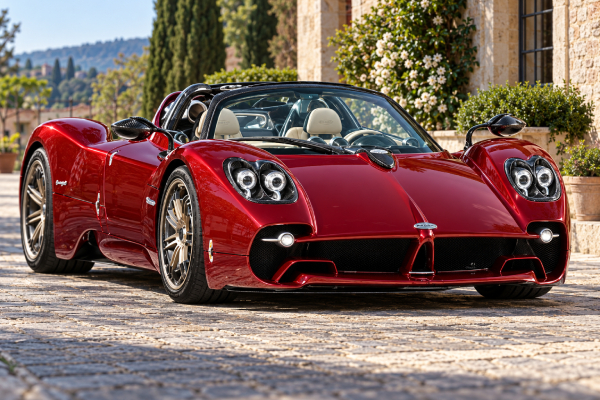
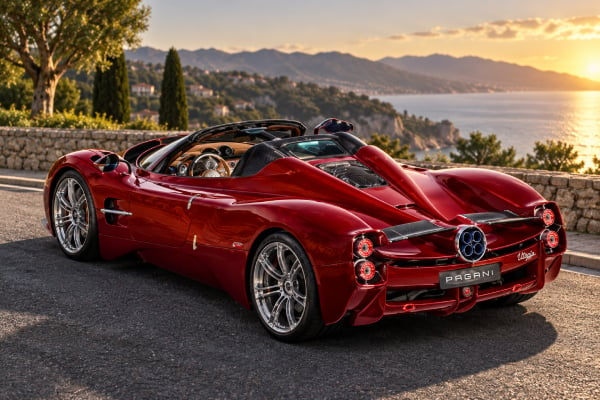
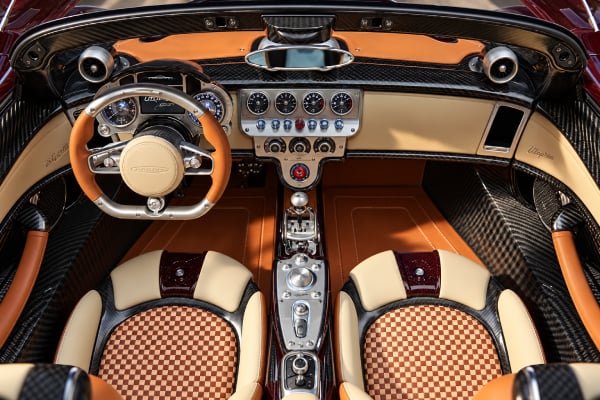
The Pagani Utopia Roadster is unusual because removing its fixed roof did not produce a heavier factory dry-weight figure. Pagani lists the open car at the same 1,280 kg as the Utopia coupé, yet it keeps the 864 hp, 5,980 cc twin-turbo V12, rear-wheel drive, and choice of seven-speed manual or automated manual transmission. The roof itself also changes the ownership experience: a rigid hard-top can be removed and stored on a stand, the car can be driven fully open, and a compact soft-top can travel with the car for weather protection. From its 2024 unveiling through the current 2026 period, the Roadster has also become the showcase for Pirelli Cyber Tyre integration with vehicle dynamics. This guide concentrates on the details that are genuinely specific to the open Utopia: verified dimensions and performance data, roof packaging, the redesigned composite structure, connected-tire technology, open-cabin care, service planning, and the checks that matter before buying one of the planned 130 cars.
Table of Contents
- Roof configurations and travel planning
- Roadster specifications and technical data
- How Pagani kept the Roadster light
- Cyber Tyre and dynamic controls
- Open-cabin care and luggage
- Roadster service and condition checks
- Commissioning or buying a Roadster
Roof configurations and travel planning
The Utopia Roadster offers three practical states: hard-top fitted, fully open, or covered by the compact soft-top. That flexibility is a major part of the model, but it also means roof handling and storage must be planned before a trip rather than improvised after the weather changes.
Pagani developed the Roadster and coupé together from the early Project C10 program. That is significant because the open version was not created by simply cutting the roof from a finished closed car. The structure, aerodynamics, door movement, roof geometry, and packaging could be considered together while the basic vehicle architecture was still being engineered.
With the rigid hard-top installed, the Roadster keeps the smooth upper profile of the Utopia while adding a large roof window. The panel is removable and Pagani provides for it to rest on a dedicated stand when off the car. The important ownership point is that the hard-top is not something to casually place against a garage wall or slide into ordinary luggage space. It is a finished body component with seals, attachment points, transparent material, and expensive surfaces that need controlled handling.
With the hard-top removed, there is no powered folding mechanism to occupy a large compartment behind the cabin. That helps preserve the car’s shape and packaging, but the rigid top does not travel with the car in normal luggage space. An owner leaving home open-top therefore needs a weather plan.
Pagani’s answer is the soft-top. It can be stored in a dedicated suitcase positioned in the central area behind the seats, replacing the vanity case that would normally occupy that location. This is best treated as portable weather protection rather than a fully equivalent substitute for the hard-top. A new owner should have the dealer demonstrate fitting, removal, folding, and storage, then make sure every fastener, protective piece, bag, and instruction supplied with the car remains together.
The roof choices also affect trip logistics. Before a long drive, decide where the hard-top will stay, whether the destination has secure covered parking, and whether the soft-top is on board. That simple planning avoids hurried roof handling near luggage, jewelry, dirty bodywork, or wind-blown grit—exactly the circumstances most likely to mark paint, exposed carbon, seals, or the roof panel.
Roadster specifications and technical data
The Utopia Roadster is an ICE hypercar: a mid-mounted, gasoline-fueled V12 drives only the rear wheels, with no hybrid motor or traction battery. Unlike the original coupé public sheet, the Roadster technical specification also publishes exterior dimensions and an electronically limited top speed. Pagani does not publish an official acceleration time, fuel economy, fuel capacity, or routine service-fluid data in that sheet, so those values are not inferred here.
| Specification | Value |
|---|---|
| Engine | Pagani V12 developed for Pagani by Mercedes-AMG |
| Layout | 60-degree V12 with twin turbochargers |
| Displacement | 5,980 cc (6.0 L) |
| Maximum power | 864 hp (635 kW) at 6,000 rpm at 18 °C |
| Maximum torque | 1,100 Nm (811 lb-ft) from 2,800 to 5,900 rpm |
| Hybrid assistance | None |
| Driven wheels | Rear |
| Specification | Value |
|---|---|
| Gearbox | Pagani by Xtrac transverse seven-speed |
| Transmission choices | Pure manual or AMT automated manual |
| Differential | Electro-mechanical |
| Manual clutch | Light, adjustable triple-disc design |
| Official top speed | 350 km/h (217 mph), electronically limited |
| Specification | Value |
|---|---|
| Body style | Two-seat Roadster with removable hard-top |
| Length | 4,673 mm (184.0 in) |
| Width | 2,060 mm (81.1 in) |
| Height | 1,165 mm (45.9 in) |
| Wheelbase | 2,796 mm (110.1 in) |
| Official dry weight | 1,280 kg (2,822 lb) |
| Planned production | 130 cars |
| Component | Factory specification |
|---|---|
| Monocoque | Carbo-Titanium HP62 G2 and Carbo-Triax HP62 |
| Subframes | Front and rear tubular chromium-molybdenum alloy steel |
| Front suspension | Independent forged-aluminum double wishbones |
| Rear suspension | Independent forged-aluminum double wishbones |
| Springs | Helical coil springs |
| Dampers | Electronically controlled shock absorbers |
| Roof-off structural strategy | Roadster-specific monocoque redesigned for rigidity and resistance without conventional heavy reinforcement |
| Specification | Front | Rear |
|---|---|---|
| Carbon-ceramic disc | 410 × 38 mm | 390 × 34 mm |
| Caliper | Six-piston monobloc | Four-piston monobloc |
| Wheel diameter | 21 inches | 22 inches |
| P Zero Corsa | 265/35 R21 | 325/30 R22 |
| Cold-weather tire | Pirelli P Zero Winter | Pirelli P Zero Winter |
| Optional performance tire | Pirelli P Zero Trofeo RS | Pirelli P Zero Trofeo RS |
The dry-weight definition deserves care. It is not the same as a fully fueled curb weight, and the installed roof state plus the individual commission can influence the mass seen in real use. The 350 km/h figure is likewise an electronically limited maximum published by Pagani, not a useful road target. Tire condition, maintenance, weather, surface, legal limits, and driver training remain more important than the headline number.
How Pagani kept the Roadster light
The Roadster’s central structural achievement is not simply that it uses carbon composites; it is that Pagani reports the same 1,280 kg dry weight as the coupé while removing the permanent roof. The company says it reached that result by redesigning the monocoque for rigidity and resistance instead of relying on the heavy reinforcement often added when a closed body becomes an open one.
A roof contributes to a car’s load path. In a closed structure, the roof, pillars, sills, floor, bulkheads, and windscreen surround can work together to resist torsion. Remove the fixed upper section and the remaining structure must carry those forces through different paths. If engineers simply add thick metal braces afterward, weight climbs and packaging can suffer.
Pagani instead uses a large set of composite formulations—more than forty across the Roadster according to the launch material. Carbo-Titanium HP62 G2 and Carbo-Triax HP62 are the best-known names, but the broader point is material placement. Different fiber orientations, resins, metallic reinforcement, thicknesses, and local structures can be chosen for the loads at specific parts of the monocoque.
This has a practical effect beyond the scale reading. Suspension geometry is designed relative to hard mounting points. If the body twists excessively, those points move and the alignment seen by the tire can change under load. A stiff platform therefore helps the electronically controlled dampers, steering, differential, and stability systems operate from a more predictable mechanical base.
The Roadster also had to remain aerodynamically coherent with and without the hard-top. Airflow through the wheel passages, along the body, around the mirrors, over the upper surfaces, and toward the elliptical tail still needs to support cooling and stability. Two movable rear flaps are integrated into the trailing area, while internal ducts manage air for cooling and intake. Open-cabin airflow changes local pressure and turbulence, so the roof states had to be considered during development rather than treated as a cosmetic afterthought.
That engineering makes accident assessment specialized. A small mark on a replaceable outer panel and damage to a structural sill, windscreen surround, suspension pick-up, bonded joint, or roof attachment point are not equivalent. Composite repair depends on fiber continuity, resin and heat history, insert condition, bonding, geometry, and finish. A conventional body shop’s visual inspection is not enough for a high-value structural decision.
It also means aftermarket aero accessories should be approached cautiously. A camera mount, wind deflector, non-factory wheel treatment, or altered underbody part can seem minor but may affect airflow or introduce loads where the original structure was not designed to take them. Factory approval matters more here than visual compatibility.
Cyber Tyre and dynamic controls
Pirelli Cyber Tyre is not simply a tire-pressure monitor. On the Utopia Roadster, sensors and software provide tire-related information to the car’s electronic control systems so functions such as ABS, electronic stability control, and traction control can respond using data associated with the actual tires and their operating state.
Pirelli and Bosch Engineering developed the integration with Pagani. By 2026, Pirelli described the Utopia Roadster as the first model to use Cyber Tyre fully integrated with the vehicle’s dynamics controls, and its 1,500 km demonstration drive linked Pagani, Bosch Engineering, and Pirelli facilities. That current-use evidence is important because the 2024 launch material described the system as a first-of-its-kind production application that was about to reach customers.
The sensor concept can help the control software understand more than wheel speed alone. Pirelli describes Cyber Tyre as collecting data including pressure, temperature, and acceleration, then processing information through proprietary algorithms and communicating with the vehicle electronics. The practical benefit is better context for systems that must decide how much braking or corrective torque to request.
None of this creates unlimited grip. The contact patch still depends on tire compound, tread condition, pressure, temperature, surface contamination, water depth, load, alignment, and driver input. Cyber Tyre cannot make an aged or damaged tire safe, and it does not remove the need for correct warm-up or replacement.
For service, the connected tire also becomes part of the electronic system. Tire replacement should therefore preserve the correct Pagani-approved specification and any required sensor hardware, identification, pairing, calibration, or software procedure. A shop that can mount a 21- or 22-inch performance tire is not automatically equipped to maintain an integrated connected-tire system on a Utopia Roadster.
The available tire families also serve different conditions. P Zero Corsa is the core road-performance fitment; P Zero Winter provides a factory cold-weather option; and P Zero Trofeo RS is offered as a more track-focused choice. The correct selection depends on temperature, use, and the exact approved configuration. Mixing specifications or treating the most aggressive tire as automatically “better” can reduce the balance Pagani and Pirelli calibrated.
The Roadster’s electronics extend beyond the tires. Active damping, the electro-mechanical differential, traction control, stability control, and braking systems are part of the same dynamic picture. That is why a warning light, sensor fault, alignment issue, or non-approved tire should not be diagnosed in isolation. The car may continue to drive, but a degraded input can change how several systems behave together.
Open-cabin care and luggage
Open-air use exposes the Roadster’s interior and roof interfaces to conditions the coupé normally keeps outside. The most important routine habits are careful roof handling, early removal of grit and moisture, protection of leather and machined surfaces, and keeping every roof and luggage component complete.
The hard-top deserves a repeatable handling routine. Before removal, the body and roof edges should be clean enough that trapped dust cannot be dragged across finished surfaces. The storage stand should be stable, padded as intended, and located where the panel cannot be struck by doors, tools, or people. If the official procedure requires two people or specified lifting points, that procedure should take priority over convenience.
Roof seals and attachment areas should be inspected for contamination, cuts, deformation, and evidence of incorrect seating. Do not treat an unusual wind noise or water mark as something to cure immediately with generic seal dressing or extra adhesive. First verify panel alignment and the exact factory maintenance method. An inappropriate chemical can swell or degrade elastomers, while improvised shims can load the roof or latch incorrectly.
The soft-top has a different risk profile. Because it is folded, packed, and carried, dirt trapped in the fabric or bag can become abrasive. It should be dry before long-term storage and packed in the approved way. After use in rain, allow the material to be cleaned and dried according to the supplied instructions rather than sealing moisture into the suitcase.
The cabin contains leather, exposed mechanisms, finished carbon, and extensive machined metal. Sun, sunscreen, skin oils, rain droplets, and airborne dust can all matter more when the roof is off. Gentle, material-specific cleaning is preferable to aggressive all-purpose products. Owners should be particularly cautious with polished or anodized metal, exposed-carbon edges, stitching, and the visible manual shift mechanism.
Pagani’s dedicated luggage is part of the car’s packaging. The Roadster can carry two matching suitcases in compartments beside the engine, plus garment bags behind the headrests. The central space behind the seats changes function when the soft-top suitcase is carried. That means luggage planning is not just about volume; it is about using the intended pieces in the intended locations without blocking mechanisms or placing loose objects near hot or moving components.
When the car is transported rather than driven, roof state should be specified to the carrier in advance. Confirm whether the hard-top is installed, where the soft-top and hard-top stand will travel, how the doors can open inside the transporter, and which lifting or tie-down points are approved. A low front overhang and expensive underbody make loading-angle discipline essential.
Roadster service and condition checks
Roadster maintenance should add roof hardware, weather exposure, connected tires, and open-cabin surfaces to the normal Utopia mechanical inspection. The public brochures are not a service manual, so fluid specifications, torque values, replacement intervals, and adjustment procedures must come from the documentation for the exact chassis.
A useful annual or pre-use condition review should cover the roof system separately from routine powertrain work. Inspect the hard-top surface, window, seals, locating features, latches, storage stand, soft-top, soft-top bag, and all related protective pieces. Check for witness marks that suggest misalignment or contact. A latch that needs unusual force is a reason for inspection, not an invitation to push harder.
Tires need both mechanical and electronic attention. Record date codes, pressures, tread condition, sidewall condition, and any evidence of puncture repair or impact. Confirm that the fitted model and size match the approved specification for all four corners. Where Cyber Tyre hardware or software is involved, scan for faults and verify correct system recognition after tire work.
The carbon-ceramic brakes should be assessed with the method Pagani and Brembo specify. Road mileage alone does not tell the full story because heat history, track use, pad condition, stone impacts, and handling during wheel service can affect expensive components. Brake cooling paths and wheel-area aero pieces should also be intact.
The V12 and gearbox require the same disciplined approach. Look for complete service history, correct warm and cold behavior, diagnostic records, and evidence of leaks or repeated temperature warnings. On a manual, evaluate clutch take-up and shift quality; on an AMT, assess actuator behavior and clutch engagement across parking, low-speed maneuvering, normal shifts, and more committed driving. Neither transmission should be judged from one fast shift on a short test route.
Open-body structural inspection is especially important after any accident, curb strike, transport incident, or roof-related mishap. Examine the sills, underbody, suspension mounting areas, front and rear subframes, windscreen surround, door apertures, and roof attachment points using Pagani-approved methods. Cosmetic perfection on the upper body cannot rule out damage underneath.
Storage remains an active maintenance task. Battery support, tire care, humidity, ventilation, fluid condition, and recommissioning should follow Pagani guidance. Avoid assuming that periodic short idling is enough to preserve the car. If the Roadster will sit for months, agree on a written storage and restart plan with the servicing facility.
Pagani Puro can be relevant when provenance and authenticity need formal support. For a later resale, invoices and photographs for roof work, film installation, tire replacement, connected-tire service, composite repair, and interior restoration can be as useful as ordinary maintenance stamps because they explain exactly what happened to vulnerable Roadster-specific areas.
Commissioning or buying a Roadster
The Roadster should be chosen as a complete specification and ownership system, not just as the open version of the coupé. Pagani plans 130 examples, and the launch price was €3.1 million before local taxes, but the meaningful cost and desirability of an individual car depend heavily on its commission, condition, roof equipment, transmission, factory options, and history.
For an original commission, think first about how the car will actually be used. If open-road touring is the priority, interior materials, roof-handling convenience, luggage choices, and protection from sun and weather may matter more than the most dramatic show specification. If track use is realistic, discuss the tire choice, brake support, seat configuration, and Sport Pack with the factory or dealer rather than assembling those decisions from resale-market assumptions.
The launch car demonstrated how far the specification can move. Its optional Sport Pack included lighter, more focused seats with Carbo-Titanium structure, a titanium exhaust, Aeroblade wheel deflectors for hot-air extraction around the brakes, Trofeo RS tires, and additional Carbo-Titanium components. A buyer should document exactly which Sport Pack elements and later factory options are fitted to the chassis being considered rather than assuming every visually aggressive Roadster has the same package.
On the secondary market, begin by inventorying everything that belongs with the car. In addition to the normal keys, books, covers, luggage, and tools, confirm the hard-top, stand, soft-top, soft-top suitcase, garment bags, vanity case if supplied for the configuration, and any model-specific protective hardware. Missing roof equipment is more consequential than a missing presentation accessory because it changes how the car can be used.
Then verify the build and alteration history. Compare the car with its original commission record and identify any later paint, carbon, upholstery, wheel, exhaust, tire, or electronic changes. Factory-supported personalization can be entirely legitimate, but it should be traceable. If a part has been changed, ask whether the original accompanies the car and whether the update affected software, homologation, or service procedures.
A pre-purchase inspection should include a roof-on and, where practical, roof-off assessment. With the hard-top fitted, listen for unusual wind noise and inspect panel seating, latches, seals, and the roof window. With it removed, examine attachment points and exposed body edges. Test doors through their full movement and check the cabin for evidence of water exposure or careless top handling.
The choice between manual and AMT should be made during a meaningful drive. The manual turns clutch operation and the exposed gate into central parts of every journey. The AMT reduces that workload and uses paddles, but it still has the character of an automated manual rather than a conventional automatic. The better fit depends on the owner’s routes, traffic, physical preference, and desired involvement.
Finally, build the ownership infrastructure before delivery. Confirm secure climate-controlled storage, insurance that covers the intended open-roof and transport use, access to a Pagani-authorized service route, suitable enclosed transport, and a safe location for the hard-top stand. If the car will travel internationally, plan how roof pieces, luggage, spares, and service support will move with it.
The Roadster’s appeal is strongest when those practical details are solved in advance. Its engineering allows an owner to switch between a bright enclosed cabin, a fully open V12 experience, and a portable weather-cover configuration without giving up the factory dry-weight figure of the coupé. Preserving that flexibility requires more than polishing the car; it requires complete roof equipment, correct connected tires, disciplined records, and specialists who understand the composite structure and electronic systems as one package.
References
- Utopia Roadster | Pagani 2024
- ACT THREE, SCENE TWO: PAGANI UTOPIA ROADSTER | Pagani 2024
- Pagani Utopia Roadster – Technical Specifications – ENG 2024 (Technical Specifications)
- Pagani Utopia Roadster: the work of art becomes “connected” 2024
- On the road with Cyber Tyre: 1,500 kilometers driving the Pagani Utopia Roadster 2026
- Pagani Puro | Pagani 2021
Disclaimer
This guide is for informational purposes and is not a substitute for professional diagnosis, inspection, maintenance, or repair. Specifications, torque values, intervals, roof procedures, software, and service methods can vary by VIN, market, production stage, and equipment. Confirm all work against the official Pagani documentation for the exact Roadster and use an appropriately qualified Pagani service facility.
If this guide helped, please consider sharing it on Facebook, X/Twitter, or a relevant enthusiast community to support our work.