
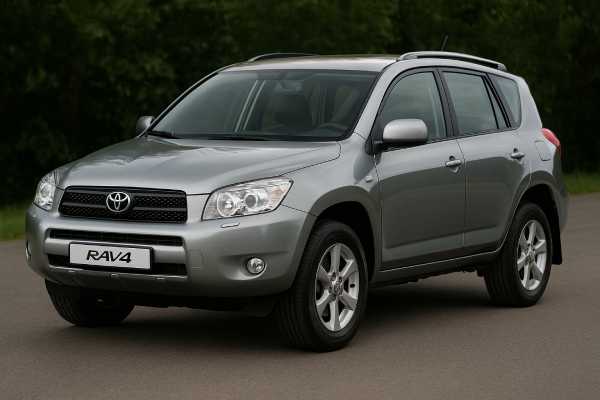
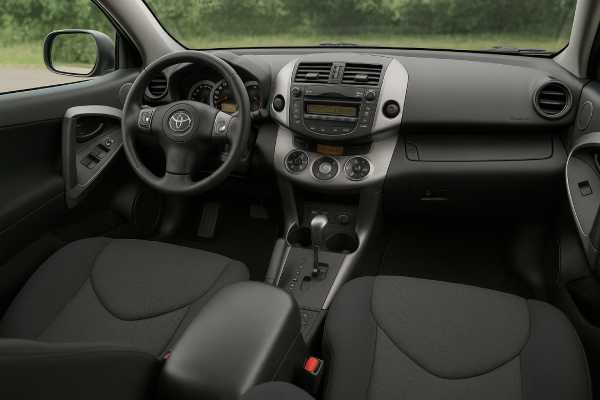
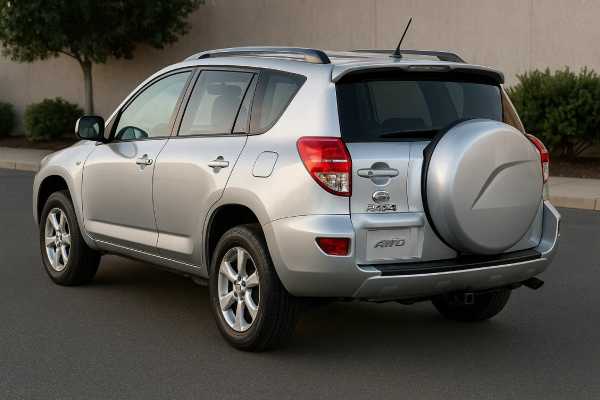
The third-generation Toyota RAV4 (XA30) with the 2.0-litre 1AZ-FE and on-demand AWD landed in Europe in early 2006 and ran through 2008 before its facelift. It kept the nameplate’s easy-going road manners but added a stiffer platform, more cabin space, and a clever Active Torque Control 4WD system that shuffles drive between the axles in real time. For buyers who want a compact SUV that behaves like a family hatchback on tarmac yet stays composed on snow or wet grass, this is the sweet spot of the pre-facelift XA30 range. The naturally aspirated, chain-driven 1AZ-FE is simple, smooth, and frugal enough for everyday use; the short-wheelbase European body brings tidy dimensions for city parking; and the cabin’s “Easy Flat” rear seats make load-carrying painless. This guide focuses on the 2.0 AWD petrol model from 2005–2008, distilling what to know on specs, performance, safety, upkeep, and ownership pitfalls—so you can buy and maintain one with confidence.
At a Glance
- Predictable handling and surefooted Active Torque Control AWD; lock mode helps in low-grip starts.
- Practical cabin with Easy-Flat rear seats; 586 L (VDA) boot, up to 1,469 L folded.
- Chain-driven 1AZ-FE is robust with regular oil changes; common fixes are inexpensive.
- Watch for rear suspension arm recall completion and seepage at the chain tensioner.
- Typical service cadence: engine oil every 10,000 mi / 15,000 km or 12 months.
What’s inside
- RAV4 XA30 AWD overview
- RAV4 2.0 AWD specs
- RAV4 trims, options, safety
- Reliability, issues, and service actions
- Maintenance and buyer’s guide
- Driving and real-world performance
- How the RAV4 compares
RAV4 XA30 AWD overview
Toyota’s third-gen RAV4 took a decisive step up in maturity without losing the original’s lighthearted usability. The 2005–2008 pre-facelift European model is the “short-wheelbase” (SWB) global body: compact outside, roomy inside, with a tight turning radius that keeps it friendly in narrow streets. The 2.0-litre 1AZ-FE petrol engine remains the simplest powertrain in the lineup—an all-aluminium, DOHC, 16-valve inline-four with dual VVT-i (variable intake timing on this generation), naturally aspirated, and driven by a timing chain rather than a belt. No turbos, no direct injection, and no complicated aftertreatment mean fewer ageing-related surprises and easier DIY servicing.
AWD is the highlight. Toyota’s Active Torque Control 4WD continuously biases torque between the front and rear axles—operating as efficient front-drive when cruising and sending drive rearward as grip falls. A driver-selectable “Lock” button momentarily fixes a 55:45 front:rear split to help pull away on snow, gravel, or wet grass; it disengages automatically beyond moderate urban speeds. Traction and stability systems are integrated more tightly than in the prior generation, and on mid/high trims Toyota layers in VSC+ (stability control that can add steering assist) along with hill-start assist and downhill assist (for automatics).
Packaging is a genuine strength. Compared with the prior model, the XA30’s cabin gained useful shoulder and cargo room. The Easy-Flat rear bench folds into the floor in one motion, eliminating the wrestling match some rivals require. Everyday livability is classic Toyota: logical controls, clear instruments, and materials that still hold up after a decade and a half. If you need a simple, reliable family SUV that’s happy in winter and doesn’t feel truck-like, this 2.0 AWD spec sits in a sweet, overlooked niche—cheaper to run than the diesel and less complicated than later generations, but safer, roomier, and more refined than the XA20 it replaced.
RAV4 2.0 AWD specs
Engine and performance (ICE-only)
| Item | Detail |
|---|---|
| Code | 1AZ-FE |
| Layout & cylinders | Inline-4, DOHC, 16 valves (4 per cyl) |
| Bore × stroke | 86.0 × 86.0 mm (3.39 × 3.39 in) |
| Displacement | 2.0 L (1,998 cc) |
| Induction | Naturally aspirated |
| Fuel system | Multi-point fuel injection (PFI) |
| Compression ratio | 9.8:1 |
| Max power | 150 hp (112 kW) @ 6,000 rpm |
| Max torque | 194 Nm (143 lb-ft) @ 4,000 rpm |
| Timing drive | Chain |
| Emissions class | Euro 4 (period European spec) |
| Rated economy (combined) | ~8.6–9.0 L/100 km (27–26 mpg US / 32.8–31.4 mpg UK) manual vs auto |
| Real-world highway @ 120 km/h (75 mph) | Typically ~8.5–9.5 L/100 km (28–25 mpg US / 33–30 mpg UK), tyre & load dependent |
| Aerodynamics | Cd ≈ 0.31 |
Notes: The rated figures above reflect the period European test cycle. Real-world consumption varies with tyres (17 vs 18 in), roof rails/box, winter fuel, and driving style.
Transmission and driveline
| Item | Manual (5-speed) | Automatic (4-speed) |
|---|---|---|
| Type | 5-MT | 4-AT (lock-up) |
| 1st | 3.538 | 3.943 |
| 2nd | 2.060 | 2.197 |
| 3rd | 1.404 | 1.413 |
| 4th | 1.121 | 1.020 |
| 5th | 0.918 | — |
| Reverse | 3.583 | 3.145 |
| Final drive | 4.562 | 2.741 |
| Drive type | Active Torque Control AWD with electronically controlled rear coupling; open diffs with brake-based traction aid | |
| Lock function | 55:45 fixed split via “4WD Lock” (auto-cancels beyond modest speeds) |
Chassis and dimensions
| Item | Detail |
|---|---|
| Suspension (front/rear) | MacPherson strut / double wishbone |
| Steering | Electric power steering; overall ratio ~14.4:1 |
| Brakes (front/rear) | 296 × 28 mm ventilated disc / 281 × 12 mm solid disc |
| Wheels/Tyres | 225/65 R17 (most trims); 18-inch on top diesel trim |
| Ground clearance | ~200 mm (7.9 in) |
| Angles (approach/departure/ramp) | 25° / 20° / 20° |
| Length/Width/Height | ~4,395 / 1,815 / 1,685 mm (173.0 / 71.5 / 66.3 in) |
| Wheelbase | ~2,560 mm (100.8 in) |
| Turning circle (kerb-to-kerb) | ~10.2 m (33.5 ft) |
| Kerb weight | approx. 1,500–1,610 kg (3,307–3,549 lb), by trim/trans |
| GVWR | ~2,070–2,110 kg (4,564–4,652 lb) |
| Fuel tank | ~60 L (15.9 US gal / 13.2 UK gal) |
| Cargo volume (VDA) | 586 L seats up / up to 1,469 L seats folded |
Performance and capability
| Metric | 2.0 AWD 5-MT | 2.0 AWD 4-AT |
|---|---|---|
| 0–100 km/h (0–62 mph) | ~10.6 s | ~12.0 s |
| Top speed | ~185 km/h (115 mph) | ~175 km/h (109 mph) |
| Towing (braked / unbraked) | up to ~1,500 kg (3,307 lb) / 750 kg (1,653 lb) | |
| Payload (typical range) | ~460–560 kg (1,014–1,235 lb) | |
| Roof load | up to 100 kg (220 lb) |
Fluids and service capacities
| System | Spec & notes | Capacity (approx.) |
|---|---|---|
| Engine oil | ACEA A3/B4 or Toyota-approved 5W-30/5W-40; quality synthetic recommended | ~4.2 L (4.4 US qt) with filter |
| Coolant | Toyota Super Long Life Coolant (SLLC), premixed 50/50 (≈ 55/45 in colder regions) | ~6.0–6.5 L (6.3–6.9 US qt) |
| Automatic trans | Toyota ATF Type T-IV | ~6.7–7.2 L (7.1–7.6 US qt) service fill varies |
| Manual trans | GL-4/GL-5 75W-90 (Toyota spec) | ~2.1–2.3 L (2.2–2.4 US qt) |
| Rear differential | 75W-90 GL-5 | ~0.8–1.0 L (0.8–1.1 US qt) |
| Transfer case | 75W-90 GL-5 | ~0.8–1.0 L (0.8–1.1 US qt) |
| A/C refrigerant | R134a | ~500–550 g (17.6–19.4 oz) |
| A/C compressor oil | ND-Oil 8 (or maker-approved) | ~120 mL (4.1 fl oz) |
Key torque specs (selected):
- Wheel lug nuts: 103 Nm (76 lb-ft).
- Spark plugs (iridium, 14 mm, 19 mm reach): typically 18–25 Nm (13–18 lb-ft); follow plug maker’s spec.
Electrical
| Item | Detail |
|---|---|
| Alternator | ~100 A (12 V), varies by equipment |
| 12 V battery | ~60 Ah (≈ 540–600 CCA) JIS 55D23L or equivalent form factor |
| Spark plugs | Iridium, e.g., DENSO IFR6/ SK20 series or NGK IFR6*; factory gap ~1.1 mm (0.043 in) |
Safety and driver assistance
- Euro NCAP (2006 test): 4-star adult, 4-star child, 2-star pedestrian.
- Airbags: front, side (thorax), full-length curtains, driver’s knee standard.
- ISOFIX: rear outboard positions (x2).
- ESC/TC: Stability control (VSC+) and traction control standard on mid/high trims; ABS with EBD/Brake Assist standard; HAC standard from mid trim; DAC on automatics mid trim and above.
- AEB/LKA/ACC: Not available on this generation.
RAV4 trims, options, safety
Trims (typical European/UK): XT3, XT4, XT5, and diesel-only T180. The 2.0 VVT-i AWD was primarily sold as XT3–XT5.
- XT3 (2.0 AWD): 17-inch alloys with rear-door spare, manual A/C, Easy-Flat rear seats, roof rails, heated power mirrors, audio with CD/MP3, remote locking, electric windows. Mechanical spec includes Active Torque Control AWD, ABS/EBD/BA, and seven/nine airbags (market-dependent, including driver’s knee).
- XT4: Adds dual-zone climate, leather upholstery in many markets, front fogs, sunroof, power-fold mirrors, and key safety/traction upgrades: VSC+ (stability with steering assist), TRC, HAC; DAC with the automatic.
- XT5: Builds on XT4 with full-map navigation, Bluetooth hands-free, Smart Entry/Start, rain/dusk sensors, cruise control, heated front seats, and powered driver’s seat.
- T180 (diesel only): 18-inch wheels with run-flats and TPMS, arch extensions, privacy glass; not applicable to the 2.0 petrol.
Quick identifiers and mechanical tells:
- AWD lock button on the dash (all AWD) and “Lock” indicator in the cluster.
- VSC+ and HAC/DAC buttons appear on XT4+; XT3 cars will lack the DAC switch.
- Spare wheel on the tailgate for most trims (T180 on run-flats omits it).
- VIN/build labels show engine code 1AZ and production month/year; fuel sticker notes octane.
Year-to-year notes (2005–2008 pre-facelift):
- 2006 launch: 2.0 VVT-i revised to 150 hp; five-speed manual or four-speed auto.
- 2007: Pack/option reshuffles (e.g., Bluetooth and steering-wheel audio more widely available depending on market).
- 2008: Final pre-facelift year; features alignments ahead of 2009 update (styling and equipment changes came with the later facelift).
Safety ratings summary (Europe):
- The model achieved four stars for adult and child protection, with maximum side-impact points and extensive airbag fit. Pedestrian protection was two stars (typical for the era). Child-seat deactivation indicator clarity was flagged; ISOFIX markings improved in later updates.
ADAS and calibration considerations:
- No camera/radar systems to recalibrate on this generation. After airbag, steering, or yaw sensor work—or any rear suspension arm replacement—ensure a proper four-wheel alignment with steering angle and yaw rate sensor zero-point calibration using the correct procedure.
Reliability, issues, and service actions
Toyota’s 1AZ-FE and the XA30 underpinnings enjoy a strong reputation provided maintenance isn’t skipped. Age-related wear, salt-region corrosion, and deferred servicing are the usual sources of pain. Below is a practical map by prevalence and severity.
Engine (1AZ-FE)
- Common, low–medium cost:
- Timing chain tensioner seep → Oil smell or drips at timing cover area after cold starts. Replace tensioner O-ring and reseal.
- Water pump seep/noise → Dried pink residue or chirp; replace pump and belt.
- VVT-i oil control valve/filter → Rough idle or DTCs; clean/replace OCV and its small screen filter, verify oil quality.
- Throttle body/MAF contamination → Hesitation or unstable idle; clean both and perform idle relearn.
- Occasional, medium cost:
- Coil-on-plug misfire → Rough under load; replace faulty coil(s) and plugs (iridium long-life), check for moisture in plug wells.
- Valve cover gasket → Weep onto exhaust shield; reseal with correct RTV corners.
- Rare, high cost:
- Head gasket or head bolt thread repair → Far less prevalent on 1AZ-FE than on some 2AZ-FE applications, but any repeated coolant loss, white smoke, or pressurised hoses warrant a block-test and leak-down before buying.
Fuel & cooling
- Radiator top tank cracking and aged hoses appear after 12–15 years; replace proactively with OEM or quality OE-style parts.
- Coolant must be Toyota SLLC; mixing green universal coolants shortens life and can cause deposits in narrow passages.
Transmission & driveline
- 4-AT (U-family) behaviours: light shift flare or harsh downshift when fluid is old; a drain-and-fill with Toyota T-IV typically restores smoothness. Solenoid cleaning/replacement is rare but possible with extreme neglect.
- 5-MT: generally robust; clutch lifespan is usage-dependent. Listen for release bearing noise and feel for engagement point.
- AWD coupling & propshaft: centre support bearing hum and rear coupling fluid seep can appear at higher mileage; inspect for play and leaks.
Suspension, steering, and brakes
- Rear suspension arm No. 2 recall: Improper tightening/corrosion could lead to arm failure. Confirm recall completion and that the updated arms and fasteners were fitted, followed by a proper alignment.
- Rear wheel bearings and front lower arm rear bushings can develop play on salted roads; easy to detect on a lift.
- EPAS column is generally durable; occasional intermediate-shaft clunk is cured with lubrication or shaft replacement.
Body and corrosion hotspots
- Rear subframe, suspension bolts, and alignment eccentrics seize in rust-belt climates. Budget for new bolts/cams during alignment work.
- Tailgate wiring and rear wiper motors see moisture-related faults; check rear harness grommets and operation.
Electrical
- Oxygen sensors and catalyst efficiency codes appear with age or short-trip use; smoke-test for leaks before condemning the cat.
- Alternator output is typically 100 A; failing diodes present as dim charge light, battery smell, or whine—test ripple before replacement.
Recalls, TSBs, extended coverage (highlights to verify by VIN):
- Rear suspension arm replacement/inspection on certain 2006–2008 vehicles; ensure the updated arms and correct torque were installed and alignment performed.
- Accelerator pedal/floor mat checks appeared in some markets; confirm the vehicle had any applicable countermeasures.
How to verify: run the VIN or registration through the official recall portals and ask the seller for dealer printouts showing completed campaigns and alignment data after rear-arm work.
Pre-purchase checklist (what to ask and test):
- Full service history with engine oil changes ≤15,000 km / 10,000 mi.
- Evidence of coolant changes (SLLC), transmission/diff/transfer fluids replaced at least once by now.
- Recall proof (rear suspension arm, others as applicable).
- Four-wheel alignment results in the last 2–3 years.
- Cold-start listen for chain/tensioner noise; hot test for fan clutch/electric fan operation.
- Highway test for driveline hum (propshaft support, wheel bearings) and shift quality.
- Inspect underbody for corrosion, especially around subframes and rear arm mounts.
Maintenance and buyer’s guide
Practical maintenance schedule (baseline petrol 2.0 AWD):
- Engine oil & filter: every 10,000 mi / 15,000 km or 12 months (severe use: 7,500 mi / 12,000 km). Use quality synthetic meeting Toyota’s recommendations, typically 5W-30 (ACEA A3/B4) in Europe; capacity ~4.2 L.
- Engine air filter: inspect annually; replace 30,000–45,000 km (shorter in dusty areas).
- Cabin pollen filter: replace 12–24 months.
- Spark plugs (iridium): inspect at 60,000 km, typically replace 90,000–120,000 km; gap ~1.1 mm; torque per plug manufacturer.
- Coolant (Toyota SLLC): first change around 100,000 km / 5–6 years, then 50,000–60,000 km / 3–4 years.
- Accessory (serpentine) belt & idler: inspect annually; replace 60,000–90,000 km or on cracks/noise.
- Manual gearbox oil (75W-90): replace 90,000–120,000 km.
- Automatic trans (ATF T-IV): drain-and-fill 60,000–80,000 km; avoid “power flushes” on high-milers—do staged services.
- Transfer case & rear diff (75W-90 GL-5): replace 60,000–80,000 km; check for water ingress after deep snow/slush use.
- Brake fluid (DOT 4): replace 24 months regardless of mileage.
- Brakes (pads/rotors): inspect each service; salt-region cars benefit from annual slider pin cleaning and pad de-glazing.
- Tyres: rotate 10,000–12,000 km, maintain AWD matching circumferences; align annually if you notice edge wear.
- Alignment: after any suspension work, pothole strike, or tyre wear changes; ensure rear cam bolts move.
- 12 V battery: load-test annually after year 4; typical replacement window 5–7 years.
Fluid specs, capacities, and essentials for decision-making:
- Oil ~4.2 L, Coolant ~6–6.5 L, ATF ~6.7–7.2 L service fill, Rear diff/Transfer ~0.8–1.0 L each. Lug nut torque 103 Nm.
- If you tow or commute in stop-and-go heat, shorten ATF intervals and consider an auxiliary cooler for the automatic.
Buyer’s guide (condensed):
- Engines: The 1AZ-FE is happiest on regular oil intervals. Avoid cars with neglected service books or repeated top-ups between changes—moderate consumption is acceptable on older engines, but blue smoke or fouled plugs are red flags.
- Transmissions: On the 4-AT, ensure crisp engagement P→D/R and no flare on 2→3. On manuals, clutch should take up smoothly without judder.
- AWD and suspension: Check for rear suspension recall documentation; verify straight-line stability and absence of clunks over expansion joints.
- Corrosion: Inspect subframes, brake lines, and rear arm mounts if the car lived near coasts or in heavy-salt regions.
- Recommended trims/years: Any 2006–2008 car with XT4-level stability features, completed recalls, documented fluids service, and recent tyres is a safe bet. Avoid neglected examples that lacked alignment after rear suspension work.
Durability outlook: With routine fluids and occasional wear-item renewal, 1AZ-FE AWD cars commonly exceed 200,000 km (125,000 mi) with original major components. The value equation improves further if you’re comfortable with basic DIY (filters, plugs, belt, ATF drain-and-fills).
Driving and real-world performance
Ride, handling, and NVH: The XA30’s stiffer shell and multi-link-style double-wishbone rear make it feel planted at motorway speeds. Electric power steering is light at parking speeds yet settles on the motorway, and the short wheelbase keeps it nimble in tight quarters. Body roll is present (it’s still an SUV), but the chassis takes a neat set and recovery is predictable. Road noise is modest on 17-inch tyres; with 18-inch wheels (diesel trims) you’ll hear more thump over sharp edges.
Powertrain character: The 1AZ-FE favours smoothness and reliability over outright punch. It wakes up above 3,500 rpm, remains quiet at a 120 km/h cruise, and responds cleanly to throttle. The 5-speed manual suits the engine’s midrange best, with a tall fifth for economy. The 4-speed automatic is relaxed around town and unobtrusive on A-roads; fewer ratios mean more frequent downshifts on motorway hills, but kickdown is decisive and torque-converter lockup keeps revs in check.
AWD behaviour: In steady-state cruising the RAV4 behaves like a front-driver to save fuel. As steering angle, throttle, or wheel-speed deltas rise, the coupling feeds torque rearward seamlessly. The Lock function (fixed 55:45 split up to modest speeds) helps when pulling away on packed snow or loose gravel, reducing the traction control’s tendency to cut power during a diagonal slip. Stability control (on mid/high trims) intervenes smoothly and, together with EPS assist, helps you tidy a line on slick roundabouts without drama.
Real-world economy and range: Expect a broad 7.8–9.5 L/100 km in mixed European use (30–25 mpg US / 36–29 mpg UK), with ~8.5–9.5 L/100 km at 120 km/h motorway pace depending on tyres, roof loads, wind, and passengers. Cold weather and short trips add 10–20%. The 60-litre tank yields 500–700 km between fills for most owners.
Key performance metrics: Independent timing typically shows 0–100 km/h in the low-11s for the automatic and around 10.5–10.8 s for the manual, with strong 50–80 mph (80–120 km/h) passing if you plan your downshift. Braking feel is reassuring with a firm middle pedal; stopping distances vary significantly with winter/summer tyres, so budget for quality rubber—it’s the single most important “performance upgrade” on an AWD RAV4.
Load and towing: With a braked rating around 1,500 kg, the petrol AWD manages small caravans and trailers respectably. Keep speeds moderate, use a friction stabiliser for higher nose weights, and expect a 15–30% fuel-economy penalty while towing. On long alpine grades, downshift early to keep coolant and ATF temps happy; staged ATF services are cheap insurance for frequent towers.
How the RAV4 compares
Honda CR-V 2.0 i-VTEC (Mk3): Similar size and reliability, but the CR-V’s AWD is more reactive and feels less secure in deep snow. Honda’s petrol is as smooth but needs revs; cabin packaging is excellent. Toyota’s Easy-Flat seats and lockable AWD edge it for utility and winter confidence.
Nissan X-Trail 2.0 (T31): More “4×4” upright feel and an effective All-Mode 4×4-i system with a true lock setting, but petrols are rarer and thirstier in practice. The RAV4’s road manners and interior quality are generally better.
Subaru Forester 2.0 (SG/SH): Permanent symmetrical AWD and great chassis balance; the Subaru impresses on slippery B-roads. Toyota counters with better corrosion protection and broader parts availability; the RAV4 is typically quieter at a cruise.
Volkswagen Tiguan (2007-on): Newer cabin tech and TSI punch, but early direct-injection petrols had well-documented carbon and timing issues. A well-kept RAV4 2.0 AWD is simpler to own long-term if you prioritise low-drama maintenance over gadgets.
Ford Kuga (2008-on): Sportier steering and chassis tuning, but petrol AWD examples are scarce in many markets; running costs vary more with spec. RAV4 remains the safer bet for long-term durability.
Bottom line: If you want a compact SUV that is easy to live with, returns consistent reliability, and brings surprisingly tidy dynamics for its era, the RAV4 XA30 2.0 AWD still makes a lot of sense. Its strengths are balance and simplicity: enough space, enough traction, enough power—without the complexity tax of later SUVs.
References
- THE NEW TOYOTA RAV4 2006 (Press Pack / Technical Data)
- Toyota RAV4 2006 2006 (Safety Rating)
- Check if a vehicle, part or accessory has been recalled 2024 (Recall Database)
- Recalls | Owners 2025 (Recall Checker)
- DENSO SPARK PLUG CATALOG 2024 (Spark Plug Data)
Disclaimer
This article is for informational purposes only and is not a substitute for professional diagnosis or repair. Specifications, torque values, fluid types, and service intervals can vary by VIN, market, production month, trim, and equipment. Always verify against your vehicle’s official service information, owner’s manual, and parts catalog before performing maintenance or repairs.
If you found this helpful, please share it with fellow owners on Facebook, X/Twitter, or your favourite forum—thank you for supporting xcar.