
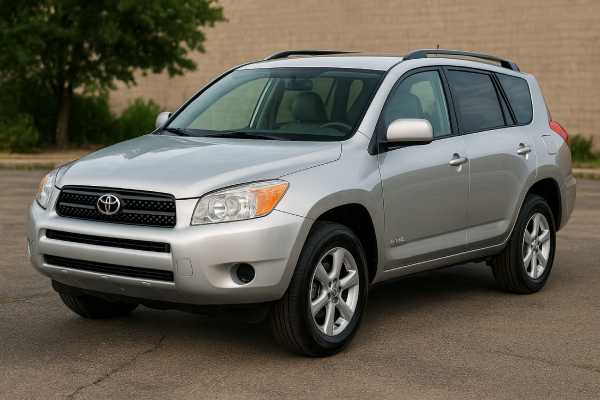
The third-generation Toyota RAV4 (XA30) brought a major step up in space, refinement, and highway stability while keeping the simple, durable formula that made early RAV4s easy to own. In 2.4-liter AWD form (2005–2008), it pairs the chain-driven 2AZ-FE four-cylinder with a proven four-speed automatic and an on-demand “Active Torque Control” AWD system. Owners prize the roomy cargo bay, efficient packaging, and straightforward mechanicals; technicians appreciate good service access and long-life fluids. This guide focuses on the 2.4 AWD variant—what it is, what to expect, and how to maintain it for the long haul. You will find the key specs, dimensions, performance notes, safety context, reliability watch-outs (including well-known service actions), and a practical maintenance plan. If you’re cross-shopping used compact SUVs, or preparing to keep your RAV4 for another 100,000 miles, this is the concise, technical overview you need.
Top Highlights
- Spacious cabin and flat load floor; rear seats fold for up to SUV-sized cargo (SAE).
- Simple, robust 2.4-liter with timing chain; no belt service required.
- Predictable, surefooted “Active Torque Control” AWD for foul weather and light trails.
- Watch for oil consumption on higher-mileage 2AZ-FE engines; monitor between services.
- Typical oil interval: 5,000 miles / 6 months (8,000 km / 6 months) on 5W-30.
Explore the sections
- RAV4 XA30 AWD overview
- RAV4 2.4 AWD specs
- RAV4 trims, options and safety
- RAV4 reliability and issues
- Maintenance and buyer guide
- Driving and performance
- How it compares to rivals
RAV4 XA30 AWD overview
The 2005–2008 RAV4 AWD on the XA30 platform grew in every dimension over its predecessor, delivering a larger cabin, better crash protection, and longer-legged highway manners. The 2.4-liter 2AZ-FE remains the heart of this configuration: an all-aluminum, chain-driven DOHC inline-four with variable valve timing on the intake side (VVT-i). It’s matched to a 4-speed automatic tuned for smoothness and durability rather than sprinting. The AWD hardware uses an electronically controlled, on-demand center coupling that pre-biases torque for take-off and sends more to the rear axle as front slip appears—transparent in daily use, helpful on snow and gravel, and maintenance-light.
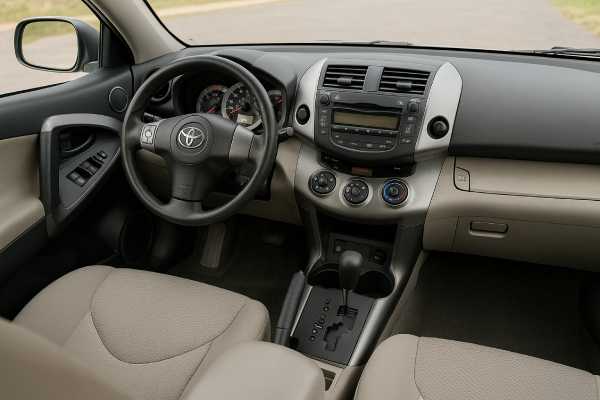
Inside, the XA30’s packaging shines. A flat cargo floor, low liftover, and 60/40 split rear bench that slides and reclines make it family-friendly. Two-row models offer generous luggage space; some markets also saw an optional compact third row, best for occasional use. Ergonomically, the tall seating position, large glass area, and straightforward controls keep fatigue down on long days.
On the road, the 2.4 AWD’s character is relaxed and predictable. There’s adequate low-to-midrange torque for city work, and the transmission favors early, clean shifts. Highway noise is well-controlled for the class; ride quality is supple on 16–17-inch wheels, with the Sport trim’s firmer suspension trading a bit of compliance for flatter cornering. Brakes are confident and easy to modulate, and stability control is standard. If you don’t need V6 thrust or heavy towing, this four-cylinder AWD spec balances operating cost, simplicity, and real-world versatility extremely well.
RAV4 2.4 AWD specs
Engine and Performance (ICE)
| Item | Detail |
|---|---|
| Code | 2AZ-FE |
| Layout & cylinders | Inline-4, DOHC, 16 valves, VVT-i (intake) |
| Bore × stroke | 88.5 × 96.0 mm (3.48 × 3.78 in) |
| Displacement | 2.4 L (2,362 cc) |
| Induction / Fuel | Naturally aspirated / Sequential multi-port |
| Compression ratio | ~9.8:1 |
| Max power | 166 hp (124 kW) @ ~6,000 rpm |
| Max torque | 224 Nm (165 lb-ft) @ ~4,000 rpm |
| Timing drive | Chain (no scheduled replacement) |
| Emissions/standard | ULEV-II (typical for period) |
| EPA economy (AWD, 2.4 auto) | ~20/25/22 mpg (city/hwy/combined) → 11.8 / 9.4 / 10.7 L/100 km |
| Real-world highway @ 120 km/h (75 mph) | ~24–26 mpg US (9.8–9.0 L/100 km), load and wind dependent |
Notes: Output and economy figures reflect typical North American ratings for the four-cylinder AWD automatic in this generation. Minor variations exist by model year and equipment.
Transmission and Driveline
| Item | Detail |
|---|---|
| Transmission | 4-speed automatic (electronically controlled) |
| Drive type | On-demand AWD (“Active Torque Control 4WD”) |
| Center coupling | Electronically controlled multi-plate clutch |
| Differentials | Open front and rear (brake-based torque control via VSC/TRAC) |
| Final drive | Model-year/trim dependent (typical compact-SUV ratios) |
| Refuel to full (typical) | ~5 min at pump |
Chassis and Dimensions
| Item | Detail |
|---|---|
| Front / Rear suspension | MacPherson strut / Double-wishbone (trailing links, coil) |
| Steering | Rack-and-pinion, power-assisted |
| Brakes | 4-wheel discs; ABS with EBD and Brake Assist |
| Wheels/Tires (common) | 215/70R16 or 225/65R17 (16–17 in rims) |
| Ground clearance | ~190 mm (7.5 in) |
| Length / Width / Height | ~4,600 / 1,815 / 1,685–1,720 mm (181.1 / 71.5 / 66.3–67.7 in) |
| Wheelbase | 2,660 mm (104.7 in) |
| Turning circle (kerb-to-kerb) | ~11.4 m (37.4 ft) |
| Curb weight (approx.) | ~1,590–1,610 kg (3,505–3,550 lb), by trim |
| GVWR (typical) | ~2,055–2,140 kg (4,530–4,718 lb) |
| Fuel tank | 60 L (15.9 US gal / 13.2 UK gal) |
| Cargo volume (2-row) | ~1,030 L seats up / ~2,070 L seats down (36.4 / 73.0 ft³, SAE) |
Performance and Capability
| Metric | Value |
|---|---|
| 0–60 mph / 0–100 km/h | ~9–9.5 s (two-row, light load) |
| Top speed (governed) | ~180+ km/h (~112+ mph) |
| Braking 100–0 km/h | Class-typical compact-SUV stopping distances with quality tires |
| Towing capacity | Up to ~680 kg (1,500 lb) with correct hitch and wiring |
| Payload | ~375–430 kg (825–950 lb), by trim/equipment |
| Roof load | ~68 kg (150 lb) with OEM crossbars (check rack rating) |
Fluids and Service Capacities (essentials)
| System | Specification | Capacity (approx.) |
|---|---|---|
| Engine oil | API SL/SM 5W-30 (later SN acceptable); OEM filter | ~4.3 L (4.5 US qt) with filter |
| Engine coolant | Toyota Super Long Life (SLLC, pink, 50/50 premix) | Model-year dependent; drain/fill per service manual |
| ATF (automatic) | Toyota WS (World Standard) | Drain/fill by procedure; no dipstick—check temp-based level |
| Rear diff / transfer | GL-5 gear oil (per spec) | Inspect level; replace on severe use intervals |
| A/C refrigerant | R-134a | Charge mass per label under hood |
| Key torque | Wheel nuts 103 Nm (76 lb-ft) |
Safety and Driver Assistance
- Crash ratings (period tests): Strong results in frontal offset and side impact for this generation when equipped with side/curtain airbags; electronic stability control standard.
- Head restraints/whiplash: Fixed headrests offer good support when properly adjusted.
- Systems: ABS with EBD and Brake Assist, VSC stability control, TRAC traction control; front, side, and side-curtain airbags; LATCH lower anchors and top tethers. Advanced ADAS (AEB, ACC, lane assist) were not fitted on this era RAV4.
RAV4 trims, options and safety
Trims (North America): Base, Sport, and Limited. All three could be paired with the 2.4-liter and on-demand AWD; the V6 was optional on Sport/Limited. Mechanical tuning is largely shared on 2.4 AWD, but the Sport adds firmer springs/dampers and specific 17-inch wheels; Limited focuses on comfort features.
- Base (2.4 AWD): 16-inch steel or alloy wheels, manual A/C, 60/40 sliding rear seats, keyless entry, CD audio with AUX (later), roof rails optional.
- Sport (2.4 AWD): 17-inch alloys, sport-tuned suspension, darker exterior trim, available moonroof, fog lamps.
- Limited (2.4 AWD): Automatic climate control, premium audio options, leather steering wheel, available leather seats and power driver seat, Smart Key (later years), heated mirrors.
Options and packages: Moonroof, JBL premium audio with subwoofer, third-row seating (limited availability; reduces cargo depth), towing prep components, and appearance items (spoilers, wheel upgrades). Quick identifiers include wheel design, grille/bumper trim differences, and badging. VIN decoding confirms engine and equipment; build stickers detail axle/transmission codes.
Year-to-year notes (highlights):
- 2006: Launch of XA30 with bigger body and improved structure.
- 2007–2008: Feature tweaks, audio updates, and package reshuffling. Four-cylinder AWD remained with the four-speed automatic and Active Torque Control 4WD.
Safety context: Six airbags standard (front, front-side, side-curtain), active front headrests, and standard stability control put the XA30 among the safer compact SUVs of its day. Child-seat anchorage is straightforward: two LATCH positions outboard with a center top tether. Headlight performance varies by trim and lamp type; ensure lens clarity and correct aim on used examples.
ADAS and calibrations: This era predates modern camera/radar systems. After collision repairs or alignment, calibrations focus on yaw/steering-angle sensors (within the VSC system) rather than camera/radar targets. ABS/VSC systems should be scanned for stored DTCs and zero-point calibrations completed when suspension height changes or steering components are replaced.
RAV4 reliability and issues
The 2.4 AWD XA30 is generally durable, but a few patterns matter for buyers and owners. Below, issues are grouped by prevalence and cost impact, with quick symptom → cause → remedy guidance.
Engine and cooling (ICE specifics)
- Oil consumption (common / medium-to-high):
Symptom: Drops from full to low between 3,000–5,000 miles.
Likely cause: Stuck oil control rings and piston design tolerances in certain 2AZ-FE production ranges.
Remedy: Monitor level; use high-quality oil and timely changes; verify service bulletins/warranty enhancements history; engine repair where excessive consumption is measured by official test. - Water pump seep/leak (occasional / low-to-medium):
Symptom: Pink crust at pump weep hole; intermittent growl.
Remedy: Replace pump; renew serpentine belt if worn. - Thermostat aging (occasional / low):
Symptom: Slow warm-up or fluctuating temperature.
Remedy: Replace thermostat and coolant as specified.
Driveline, transmission, AWD
- ATF “lifetime” misunderstandings (occasional / low):
Symptom: Harsh or delayed shifts after high mileage.
Remedy: Temperature-controlled level check; conservative drain/fill with Toyota WS can smooth operation. - Rear suspension arm corrosion/loosened adjusters (common in salt regions / medium):
Symptom: Rear toe out of spec; instability; uneven tire wear.
Remedy: Verify recall/field fix for rear suspension arm and locknut procedure; replace components if deformed/corroded. - Rear wheel bearing noise (occasional / medium):
Symptom: Humming that rises with speed and road load.
Remedy: Replace hub/bearing assembly; check alignment afterward. - AWD coupling noise under high load (rare / low-to-medium):
Symptom: Driveline shudder on tight turns when hot.
Remedy: Inspect tire size/pressure match; service diff/transfer oils; scan VSC/TRAC for faults.
Chassis and structure
- Steering intermediate shaft clunk (occasional / low):
Symptom: Knock over small inputs around center.
Remedy: Lubrication or updated shaft/column components. - Exhaust flange studs and gaskets (occasional / low):
Symptom: Ticking at cold start; leak smell.
Remedy: Replace hardware/gaskets; check for corrosion elsewhere. - Body and hatch hardware (occasional / low):
Symptom: Rear door check-strap popping, rattles, or latch misalignment.
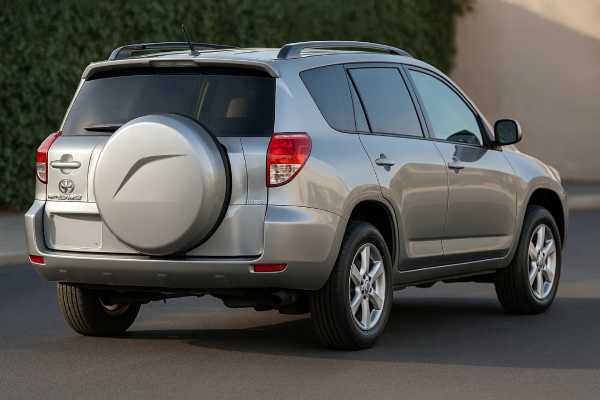
Remedy: Adjust or replace stop/latch; inspect spare-wheel carrier on swing gate for rust.
Software / calibrations
- VSC zero-point calibration (occasional / low):
After suspension work or alignment, perform the steering angle and yaw rate zero-point calibration to prevent unwanted VSC intervention.
Recalls, TSBs, extended coverage (summary)
- Rear suspension arm toe adjuster / locknut repair: Confirm via official VIN recall lookup and dealer records.
- Airbag and seatbelt campaigns: Vary by VIN and year; verify completion.
- Oil consumption customer support (where applicable): Some vehicles qualify for inspection and repair based on measured consumption within specific VIN/build ranges.
Pre-purchase checks
- Full service history (oil change cadence, coolant age, transmission service).
- VIN-based recall/TSB completion printout.
- Uniform tires (brand/size/tread) on all four corners to protect AWD.
- Brake condition and rear alignment; look for cupped tires.
- Cooling system integrity (cap, leaks, radiator fins).
- Underbody corrosion on control arms, subframes, and rear arm adjusters.
- Confirm both keys and remote functions; check HVAC blend doors and A/C performance.
Maintenance and buyer guide
Below is a practical, conservative schedule blending official guidance with real-world longevity practices. Distances are miles (km) and time, whichever comes first.
Core services
- Engine oil & filter: Every 5,000 mi / 8,000 km or 6 months with API SL/SM/SN 5W-30; check level monthly if consumption is noted.
- Engine air filter: Inspect 15,000 mi / 24,000 km; replace 30,000–45,000 mi (48,000–72,000 km) depending on dust.
- Cabin filter: Replace 15,000–20,000 mi (24,000–32,000 km); more often in dusty or urban conditions.
- Coolant (SLLC pink): First replacement typically 100,000 mi / 10 years, then 50,000 mi / 5 years.
- Spark plugs (iridium): 120,000 mi / 192,000 km; check coil boots; use proper torque and anti-seize guidance per service manual.
- Serpentine belt & hoses: Inspect each oil change; replace 60,000–90,000 mi (96,000–145,000 km) or at first cracking/noise.
- Brake fluid: Replace every 2–3 years, regardless of mileage.
- ATF (Toyota WS): Temperature-based level check at major services; conservative drain & fill at 60,000–90,000 mi helps shift quality (especially if towing or steep grades).
- Rear differential & transfer case oils: Inspect for level/condition every 30,000–45,000 mi; replace 60,000–90,000 mi in severe duty (towing, mountain driving, frequent AWD engagement).
- Tire rotation & alignment: Rotate 5,000 mi / 8,000 km; align annually or whenever tire wear patterns appear.
- 12-V battery: Test annually after year 3; expect 4–6 years service life.
Essential torque references
- Wheel lug nuts: 103 Nm (76 lb-ft) on clean, dry studs.
- For other fasteners (drain plugs, suspension, spark plugs), follow the official repair manual for your VIN due to running-change differences.
Buyer’s checklist
- Inspect rear suspension arms and adjusters for rust and seized hardware; verify alignment printout.
- Confirm all recall and service actions are closed through an official VIN check.
- Look for oil residue around the engine/transmission mating area and under the intake—light film is common; heavy wetness merits further diagnosis.
- Verify even tire wear and that all four tires match; AWD systems dislike mismatches.
- Drive at 60–75 mph (100–120 km/h): check for wheel-bearing growl, steering shimmy, and driveline vibrations.
- Interior electronics: confirm HVAC blend doors, 12-V outlets, audio inputs, and keyless entry.
- Prefer two-row models if you need maximum cargo; the third row reduces luggage space significantly.
Durability outlook
With timely fluids and attention to rear alignment hardware, the 2.4 AWD XA30 routinely crosses 200,000–300,000 miles (320,000–480,000 km). Most owners’ biggest variables are oil consumption management and staying ahead of corrosion in salt climates.
Driving and performance
Ride, handling, NVH: The 2.4 AWD RAV4 rides comfortably on broken pavement, soaking up sharp edges without float. The electric-assist steering of later crossovers wasn’t here yet—the hydraulic steering has linear effort and decent on-center feel once aligned correctly. Straight-line stability is secure, aided by the longer wheelbase introduced with XA30. Cabin noise at 65–75 mph (105–120 km/h) is modest for its era; wind and tire roar dominate over engine sound in steady cruising.
Powertrain character: The 2AZ-FE makes its best work between 2,500–5,000 rpm. Throttle mapping is progressive, with minimal tip-in surge. Around town it steps off cleanly; on ramps you’ll hear a purposeful growl as it climbs toward 4,000 rpm, where peak torque arrives. The 4-speed automatic prioritizes smoothness and will hold top gear gently on light grades, kicking down decisively when prodded. There’s no turbo lag to mask—just a naturally aspirated, linear pull.
Efficiency in the real world: Expect ~22 mpg US combined (10.7 L/100 km), with 24–26 mpg US (9.8–9.0 L/100 km) at a steady 75 mph depending on wind, elevation, and roof-rack/box usage. Short trips in winter will drag city numbers into the high teens; gentle suburban loops can return mid-20s. Good tires at correct pressures and a fresh air filter help the RAV4 meet or beat its period ratings.
Braking and control: Pedal feel is consistent and easy to modulate. Emergency stops track straight when tires are matched, and the VSC system intervenes discreetly if you enter a decreasing-radius curve too hot or encounter patchy grip. Brake fade is rarely an issue in daily driving; prolonged mountain descents benefit from downshifts to use engine braking.
Traction, snow, and light trails: The AWD system’s pre-emptive torque split on launch inspires confidence in snow. On loose surfaces, the system sends more torque rearward as fronts slip, and stability control trims wheelspin. Winter tires meaningfully improve braking and turn-in on snow/ice; with quality winters, the RAV4 AWD feels planted and predictable. Ground clearance is sufficient for rutted tracks and deep slush; this is not a low-range 4×4, so approach obstacles accordingly.
Load and towing: With a ~1,500 lb (680 kg) tow rating on the four-cylinder, stay within tongue-weight limits and use trailer brakes where required. Under moderate tow, expect a ~10–20% fuel-consumption penalty; downshift early on long grades to keep ATF temperatures in check. The longer body and wider track versus the prior generation aid stability with a full cargo bay.
How it compares to rivals
Honda CR-V (2007–2008, 2.4 AWD): The CR-V feels a touch more car-like with slightly sharper steering and a calmer cabin at highway speed. Cargo versatility is excellent but lacks an available V6 option; towing capacity is similar. Maintenance access is comparable; both use timing chains. If you favor ride/handling polish over foul-weather traction bias, the CR-V edges ahead; if you want a simpler AWD feel and more towing headroom with the optional V6 elsewhere in the line, RAV4 offers that ladder.
Subaru Forester (2006–2008, 2.5): Standard full-time AWD and a low center of gravity give the Forester great winter manners. It’s smaller inside and has a shorter cargo bay than the XA30. Head gaskets on older EJ engines and rear wheel bearings can enter the conversation; Toyota’s 2AZ-FE oil consumption risk is the RAV4’s main engine concern. For gravel roads and trailheads, both are solid; the RAV4 has a roomier cabin and longer wheelbase.
Ford Escape (2005–2008, 2.3/3.0 AWD): The Escape’s available V6 rivals the RAV4 V6, but the four-cylinder is weaker than Toyota’s 2.4. Cabin materials and long-term squeaks/rattles tend to favor the Toyota; maintenance access on the Ford V6 is tighter. If budget drives the decision, a well-kept Escape can be good value; if longevity with fewer surprises is the goal, the RAV4’s track record is more consistent.
Mitsubishi Outlander (2007–2008, 3.0 V6 / 2.4): Outlander offers a slick third-row solution and strong V6 road manners. Parts availability varies by region, and resale values trend lower, which can favor buyers on a budget. The RAV4 counters with a broader support network and typically lower running costs.
References
- Gas Mileage of 2008 Toyota RAV4 2008 (EPA Ratings Database)
- 2006 Toyota RAV4 2006 (Safety Rating)
- Vehicle Detail Search – 2008 TOYOTA RAV4 4 DR 4WD 2008 (Recall Database)
- 08_RV4_Eng_V3_LR 2008 (Specifications Brochure)
- 2008 RAV4 – Owners’s Manual 2008 (Owner’s Manual)
Disclaimer
This guide is for informational purposes only and is not a substitute for professional diagnosis or repair. Specifications, torque values, service intervals, and procedures vary by VIN, model year, market, and equipment. Always verify against your vehicle’s official service documentation and safety recalls before performing maintenance or repairs.
If this article helped, consider sharing it with fellow owners on Facebook or X/Twitter to support xcar’s work. Thank you!