
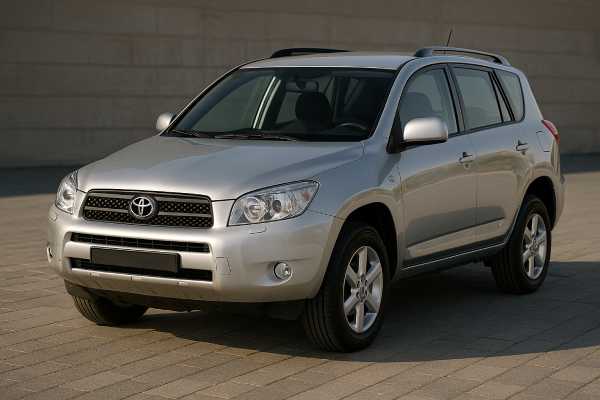
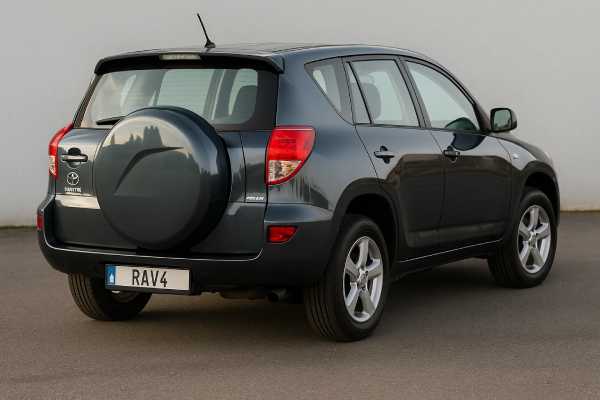
The RAV4’s third generation (XA30) pushed Toyota’s compact SUV into a more refined, long-legged space. The 2007–2008 2AD-FHV diesel is the range’s performance diesel: 2.2 litres, variable-nozzle turbo, and a stout 177 hp with a broad torque band. Unlike the lower-output 150-hp tune, this version carries Toyota’s D-CAT aftertreatment (a combined NOx and particulate trap with a fifth injector), paired almost universally with a six-speed manual and Active Torque Control AWD. In practice that means easy mid-range pace, secure winter traction, and motorway calm at low rpm. Cabin packaging is a strong suit—Easy-Flat rear seats, generous shoulder room, and sensible controls—and the 18-inch wheel package on top trims brings confident grip with a firmer ride. Ownership rewards come with disciplined diesel care: low-SAPS oil in DPF markets, clean EGR and intake paths, timely fuel-filter services, and awareness of the well-documented head-gasket risk on neglected AD-series engines. This guide condenses what owners and buyers need to know.
Fast Facts
- Strong 177-hp diesel with ~400 Nm torque and long sixth gear for relaxed cruising.
- Active Torque Control AWD with low-speed Lock improves pull-away on snow or wet grass.
- “Easy-Flat” rear seats fold into a flat load floor; big, square cargo bay is genuinely useful.
- Watch for EGR/DPF loading and early signs of head-gasket distress; verify coolant care.
- Typical oil change: 15,000 km / 12 months (shorter for heavy city or short-trip use).
Start here
- RAV4 2.2 D-CAT overview
- 2AD-FHV specs and data
- Trims, options, and safety
- Reliability, issues, and actions
- Maintenance schedule and buyer guide
- Road manners and performance
- How it compares to rivals
RAV4 2.2 D-CAT overview
Toyota designed the XA30 RAV4 to feel like a quiet, stable family car that just happens to shrug off winter. The 2AD-FHV “D-4D 177” engine makes that brief stick: there is useful pull from just above idle, a wide plateau for overtakes, and sixth gear that knocks down revs on the motorway. The AWD system is tuned for normal efficiency—front-biased when you are cruising—yet it feeds torque to the rear proactively as throttle and steering inputs rise. Pressing the AWD Lock button fixes a near-even split at low speed to prevent traction-control power cuts when you try to move off on packed snow or wet grass; the system disengages automatically with speed so the car stays stable and economical.
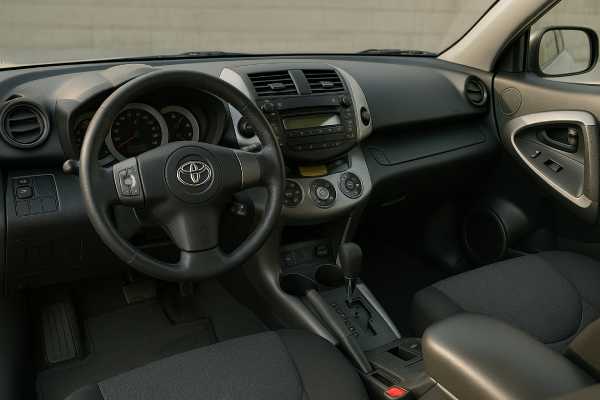
Inside, the XA30’s Easy-Flat rear bench is still a highlight. In one motion the bench folds into the floor, leaving a flat, low load platform without removing heavy seat bases. The cabin is wider than before, instruments are clear, and the driving position is supportive enough for multi-hour stints. The side-hinged tailgate divides opinion in tight bays but makes loading tall items straightforward once you allow for its swing. Materials and switchgear have aged well when cared for; squeaks tend to come from the cargo area or door seals rather than the dashboard.
Compared with the 150-hp 2.2 diesel, the 177-hp D-CAT tune trades some simplicity for stronger mid-range and cleaner tailpipe chemistry. D-CAT’s combined NOx and particulate control uses a fifth injector in the exhaust to raise regeneration temperatures, which means it is sensitive to short-trip use and oil quality. Choose a low-SAPS oil where the car has a particulate trap, keep the EGR and intake passages clean, and stick to fuel-filter intervals; the harder you drive on the open road, the better the aftertreatment system tends to behave. When maintained this way the 2AD-FHV can rack up high mileages with consistent consumption and no drama, and the AWD hardware is largely “fit-and-forget” aside from normal fluid changes.
2AD-FHV specs and data
Below are scannable technical tables for 2007–2008 RAV4 2.2 D-CAT (2AD-FHV) AWD. Figures vary slightly by market, VIN, emissions hardware, and equipment level.
Engine and performance (ICE-only)
| Item | Detail |
|---|---|
| Code | 2AD-FHV (D-4D 177 / D-CAT) |
| Engine layout & cylinders | Inline-4, DOHC, 16 valves, common-rail DI |
| Bore × stroke | 86.0 × 96.0 mm (3.39 × 3.78 in) |
| Displacement | 2.2 L (2,231 cc) |
| Induction | Variable-nozzle turbo with intercooler |
| Fuel system | DENSO common-rail direct injection |
| Compression ratio | ~15.8:1 (calibration dependent) |
| Max power | 177 hp (130 kW) @ ~3,600 rpm |
| Max torque | 400 Nm (295 lb-ft) @ ~2,000–2,800 rpm |
| Timing drive | Chain with hydraulic tensioner |
| Emissions / efficiency | Euro 4 (D-CAT aftertreatment on most markets) |
| Rated economy (combined) | ~6.9–7.5 L/100 km (34–31 mpg US / 41–38 mpg UK) |
| Real-world highway @ 120 km/h | ~7.2–8.2 L/100 km (33–29 mpg US / 40–35 mpg UK) |
| Aerodynamics | Cd ≈ 0.31–0.33 (wheel/trim dependent) |
Transmission and driveline
| Item | 6-speed manual |
|---|---|
| Type & family | 6-MT (EA60-series typical) |
| 1st | ~3.538 |
| 2nd | ~2.045 |
| 3rd | ~1.333 |
| 4th | ~1.028 |
| 5th | ~0.820 |
| 6th | ~0.675 |
| Final drive | ~3.95 (varies by VIN) |
| Drive type | AWD with electronically controlled rear coupling |
| Differentials | Open diffs; brake-based traction aids |
| Lock function | AWD Lock (low-speed fixed split; auto-cancel with speed) |
| Replenishment time | Refuel to full ≈ 3–5 minutes |
Chassis and dimensions
| Item | Detail |
|---|---|
| Platform | XA30 |
| Suspension (front/rear) | MacPherson strut / Double-wishbone independent |
| Steering | Electric power steering; overall ratio ~14–15:1 |
| Brakes (front/rear) | 296 × 28 mm ventilated disc / 281 × 12 mm solid disc |
| Wheels/tyres (T180-type) | 235/55 R18 run-flats with TPMS |
| Wheels/tyres (others) | 225/65 R17 or 215/70 R16 (market/trim) |
| Ground clearance | ~200 mm (7.9 in) |
| Angles (approach/departure/ramp) | ~25° / ~20° / ~20° |
| Length / Width / Height | ~4,395 / 1,815 / 1,685 mm (173.0 / 71.5 / 66.3 in) |
| Wheelbase | ~2,560 mm (100.8 in) |
| Turning circle (kerb-to-kerb) | ~10.4–10.8 m (34.1–35.4 ft) |
| Kerb (curb) weight | ~1,670–1,740 kg (3,682–3,836 lb) by spec |
| GVWR | ~2,130–2,170 kg (4,696–4,784 lb) |
| Fuel tank | 60 L (15.9 US gal / 13.2 UK gal) |
| Cargo volume (VDA) | ~586 L seats up / ~1,469 L seats folded |
Performance and capability
| Metric | 2.2 D-CAT AWD 6-MT |
|---|---|
| 0–100 km/h (0–62 mph) | ~9.3–9.6 s |
| Top speed | ~200 km/h (124 mph) |
| 100–0 km/h braking | ~38–40 m (125–131 ft) on quality tyres |
| Towing capacity (braked/unbraked) | up to 2,000 kg (4,409 lb) / 750 kg (1,653 lb) |
| Payload | ~480–560 kg (1,058–1,235 lb) |
| Roof load | ~100 kg (220 lb) with approved crossbars |
Fluids and service capacities
| System | Specification | Capacity (approx.) |
|---|---|---|
| Engine oil | ACEA C2 5W-30 (DPF/D-CAT markets); ACEA B4 5W-30/5W-40 where no DPF | ~5.9 L (6.2 US qt) incl. filter |
| Coolant | Toyota Super Long Life Coolant (premix) 50:50 | ~6.5–7.5 L (6.9–7.9 US qt) |
| Manual gearbox | API GL-4 75W-90 (Toyota MTF spec) | ~2.2–2.5 L (2.3–2.6 US qt) |
| Transfer case | 75W-90 GL-5 | ~0.8–1.0 L (0.8–1.1 US qt) |
| Rear differential | 75W-90 GL-5 | ~0.8–1.0 L (0.8–1.1 US qt) |
| Brake fluid | DOT 4 | Fill to MAX; replace bi-annually |
| A/C refrigerant | R134a | ~500–550 g (17.6–19.4 oz) |
| A/C compressor oil | ND-Oil 8 / PAG 46 | ~120 mL (4.1 fl oz) |
| Key torque specs | Wheel nuts 103 Nm (76 lb-ft); Oil drain plug ~39 Nm (29 lb-ft); Caliper carrier ~100 Nm (74 lb-ft) |
Electrical
| Item | Detail |
|---|---|
| Alternator output | ~120 A |
| 12 V battery | ~70 Ah (≈ 620 CCA), DIN H5/H6 common |
| Glow plugs | 11 V ceramic; ECU-controlled pre/post-heat |
Safety and driver assistance
- Crash performance: Strong adult occupant protection for its era; robust passenger cell, effective restraint logic.
- Restraints and airbags: Dual front, side thorax (front), full-length curtains, driver’s knee (market dependent); front pretensioners/limiters.
- Child seats: ISOFIX/lower anchors with top tethers on rear outboard seats.
- Active safety: ESC (VSC), traction control, ABS with EBD and Brake Assist.
- ADAS: Pre-AEB era; no ACC or lane support. Halogen headlamps predominant; headlamp aim matters if wheel sizes change.
Trims, options, and safety
Line-up logic. European naming varies by country (e.g., Active/Sol/Executive or UK XT3/XT4/XT5). The 177-hp diesel commonly appears as a high-spec grade—T180 in the UK—positioned above the 150-hp diesel and petrols.
Equipment highlights typical of the 177-hp AWD:
- Wheels and tyres: 18-inch alloys with factory run-flats and TPMS on T180-type cars; 17-inch packages appear in some markets without run-flats.
- Comfort and convenience: Dual-zone climate, Smart Entry/Start, cruise control, auto lights/wipers, privacy glass, heated front seats, power driver’s seat on upper trims.
- Infotainment: CD with MP3/WMA and AUX as baseline; integrated navigation and Bluetooth hands-free on top trims or option packs.
- Seating and cargo: Five seats; Easy-Flat rear bench folds into floor. The occasional-use third row is rare with D-CAT AWD.
Mechanical distinctions by trim. Braking hardware is generally shared, but 18-inch run-flat packages stiffen ride quality and increase tyre replacement costs. Tow ratings may vary with cooling packs; always confirm on the VIN plate. TPMS sensor batteries age—budget for replacements on original sensors.
Year-to-year notes (2007 → 2008). Running tweaks touched audio interfaces and minor NVH items. Emissions hardware (DPF and D-CAT calibrations) depends on country cutovers and homologation; urban-LEZ compliance may hinge on specific VIN details.
Safety ratings and features. The XA30 platform’s structure and restraint coverage support solid crash outcomes for the time. VSC and Brake Assist were widespread by these years; ISOFIX and top tethers are present on outer rear seats. After any suspension or steering work, ask for a four-wheel alignment and a steering angle/yaw zero-point calibration so stability control works as intended. If the car uses run-flats, confirm the tyre pressure placard values and TPMS relearn steps are followed after rotation or replacement.
Quick identifiers and tells for the 177-hp car.
- D-CAT/177 badging (market dependent) and a noticeably stronger mid-range punch.
- 18-inch wheels with run-flats and TPMS (T180-type trims).
- AWD Lock button near the shifter and a tach that sits low at 120 km/h in sixth.
Reliability, issues, and actions
The 2AD-FHV can be long-lived when its diesel-specific needs are respected. The themes below are what owners and buyers most often encounter, mapped by prevalence and cost.
Engine and aftertreatment.
- EGR and intake soot — common / low–medium cost.
Symptoms: Hesitation, uneven idle, rising fuel use, smoke under load.
Cause: EGR plus oil mist deposits carbon through intake runners and valve area.
Fix: Remove and clean EGR valve and intake manifold; renew gaskets; reset ECU adaptations. Pair with shorter oil intervals on heavy city use. - DPF/D-CAT loading — occasional / usage-dependent.
Symptoms: Frequent regenerations, fan running after shutdown, limp with differential-pressure faults.
Cause: Short trips prevent full regens; ash builds with the wrong oil.
Fix: Verify pressure sensor hoses and temp sensors; conduct a proper regeneration only after diagnosing root cause. Use ACEA C2 low-SAPS oil; include a periodic 20–30-minute highway run in your routine. - Fifth-injector coking — occasional / medium cost.
Symptoms: Sooty tailpipe, regen faults, fuel smell in exhaust.
Cause: Incomplete post-injection burn during regens leads to deposits.
Fix: Inspect and replace the injector if spray pattern is poor; ensure ECU is on latest calibration; check for exhaust leaks upstream of D-CAT. - Turbo VNT sticking — occasional / medium cost.
Symptoms: Over- or under-boost, flat mid-range, oscillating boost.
Cause: Soot on vane ring plus limited hot cycles.
Fix: Mechanical clean or CHRA service; verify vacuum lines, N75-equivalent control, and actuator movement. - Head-gasket distress — occasional / high cost if ignored.
Symptoms: Coolant loss without external leak, stiff top hose when cold, bubbles in header tank, exhaust sweet smell.
Cause: Clamping and thermal-cycle sensitivities on some AD blocks, exacerbated by overheating or poor coolant care.
Fix: Confirm with block-test and combustion-gas analysis; repair with updated gasket/fasteners and machine-checked head; renew water pump and thermostat; bleed SLLC correctly. Historical goodwill programs existed in some regions—documentation is valuable. - Injector sealing leak (“black death”) — occasional / medium cost.
Symptoms: Diesel smell in cabin, tar around injector seats, chuffing noise.
Fix: Replace copper washers and clamp bolts; clean bores; re-torque carefully; confirm learned pilot quantities.
Fuel and controls.
- Suction Control Valve (SCV) drift — occasional / medium cost.
Symptoms: Hot-start difficulty, rail-pressure deviation codes, unstable idle.
Fix: Replace SCVs and fuel filter; check injector return rates; reset adaptations.
Cooling and ancillaries.
- Water pump seep or bearing noise — common with age / low–medium cost.
Replace pump proactively at coolant service; inspect auxiliary belt, idler, and tensioner.
Driveline and chassis.
- Rear suspension arm campaign — model-family notable.
Ensure updated arms and fasteners; demand a four-wheel alignment afterwards. - Front lower arm rear bushes — common / low–medium cost.
Brake shimmy or vague turn-in; renew bushes or arms; align to spec. - Wheel bearings (rear) — occasional / medium cost.
Speed-related humming that changes with load or gentle steering input.
Electrical and HVAC.
- TPMS sensor batteries — inevitable with age / low cost.
On T180-type run-flat cars, plan for sensor replacement. - Blower resistor or motor wear — occasional / low cost.
Intermittent fan speeds; replace resistor pack; inspect connector.
Service actions and proofs.
Use official VIN portals to confirm campaigns (rear suspension arms, pedal/floor-mat measures where applicable). For any suspension or steering work, request the alignment printout and zero-point calibration invoice line.
Pre-purchase checks that save money.
- Cold start after an overnight rest: quick light-off, no excessive smoke, no coolant pressurisation.
- Cooling system health: pink SLLC, no oil sheen, heater warms promptly.
- Boost control: clean, linear pull in 3rd–5th from ~1,800 rpm; no oscillation.
- DPF/D-CAT history: invoices for sensor replacements, hose cleaning, and regens done for cause.
- AWD ancillaries: propshaft support bearing quiet; transfer and rear diff dry.
- Underbody: rear subframe mounts and alignment eccentrics free of heavy corrosion.
- Records: oil ≤15,000 km, fuel-filter changes, coolant service, EGR/intake cleaning, and any head-gasket-related repair paperwork.
Maintenance schedule and buyer guide
Practical service cadence (distance/time). Adjust for severe duty (short trips, towing, dusty climates). Always verify by VIN.
- Engine oil and filter: 15,000 km / 12 months (or 10,000–12,000 km for urban short-trip use). Use ACEA C2 5W-30 where DPF/D-CAT is present; ACEA B4 otherwise. Capacity ~5.9 L.
- Fuel filter: 30,000–45,000 km / 2–3 years; sooner after questionable fuel events.
- Engine air filter: Inspect each service; replace 30,000–45,000 km.
- Cabin filter: 12–24 months, more often in dusty cities.
- Coolant (SLLC): First major change around 160,000 km / 10 years, then every 80,000 km / 5 years.
- Timing chain system: No fixed replacement; listen for cold-start rattle; check cam/crank correlation if codes appear; renew guides/tensioner only if out of spec.
- Accessory belt and idlers: Inspect annually; replace 90,000–120,000 km or at noise/cracking.
- Manual gearbox oil (GL-4 75W-90): 90,000–120,000 km; sooner with heavy towing.
- Transfer and rear diff (GL-5 75W-90): 60,000–90,000 km.
- Brake fluid (DOT 4): 24 months regardless of mileage.
- Brakes: Inspect every service; clean and lubricate slider pins annually.
- Tyres: Rotate 10,000–12,000 km; keep circumferences matched on AWD; align annually or after pothole hits.
- 12 V battery: Load-test annually after year 4; typical replacement 5–7 years.
- A/C: Performance check every 24 months; keep condenser clean.
Fluids and quick rules for decision-making.
- Oil: Low-SAPS ACEA C2 is non-negotiable on DPF/D-CAT cars; it reduces ash and protects the trap.
- Coolant: Use Toyota SLLC; do not mix chemistries.
- Gear oils: GL-4 for the manual transmission (synchroniser-friendly); GL-5 for transfer and rear diff.
- Brake fluid: Fresh DOT 4 from a sealed bottle; humidity kills braking consistency.
Essential torque values (common DIY).
- Wheel nuts 103 Nm (76 lb-ft).
- Oil drain plug ~39 Nm (29 lb-ft) with new washer.
- Front caliper guide pins ~25–35 Nm (check variant).
- Caliper carrier bolts ~100 Nm (74 lb-ft).
Always confirm by VIN in official data.
Buyer’s checklist (what to feel, see, and ask for).
- Head-gasket health: Cold top hose should be soft; no bubbles in the header tank at idle; no unexplained coolant loss.
- DPF/D-CAT state: Ask for proof of pressure hose cleaning, sensor health, and regens done after diagnosis (not as guesswork).
- EGR and intake: Documentation of periodic cleaning keeps throttle response crisp and consumption stable.
- Turbo control: Vacuum hoses supple, actuator moves smoothly on a hand pump; no boost oscillation in 4th/5th from 1,800 rpm.
- AWD hardware: Dry seals at transfer and rear diff; propshaft support bearing quiet.
- Corrosion: Rear subframe mounts and alignment cams should move freely; seized hardware adds cost at the next alignment.
- Tyres and TPMS: Even wear; on run-flat cars, verify TPMS sensors read correctly and that a relearn was done after rotation.
Durability outlook. Kept on schedule with the right oil and filters, with clean EGR/intake paths and a healthy cooling system, the 2AD-FHV AWD rewards owners with consistent economy, secure winter traction, and long service life. The biggest risks—DPF neglect and cooling-system lapses—are avoidable with predictable routine.
Road manners and performance
Ride, handling, and NVH. The XA30’s stiffer shell and independent rear suspension deliver a composed, quietly damped ride. On 18-inch run-flats the car feels tied down with a firmer edge over sharp joints; switching to a high-quality conventional tyre (where legal and compatible with your spare strategy) softens impacts and trims road roar. Straight-line stability is confident at 120 km/h; crosswinds nudge rather than shove. The steering is light for parking but weights up naturally on the motorway, and the body takes a neat set through medium-speed curves without unruly roll.
Powertrain character. The 177-hp diesel’s strength is usable torque. In town you short-shift at 2,000–2,500 rpm and surf the mid-range; on the motorway it sits quietly in sixth. Passing is best planned from ~1,800 rpm in fourth or fifth where the VNT turbo is fully on song. The ECU’s smoke and torque control keep delivery tidy, so if you experience flat spots or surging, look first to EGR cleanliness, boost-control vacuum leaks, or clogged DPF pressure lines.
AWD behaviour. Active Torque Control behaves like a front-driver in steady cruise to reduce drag. Add throttle or steering on a slick surface and rear-axle torque arrives progressively; AWD Lock reduces diagonal spin at pull-away, then disengages with speed. Stability control is well-calibrated and integrates with steering assist to help you correct a line on low-grip roundabouts without abrupt power cuts.
Efficiency and range. Healthy examples on 17–18-inch tyres typically return 7.2–8.2 L/100 km in mixed driving (33–29 mpg US / 40–35 mpg UK). At a steady 120 km/h with light load expect results near the lower half of that band; winter diesel, HVAC loads, roof boxes, and short-trip use add 0.5–1.0 L/100 km. With a 60-litre tank, realistic range sits around 650–800 km depending on conditions.
Selective performance metrics.
- 0–100 km/h: ~9.3–9.6 s with the six-speed manual.
- 80–120 km/h: ~7–9 s in fourth/fifth when the intake is clean and boost control is healthy.
- 100–0 km/h: ~38–40 m with fresh pads and quality tyres; annual slider-pin service keeps pedal feel consistent.
Load and towing. Braked tow ratings up to 2,000 kg (market dependent) make the D-CAT AWD a capable tower. Stability is good with correct nose weight and a friction stabiliser; keep speeds conservative and allow for longer braking distances. Expect a 20–35% consumption penalty at 90–100 km/h with a medium caravan. If you tow often or traverse mountain passes, shorten gearbox, diff, and brake-fluid intervals.
How it compares to rivals
- Honda CR-V 2.2 i-CTDi (Mk3): Honda’s aluminium diesel is smooth and punchy (140 hp), and the manual shift quality is a benchmark. The CR-V’s cabin packaging is excellent, but some cars show rear-subframe corrosion in salted climates. The RAV4 counters with stronger mid-range, quieter high-speed NVH, and the security of AWD Lock for slick pull-aways.
- Nissan X-Trail 2.0 dCi (T31): A more utilitarian vibe with an effective on-demand 4×4 system. It rides a bit more firmly and can ask more of owners in EGR/turbo maintenance as mileage climbs. The RAV4 feels better isolated and more consistent in winter.
- Volkswagen Tiguan 2.0 TDI 170 (launch era): Sharp chassis and modern cabin tech; strong real-world economy. Ownership costs can be more variable when emissions hardware ages. The RAV4’s simpler maintenance story and parts pricing appeal to long-term keepers.
- Subaru Forester 2.0D (early boxer diesel): Symmetrical AWD and great traction balance, but the first boxer diesels brought their own well-documented reliability considerations. The RAV4 trades some steering feel for calmer motorway refinement and typically lower parts exposure.
- Mitsubishi Outlander 2.2 DI-D (contemporary): Good space and value, available with on-demand 4WD. Cabin materials and noise suppression trail the Toyota; diesel specifics vary with engine supplier and year.
Verdict: If you want a compact SUV that is quiet on the motorway, secure in winter, and genuinely swift in real-world overtakes, the RAV4 2.2 D-CAT AWD (2007–2008) remains a compelling used buy—provided you respect diesel housekeeping and verify cooling-system health.
References
- THE NEW TOYOTA RAV4 2006 (Press Pack / Technical Data)
- Toyota RAV4 2006 2006 (Safety Rating)
- Recalls | Owners 2025 (Recall Checker)
- Check if a vehicle, part or accessory has been recalled 2025 (Recall Database)
Disclaimer
This article is for informational purposes only and is not a substitute for professional diagnosis or repair. Specifications, capacities, torque values, and maintenance intervals vary by VIN, market, emissions package, and production changes. Always verify against your vehicle’s official owner’s manual, workshop information, and manufacturer bulletins before performing service.
If this guide helped, please share it with fellow owners on Facebook or X/Twitter to support xcar’s work.