
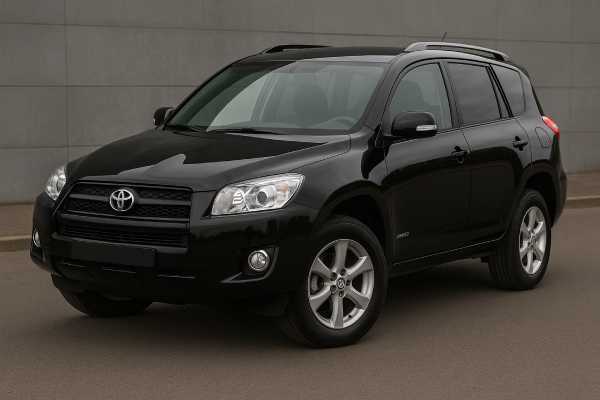


The facelifted 2009–2012 Toyota RAV4 with the 2AR-FE 2.5-liter four-cylinder and on-demand AWD represents the last evolution of the third-generation XA30 platform. It balances compact exterior size with a surprisingly roomy cabin, a robust service record, and low running costs. The 2.5 is chain-driven and tuned for smooth mid-range torque, while the simple four-speed automatic is durable and inexpensive to service. The AWD system uses an electronically controlled rear coupling with a driver-selectable lock for low-speed traction, yet decouples for efficiency in steady cruising. Owners value the clever interior (flat-fold second row, optional third row on certain trims), cargo capacity that rivals larger SUVs, and straightforward maintenance with widely available parts. This guide dives into specs and dimensions, real-world efficiency, safety data, reliability patterns, and practical maintenance intervals so you can shop and own with confidence.
Fast Facts
- Roomy interior and cargo: up to ~73.0 ft³ seats folded; easy flat-load floor.
- Proven 2.5L chain-driven engine and simple AWD; low long-term upkeep.
- Moderate highway economy for its era: ~27 mpg US (≈8.7 L/100 km) when lightly loaded.
- Watch for rear suspension arm corrosion in rust-belt cars; verify recall completion.
- Oil and filter: 10,000 miles / 12 months with 0W-20 (5,000 miles if severe service).
What’s inside
- RAV4 2.5 AWD overview
- RAV4 2.5 AWD specs
- Trims, options and safety
- Reliability and service actions
- Maintenance and buyer’s guide
- Driving and performance
- How RAV4 compares to rivals
RAV4 2.5 AWD overview
The facelifted XA30 RAV4 refined a formula that made the nameplate a default recommendation in the compact-SUV class. With the 2AR-FE 2.5-liter inline-four (179 hp, 172 lb-ft) and electronically controlled on-demand AWD, it prioritizes dependable performance and predictable traction over headline output. The AWD system operates in front-drive most of the time to save fuel, sending torque rearward when the front wheels slip or when you accelerate on low-friction surfaces. A dash-mounted “LOCK” button temporarily fixes a near-50:50 split at low speeds to help launch in snow or mud; it disengages automatically as speed rises to protect the coupling and maintain stability.
Packaging remains a standout. Compared with many rivals of the era, the RAV4 offers one of the flattest load floors with the second row folded and generous width between the wheel wells. Base and Limited grades in this period could be configured with an occasional-use third row, while Sport grades emphasize chassis feel with 18-inch wheels and firmer dampers. An Appearance Package on Sport removes the outside rear spare tire and adds run-flats; useful for people who park in tight urban garages or prefer cleaner styling, but it limits tyre choices and ride comfort slightly.
From an ownership perspective, the 2.5’s chain-driven camshafts and port-injection layout reduce long-term maintenance complexity. The four-speed automatic (ECT-i) is conservative by today’s standards but benefits from mature calibration and a proven torque-converter lockup strategy for steady-state cruising. Cabin materials favor durability: resilient fabrics, simple switchgear, and large HVAC knobs that still feel solid over a decade on. If you need a compact SUV that just works, hauls bulky items on weekends, and stays affordable to keep, this configuration hits that brief.
RAV4 2.5 AWD specs
Engine and Performance (ICE)
| Item | Detail |
|---|---|
| Code | 2AR-FE |
| Layout & valvetrain | Inline-4, DOHC, 16 valves (dual VVT-i) |
| Bore × stroke | 90.0 × 98.0 mm (3.54 × 3.86 in) |
| Displacement | 2.5 L (2,494 cc) |
| Induction | Naturally aspirated |
| Fuel system | Sequential multi-port EFI |
| Compression ratio | ~10.4:1 |
| Max power | 179 hp (133 kW) @ 6,000 rpm |
| Max torque | 233 Nm (172 lb-ft) @ 4,000 rpm |
| Timing drive | Chain |
| Emissions / efficiency std. | ULEV II / EPA gasoline |
| EPA-type economy (AWD auto) | 21 / 27 / 23 mpg US city/hwy/comb (≈11.2 / 8.7 / 10.2 L/100 km) |
| Real-world highway @ 75 mph | ~27 mpg US (≈8.7 L/100 km), light load |
| Aerodynamics | Cd: — / Frontal area: — |
Transmission and Driveline
| Item | Detail |
|---|---|
| Transmission | 4-speed automatic ECT-i (torque-converter lockup) |
| Gear ratios | 1st 2.84, 2nd 1.53, 3rd 1.00, 4th 0.70 (typical for family) |
| Final drive ratio | ~3.08–3.29 (varies by market/grade) |
| Drive type | On-demand AWD with electromagnetic rear coupling |
| Differential(s) | Open front/rear; electronic coupling acts as center |
| AWD lock | Driver-selectable (low-speed), auto-disengage with speed/brake |
| Refuel to full | ≈5 minutes (from low-fuel warning, typical pump flow) |
Note: Minor ratio variations exist by calibration and axle supplier; verify by VIN if you need exact gearing.
Chassis and Dimensions
| Item | Detail |
|---|---|
| Front / rear suspension | MacPherson strut / Double-wishbone (trail arm) |
| Steering | Rack-and-pinion, Electric Power Steering (EPS) |
| Brakes | 4-wheel discs (vented front, solid rear), ABS with EBD, BA |
| Wheels & tyres (tires) | Base: 215/70R16; Limited: 225/65R17; Sport: 235/55R18 |
| Ground clearance | ~190 mm (7.5 in) |
| Length / width / height | ~4,605 mm / 1,815 mm / 1,685–1,745 mm (181.1 / 71.5 / 66.3–68.7 in) |
| Wheelbase | 2,660 mm (104.7 in) |
| Turning circle (curb-to-curb) | ~10.6 m (34.8 ft) |
| Curb weight (typical AWD 2-row) | ~1,560–1,600 kg (3,440–3,530 lb) |
| GVWR | ~2,030–2,070 kg (4,475–4,565 lb) |
| Fuel tank | 60 L (15.9 US gal / 13.2 UK gal) |
| Cargo volume (SAE) | ~1,030 L (36.4 ft³) seats up / ~2,067 L (73.0 ft³) seats down |
Performance and Capability
| Metric | Value |
|---|---|
| 0–100 km/h (0–62 mph) | ~9.8–10.5 s (typical owner tests) |
| Top speed | ~185 km/h (115 mph), electronically limited behavior |
| Braking 100–0 km/h / 62–0 mph | ~38–40 m (125–131 ft), street tyres |
| Towing capacity (I4) | 680 kg (1,500 lb) braked; light-duty unbraked only (local regs) |
| Payload | ~385–475 kg (850–1,050 lb) depending on trim |
| Roof load | ~45–68 kg (100–150 lb) with OEM rails/crossbars |
Fluids and Service Capacities
| System | Spec | Capacity (typical) |
|---|---|---|
| Engine oil | SAE 0W-20 (API SN/ILSAC GF-5 or later) | ≈4.4 L (4.6 qt) with filter |
| Engine coolant | Toyota Super Long Life Coolant (pink), 50:50 premix | ≈7–8 L (7.4–8.5 qt) total system |
| Automatic transmission | Toyota ATF WS | Drain/fill ≈3.0–3.5 L (3.2–3.7 qt) |
| Rear differential | API GL-5 75W-90 | ≈0.7–0.9 L (0.7–1.0 qt) |
| Transfer case | API GL-5 75W-90 | ≈0.4–0.6 L (0.4–0.6 qt) |
| A/C refrigerant | R-134a; compressor oil ND-8 (PAG) | ~500 g (17–18 oz) R-134a; oil ~120 mL (4 fl oz) |
| Key torque specs | Wheel nuts ≈103 Nm (76 lb-ft); oil drain ≈40 Nm (30 lb-ft) | — |
Always check the under-hood labels and your VIN-specific service data; capacities vary with options and region.
Electrical
| Item | Detail |
|---|---|
| Alternator | ~100 A |
| 12V battery | Group 35 (typical), ~48–60 Ah; 500–600 CCA |
| Spark plugs | Long-life iridium; gap ~1.1 mm (0.043 in) |
Safety and Driver Assistance
| Area | Summary |
|---|---|
| Crash ratings | IIHS: Good in moderate overlap front, side, head restraints; Acceptable roof strength (no Top Safety Pick). |
| Headlights (era) | Not rated by IIHS headlight protocol in this period. |
| Standard safety | 7 airbags (front, side, curtains; driver knee varies by market), ABS/EBD/BA, VSC (stability control), TRAC. |
| Driver assistance | AEB/ACC/lane-keep not available; optional backup camera on selected trims; Hill-start Assist and Downhill Assist on models with third row. |
Trims, options and safety
Grades and identifiers. In this period the main grades are Base, Sport, and Limited. Base is the value leader, easily identified by 16-inch wheels and the outside spare tire on most cars. Sport adds 18-inch alloys, firmer suspension tuning, smoked headlamp trim, and seats with darker accents; several receive the Sport Appearance Package (no outside spare; run-flat tyres and a revised tailgate). Limited is the comfort-focused model with 17-inch alloys, dual-zone climate control, Smart Key with push-button start (availability by year), chrome exterior accents, and optional JBL audio. Interior tells include Optitron gauges across the line and, on Limited, chromed switch garnishes and available leather.
Seating and cargo. Two-row is standard; Base and Limited offered an occasional-use third row. Two-row models often include under-floor cargo bins; third-row cars trade that space for folded seats. The second row reclines and slides, and the fold-flat mechanism uses levers both at the seatbacks and in the cargo area for one-motion loading.
Mechanical and wheel packages. All 2.5 AWD models use the on-demand AWD with electro-magnetic rear coupling and a LOCK button for low-speed traction. Wheel packages are grade-dependent: 16-inch steel/alloy on Base (215/70R16), 17-inch on Limited (225/65R17), and 18-inch on Sport (235/55R18). The Sport Appearance Package’s run-flats eliminate the external spare; note that ride quality stiffens and tyre replacement cost rises.
Infotainment and tech. Over these years, head units evolve from CD/MP3 systems to touch-screen navigation on higher trims. Bluetooth hands-free and backup camera become more common toward 2011–2012; the camera typically displays in the rear-view mirror on non-nav cars.
Year-to-year highlights.
- 2009 facelift: updated front fascia and interior details, introduction of the 2.5-liter four-cylinder.
- 2010: packaging adjustments; third-row availability varies by grade.
- 2011: “Upgrade/Extra Value” packages on Base increase equipment (wheels, moonroof, audio); AWD mpg ratings carry over.
- 2012: feature mix rationalized ahead of the next-gen model; AWD/2.5 configuration continues with the same core hardware.
Safety equipment and ADAS. Stability control (VSC), traction control (TRAC), ABS with Electronic Brake-force Distribution and Brake Assist are standard across trims. Curtain airbags cover both rows; lower anchors and top tether points are provided for child seats (LATCH). A backup camera is optional or packaged with higher radios; there is no forward-collision automatic emergency braking, adaptive cruise, or active lane support in this generation. Some models with the third row include Hill-start Assist and Downhill Assist, useful when fully loaded on ramps or gentle trails.
Crash-test ratings. The 2012 RAV4’s structural performance is solid for the era: Good in the IIHS moderate frontal offset, Good in side, Acceptable roof strength, and Good head restraints—respectable results, though the Acceptable roof score kept it from earning a Top Safety Pick at the time. If safety ranking is your top priority, compare against same-year CR-V, Forester, or later-generation RAV4 models.
Reliability and service actions
The 2.5-liter AWD RAV4 has a strong reputation for durability. Most cars run well past 150,000 miles with routine maintenance. Still, after more than a decade on the road, patterns have emerged that shoppers and owners should understand.
Common (low–medium severity):
- Cooling system seepage: Water pump weepage and occasional radiator cap degradation appear as pink crust or coolant odor. Symptom → cause → fix: visible crust/low coolant → pump shaft seal aging → replace pump; inspect belt and idlers while there.
- Accessory belt noise: Chirp/squeak at idle, especially in wet conditions. Cause: glazing or tension loss. Remedy: replace serpentine belt; inspect tensioner pivot for play.
- Exhaust heat shield buzz: Corrosion at spot welds leads to rattle around 2,000–2,500 rpm. Remedy: re-secure or replace shield; avoid removing shields altogether due to heat-soak risks.
Occasional (medium severity):
- EVAP system faults (P0441/P0455/P0456): Loose fuel caps are common, but aging purge/vent valves and canister cracks also occur. Fix: test cap, smoke-test EVAP, replace faulty valve or canister; perform readiness drive cycle afterward.
- Rear differential or coupling seep/leak: Aging seals at the on-demand coupling or pinion may sweat gear oil. Fix: reseal; refill with correct GL-5 75W-90; inspect for bearing noise under load.
Rare but important (medium–high severity):
- Rear suspension arm corrosion (rust-belt cars): Accelerated corrosion can weaken the rear lower control arm (arm No. 1), risking separation. A large recall addresses this; verify completion by VIN and look for anti-corrosion measures and proper four-wheel alignment plus epoxy sealer application afterward.
- EPS zero-point/steering angle calibration needed after repairs: If the steering wheel sits off-center or stability control intervenes early after suspension work, the steering angle sensor likely needs a zero-point calibration. Fix: perform calibration with a capable scan tool during alignment.
ECU/TCU updates. Some vehicles received transmission calibration updates to reduce hunting between 3rd and 4th on grades and improve downshift logic during deceleration. If your car feels indecisive, ask a dealer to check for the latest calibration.
Corrosion hotspots (salt regions): Rear subframe, brake backing plates, and tailgate hinges (especially on outside-spare cars). Budget for underbody cleaning, line/bracket inspection, and periodic protective sprays.
Pre-purchase checks to request:
- VIN recall history printout and alignment records after any rear suspension work.
- Complete service history: oil changes (0W-20), coolant service milestones, and any ATF/diff/transfer fluid changes.
- AWD function test: low-speed lock engagement and disengagement; listen for coupling groan in tight turns.
- Brake inspection: even pad wear, free-moving slide pins in rust climates.
- Charging system test: alternator and battery, especially before winter.
Ownership outlook. With regular fluids and timely wear-item replacement, this drivetrain is among the most economical to own in the segment. Parts are abundant, and most jobs are straightforward for experienced DIYers or independent shops.
Maintenance and buyer’s guide
Baseline schedule (normal service):
- Engine oil and filter: 10,000 miles / 12 months with full-synthetic 0W-20; use 5,000 miles / 6 months if you tow, idle often, or make frequent short trips.
- Engine air filter: inspect 15,000 miles; replace ~30,000 miles (earlier in dusty regions).
- Cabin filter: 15,000–20,000 miles or annually; more often if airflow drops.
- Coolant (SLLC pink): first change at 100,000 miles / 10 years; then every 50,000 miles / 5 years.
- Spark plugs (iridium): 120,000 miles (192,000 km).
- ATF WS (4-speed): Toyota labels “lifetime” under normal use; practical interval is a drain-and-fill at 60,000–90,000 miles if you keep the vehicle long-term or tow in hot climates.
- Rear differential / transfer case: 60,000 miles (96,000 km) drain and fill with GL-5 75W-90.
- Brake fluid: 2–3 years regardless of mileage.
- Brake pads/rotors: inspect every tire rotation; measure rotor thickness and runout—stick to quality pads to maintain pedal feel.
- Serpentine belt and tensioner: inspect 30,000 miles; typically replace around 90,000–120,000 miles or when noisy/cracked.
- Tyre rotation and alignment: rotate every 5,000–7,500 miles; alignment annually (or after pothole/curb hits).
- 12V battery: load-test ahead of winter; plan replacement in the 4–6 year window depending on climate.
- Valve clearances: shim-under-bucket design rarely needs service unless noise or correlation codes appear.
Fluids quick reference (owner-decision essentials):
- Engine oil: SAE 0W-20, ~4.4 L (4.6 qt) with filter.
- Coolant: Toyota Super Long Life Coolant premix (pink), 50/50.
- ATF: Toyota WS; drain/fill ~3–3.5 L.
- Final drive/transfer: GL-5 75W-90.
- A/C: R-134a; use ND-8 PAG oil.
Essential torque values (select):
- Wheel nuts: ~103 Nm (76 lb-ft).
- Oil drain plug: ~40 Nm (30 lb-ft).
- Caliper bracket bolts: typical ~98–107 Nm (72–79 lb-ft) front; confirm per VIN.
DIY practicality. Oil, air and cabin filters, engine coolant service (with proper burping), and diff/transfer case drains are weekend-level jobs with ramps and a torque wrench. ATF drain-and-fill is approachable (check fluid temperature procedure). Wheel-bearing or AWD coupling repairs require more tooling and are best left to pros.
Buyer’s checklist (used market):
- Underbody and rear suspension: inspect the rear arms/subframe for corrosion; request a post-recall alignment printout.
- AWD function: confirm the LOCK button engages and releases; check for binding noises in tight circles on dry pavement (should be smooth).
- Tires and wheels: mismatched diameters or severely staggered tread depths stress the coupling—replace in sets of four on AWD.
- Brakes: uneven wear points to seized slide pins; budget for hardware/cleaning on rust-belt cars.
- Cooling and heating: steady temperatures, no coolant smell; verify heater output (heater core flow).
- Electrical: stable idle with A/C on, no flicker at night (alternator/battery health).
- Documents: oil-change receipts showing 0W-20, coolant age, and any ATF service.
Durability outlook. Expect a long, low-drama service life with routine maintenance. The powertrain tolerates high mileage well; suspension bushings, brakes, and exhaust fasteners are the usual wear items. Prioritize rust-belt cars with documented underbody care and completed suspension recalls.
Driving and performance
Ride and handling. The RAV4’s independent suspension and relatively low curb weight for the class give it a settled, unflustered ride on rough urban pavement. The steering is light at parking speeds and stabilizes nicely on the highway; there is little tramlining even with the 18-inch Sport wheels if the tires are properly aligned and inflated. Body roll is moderate, managed well by the Sport grade’s firmer dampers. Brake feel is consistent with a linear pedal, though heavy mountain descents will benefit from downshifts (the automatic obliges with a gentle tap of the brake).
Powertrain character. The 2AR-FE is quiet at idle and wakes up above 3,000 rpm with a smooth growl. Throttle tip-in is progressive; the engine’s best work is the usable mid-range torque that makes short on-ramps and two-lane passes predictable. The four-speed automatic’s widely spaced ratios emphasize simplicity over snap; expect a decisive downshift for passing and a lockup at cruise that helps economy. The grade logic limits hunting on rolling terrain, and manual control is rarely necessary.
AWD behavior. In normal driving the system is transparent, shuffling torque rearward only when needed. On wet intersections or snowy starts, the car hooks up and goes with far less wheelspin than a front-drive equivalent. The LOCK button provides confidence for plowed driveways or muddy campsites; once above neighborhood speeds the system returns to automatic mode, keeping stability control and ABS fully effective.
Real-world economy. In mixed suburban driving, owners typically see 22–25 mpg US (10.7–9.4 L/100 km). At a steady 70–75 mph (113–120 km/h), ~27 mpg US (≈8.7 L/100 km) is achievable in mild weather on all-season tires. Winter tires, roof cargo, and headwinds can drop highway results by 2–3 mpg. A loaded car or small trailer (under the 1,500 lb rating) trims economy by roughly 10–20%, depending on terrain and speed.
Key metrics (typical owner/independent tests):
- 0–60 mph: ~9.1–9.6 s (with 1–2 passengers, no cargo).
- 50–80 mph passing: ~7.2–7.8 s with a one-gear kickdown.
- 100–0 km/h braking: ~38–40 m on good all-season tyres at 20°C.
- Turning circle: ~34.8 ft (10.6 m) curb-to-curb—easy U-turns in most streets.
Towing and load behavior. With a modest 1,500 lb rating, light trailers are fine; the cooling package is adequate and the transmission’s downhill control helps on grades. Keep tongue weight balanced (roughly 10%), use conservative speeds, and plan for earlier downshifts—trans temps stay happier that way. Expect a 15%+ fuel-use penalty at highway speeds even with a small trailer.
How RAV4 compares to rivals
Honda CR-V (2010–2012). The CR-V counters with a refined cabin and excellent space efficiency but a softer drivetrain (noisy at high rpm) and comparably simple AWD. The RAV4’s 2.5 is stronger off the line, and Toyota’s cargo floor is flatter. CR-V wins on ride isolation and cabin ergonomics; RAV4 wins on long-term robustness and power.
Subaru Forester (2009–2012). Subaru’s standard AWD and tall glasshouse give confident snow manners and outstanding visibility. Naturally aspirated models feel slower and can consume more fuel; turbo variants are quicker but more complex to keep. RAV4 typically costs less to maintain and offers a more flexible cargo area.
Ford Escape (2009–2012). Boxy packaging and available hybrid model made the Escape versatile, but non-hybrid four-cylinders lag performance-wise and interior aging can be more apparent. RAV4’s powertrain tends to outlast with fewer quirks, especially in high-mileage ownership.
Hyundai Tucson / Kia Sportage (2010–2012). These bring sharp styling and generous features for the money. Ride can be firmer, road noise higher, and resale trails Toyota. If budget is tight and equipment is priority, they’re compelling; for conservative long-term ownership, the RAV4 remains the safer bet.
Verdict. If your checklist reads space, reliability, low running costs, and uncomplicated AWD, the 2009–2012 RAV4 2.5 AWD is still one of the most rounded picks in its class. Rivals might edge it for ride isolation or tech, but few match its blend of utility, simplicity, and proven longevity.
References
- 2011 Toyota RAV4 Offers New Extra Value Package 2010 (Press Release)
- The 2012 Toyota RAV4: Equal Parts Sport, Utility and Value 2011 (Press Release)
- 2012 Rav4 Specifications 2011 (Specifications)
- 2012 Toyota RAV4 4-door SUV 2012 (Safety Rating)
- Manufacturer Recall Report – 16V596-5042 2016 (Recall Report)
Disclaimer
This guide is for informational purposes only and is not a substitute for professional diagnosis, repair, or VIN-specific service information. Specifications, torque values, fluid capacities, and maintenance intervals can vary by model year, market, options, and production date. Always confirm against your vehicle’s official service documentation and under-hood labels before performing work.
If this article helped you, please consider sharing it with fellow owners on Facebook or X/Twitter to support xcar’s work. Thank you!