
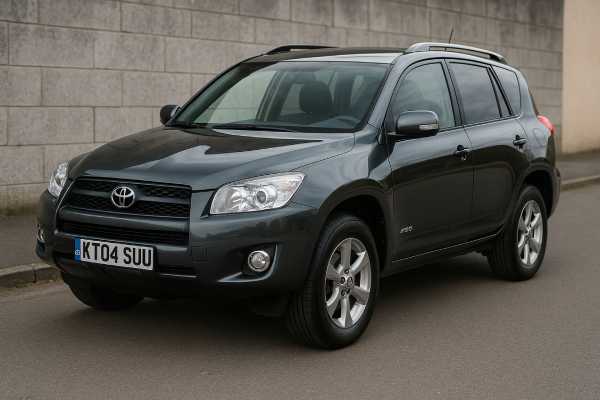
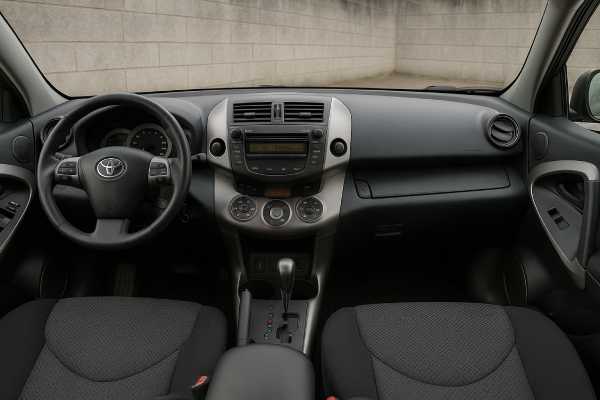
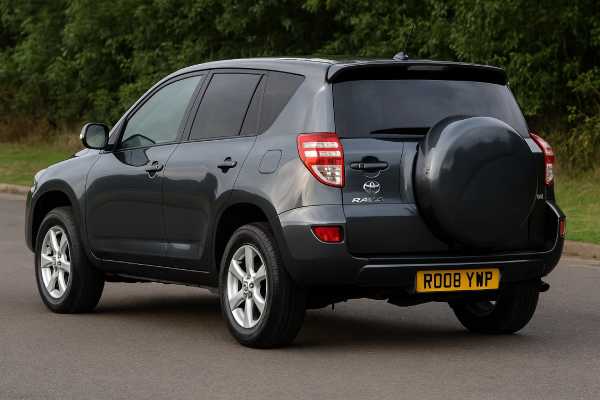
The facelifted third-generation Toyota RAV4 with the 2AD-FTV 2.2-litre diesel and all-wheel drive is the “use it every day, take it anywhere” version of XA30. It mixes a flexible, low-rpm torque band with a calm ride and the secure traction of Toyota’s Integrated Active Drive system. The update brought quieter cabins, sharper front-end styling, and a more polished equipment mix, while the 150 hp diesel settled into a sweet spot for economy, towing, and long-distance commuting. Real-world owners value how easily it cruises at motorway speeds and how the square cargo bay swallows family gear without fuss. If you cover regular highway miles and sometimes tow or load the car heavily, this powertrain is the one that keeps costs predictable—provided you respect modern diesel housekeeping (clean EGR paths, healthy DPF, and good oil). What follows is a focused guide to specs, upkeep, and ownership patterns that matter when choosing, maintaining, or selling a RAV4 2.2 D-4D AWD from 2008–2012.
Essential Insights
- Confident torque (≈340 Nm) from 2.2 D-4D makes light work of hills, loads, and towing up to 2,000 kg.
- Integrated Active Drive adds secure traction and predictable manners on wet, gravel, or snow.
- Cabin and cargo space are genuinely useful; split-fold rear bench and low lift-over height help daily use.
- Watch EGR/DPF cleanliness on short-trip cars; insist on correct low-SAPs oil and proof of regular highway runs.
- Oil and filter every 15,000 km or 12 months; shorten to 10,000 km for mostly urban duty.
Explore the sections
- RAV4 2.2 D-4D AWD Overview
- RAV4 2.2 D-4D Specs and Data
- Trims, Safety and Driver Assistance
- Reliability, Issues and Service Actions
- Maintenance and Buying Guide
- Driving and Performance
- How RAV4 Compares to Rivals
RAV4 2.2 D-4D AWD Overview
This facelifted XA30 RAV4 aims squarely at owners who need compact-SUV practicality without giving up diesel torque or four-season traction. The 2AD-FTV 2.2-litre four-cylinder turbo-diesel produces around 150 hp (110 kW) and ≈340 Nm (251 lb-ft), with its best work delivered from roughly 1,600–3,000 rpm. It is paired primarily with a six-speed manual; on certain markets and grades, a six-speed automatic was offered with the 150-hp D-CAT emissions package. The headline ability is easy, rolling acceleration in third and fourth and a relaxed sixth-gear cruise at 120 km/h (75 mph). That calmness stems from long gearing and the diesel’s flat torque plateau.
Traction is handled by Toyota’s Integrated Active Drive with Active Torque Control. In normal running it sends all power to the front axle for efficiency and continuously apportions torque rearward as the surface demands. A dashboard 4WD Lock button can hold a fixed front/rear split at low speeds for slippery ramps or snow starts. On dry tarmac the system is unobtrusive; on wet backroads it simply finds grip and gets on with it. The calibration works with the stability control and electric power steering to keep responses tidy if you enter a turn too hot or meet a slick patch mid-corner.
Inside, the RAV4 favours function over fashion: large, durable switchgear; sensible storage; and a square, low-floor cargo bay. The side-hinged tailgate divides opinion—you need lateral clearance to open it—but many owners appreciate the externally mounted spare for rural commutes. Seats are supportive for long stints, and the driving position offers a broad view without the “perched” feel some rivals impose. Ride quality sits on the comfortable side of firm, thanks to a well-damped MacPherson/double-wishbone setup that keeps body motions in check without clatter over scarred surfaces.
Where this model shines is mixed-duty life—school runs and city errands during the week, then an effortless 300-km motorway trip or light trailer on the weekend. If your use case includes repeated short, cold starts with little highway time, a petrol RAV4 may be lower-stress; but for owners who log regular continuous runs, the 2.2 D-4D AWD is a rational, long-legged choice with predictable running costs.
RAV4 2.2 D-4D Specs and Data
Engine and Performance (ICE)
| Item | Value |
|---|---|
| Code | 2AD-FTV (D-4D 150) |
| Layout and valvetrain | Inline-4, DOHC, 16-valve; timing chain |
| Bore × stroke | 86.0 × 96.0 mm (3.39 × 3.78 in) |
| Displacement | 2.2 L (2,231 cc) |
| Induction | Turbocharged with intercooler (variable-geometry) |
| Fuel system | Common-rail direct injection (Denso) |
| Compression ratio | ≈15.8:1 |
| Max power | 150 hp (110 kW) @ ~3,600 rpm |
| Max torque | ≈340 Nm (251 lb-ft) @ ~2,000–2,800 rpm |
| Emissions class | Euro 4 → Euro 5 (by year/emissions package) |
| Rated economy (mixed) | ≈6.0–6.4 L/100 km (39–37 mpg US / 47–44 mpg UK) |
| Real highway @120 km/h | ≈6.8–7.4 L/100 km (35–32 mpg US / 42–39 mpg UK) |
| Aerodynamics | Cd ≈0.31; frontal area ≈2.25 m² (24.2 ft²) |
Transmission and Driveline
| Item | Value |
|---|---|
| Transmission | 6-speed manual (most common); 6-speed automatic available on select grades/markets |
| Final drive | ≈3.9 (varies slightly by build) |
| Drive type | AWD (Active Torque Control) |
| AWD behaviour | 100:0 default → up to ~55:45 on demand; 4WD Lock at low speeds |
| Differentials | Open front and rear; electro-magnetic coupling ahead of rear diff |
| Refuel to full | ≈5 min at diesel pump |
Chassis and Dimensions
| Item | Value |
|---|---|
| Front / rear suspension | MacPherson strut / Double wishbone |
| Steering | Electric power steering; ratio approx. 15–16:1 |
| Brakes (front/rear) | Ventilated disc / solid disc |
| Wheels and tyres | Common: 225/65 R17 (17-in); some trims 215/65 R16 |
| Ground clearance | ≈180 mm (7.1 in) |
| Length / width / height | 4,365 / 1,815 / 1,685 mm (171.9 / 71.5 / 66.3 in) |
| Wheelbase | 2,560 mm (100.8 in) |
| Turning circle (kerb-to-kerb) | ≈10.6–11.6 m (35–38 ft) |
| Kerb (curb) weight | ≈1,570–1,640 kg (3,461–3,616 lb) |
| GVWR | ≈2,150–2,200 kg (4,740–4,850 lb) |
| Fuel tank | 60 L (15.9 US gal / 13.2 UK gal) |
| Cargo volume (seats up/down) | ≈410 / ≈1,470 L (14.5 / 51.9 ft³) VDA |
Performance and Capability
| Item | Value |
|---|---|
| 0–100 km/h (0–62 mph) | ≈10.2–10.8 s (manual quicker than auto) |
| Top speed | ≈185–190 km/h (115–118 mph) |
| Braking 100–0 km/h | ≈38–39 m (125–128 ft) on quality tyres |
| Towing capacity (braked/unbraked) | up to ≈2,000 / 750 kg (4,409 / 1,653 lb) |
| Payload | ≈520–600 kg (1,146–1,323 lb) |
| Roof load | 75 kg (165 lb) |
Fluids and Service Capacities
| System | Spec / Capacity |
|---|---|
| Engine oil | ACEA C2/C3 low-SAPs 5W-30 (DPF-safe); ≈6.3 L (6.7 US qt) incl. filter |
| Coolant | Toyota Super Long Life (pink) ~50/50; ≈6.5–7.0 L (6.9–7.4 US qt) |
| Manual transaxle | API GL-4 75W–90; ≈2.2 L (2.3 US qt) |
| Automatic (if fitted) | Toyota WS ATF; drain/refill ≈3.5–4.0 L (varies by procedure) |
| Transfer (AWD) | API GL-5 75W–90; ≈0.45 L (0.48 US qt) |
| Rear differential | API GL-5 75W–90; ≈0.6 L (0.63 US qt) |
| A/C refrigerant | R-134a; ≈430 g (15.2 oz) |
| A/C compressor oil | ND-Oil 8; ≈120 mL (4.1 fl oz) |
| Key torque specs | Wheel nuts 103 Nm (76 lb-ft); engine drain plug ≈39 Nm (29 lb-ft); diff/transfer drains ≈39 Nm (29 lb-ft) |
Electrical
| Item | Value |
|---|---|
| Alternator output | ≈120 A |
| 12V battery | ≈70 Ah (≈620 CCA), H5/H6 form factor |
| Glow plugs | 11V ceramics (Denso) |
Safety and Driver Assistance
| Area | Details |
|---|---|
| Crash ratings | Euro NCAP (2006 protocol): 4-star for the relevant generation |
| Airbags and structure | Front, side, curtain, and driver’s knee airbags; ISOFIX/LATCH points; stiff passenger cell with defined load paths |
| Stability and braking | ABS with EBD, Brake Assist; Vehicle Stability Control and Traction Control standard |
| Hill aids | Hill-start Assist Control; Downhill Assist Control on auto/Multidrive-equipped grades |
| Headlights | Halogen reflectors common; projector low-beam on higher trims/late years |
| ADAS | Pre-AEB era for this class; parking sensors and reversing camera available by grade |
Values vary by country pack, wheel/tyre, and year. Confirm against the build sheet for your VIN.
Trims, Safety and Driver Assistance
Grades and key options (Europe, 2008–2012). Naming differs by market, but the pattern is consistent: a core grade with cloth seats and 16- or 17-inch wheels; a comfort/XT-R-type grade with dual-zone climate, audio upgrades, and more driver aids; and an SR/Executive-type grade with leather/Alcantara, larger alloys, and navigation. The 2.2 D-4D 150 AWD appears widely across the middle grades with the six-speed manual; in select countries, a six-speed automatic was offered when paired with the D-CAT emissions package. Wheel packages range from 16-in steel to 17-in alloys; some upper trims add smoke-finish headlamps and privacy glass.
Mechanical differences by grade. Chassis hardware is common—MacPherson/double-wishbone with discs all around—but spring and damper rates differ slightly by engine/axle load. AWD cars add a transfer unit and electromagnetic coupling ahead of the rear differential; there are no mechanical lockers. Tow packages can include upgraded cooling and a higher wiring spec; verify the type-approved tow rating on the VIN plate rather than assuming a blanket figure.
Infotainment and convenience. Early facelift cars carry a straightforward CD/MP3 head unit with AUX. Later cars offer Touch/Touch & Go systems with Bluetooth and USB, and many higher grades include a reversing camera. Factory parking sensors are common; their ultrasonics may need recalibration after bumper repair or repaint.
Safety ratings and context. The relevant Euro NCAP result for this generation is four stars under the 2006 protocol, with good cabin integrity and strong side protection for the period. North American testing (IIHS/NHTSA) covered petrol-engined, long-wheelbase variants with different protocols and is not a direct proxy for European diesels. For child seats, ISOFIX anchors are accessible at the outboard rear positions; top-tether fitment is straightforward with the correct routing.
Driver assistance. This pre-AEB era RAV4 lacks forward auto-braking, adaptive cruise, and lane keep. Stability control tuning is gentle but effective, blending wheel-speed braking with torque re-apportioning through the AWD coupling. Tyre choice dramatically affects winter behaviour; good Nordic-type winters transform uphill starts and stopping distances.
Year-to-year notes. The 2010 refresh brought the bolder grille, projector low-beams on many trims, and a tidier options list. Late cars are more likely to have USB/Bluetooth and the camera pre-wired from factory. In some markets the D-CAT 150 automatic was added to the line-up to broaden choice.
Reliability, Issues and Service Actions
Overall picture. With routine maintenance and sensible use, the 2AD-FTV AWD RAV4 is a durable, high-mileage companion. The most common complaints trace back to soot management (EGR/DPF), wear of the clutch/dual-mass flywheel under urban or towing duty, and age-related sensors or hoses. The AWD hardware itself is largely trouble-free if fluids stay clean and boots remain intact.
Common (low–medium severity/cost):
- EGR valve and cooler fouling → rough idle, hesitation, increased smoke, or MIL. Remedy: remove and clean EGR/cooler and throttle plate; confirm post-clean adaptations; consider shorter oil intervals on mostly urban cars.
- DPF saturation after repeated short trips → frequent regens, rising oil level from fuel dilution, limp responses. Remedy: diagnose for pressure-sensor plausibility and hose integrity; perform a controlled service regeneration if needed; replace engine oil if fuel-diluted; counsel owner on weekly steady-state runs (20–30 minutes).
- Intercooler and boost hoses → softening or splits at bends, oily mist, whistle, reduced boost. Remedy: replace degraded hoses and clamps; verify MAP and MAF readings after repair.
- Glow plugs and relay (age/mileage) → reluctant cold starts, stored codes. Remedy: test and replace as a set; apply correct torque and anti-seize practices for ceramics.
Occasional (medium severity/cost):
- Dual-mass flywheel (DMF) rattle or clutch slip on high-mileage urban commuters or frequent towers. Symptoms: shudder on take-up, rattly idle, rpm flare in higher gears. Remedy: clutch and DMF replacement; inspect rear main seal; renew mounts if perished.
- Suction Control Valve (SCV) wear on high-pressure pump → intermittent stalling/hunting, poor hot restarts. Remedy: replace SCV; clear codes; perform idle learn; maintain clean fuel via timely fuel filter renewal.
- Water pump seep → pink crust around pump, coolant smell. Remedy: replace pump and belt; bleed with heater on; verify cooling fan control.
Rare but important:
- Cylinder head gasket/short block concerns were widely publicised on some 2.2-litre AD-family diesels pre-facelift. Incidence is far lower on late-2009-on updates, but a cold-start pressure test and diligent coolant checks are prudent. Proof of any goodwill short-block replacements in history is a plus.
- Turbo vane sticking after long, gentle operation → lazy boost response. Remedy: targeted cleaning and actuator checks; ensure correct post-repair calibrations.
Chassis and body:
- Rear lower suspension arm service history. If alignment work was done, confirm fasteners were torqued correctly and rechecked; improper procedures can lead to loosening.
- Tailgate harness flex on cars opening the side-hinged door dozens of times daily → intermittent rear wiper or number-plate light. Remedy: inspect for broken conductors near the hinge; fit repair section if needed.
- Underbody corrosion points: exhaust hangers, rear subframe hardware, and the external spare-wheel carrier on cars left with road salt deposits.
Safety recalls and actions to verify:
- Rear outboard seatbelt webbing (2006–2012 builds): installation of protective resin guides on the rear-seat frame to prevent belt damage in a severe frontal crash—confirm completion by VIN.
- Regional campaigns vary; always run an official VIN check and ensure documentation is in the service file.
Pre-purchase requests: full, invoice-backed service history; proof of low-SAPs oil since DPF fitment; any EGR/DPF cleaning or component replacement; brake fluid dates; clutch/DMF work; coolant age; tyre dates and matching sets. Scan for DPF ash/soot load, pending codes, and regeneration history.
Maintenance and Buying Guide
Service rhythm (typical European diesel practice):
- Engine oil and filter: every 15,000 km or 12 months; shorten to 10,000 km for heavy city/short-trip use. Use ACEA C2/C3 5W-30 low-SAPs.
- Fuel filter: inspect 30,000 km; replace 60,000 km or 4 years sooner if water contamination suspected.
- Engine air filter: inspect 15,000 km; replace 30–45,000 km based on environment.
- Cabin filter: 12 months (more often in dusty/pollen seasons).
- Coolant (SLLC pink): first change 10 years/160,000 km, then 5 years/100,000 km (confirm against your handbook).
- Manual transaxle oil: check 90,000 km; refresh 120–150,000 km if shift feel degrades (GL-4 75W–90).
- Automatic (if fitted): temperature-controlled drain and fill with Toyota WS; adapt shift logic after service.
- Transfer and rear differential oils: 120,000 km typical; earlier if towing/track off-road; GL-5 75W–90.
- Brake fluid: 24 months; bleed method mindful of ABS modulator.
- Pads and rotors: inspect every service; pads often last 30–60,000 km with mixed use.
- Serpentine/aux belt and tensioner: inspect annually; replace 90–120,000 km if cracked/noisy.
- Timing drive: chain—inspect for stretch (cam/crank correlation), guide wear, noise; replace components if out of spec.
- EGR and intake cleanliness: plan a 60–90,000 km cleaning cycle on urban-heavy cars.
- DPF care: monitor differential pressure and ash load at service; encourage weekly 20–30-minute steady-state runs.
- 12V battery: test yearly from year 4; typical replacement window 5–7 years.
Fluids at a glance (capacities for planning):
- Oil: ≈6.3 L incl. filter.
- Coolant: ≈6.5–7.0 L.
- Manual trans: ≈2.2 L.
- Transfer: ≈0.45 L; rear diff: ≈0.6 L.
- R-134a refrigerant: ≈430 g.
Essential torque values:
- Wheel nuts: 103 Nm (76 lb-ft).
- Engine drain plug: ≈39 Nm (29 lb-ft).
- Diff and transfer drains: ≈39 Nm (29 lb-ft).
Buyer’s inspection checklist:
- Cold start and idle: listen for chain rattle (brief is acceptable; sustained is not) and DMF clunk at shutdown.
- DPF/EGR status: read soot/ash load and regen count; avoid cars with frequent forced regens and fuel-diluted oil.
- Clutch/DMF test: steady pull from 1,500–2,000 rpm in third; any flare equals upcoming spend.
- Cooling system: pink residue around the water pump; pressure-test if suspicious.
- Boost system: check intercooler hoses and clamps for oil weep or splits; verify actuator movement.
- AWD health: inspect transfer and rear diff for leaks; confirm even tyre brand/age across all four corners.
- Underbody: rear subframe hardware and spare-wheel carrier for corrosion.
- Recalls: confirm rear seatbelt remedy and any local campaigns by VIN printout.
Which cars to shortlist? Late-cycle (2010–2012) examples with documented low-SAPs oil, periodic EGR/DPF cleaning, and recent brake fluid and coolant dates. Mid-grades with 17-in wheels, dual-zone climate, and reversing camera hit a sweet spot. Avoid neglected urban-only cars with DPF warnings or uneven, mismatched tyres.
Long-term outlook. With the right driving profile and routine care, these engines commonly see 250,000+ km without internal work. The AWD hardware is low-drama if you refresh fluids on time and keep tyres matched.
Driving and Performance
Ride, handling, and refinement. The RAV4 2.2 D-4D AWD majors on everyday comfort. Spring and damper tuning smother sharp ridges yet keep the body calm over long undulations. On the motorway the cabin settles into a quiet cruise with modest wind noise and a subdued diesel hum. The double-wishbone rear helps the back axle track cleanly across broken surfaces, and the steering—though not chatty—proves accurate and consistent from parking speeds to 130 km/h (81 mph). Brake feel is dependable; quality pads and fresh fluid produce repeatable stops without early fade.
Powertrain character. The torquey mid-range is the point: from 1,600 rpm the engine pulls without strain, making short work of hills with passengers and luggage. The six-speed manual has sensible ratios; fifth is a flexible overtaking gear, and sixth is long for economy. Where fitted, the six-speed automatic shifts smoothly and makes good use of the engine’s torque; use its manual mode on descents or when towing to keep temperatures in line.
Real-world economy. Expect roughly:
- City: 7.6–8.5 L/100 km (31–28 mpg US / 37–33 mpg UK), sensitive to trip length and temperature.
- Highway (100–120 km/h / 60–75 mph): 5.8–6.8 L/100 km (41–35 mpg US / 49–42 mpg UK).
- Mixed: 6.3–7.0 L/100 km (37–34 mpg US / 45–41 mpg UK).
Winter sees a modest increase; block heaters and proper winter diesel help.
Metrics that matter. A healthy AWD 150 will run 0–100 km/h in ≈10.2–10.8 s, depending on gearbox and tyres, and stop from 100 km/h in ~38–39 m on good rubber. The turning circle is tight enough for multistorey ramps, and outward visibility simplifies tight city work compared with chunkier rivals.
Traction and stability. On wet or gritty surfaces the AWD calibration is confidence-inspiring and unobtrusive. The 4WD Lock button is useful for crawling out of a muddy lay-by or starting on snowy inclines, but you rarely need it; the system anticipates slip and apportions torque proactively. As always, tyres define winter behaviour; a quality winter set transforms braking and corner exit.
Loads and towing. The diesel’s torque and the auxiliary cooling hardware on tow-prepped cars make 1,500–2,000 kg trailers realistic within rated limits. Plan for a 15–25% fuel-consumption penalty when towing or carrying full holiday loads. Fit a fresh cabin filter before a long, hot holiday tow—the HVAC will thank you—and service brakes and fluids ahead of any Alpine trip.
How RAV4 Compares to Rivals
Volkswagen Tiguan 2.0 TDI (AWD). The Tiguan feels more “Germanic” inside and can be a touch quieter on long motorway slogs. Later emissions hardware adds complexity, though, and parts pricing can sting out of warranty. The RAV4 counters with a calmer ride on poor tarmac and often cheaper long-term maintenance.
Honda CR-V 2.2 i-DTEC (AWD). Spacious cabin and strong motorway composure. The Honda diesel is an efficient unit but can suffer from injector and DPF issues on neglected cars. The Toyota’s simpler AWD coupling and robust suspension components age well, provided fluids are changed on time.
Ford Kuga 2.0 TDCi (AWD). Steering feel and front-end bite are class-leading, but rear brake wear and occasional electrical gremlins sneak up on owners. The RAV4 rides more softly and tends to hold value better in many markets.
Nissan X-Trail 2.0/2.2 dCi (AWD). Useful packaging and an honest tool for rural use. Cabin wear shows quicker, and rust in subframes or rear sills appears earlier than on Toyotas. The RAV4’s interior plastics and paint finishes generally age more gracefully.
Why choose the RAV4 2.2 D-4D AWD? It balances everyday comfort, diesel efficiency, and all-weather security with a reputation for durability. If your routine includes steady highway mileage and occasional towing or mountain trips, this is the configuration that keeps ownership calm and predictable.
References
- Toyota Introduces the 2010 RAV4 2010 (Press Release)
- New RAV4 2010 2010 (Press Release)
- Official Toyota RAV4 2006 safety rating 2006 (Safety Rating)
- Part 573 Safety Recall Report 16V-096 2016 (Recall Report)
- More Choice, More Equipment and New Styling for Toyota’s 2010 RAV4 2010 (Press Release)
Disclaimer
This article is for informational purposes and is not a substitute for professional diagnosis or repair. Specifications, torque values, service intervals, and procedures vary by VIN, market, year, and equipment. Always verify against your vehicle’s official service documentation and follow current manufacturer guidance.
If this guide helped, please consider sharing it with fellow owners on Facebook or X/Twitter to support xcar’s work. Thank you!