


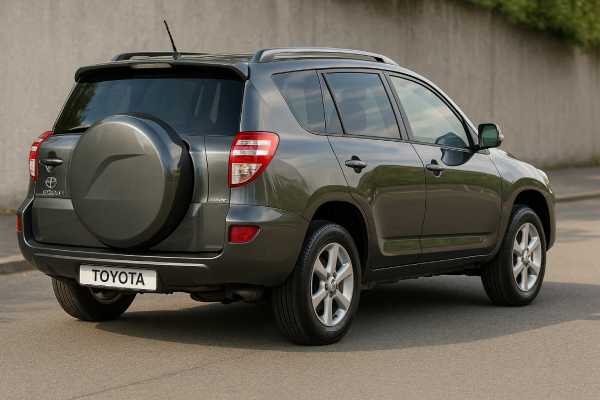
The facelifted third-generation Toyota RAV4 (XA30, 2009–2012) in 2.0-liter Valvematic AWD form is a practical, durable compact SUV that favors real-world usability over flash. Its 3ZR-FAE engine uses Toyota’s Valvematic variable-lift system to balance efficiency and response, while the on-demand Active Torque Control AWD adds confident traction without the weight and drag of a full-time system. Inside, the short-wheelbase European body brings a tidy footprint and excellent maneuverability with a wide cargo bay and flat-fold rear seats. Owners value its low running costs, robust suspension, and corrosion-resistant body, and while the Multidrive S CVT is tuned for smoothness rather than speed, it suits daily commuting and winter travel well. If you want a compact SUV that feels unburstable, carries a family and weekend gear without fuss, and stays reasonable to service, this RAV4 spec deserves a close look.
At a Glance
- Valvematic 2.0 (3ZR-FAE) is smooth, frugal, and chain-driven; AWD adds secure winter traction without big economy penalties.
- Short-wheelbase XA30 is easy to park yet has a wide, flat cargo floor and split-fold rear seats.
- Safety kit is strong for the era: 7 airbags, VSC/TRC, ISOFIX, plus hill-start and downhill assist on AWD autos.
- Watch for CVT fluid neglect and rear-driveline oil changes; service history matters more than mileage.
- Typical service rhythm: every 15,000 km or 12 months (oil/filter), whichever comes first.
Explore the sections
- RAV4 XA30 Facelift Overview
- RAV4 2.0 Valvematic Specs
- RAV4 Trims, Safety, ADAS
- Reliability and Known Issues
- Maintenance and Buying Tips
- On-Road Behavior and Economy
- RAV4 vs Key Rivals
RAV4 XA30 Facelift Overview
The 2009 facelift brought cleaner styling, improved equipment, and—crucially for this variant—the 3ZR-FAE “Valvematic” petrol engine. Valvematic continuously varies intake valve lift and timing (paired with Dual VVT-i), allowing finer control of charge and higher combustion efficiency than earlier VVT-i units. In the RAV4, the 2.0 produces around 152 hp (112 kW) and 198 Nm (146 lb-ft), with a friendly torque curve and quieter cruising than old 2.0 VVT-i engines.
AWD versions use Active Torque Control 4WD: under steady running the RAV4 behaves like a front-driver; when slip is detected—or when pulling away—it quickly feeds torque rearward through an electronically controlled coupling. Brake-actuated traction aids and stability control trim wheelspin on loose or icy surfaces. On AWD autos (Multidrive S CVT), hill-start assist (HAC) and downhill assist (DAC) support steep ramps or low-grip declines.
The European (short-wheelbase) XA30 measures 4,365 mm end-to-end with a 2,560 mm wheelbase—compact outside, yet sensibly packaged inside. With rear backrests tumbled, the floor goes flat and wide for bikes, strollers, or camping boxes; with seats up, the bay is square-shouldered and easy to load. Typical alloy packages are 17-inch (225/65 R17) on mainstream trims and 18-inch (235/55 R18) on sportier grades.
Strengths owners notice quickly:
- Predictable, low-stress driving manners; light but accurate steering and absorbent suspension.
- Genuine all-weather footing from the AWD system without the weight/drag penalty of permanent 4×4.
- Tight turning radius (city-friendly), good visibility, and hardy interior materials that wear slowly.
Limitations to weigh:
- The CVT prioritizes smoothness over urgency; best results come from measured throttle and using the manual “steps” on hills or overtakes.
- Cabin tech and ADAS reflect the 2010 era: no factory AEB or lane assist.
If you’re shopping one, a clean service record (particularly for fluids in the CVT, transfer case, and rear diff) and a corrosion inspection underneath are the fastest ways to separate keepers from projects.
RAV4 2.0 Valvematic Specs
Below are the key numbers for the 2009–2012 XA30 AWD with the 3ZR-FAE petrol engine (European short-wheelbase body). Figures reflect manufacturer data for this configuration; where ranges are given, they cover trim/wheel variations and option weights.
Engine and Performance
| Item | Data |
|---|---|
| Code | 3ZR-FAE (Valvematic, Dual VVT-i) |
| Layout & cylinders | Inline-4 DOHC, 16 valves (4 per cyl) |
| Bore × stroke | 80.5 × 97.6 mm (3.17 × 3.84 in) |
| Displacement | 2.0 L (1,987 cc) |
| Induction | Naturally aspirated |
| Fuel system | Sequential electronic fuel injection (port) |
| Compression ratio | 10.0 : 1 |
| Max power | 152 hp (112 kW) @ 6,200 rpm (≈158 PS DIN) |
| Max torque | 198 Nm (146 lb-ft) @ 4,400 rpm |
| Timing drive | Chain (no routine replacement interval) |
| Emissions standard | Euro 5 |
| Rated efficiency (combined) | ~7.6 L/100 km (31.0 mpg US / 37.2 mpg UK) |
| Real-world highway @ 120 km/h | 8.5–9.0 L/100 km (26–28 mpg US / 31–34 mpg UK), light load |
| Aerodynamics | Cd ≈ 0.31 |
Transmission and Driveline
| Item | Data |
|---|---|
| Transmission | Multidrive S CVT (step-logic manual mode) |
| Drive type | Active Torque Control AWD (electronically controlled rear coupling) |
| Differential | Open front/rear; brake-actuated traction aids |
| Notes | Petrol AWD commonly paired with CVT; a 6-MT existed mainly with 2WD petrol/diesel in Europe |
Chassis and Dimensions
| Item | Data |
|---|---|
| Suspension (front/rear) | MacPherson strut / Double wishbone |
| Steering | Electric power steering (rack-and-pinion) |
| Brakes | Ventilated discs (front), solid discs (rear) |
| Wheels/Tyres | 225/65 R17; 235/55 R18 on high grade |
| Ground clearance | 180 mm (7.1 in) |
| Angles | Approach 28°, Departure 24°, Breakover 20° |
| Length / Width / Height | 4,365 / 1,815 / 1,685 mm (171.9 / 71.5 / 66.3 in) — ~1,855 mm width and 1,720 mm height with arch/roof-rail options |
| Wheelbase | 2,560 mm (100.8 in) |
| Turning circle (curb-to-curb) | ~10.2–11.6 m (33.5–38.1 ft) depending on wheel/body reference |
| Curb weight | 1,510–1,565 kg (3,329–3,450 lb) |
| GVWR | ~2,110 kg (4,652 lb) |
| Fuel tank | 60 L (15.9 US gal / 13.2 UK gal) |
| Cargo volume | 410 L (VDA) seats up; flat load floor with rear seat tumbled |
Performance and Capability
| Metric | Value |
|---|---|
| 0–100 km/h (0–62 mph) | ~11.0 s (AWD CVT) |
| Top speed | ~185 km/h (115 mph) |
| Towing capacity | 1,500 kg (3,307 lb) braked / 750 kg (1,653 lb) unbraked |
| Payload | ~545–600 kg (1,202–1,323 lb) depending on curb weight |
| Roof load | Typically 75 kg (165 lb) with OEM rails/bars; check accessory rating |
Fluids and Service Capacities
Important: capacities vary slightly by VIN/market, temperature, and service method (dry fill vs drain/refill). Always verify on the under-hood labels and the official service documentation for your vehicle.
| System | Specification | Capacity (approx.) |
|---|---|---|
| Engine oil | 0W-20 (ACEA A5/B5) preferred; 5W-30 acceptable in warm climates | 4.2 L (4.4 US qt) with filter |
| Coolant | Toyota Super Long Life Coolant (SLLC, pink) | ~6.5 L (6.9 US qt) |
| CVT (Multidrive S) | Toyota CVT Fluid FE (factory); drain/refill intervals by condition | ~8.4 L full fill; ~3–4 L typical drain/refill |
| Transfer case | GL-5 75W-90 | ~0.45 L (0.48 US qt) |
| Rear differential | GL-5 75W-90 | ~0.50 L (0.53 US qt) |
| A/C refrigerant | R134a; ND-OIL8 (PAG46) | 430 ± 30 g; oil ~90–160 mL |
| Key torque values | Wheel nuts: 103 Nm (76 lb-ft) • Engine drain plug: ~39 Nm (29 lb-ft) • Spark plugs: ~18 Nm (13 lb-ft) |
Electrical (service-relevant)
| Item | Data |
|---|---|
| 12 V battery | ~60 Ah (CCA 540–600 A) DIN/H5 (Group 47) size commonly fitted |
| Spark plugs | Denso SC16HR11 (iridium) or equivalent; gap 1.0–1.1 mm (0.039–0.043 in) |
Safety and Driver Assistance (equipment baseline)
| Area | Details |
|---|---|
| Structure/Airbags | 7 airbags: dual-stage front, front side, full-length curtains, driver’s knee; WIL (Whiplash Injury Lessening) front seats |
| Stability/Traction | ABS with EBD and Brake Assist, VSC (stability control), TRC (traction control) |
| Hill aids (AWD auto) | HAC (hill-start), DAC (downhill control) |
| Child seat | ISOFIX/LATCH anchors rear outboard; front passenger airbag deactivation switch |
| Lighting | Projector halogen headlamps; rear LED brake lights on many trims |
RAV4 Trims, Safety, ADAS
Trims (Europe, facelift years): Common UK/EU grades included XT-R 2WD, XT-R AWD, and SR AWD. All AWD grades bring the Intelligent All Wheel Drive system, heated front seats, and an electric driver’s seat; SR typically adds 18-inch wheels, darkened headlamps/arch trims, Smart Entry/Start, and the premium navigation pack with rear-view monitor. Identifiers: SR’s arch extensions and 18-inch alloys, plus darker lamp internals, are easy driveway tells. VIN/build plates confirm drivetrain; AWD cars list transfer/diff codes.
Year-to-year changes: The 2009 refresh introduced the 2.0 Valvematic petrol and Toyota Optimal Drive updates. Equipment was consolidated; navigation moved to a larger 7-inch unit on higher grades, and rear-view camera became common with the premium nav pack. Wheel/tire packages and minor interior trim changes vary by market.
Mechanical differences by trim: Springs/dampers are shared across AWD petrol trims; SR’s 18-inch package adds a small ride/impact firmness versus XT-R on 17s. Hill-start control and downhill assist are packaged with the AWD automatic. Brakes are common, though rotor part numbers vary with wheel package.
Infotainment/audio: Base head units offer CD/MP3 with six speakers; premium navigation adds hard-disk music storage (≈10 GB), traffic avoidance, and camera integration. Bluetooth calling is widespread; audio streaming support depends on head-unit version.
Child-seat and cabin safety: Two ISOFIX anchors in the second row (outboard) with top tethers, plus a passenger-airbag cut-off, make the XA30 straightforward for family duty. Head-restraint geometry and WIL (active headrests) improve rear-impact protection.
Crash-test results: Euro-spec RAV4 of this generation achieved strong ratings for the period under earlier Euro NCAP protocols, with four stars adult protection and robust side-impact performance. Keep in mind that rating scales and tests evolved after 2009; direct star-to-star comparisons with modern cars are not apples-to-apples. In North America, the related long-wheelbase RAV4 (2007–2012) scored well in IIHS moderate overlap and side tests; small-overlap and advanced front crash-prevention were not yet applicable to this era.
ADAS availability and calibration: This generation predates factory AEB, ACC, lane keeping, and blind-spot monitoring. Stability control is standard and can require calibration if wheel-speed sensors, steering angle sensor, or yaw rate sensor are replaced; alignment on a flat, level surface and a capable scan tool are required. After windshield replacement on camera-equipped later head units (if fitted with accessories), no factory forward camera calibration is needed because the car does not run lane or AEB features.
Tow prep and ratings: AWD 2.0 Valvematic is typically rated at 1,500 kg braked (750 kg unbraked) with a 75 kg tongue load. Many markets offered factory loom modules; trailer stability is aided by VSC logic. Confirm cooling-package fitment if you tow regularly in mountains or heat.
Reliability and Known Issues
The facelift XA30 RAV4 with the 3ZR-FAE is generally a low-drama ownership proposition. Most examples go deep into six-figure mileage with routine servicing and occasional wear-item replacement. The following map groups issues by prevalence and cost, with what to look for and how to resolve them.
Engine (3ZR-FAE Valvematic)
- Occasional – Low/Medium: Water pump seep around 80–150k km. Symptom: pink crust or coolant odor at pulley; slight coolant loss. Fix: replace pump and gasket; refresh SLLC.
- Occasional – Low: Aux belt noise on cold starts. Cause: aged belt/tensioner. Fix: belt and, if needed, tensioner.
- Rare – Medium: Valvematic actuator fault. Symptoms: limp mode, DTCs for lift control/position; rough idle. Cause: actuator or position sensor out of range. Fix: guided tests; software update if applicable; replace actuator if confirmed faulty.
- Rare – Low: Oil consumption. Less common than older AZ engines; check PCV and use the correct 0W-20/5W-30 to spec.
Fuel/air and sensors
- Occasional – Low: MAF contamination (short-trip cars). Symptoms: surging idle, poor response. Fix: careful MAF cleaning or replace.
- Occasional – Low: O2 sensor aging after 10+ years; sluggish feedback raises consumption. Fix: replace with OE-grade sensors.
CVT and driveline (AWD)
- Common – Medium: CVT fluid never serviced. Symptoms: flare or drone under load; harshness on long grades. Fix: staged drain/refill with Toyota CVT FE fluid; avoid power-flushes. Inspect cooler lines.
- Occasional – Medium: Rear differential and transfer case neglect. Symptoms: humming/whine at 60–90 km/h, seep at seals. Fix: refresh GL-5 gear oil; replace seals/bearings if noisy.
- Occasional – Low: Front wheel-bearing wear (bigger wheels/rough roads). Fix: hub assembly replacement.
Chassis and body
- Occasional – Low: Rear coil-spring fracture in salty regions; car sits slightly low on one corner. Fix: replace both rear springs; check upper seats.
- Occasional – Low: Steering intermediate-shaft knock at parking speeds. Fix: updated shaft/coupler.
- Occasional – Low/Medium: Exhaust flange/cat shield corrosion leading to rattles; simple hardware fixes.
- Regional – Medium: Underbody/subframe corrosion on older, high-salt cars. Fix: thorough cleaning, rust treatment; inspect brake/fuel lines and rear subframe seams.
Electrical and HVAC
- Rare – Low: HVAC blower resistor failures; fan stuck on one speed. Fix: replace resistor pack.
- Rare – Low: Alternator wear beyond 200k km; watch for dimming or battery lamp under load.
Safety-related service actions
- Rear outboard seatbelt recall (2006–2012 build range). In a very severe frontal crash, the lap belt could contact the rear seat-frame edge and cut. Remedy is a plastic guard over the frame. Action: run an official VIN recall check and confirm the guard installation on the rear cushion frame.
- Airbag/ECU and other market-specific campaigns may apply by VIN; always verify with a dealer.
What a good one looks like: smooth idle and throttle tip-in; no gearbox shudder; quiet, linear braking; no humming from the rear at 60–90 km/h; clean coolant and leak-free pump; recent records for engine oil, coolant, CVT, transfer, and diff oils; and solid underbody condition.
Maintenance and Buying Tips
Baseline schedule (petrol AWD, Europe)
- Every 15,000 km / 12 months: engine oil and filter; inspect air filter, cabin filter, brakes, tires (rotate), lights, wipers, battery test.
- Every 30,000 km / 2 years: cabin filter (if dusty, yearly); engine air filter; brake fluid; full inspection (steering/suspension, boots, leaks).
- Every 45,000–60,000 km / 3–4 years: CVT fluid drain/refill (use Toyota CVT FE); transfer and rear-diff gear oils; coolant test.
- 90,000 km / 6 years: spark plugs (iridium), coolant replacement (SLLC typically 100–160k km/10 years first interval, then 5 years—follow the under-bonnet label); serpentine belt inspection and tensioner check.
- As needed: alignment (after pothole hits/uneven wear), brake pads/rotors (often 40–80k km front, longer rear), wheel bearings, shocks (check by 150k km).
Fluid choices (quick reference)
- Engine oil: 0W-20 A5/B5 preferred for economy; 5W-30 A5/B5 acceptable in warm climates or higher mileage.
- CVT: Toyota CVT Fluid FE only; avoid mixing types.
- Transfer/rear diff: GL-5 75W-90.
- Coolant: Toyota SLLC (pink).
- Brake fluid: DOT 4.
- A/C: R134a only; verify charge and oil amounts on the under-hood sticker.
DIY torque notes (essentials)
- Wheel nuts 103 Nm (76 lb-ft); engine drain plug ~39 Nm (29 lb-ft); spark plugs ~18 Nm (13 lb-ft) on clean, dry threads. Always verify spec by VIN; aluminum sumps and long-reach plugs are easy to over-torque.
Buyer’s checklist
- Paperwork: full service history with annual oil changes; proof of coolant, CVT, transfer, and rear-diff services; recall/TSB completion.
- Underbody: lift the car—check rear subframe, brake/fuel lines, and diff seals; look for flaky seams.
- Powertrain: warm test drive; listen for rear-axle hum (60–90 km/h); check for CVT flare.
- Cooling system: look for pink residue at the water pump; radiator end tanks dry; cooling fans cycle normally.
- Suspension/steering: clunks over speed bumps (intermediate shaft/links), rear spring condition, and front strut tops.
- Electrics/airbags: confirm all warning lights illuminate at key-on and go out; airbag light must be off; inspect rear seat-belt guards (recall remedy).
- Tires/wheels: 18-inch SR looks great but rides firmer and can be pricier to tire; 17-inch XT-R is the sweet spot for comfort and winter options.
Best picks
- Use case: mixed commuting + winter trips + light towing. Choose XT-R AWD on 17-inch wheels with the premium nav/camera if you value parking ease.
- Avoid cars with unknown CVT fluid history or obvious rear-end noise; you’re likely buying deferred maintenance.
- Longevity outlook: With fluid care and rust prevention, 250–300k km without major engine/driveline work is common.
On-Road Behavior and Economy
Ride, handling, NVH: The short-wheelbase RAV4 is tidy and cooperative in town. Electric power steering is light at parking speeds and consistent on the motorway; straight-line tracking is calm up to typical European cruising. The suspension strikes a practical balance—supple over broken tarmac yet controlled on undulating B-roads. On 17-inch tires, impacts are rounded off; 18-inch SR wheels add precision but transmit more texture. Braking feels natural with good initial bite and repeatability; the system resists fade in everyday use.
Powertrain character: The 3ZR-FAE wakes up cleanly and prefers the mid-range. Throttle mapping is progressive; paired with the Multidrive S CVT it keeps revs steady under moderate acceleration. For hills or quick passes, using the manual “steps” via the shifter helps maintain engine speed without the classic CVT flare sound. NVH is low at a 110–120 km/h cruise; engine tone is subdued and wind rustle modest thanks to the rounded body.
AWD behavior and traction: Active Torque Control 4WD anticipates slip and apportions rear torque early when surfaces get greasy or snowy. It’s transparent on dry tarmac—no binding, no extra steering weight. Stability control is well-tuned; it trims excessive yaw without grabbing too early. On packed snow with decent all-season or winter tires, the RAV4 pulls away cleanly and tracks confidently up grades. Ground clearance (180 mm) avoids bumper scraping in slush ruts; approach/departure angles are useful for ferry ramps, tracks, and light forest roads.
Efficiency in practice: Owners typically see 7.8–8.5 L/100 km mixed (27–30 mpg US / 32–36 mpg UK), with 8.5–9.0 L/100 km (26–28 mpg US) at 120 km/h, two aboard and light luggage. Cold weather and roof bars can add 0.5–1.0 L/100 km. Winter tires and short trips pull numbers down; conversely, steady 100–110 km/h touring can dip into the mid-7s.
Load and towing: With a braked-trailer limit of 1,500 kg, the petrol AWD will tow small boats or a compact camper. Use manual CVT steps on long grades and leave extra following distance; expect a 25–40% fuel-use penalty under moderate tow. Temperature management is sound in ambient European summers if the cooling pack is clean and fans run correctly.
What stands out: The XA30 RAV4 never tries to be a hot hatch in disguise. Instead, it delivers calm progress, easy placement, and confidence when the weather turns—exactly what many owners actually want from a compact SUV.
RAV4 vs Key Rivals
Honda CR-V (2007–2012, 2.0 i-VTEC AWD): Similar power on paper, but the CR-V’s AWD behaves more like a reactive slip-and-grip system and its cabin is larger in back. Ride comfort is excellent; running costs are comparable. The RAV4 counters with better approach/departure geometry, a flatter cargo floor, and (subjectively) sturdier interior wear over time.
Nissan Qashqai+2 / X-Trail T31 (2.0 petrol AWD): The Qashqai’s strength is packaging and low purchase prices; the X-Trail is boxier and roomier. Both can feel harsher over rough roads and, in older age, may need more chassis reconditioning (bushings, bearings). RAV4’s Valvematic engine is thriftier in mixed use and tends to show fewer oiling/cooling niggles.
Subaru Forester (SH, 2.0 petrol): Full-time symmetrical AWD, a bit more off-piste credibility, and a likeable chassis. However, some Subaru petrols of the era can be thirstier and noisier; parts pricing varies by region. The RAV4 is quieter day-to-day and easier to service at any independent shop.
VW Tiguan (2008–2015, 1.4/2.0 TSI 4Motion): Punchy turbo options and sophisticated interiors, but higher complexity (direct injection, turbo, and DSG) can increase ownership risk as miles accrue. The RAV4’s naturally aspirated, port-injected 3ZR-FAE is simpler and usually cheaper to keep.
Verdict: If your priorities are reliability, straightforward maintenance, confident winter traction, and an interior that withstands family duty, the RAV4 2.0 Valvematic AWD remains one of the most sensible buys of its era.
References
- 2009 RAV4 With Toyota Optimal Drive 2009 (Press Release)
- New RAV4 2010 2010 (Press Release)
- Official Toyota RAV4 2006 safety rating 2006 (Safety Rating)
- Part 573 Safety Recall Report 16V-096 2016 (Recall Report)
- Toyota RAV4 2011 UK Brochure 2011 (Specifications Brochure)
Disclaimer
This guide is for informational purposes and does not replace professional diagnosis or repair. Specifications, torque values, fluid types/capacities, safety ratings, and maintenance intervals can vary by VIN, market, and equipment. Always confirm details against your vehicle’s official owner’s manual, service literature, and under-hood labels. If in doubt, consult a qualified technician.
If you found this helpful, feel free to share it with fellow owners on Facebook or X to support our work.