


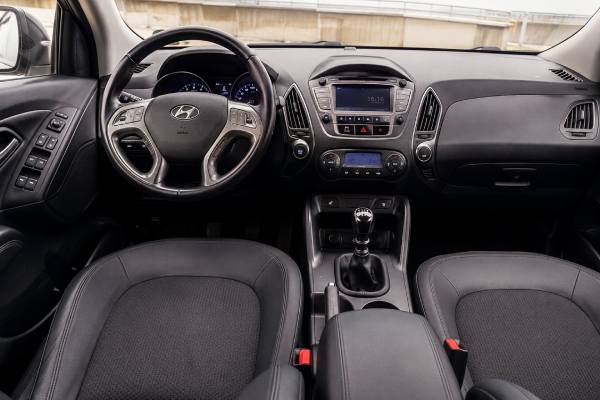
The facelift Hyundai ix35 FWD with the 2.0 GDi D-CVVT petrol engine is a practical compact SUV for buyers who want more space and stronger naturally aspirated power than the common 1.6 GDi, without the extra weight and driveline complexity of the 4WD versions. Built on the LM platform and sold in many markets from 2013 to 2015, it sits in the same family as the second-generation Tucson and the Kia Sportage SL.
This version is not a sporty SUV, but it has a useful mix of cabin room, simple front-wheel drive, a six-speed manual or automatic transmission, and a 166 hp direct-injection petrol engine. Its appeal today depends heavily on condition, service history, recall completion, and whether the buyer accepts petrol-SUV fuel consumption in exchange for lower diesel-emissions complexity.
Final Verdict
The Hyundai ix35 FWD 2.0 GDi is a sensible used compact SUV for drivers who value space, straightforward petrol ownership, and decent naturally aspirated performance more than sharp handling or diesel-like economy. It suits families, suburban drivers, and buyers who want a roomy crossover without a turbocharger, DPF, AdBlue, or AWD service burden. The main tradeoff is fuel use: this 166 hp GDi engine feels stronger than the 1.6, but it is not especially economical in city driving. Buy only with clear oil-change history, smooth cold starts, no timing-chain rattle, clean transmission behavior, and proof that relevant ABS/ESC and market-specific safety campaigns have been checked by VIN.
| Pros | Cons |
|---|---|
| 166 hp GDi engine gives better flexibility than the 1.6 petrol | City fuel economy is noticeably higher than diesel ix35 versions |
| FWD layout avoids rear differential and transfer-case servicing | Less wet-weather and snow traction than 4WD ix35 models |
| Large boot and useful rear-seat space for family use | Interior plastics and road noise feel older than newer rivals |
| No DPF, EGR-diesel, turbo-diesel, or AdBlue ownership concerns | Direct injection can suffer intake deposits with short-trip use |
| Good parts availability shared with Tucson and Sportage relatives | Recall status must be verified carefully by VIN and market |
Table of Contents
- Hyundai ix35 LM 2.0 GDi Overview
- 2.0 GDi Specifications and Dimensions
- Trims, Safety and Driver Assistance
- Reliability, Common Issues and Recalls
- Maintenance and Used Buying Guide
- Driving, Performance and Fuel Economy
- How the Hyundai ix35 Compares to Rivals
Hyundai ix35 LM 2.0 GDi Overview
The Hyundai ix35 FWD 2.0 GDi is best understood as the roomier, stronger petrol choice in the facelift ix35 range. It is more relaxed than the 1.6 GDi when carrying passengers, but it still needs revs for quick overtakes because it is a naturally aspirated engine, not a turbocharged one.
The 2013 facelift did not turn the ix35 into a new-generation SUV. Instead, it updated the original LM model with revised styling, improved equipment in many markets, cleaner cabin details, and updated powertrain availability. The 2.0 GDi version uses Hyundai-Kia’s Nu-family direct-injection four-cylinder engine, commonly identified as G4NC in parts catalogues for this application. It has dual continuously variable valve timing, a timing chain, and a conventional front-transverse layout.
For used buyers, the FWD configuration is a major part of the appeal. Compared with 4WD models, it removes the rear differential, propshaft, coupling, and transfer hardware. That means less weight, fewer driveline fluids, and fewer inspection points. It also means the car is not the best ix35 for mountain roads, muddy tracks, or frequent winter driving on poor tyres. Most owners who use it as a family crossover, school-run vehicle, commuter SUV, or light holiday car will be better served by condition than by the missing AWD badge.
The 2.0 GDi sits in an interesting middle ground. Diesel ix35 models are more economical and better suited to high annual mileage, but they bring diesel-specific age concerns. The 1.6 GDi is simpler and cheaper to fuel on paper, but it can feel stretched in a loaded compact SUV. The 2.0 GDi gives stronger everyday performance and works well with an automatic gearbox, yet it asks the buyer to accept real-world petrol consumption that often lands closer to an older medium SUV than a modern small crossover.
The facelift ix35 is also old enough that individual care matters more than brochure specification. A well-serviced example with clean oil, dry underside, working electronics, even tyre wear, and completed recalls is usually a better buy than a higher-trim car with uncertain history. The best examples feel solid, simple, and practical. Neglected ones can suffer from suspension wear, brake corrosion, intake deposits, oil consumption, ageing sensors, and expensive-looking electrical warnings that often trace back to batteries, ABS modules, wiring, or neglected maintenance.
2.0 GDi Specifications and Dimensions
This ix35 uses a front-mounted 2.0-litre naturally aspirated petrol engine driving the front wheels through either a six-speed manual or six-speed automatic transmission, depending on market and trim. The key technical points are the direct-injection GDi fuel system, D-CVVT valve timing, timing-chain layout, and compact-SUV body with five doors and five seats.
| Item | Hyundai ix35 FWD 2.0 GDi D-CVVT |
|---|---|
| Model generation | Hyundai ix35 LM facelift, 2013–2015 |
| Engine family / code | Nu 2.0 GDi, commonly G4NC |
| Fuel type | Petrol / gasoline |
| Displacement | 1,998 cc, 2.0 litres |
| Layout | Inline-four, transverse front engine |
| Valvetrain | DOHC, 16 valves, D-CVVT |
| Fuel system | Gasoline direct injection |
| Induction | Naturally aspirated |
| Maximum power | 166 hp / 122 kW at 6,200 rpm |
| Maximum torque | 205 Nm / 151 lb-ft at 4,000 rpm |
| Timing drive | Timing chain |
| Item | Specification |
|---|---|
| Drive type | Front-wheel drive |
| Manual transmission | 6-speed manual, where fitted |
| Automatic transmission | 6-speed torque-converter automatic, where fitted |
| Front suspension | MacPherson strut |
| Rear suspension | Independent multi-link |
| Front brakes | Ventilated discs |
| Rear brakes | Discs |
| Common tyre size | 225/60 R17; some trims use 18-inch wheels |
| Turning circle | About 10.6 m |
| Item | Value |
|---|---|
| Body style | Five-door compact SUV |
| Seats | 5 |
| Length | 4,410 mm / 173.6 in |
| Width | 1,820 mm / 71.7 in |
| Height | About 1,655–1,665 mm / 65.2–65.6 in |
| Wheelbase | 2,640 mm / 103.9 in |
| Curb weight | About 1,455 kg / 3,208 lb |
| Gross weight | About 1,980 kg / 4,365 lb |
| Payload | About 525 kg / 1,157 lb |
| Cargo volume | 591–1,436 litres / 20.9–50.7 cu ft |
| Fuel tank | About 55–58 litres, depending on published market data |
| Item | Published / practical figure |
|---|---|
| 0–100 km/h | About 10.4 seconds |
| 0–60 mph | About 10.1 seconds |
| Top speed | About 196 km/h / 122 mph |
| Combined official economy | About 7.8 L/100 km / 36.2 mpg UK / 30.1 mpg US |
| CO₂ emissions | About 182 g/km on published European data |
| Braked towing capacity | Up to about 1,900 kg where rated and properly equipped |
| Unbraked towing capacity | About 750 kg |
| Item | Useful service reference |
|---|---|
| Engine oil grade | Commonly 5W-30 meeting ACEA A5/B5 or suitable API/ILSAC petrol specification |
| Engine oil fill | About 4.0–4.1 litres with filter |
| Coolant | Ethylene-glycol long-life coolant suitable for aluminium engines |
| Brake fluid | DOT 3 or DOT 4, depending on market documentation |
| Timing system | Chain; inspect for noise, stretch symptoms and correlation faults |
| Wheel nuts | Typically tightened in the 88–108 Nm range on Hyundai passenger vehicles |
Trims, Safety and Driver Assistance
Trim names vary widely by country, but the important buying differences are equipment, wheel size, transmission, lighting, infotainment, and whether the car has the safety and convenience features you actually want. The 2.0 GDi FWD usually shares the same basic chassis and braking layout across trims, so condition and service history matter more than badges.
Trim and option differences
Depending on market, ix35 facelift trims may be labelled with names such as Classic, Comfort, Style, Premium, Trend, Elite, SE, or similar local grades. Rather than relying only on the trim badge, check the equipment fitted to the actual car. Used imports and cross-border European cars can have different packages from local brochure examples.
Look for these quick identifiers:
- Wheels and tyres: lower trims commonly use 16- or 17-inch wheels, while higher trims may have 18-inch alloys. The 17-inch package usually gives the best ride comfort and tyre cost balance.
- Lighting: projector headlights, LED daytime running lights, rear LED details, and front fog lamps are useful visual clues on facelift cars.
- Cabin features: dual-zone climate control, heated front seats, part-leather or leather upholstery, keyless entry, reversing camera, parking sensors, panoramic roof, and upgraded audio often mark higher grades.
- Infotainment: navigation-equipped cars may have different head units and map-update requirements from basic audio cars.
- Transmission: some markets paired the 2.0 GDi with both manual and automatic gearboxes; others offered it mainly with one transmission and selected trims.
Mechanically, the FWD 2.0 GDi does not get the rear driveline hardware of 4WD models. That is good for lower ownership cost, but it also means the tyres do all traction work through the front axle. On a test drive, check for wheelspin on wet uphill starts, torque steer under hard acceleration, and uneven front tyre wear caused by poor alignment.
Safety ratings
The ix35 achieved a strong safety result when tested under the period’s crash-test protocols. European-market ix35 models are commonly associated with a five-star Euro NCAP rating from the early LM generation, with published category scores of 90% adult occupant protection, 88% child occupant protection, 54% pedestrian protection, and 71% safety assist. ANCAP also rated the ix35 highly in its market and notes that newer active safety systems such as AEB and lane support were not available across the variant range.
The key point for a used buyer is that a five-star 2010-era result should not be compared directly with a five-star modern SUV rating. Test protocols have become tougher, and newer rivals may include standard AEB, lane-keeping assistance, adaptive cruise, and better pedestrian-impact performance. For its age, the ix35 is respectable. Against a 2020s compact SUV, its active safety technology is limited.
Safety equipment and ADAS
Typical safety equipment includes front airbags, front side airbags, curtain airbags, ABS, electronic brake-force distribution, electronic stability control, traction control, hill-start assistance on many versions, and ISOFIX child-seat mounting points in the rear. Active head restraints and three-point belts are part of the safety package in many markets.
Do not expect modern driver assistance as standard. Autonomous emergency braking, adaptive cruise control, lane-keeping assistance, blind-spot monitoring, and rear cross-traffic alert are generally not the defining strengths of this generation. Parking sensors and a reversing camera are more realistic features to look for.
After windscreen replacement, front-end repair, steering work, or suspension repair, make sure warning lights are off and the steering angle sensor, ABS/ESC system, and parking-camera or parking-sensor systems work correctly. Even without modern camera-based ADAS, the ix35 depends on clean wheel-speed signals, stable battery voltage, and correct steering-angle information for stability-control functions.
Reliability, Common Issues and Recalls
A well-maintained ix35 2.0 GDi can be durable, but this is now an ageing direct-injection petrol SUV, so the main risks are oil neglect, timing-chain symptoms, intake carbon, suspension wear, brake corrosion, and unresolved safety campaigns. The FWD version has fewer driveline failure points than 4WD cars, which is a useful advantage.
| Issue area | Prevalence | Cost tier | Typical signs |
|---|---|---|---|
| Front suspension links and bushes | Common with age | Low to medium | Knocks, wandering, uneven tyre wear |
| Brake corrosion and seized sliders | Common in damp climates | Low to medium | Pulsation, dragging brakes, hot wheels |
| GDi intake carbon deposits | Occasional | Medium | Rough idle, hesitation, misfires |
| Timing-chain wear or tensioner noise | Occasional, worse with poor oil history | Medium to high | Cold-start rattle, fault codes, poor running |
| Oil consumption | Occasional | Medium to high | Low dipstick level, blue smoke, catalyst stress |
| ABS/ESC campaign-related faults | Market and VIN dependent | High if ignored | Warning lights, recall notices, fire-risk campaigns |
Engine and fuel-system issues
The G4NC 2.0 GDi is a direct-injection engine, so fuel is sprayed directly into the combustion chamber rather than washing over the backs of the intake valves. Over time, oil vapour from the crankcase ventilation system can leave carbon deposits on the intake ports and valves. This is more likely in cars used for short trips, low-speed driving, extended idling, and infrequent oil changes.
Symptoms include uneven idle, hesitation from low speed, misfire codes, poor fuel economy, and a flat feeling below mid-range revs. A basic fuel additive may help injectors, but it will not properly clean the intake valves on a GDi engine. Proper diagnosis should separate spark plugs, ignition coils, injector performance, vacuum leaks, and valve deposits before parts are replaced.
Timing-chain issues are not a routine interval item like a belt, but the chain system is not something to ignore. Listen carefully on a cold start. A brief mechanical noise that disappears instantly may be less serious than a sustained rattle, but any repeated chain noise, cam/crank correlation fault, or rough running should be investigated. Frequent oil changes with the correct grade are the best prevention.
Oil consumption deserves special attention. Check the dipstick before starting a viewing, then again after a long test drive. A seller who says “they all use oil” may be hiding neglect. Some consumption can appear with age, but a healthy engine should not need constant topping up between normal service intervals. Low oil can accelerate chain, tensioner, cam phaser, and bearing wear.
Transmission and driveline
The six-speed manual should shift cleanly without crunching, clutch slip, or heavy pedal action. A worn clutch may show itself under load in a high gear, especially on hills. Listen for bearing noise with the clutch engaged and disengaged.
The six-speed automatic is generally more pleasant for urban use and suits the 2.0 GDi’s character. It should engage Drive and Reverse smoothly, shift without flares, and kick down predictably. A harsh 2–3 or 3–4 shift, delayed engagement, shudder, or burnt-smelling fluid points to overdue service or internal wear. Even when a market describes the fluid as long-life, older automatic transmissions benefit from periodic fluid renewal using the correct Hyundai/Kia specification.
FWD cars avoid the 4WD coupling, transfer-case oil, rear differential oil, and rear propshaft checks. Still, inspect front driveshaft boots, inner CV joints, engine mounts, and lower control arms. Clicking on full lock usually points to outer CV wear; vibration under load can indicate inner joint wear or mount problems.
Chassis, brakes and corrosion
Suspension wear is one of the most common age-related ix35 issues. Clonks over sharp bumps often come from anti-roll-bar links, control-arm bushes, top mounts, or worn dampers. A vague steering feel can be made worse by old tyres, cheap mismatched tyres, or poor alignment.
Brake hardware can corrode if the vehicle spends time parked outside, does short trips, or is used in salted-road climates. Rear discs, parking-brake mechanisms, caliper sliders, and brake backing plates should be inspected carefully. A car that pulls to one side, has a hot wheel after a test drive, or rolls poorly on a gentle slope may have a sticking caliper.
Rust protection is generally reasonable, but no used ix35 should be bought without an underside check. Look at the front subframe, rear suspension mounts, brake pipes, fuel tank straps, lower door seams, tailgate edges, jacking points, and the area around the rear wheel arches. Surface corrosion is expected on older cars; structural rust or heavily corroded brake lines should affect the buying decision.
Recalls, service campaigns and software
Recall coverage depends on country, VIN, production date, and local regulatory action. The ix35/Tucson LM family has been included in various market-specific campaigns, including ABS/ESC module fire-risk campaigns in some regions and other safety-related actions on related Hyundai/Kia platforms. Some official notices advise owners of affected vehicles to park outside until the repair is completed.
Do not rely on a seller saying “there are no recalls.” Ask for a printed dealer history or check the VIN through the official Hyundai recall portal for the vehicle’s market. Also check national recall databases where available. If the car has an ABS/ESC warning light, repeated battery drain, brake warning messages, or unexplained electrical faults, resolve those before purchase rather than treating them as minor annoyances.
Software updates may apply to infotainment, navigation, ECU driveability, or transmission behavior depending on market equipment. A dealer can confirm campaign status by VIN. For a used ix35, proof of completed campaigns is worth more than a verbal promise.
Maintenance and Used Buying Guide
The safest maintenance approach for the ix35 2.0 GDi is shorter oil intervals than optimistic long-life schedules, regular brake and suspension inspections, and careful attention to the timing chain, spark plugs, coolant, and automatic transmission fluid. This is a simple SUV by modern standards, but it does not reward neglect.
| Interval | Recommended work |
|---|---|
| Every 10,000–12,000 km or 12 months | Engine oil and filter; inspect tyres, brakes, lights, leaks and suspension |
| Every 15,000–20,000 km | Inspect engine air filter, cabin filter, belts, hoses and battery condition |
| Every 30,000 km or 2 years | Replace cabin filter; inspect brake fluid, coolant strength and alignment |
| Every 40,000–60,000 km | Replace engine air filter; inspect spark plugs, throttle body and intake deposits |
| Every 60,000–80,000 km | Renew automatic transmission fluid if fitted and used in mixed or severe driving |
| Every 2 years | Replace brake fluid, especially in humid climates or mountain use |
| Every 90,000–105,000 km | Replace spark plugs if iridium plugs are fitted and condition supports the interval |
| Every 5 years or as tested | Replace coolant if protection, pH, or service history is uncertain |
| At every major service | Listen for timing-chain noise and inspect for oil leaks, coolant leaks and fault codes |
For cars used mostly in short trips, heavy traffic, dusty areas, hot climates, mountain roads, or towing, shorten the oil and transmission service intervals. Direct-injection petrol engines run cleaner and quieter when oil is kept fresh. A cheap annual oil service is far better than trying to recover a noisy chain, sticky cam phaser, or oil-consuming engine later.
Fluid and torque priorities
For the 2.0 GDi engine, a 5W-30 oil meeting the correct Hyundai-approved petrol specification is the normal safe choice in many climates. Some markets and climates allow other viscosities, but oil quality matters more than chasing a thicker grade. Use the owner’s manual climate chart and VIN-specific service data before changing viscosity. The common oil fill is about 4.0–4.1 litres with the filter, but always fill by dipstick level rather than by number alone.
Brake fluid should be replaced on time because moisture lowers the boiling point and can contribute to internal corrosion. Coolant should be compatible with aluminium engines and mixed correctly. Automatic transmission fluid must meet the correct Hyundai/Kia specification; using a generic fluid because it is “close enough” is false economy.
Wheel nuts are usually tightened in the 88–108 Nm range on Hyundai passenger vehicles, but the correct figure should be verified from the owner’s manual or workshop data. Over-tightening can distort brake discs and damage studs; under-tightening is unsafe.
Used-buying inspection checklist
Start with the paperwork. The ideal car has yearly oil services, recall checks, tyre records, brake work, and invoices that match mileage progression. A stamped book is useful, but itemised invoices tell you more.
Before the test drive, check:
- Oil level, oil colour, coolant level and signs of oil-coolant mixing.
- Cold-start behavior, timing-chain noise, idle quality and exhaust smoke.
- Battery age, charging voltage, warning lights and dashboard messages.
- Tyre brand, tread depth, date codes and matching sizes across the axle.
- Brake disc condition, caliper drag and parking-brake operation.
- Air-conditioning performance and heater-blower operation.
- Tailgate, central locking, window regulators, mirrors and infotainment.
- Underside corrosion, accident repairs, wet carpets and boot-floor water leaks.
During the drive, the engine should pull cleanly from low rpm but feel happiest from the mid-range upward. The manual gearbox should not baulk, and the automatic should not flare or thump. The car should track straight, brake evenly, and settle quickly after bumps. A loud rear end, knocking front suspension, steering shake, or pulsing brake pedal should be priced into the deal.
The best trims to seek are usually not the absolute highest-spec cars unless the equipment works perfectly. A panoramic roof, navigation system, leather trim, large wheels, and parking-camera system are nice, but each adds an inspection point. A mid-to-high trim with 17-inch wheels, climate control, reversing aids, heated seats, and excellent maintenance history is often the smartest long-term buy.
Avoid cars with unresolved warning lights, missing service history, overheating history, heavy oil use, transmission shudder, structural corrosion, flood signs, or sellers who resist a VIN recall check. The 2.0 GDi can last well, but buying a neglected example can quickly erase the price advantage over a newer SUV.
Driving, Performance and Fuel Economy
The ix35 2.0 GDi FWD feels relaxed and adequate rather than quick. Its 166 hp output is useful, but the 205 Nm torque peak arrives at higher revs than in a turbocharged petrol or diesel, so the driver sometimes needs to downshift for brisk acceleration.
Powertrain character
At low speed, the engine is smooth enough and easy to manage. It does not have strong low-rpm shove, but it is more flexible than the 1.6 GDi when the car is loaded. From around the mid-range, it pulls more convincingly and feels comfortable joining faster roads. The engine becomes louder when revved hard, but it is not harsh when maintained properly.
The manual gearbox gives the driver better control on hills and overtakes, but it also exposes the engine’s need for revs. The automatic is easier in traffic and suits the family-SUV role well. It may shift down readily on inclines or when the car is full, which is normal for this engine. Hunting between gears, a flare between shifts, or harsh engagement is not normal and should be investigated.
Ride, handling and refinement
The ix35 is stable on the motorway and easy to place in town. Steering is light, which helps parking but does not give much feedback. The body leans if pushed, and the front tyres do most of the work in the FWD model. It is not a driver’s SUV in the way a Mazda CX-5 can feel, but it is predictable and secure when fitted with good tyres.
Ride comfort depends heavily on wheel size and tyre quality. Cars on 17-inch wheels usually ride better than those on larger wheels. Worn dampers, cheap tyres, and tired suspension bushes can make the ix35 feel noisier and less settled than it should. Cabin noise is acceptable for the era, though road roar and wind noise are more noticeable than in newer compact SUVs.
Braking feel should be steady and progressive. If the pedal pulses, the steering wheel shakes, or the car pulls to one side, inspect discs, pads, calipers, tyres and front suspension before blaming alignment alone.
Real-world fuel economy
Official combined figures sit around the high-7 L/100 km range, but real-world economy depends strongly on traffic, tyre choice, transmission and driving style. Typical results are:
- City use: about 9.5–11.5 L/100 km, or roughly 20–25 mpg US / 25–30 mpg UK.
- Mixed driving: about 8.0–9.5 L/100 km, or roughly 25–29 mpg US / 30–35 mpg UK.
- Steady highway use: about 7.0–8.2 L/100 km, or roughly 29–34 mpg US / 34–40 mpg UK.
Cold weather, short trips, roof bars, underinflated tyres, heavy loads and automatic transmission use can all push those numbers higher. Drivers coming from a diesel ix35 or a modern hybrid SUV may find the fuel use disappointing. Drivers coming from an older petrol SUV may find it normal.
Load and towing
The ix35 has enough cargo space and payload for family trips, but load changes the character of the 2.0 GDi. With passengers and luggage on board, the engine needs more throttle and more revs on hills. For occasional light towing, it can be suitable when the car is properly rated and maintained, but it is not the best ix35 powertrain for frequent heavy towing. The diesel engines are stronger for that job.
When towing or carrying heavy loads, check coolant condition, brake health, tyre load ratings, and transmission behavior. Automatic cars used for towing should have their fluid serviced more often. Fuel consumption can rise sharply under load, especially at motorway speeds.
How the Hyundai ix35 Compares to Rivals
The ix35 2.0 GDi is strongest against rivals when judged as a roomy, well-equipped, good-value petrol family SUV. It is less convincing if the buyer wants modern active safety, sharp handling, premium cabin feel, or hybrid-level economy.
| Rival | Where the ix35 is stronger | Where the rival may be stronger |
|---|---|---|
| Kia Sportage 2.0 petrol | Very similar platform feel; Hyundai examples may be better value | Sportage styling and trim availability may appeal more |
| Nissan Qashqai petrol | ix35 feels roomier and often stronger with 2.0 GDi | Qashqai is easier to park and often cheaper to fuel |
| Toyota RAV4 petrol | ix35 can offer better used value and equipment | RAV4 has a stronger durability reputation |
| Honda CR-V petrol | ix35 is usually cheaper to buy | CR-V is larger, more refined and very practical |
| Volkswagen Tiguan petrol | ix35 avoids some turbo and dual-clutch complexity | Tiguan feels more premium and sharper to drive |
| Mazda CX-5 petrol | ix35 can be cheaper and simpler in equipment | CX-5 has better handling and more modern efficiency |
The closest rival is the Kia Sportage SL, because it shares much of the same engineering family. The choice between them should be made on condition, price, service history and equipment rather than brand loyalty. A cleaner Sportage is better than a tired ix35, and the reverse is also true.
Against the Qashqai, the ix35 feels more substantial and offers better luggage space, but it is thirstier and less nimble in tight urban use. Against the RAV4 and CR-V, the Hyundai is usually cheaper, but the Toyota and Honda often feel more robust and may have stronger resale confidence. Against the Tiguan, the ix35 is less premium but can be simpler if comparing it with turbocharged or dual-clutch Volkswagen versions.
The best reason to choose the ix35 FWD 2.0 GDi is not that it beats every rival on paper. It is that a good example can deliver a spacious cabin, useful boot, acceptable performance, and manageable running costs for less money than many better-known alternatives. The worst reason to buy one is because it looks cheap upfront while ignoring a poor service record. With this model, the right car is worth paying more for.
References
- Hyundai Owners Manuals 2026 (Owner’s Manual Portal)
- Hyundai ix35 2.0 specs (2013-2015), performance, dimensions & technical specifications – encyCARpedia 2023 (Specifications)
- Hyundai ix35 | Safety Rating & Report 2026 (Safety Rating)
- Service & Safety Campaigns 2026 (Recall and Service Campaigns)
- Consumer Alert: Kia and Hyundai Issue Recalls for 3.3M Vehicles, Advise Owners to Park Outside 2023 (Recall Database)
Disclaimer
This article is for informational purposes only and is not a substitute for professional diagnosis, repair, inspection, or official workshop instructions. Specifications, torque values, service intervals, fluids, recall eligibility, procedures, equipment and safety systems can vary by VIN, market, production date and trim. Always verify critical information against the official owner’s manual, workshop manual, dealer service data, VIN recall check and qualified technician advice before buying, servicing or repairing a vehicle.
If this guide helped you, please consider sharing it on Facebook, X/Twitter, or your favourite automotive group to support our work.