
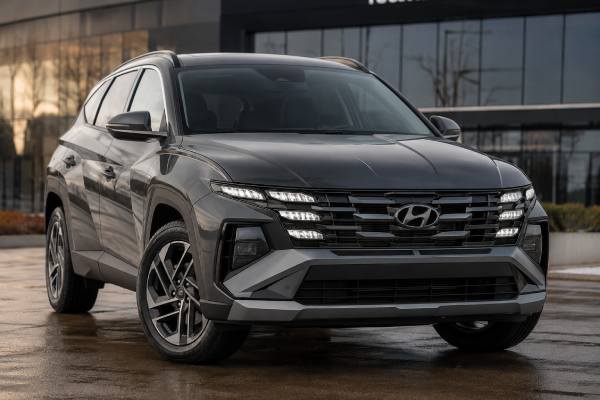


The facelifted Hyundai Tucson Plug-in Hybrid HTRAC AWD is the most powerful and most complex version of the NX4 Tucson sold in many markets from the 2025 model year onward. It combines a 1.6-liter turbocharged petrol engine, a strong electric motor, a 13.8 kWh lithium-ion battery, a conventional 6-speed automatic transmission, and Hyundai’s active on-demand HTRAC all-wheel drive.
Its appeal is simple: it gives compact SUV buyers usable electric driving for short trips without giving up long-distance petrol range, winter traction, or family practicality. The main question is not whether the Tucson PHEV is clever. It is whether your charging habits, driving pattern, and maintenance discipline make it the right Tucson to own.
Final Verdict
The 2025–present Hyundai Tucson PHEV HTRAC AWD is a strong choice for buyers who can charge regularly and want a refined, practical compact SUV with brisk performance, standard AWD, and enough electric range for many daily errands. Its biggest strength is how smoothly it blends EV driving with a normal automatic transmission feel, avoiding the rubber-band character some hybrids have. The main tradeoff is complexity: turbo engine, battery, charger, AWD hardware, and brake-by-wire-style blending all need proper checks. Buy one only with complete service records, verified recall status, and a healthy high-voltage battery and charging system.
| Pros | Cons |
|---|---|
| 268 hp gives genuinely quick compact-SUV performance | Efficiency depends heavily on charging discipline |
| HTRAC AWD is standard on the PHEV | More mechanical complexity than the regular hybrid |
| 13.8 kWh battery suits short electric commutes | PHEV cargo space is reduced versus ICE and HEV models |
| 6-speed automatic feels more natural than many CVTs | Turbo GDI engine needs clean oil and quality fuel |
| Facelift cabin brings better controls and modern screens | Used buyers must verify battery, charger, and recalls |
Table of Contents
- Tucson PHEV facelift overview
- Specifications and technical data
- Trims, options, safety and ADAS
- Reliability, common issues and service actions
- Maintenance and buyer’s guide
- Driving, performance, efficiency and charging
- Tucson PHEV vs rivals
Tucson PHEV facelift overview
The facelifted NX4 Tucson Plug-in Hybrid is best understood as a family SUV with a performance and efficiency bonus, not as a pure EV replacement. It works best when the owner plugs in at home or work, uses electric mode for local driving, and lets the petrol engine cover highway trips.
The 2025 update did not turn the Tucson into a new generation. It is still the fourth-generation NX4 platform, but with revised exterior detailing, a much-improved interior layout, updated infotainment, broader wireless phone integration in many markets, and newer driver-assistance features. The PHEV keeps the same basic formula: a turbocharged 1.6-liter Smartstream petrol engine paired with a high-voltage electric motor and a rechargeable battery.
Unlike many plug-in hybrids that use a CVT or power-split hybrid transmission, this Tucson uses a 6-speed torque-converter automatic. That gives it a more familiar step-shift feel under acceleration. It also makes the car feel more conventional when the petrol engine is running, which many drivers prefer.
The PHEV version is the one to choose if most of your daily use is short enough to fit within its electric range. For a school run, urban commute, local errands, and mixed suburban driving, it can spend much of its time as a quiet electric SUV. For long motorway trips, it behaves like a heavier hybrid with a relatively small petrol tank and a strong turbo engine.
The ownership equation changes if you rarely charge. In that case, the regular Tucson Hybrid often makes more sense. It is lighter, cheaper, still quick enough, and avoids the extra charging hardware. The PHEV earns its keep only when the battery is used often.
Packaging is another point to understand. The high-voltage battery sits low in the vehicle, but the PHEV still loses cargo volume compared with non-plug-in Tucson versions. It remains practical for a small family, but buyers moving from an ICE Tucson should check the boot with their actual pushchair, dog crate, luggage, or sports kit.
For used buyers, the most important items are service history, battery condition, charging behavior, coolant condition, software updates, and recall completion. A well-maintained Tucson PHEV can be a satisfying long-term car. A neglected one can become expensive because several systems overlap: turbo engine, hybrid system, onboard charger, 12 V electronics, AWD, brakes, and driver-assistance sensors.
Specifications and technical data
The Tucson PHEV uses Hyundai’s 1.6-liter Smartstream Turbo-GDI engine with a permanent-magnet synchronous electric motor and a 13.8 kWh lithium-ion battery. Power goes through a 6-speed automatic transmission to HTRAC AWD, rather than through an e-CVT. The most important numbers are 268 hp system output, a roughly 2-hour Level 2 charge time, and reduced cargo volume compared with non-PHEV Tucson models.
| Item | Specification |
|---|---|
| Engine family | Smartstream 1.6L Turbo-GDI |
| Engine layout | Inline-4, DOHC, 16 valves |
| Displacement | 1,598 cc |
| Induction | Turbocharged gasoline direct injection |
| Gas engine output | 178 hp; 195 lb-ft from 1,500–4,500 rpm |
| Electric motor | Permanent-magnet synchronous motor |
| Electric motor output | 72 kW, or 97 hp; 224 lb-ft |
| Total system output | 268 hp; 258 lb-ft |
| Battery | 13.8 kWh lithium-ion, 360 V maximum |
| Recommended fuel | Regular unleaded gasoline |
| Item | Specification |
|---|---|
| Transmission | 6-speed torque-converter automatic |
| Drive system | HTRAC AWD, active on-demand |
| Final drive ratio | 3.367 for PHEV |
| Front suspension | MacPherson struts with coil springs |
| Rear suspension | Multi-link |
| Front brakes | Ventilated discs, 325 x 30 mm |
| Rear brakes | Solid discs, 300 x 10 mm |
| Steering | Motor-driven rack-and-pinion power steering |
| Turning diameter | 38.6 ft, or 11.8 m |
| Item | Specification |
|---|---|
| Body style | 5-door compact SUV |
| Wheelbase | 108.5 in, or 2,756 mm |
| Length | 182.7 in, or 4,641 mm |
| Width | 73.4 in, or 1,864 mm |
| Height with roof rails | 66.3 in, or 1,684 mm for AWD |
| Ground clearance | 8.3 in, or 211 mm for AWD |
| Passenger volume | 105.9 cu ft without panoramic sunroof |
| Cargo volume, seats up | 31.9 cu ft SAE |
| Cargo volume, seats folded | 66.3 cu ft SAE |
| Fuel tank | 11.1 US gal, or 42.0 L |
| Maximum trailer weight | 2,000 lb braked; 1,650 lb unbraked |
| Item | Specification |
|---|---|
| EPA electricity use | 44 kWh per 100 miles |
| EPA combined electric rating | 77 MPGe |
| EPA combined gas-only rating | 35 mpg US, about 6.7 L/100 km |
| Typical official EV range | About 32 miles, or 51 km |
| Onboard AC charger | 7.2 kW at 240 V |
| Level 2 charge time | About 2 hours |
| Item | Specification or note |
|---|---|
| Engine oil capacity | 4.8 L for 1.6T HEV/PHEV application |
| Engine oil type | Use the grade and approval listed on the under-hood label and official manual |
| Brake fluid | Replace by time, not only mileage |
| Timing drive | Chain; inspect for noise, stretch, and timing-correlation faults |
| High-voltage battery | Check state of health and cooling system during inspection |
Trims, options, safety and ADAS
The PHEV trim structure is deliberately simpler than the wider Tucson range. In North America, the facelifted Tucson Plug-in Hybrid is commonly offered as SEL and Limited, both with AWD and the same 268 hp plug-in hybrid powertrain.
Trim and equipment differences
The SEL is the value-focused version. It usually brings the plug-in powertrain, AWD, modern infotainment, heated front seats, dual-zone climate control, key driver-assistance systems, and the core convenience equipment most buyers expect.
The Limited is the more complete version. It typically adds luxury and technology items such as leather-trimmed seating, ventilated front seats, premium audio, surround-view camera, blind-spot view monitor, parking collision assistance, upgraded driver-assistance functions, and more cabin convenience features. The mechanical powertrain is not meaningfully different, so the choice is about equipment rather than performance.
Quick identifiers include the PHEV charge door, HTRAC/AWD badging, model-specific hybrid displays, high-voltage warning labels under the hood, and the larger PHEV cargo-floor packaging. Build stickers and VIN decoding remain the safest way to confirm whether a Tucson is a PHEV, HEV, or conventional petrol model.
Safety ratings
The NX4 Tucson has a strong safety record in major testing. Euro NCAP rated the Tucson at five stars in 2021, and the rating validity list includes the 1.6 T-GDI PHEV 4×4. Euro NCAP also recorded a facelift review in 2024, with the rating outcome carried forward under the applicable protocol.
The IIHS page for the 2025 Tucson applies many ratings across 2022–2026 models. It lists good small-overlap results and notes structural updates from 2024, including reinforced side structure and rear side thorax airbags. For shoppers, this means the facelifted Tucson is not just a tech-heavy SUV; it also has a credible crash-test foundation.
NHTSA selected the 2025 Tucson for 5-Star Safety Ratings testing. Buyers in the United States should check the latest NHTSA listing by VIN and trim because results and recall status can update after a vehicle first goes on sale.
Safety systems and driver assistance
Core restraint equipment includes advanced front airbags, front side-impact airbags, side curtain airbags, rear side airbags, front and rear outboard belt pretensioners, five-position seatbelt reminders, and LATCH child-seat anchors. Stability control, traction control, ABS, brake assist, hill-start assist, downhill brake control, and individual tire-pressure monitoring are standard safety fundamentals.
Common ADAS equipment includes:
- Forward Collision-Avoidance Assist with pedestrian, cyclist, and junction-turning detection
- Blind-Spot Collision Warning
- Rear Cross-Traffic Collision-Avoidance Assist
- Lane Keeping Assist and Lane Following Assist
- Driver Attention Warning
- Intelligent Speed Limit Assist
- Safe Exit Warning
- Available Highway Driving Assist and navigation-based smart cruise control
- Available surround-view and blind-spot camera views on higher trims
After windshield replacement, bumper repairs, alignment work, front-end collision repair, or suspension replacement, the camera and radar systems may need calibration. This is not optional if the car is expected to brake, steer, and warn accurately.
Reliability, common issues and service actions
The facelifted Tucson PHEV is still too new for a full long-term reliability picture, but its risk areas are clear. Most concerns are not catastrophic design flaws; they are the normal weak spots of a modern turbocharged plug-in hybrid if it is serviced poorly or used outside its ideal pattern.
Common and occasional issue map
| Issue area | Prevalence | Severity | What to watch for |
|---|---|---|---|
| 12 V battery weakness | Occasional | Low to medium | No-start, warning lights, failed remote functions |
| Brake rotor corrosion | Occasional | Low | Rust grooves, pulsing, scraping after EV-heavy use |
| Turbo-GDI carbon buildup | Occasional over time | Medium | Rough idle, misfires, reduced economy |
| Charging port or OBC faults | Rare to occasional | Medium to high | Failed charging session, charger errors, warning lights |
| ADAS calibration problems | Repair-related | Medium | False warnings, disabled assist functions |
| Coolant or hybrid-loop neglect | Neglect-related | High | Overheating warnings, inverter or battery temperature faults |
Powertrain and hybrid system
The 1.6 T-GDI is a small turbocharged direct-injection engine working in a heavy AWD PHEV. It needs clean oil, correct warm-up habits, and proper coolant service. Short petrol-engine run cycles can be harder on oil because the engine may start, run cold, then shut off repeatedly. Owners who mostly drive in EV mode should still change oil by time.
Possible symptoms and remedies:
- Rough idle or misfire: check spark plugs, ignition coils, injector behavior, vacuum leaks, and intake-valve deposits.
- Rattle on cold start: inspect timing chain tensioner behavior, oil level, and timing-correlation data.
- Coolant smell or temperature warning: pressure-test the cooling system and inspect both engine and electrified-system loops.
- Hesitation under boost: check software updates, air leaks, turbo-control hardware, and fuel quality.
The high-voltage battery is not usually a fast-wearing item if kept within normal temperature limits. More important than mileage alone is how the car charges and cools. A pre-purchase scan should check battery state of health, cell voltage balance, stored hybrid codes, charging history where available, and thermal-management data.
The onboard charger, charge port, DC–DC converter, contactors, and hybrid control unit should be treated as inspection items. A PHEV that charges normally on both a household supply and a Level 2 unit is less worrying than one with repeated interrupted sessions or unexplained charging messages.
Transmission, AWD and chassis
The 6-speed automatic is a plus for drivability, but fluid condition still matters. Harsh engagement, flare between gears, or vibration during torque transfer should not be dismissed as “hybrid behavior.” The HTRAC AWD system should engage smoothly, with no binding on tight turns and no rear driveline noise.
Suspension issues are likely to be normal SUV wear rather than model-specific disasters. Check front strut mounts, rear multi-link bushings, ball joints, wheel bearings, and alignment, especially on cars using larger wheels or rough roads.
Recalls and service actions
Recall coverage varies by market, plant, powertrain, and production date. Some Tucson recalls apply to a narrow group of 2025 vehicles, while others apply to older or accessory-equipped vehicles. For example, NHTSA documents show a 2025 Tucson SRS glove-box warning-label recall affecting a very small production group. Separate NHTSA filings also show engine connecting-rod bolt recall activity affecting certain 2025–2026 Tucson vehicles with 2.5L engines, which is not the PHEV engine, and trailer-wiring harness recalls tied to accessory equipment and earlier Tucson applications.
The practical rule is simple: never assume by model year alone. Check the VIN through the manufacturer or official recall database, then ask the dealer for proof that all open campaigns, software updates, and customer satisfaction actions were completed.
Maintenance and buyer’s guide
The Tucson PHEV rewards preventive maintenance. It may use less fuel and fewer friction-brake pads than a petrol SUV, but it still has an engine, turbocharger, automatic transmission, AWD system, brake fluid, coolant loops, and a high-voltage battery.
Practical maintenance schedule
Use the official schedule for your VIN and market, but the following is a sensible ownership framework:
| Interval | Service items |
|---|---|
| Every 6–12 months | Engine oil and filter by usage pattern; tire rotation; brake inspection; 12 V battery test |
| Every 12 months | Cabin filter; wiper check; charging-port inspection; coolant visual inspection |
| Every 24 months | Brake fluid replacement; inspect brake rotor corrosion and caliper slide movement |
| Every 30,000 miles | Engine air filter; alignment check; suspension, bushings, and driveline inspection |
| Every 40,000–60,000 miles | Transmission and AWD fluid inspection; consider earlier fluid service under severe use |
| By manual interval | Spark plugs, coolant, hybrid cooling loops, and any drive-unit fluids |
| At every major service | Full diagnostic scan, battery state-of-health check, software campaign check |
Severe use includes frequent short trips, mountain driving, dusty roads, towing, heavy urban traffic, extreme heat, and repeated cold starts. PHEVs can fall into severe use even when mileage is low because the petrol engine may run in short, cold bursts.
The timing chain does not have a normal belt-style replacement interval, but it should not be ignored. Listen for cold-start rattle, check for timing-correlation fault codes, and inspect chain guides and tensioner behavior if symptoms appear.
Brake maintenance deserves special attention. Regenerative braking means the friction brakes may be used lightly, which can let rust build up on discs. Occasional firm braking in safe conditions helps keep rotors clean, but inspection is still needed in wet, coastal, or winter-salt climates.
Buyer inspection checklist
Before buying a used Tucson PHEV, ask for:
- Full service history with dates, not only mileage
- VIN recall and campaign completion proof
- High-voltage battery state-of-health report
- Evidence that the vehicle charges correctly on Level 1 and Level 2
- Diagnostic scan of engine, hybrid, transmission, AWD, ABS, and ADAS modules
- Inspection of coolant condition and leaks
- Brake rotor, caliper, and tire-wear inspection
- Undercar check for impact damage, corrosion, and damaged aero panels
- ADAS calibration proof after any windshield, bumper, or crash repair
Avoid cars with unexplained warning lights, repeated charging faults, missing service records, accident damage around radar/camera areas, or signs of flood exposure. A bargain PHEV can become expensive quickly if the battery, charger, or hybrid electronics have been neglected.
The best used examples are privately or dealer-owned cars with predictable charging routines, annual oil changes, clean coolant, even tire wear, and no unresolved campaigns. Limited trims are more desirable if you want the full tech package, but SEL examples may be better value if condition and service history are stronger.
Driving, performance, efficiency and charging
The Tucson PHEV feels stronger than the regular petrol Tucson and smoother than many compact SUVs under light loads. Its best driving quality is the way it moves away quietly in EV mode, then blends in the petrol engine without making the car feel strange or overly busy.
In city driving, the electric motor gives instant response. The Tucson pulls away cleanly, and the 6-speed automatic avoids the droning feel that some CVT-based hybrids have. When the battery has charge, the car feels relaxed and quick at everyday speeds. When the battery is depleted, it still has hybrid assistance, but it feels more like a heavier turbo SUV.
Steering is light and predictable rather than sporty. The Tucson is easy to place in traffic and stable on the highway. It is not as sharp as a Mazda CX-5 or as fast as a Toyota RAV4 Plug-in Hybrid, but it feels composed, quiet, and secure. Ride comfort is generally good, though larger wheels can add firmness over broken pavement.
Braking feel is a mix of regenerative and friction braking. Hyundai’s blending is usually smooth, but buyers should test for pulsing, scraping, or uneven stopping because lightly used PHEV brakes can corrode. This is especially important in cold or wet climates.
Real-world efficiency depends almost entirely on charging. With regular charging and short trips, many owners can use very little petrol during the week. On longer highway runs with a depleted battery, expect economy closer to a conventional hybrid SUV, with the official gas-only combined rating around 35 mpg US, or about 6.7 L/100 km. At motorway speeds, cold weather, roof loads, winter tires, and full cabin heating can reduce both EV range and petrol efficiency.
Charging is straightforward. The 7.2 kW onboard charger means a Level 2 wallbox can refill the battery in about two hours. A standard household outlet is usable overnight but much slower. There is no meaningful DC fast-charging use case here; this is a plug-in hybrid designed for home and workplace AC charging.
For towing, the Tucson PHEV’s 2,000 lb braked rating is useful for a small trailer, light utility load, or compact camping trailer. It is not a heavy tow vehicle. Towing adds heat, fuel consumption, and brake demand, so fluid condition, tire pressure, trailer tongue weight, and cooling-system health matter.
Tucson PHEV vs rivals
The Tucson PHEV sits in a competitive group of compact plug-in hybrid SUVs. Its closest rival is the Kia Sportage PHEV, which shares a similar engineering philosophy. The Toyota RAV4 Plug-in Hybrid is the performance and EV-range benchmark. The Ford Escape PHEV is efficient but front-wheel drive only in many markets. The Mitsubishi Outlander PHEV is larger and offers available third-row seating, but it feels heavier and more expensive.
| Model | Main advantage | Main tradeoff |
|---|---|---|
| Hyundai Tucson PHEV | Balanced comfort, standard AWD, strong equipment | Less EV range than the RAV4 PHEV |
| Kia Sportage PHEV | Similar powertrain with bold styling and space | Cabin design may be more polarizing |
| Toyota RAV4 Plug-in Hybrid | More power and longer electric range | Often pricier and harder to find used |
| Ford Escape PHEV | Good efficiency and commuter value | No AWD in many configurations |
| Mitsubishi Outlander PHEV | Larger body and available extra seating | Heavier feel and higher running costs |
Choose the Tucson if you want a comfortable, well-equipped, easy-to-drive PHEV with AWD and a normal automatic feel. Choose the RAV4 Plug-in Hybrid if acceleration and electric range are top priorities. Choose the Sportage PHEV if you like the same general mechanical package but prefer Kia’s styling and cabin layout. Choose the Escape PHEV if AWD is not important and value is the main goal. Choose the Outlander PHEV if you need more space than a Tucson offers.
For most households, the Tucson PHEV’s sweet spot is daily use under 30 miles with overnight charging and occasional longer trips. In that routine, it can be quiet, efficient, quick, and practical. Outside that routine, the regular Tucson Hybrid may be the more rational long-term buy.
References
- 2025 Tucson Product Guide 2025 (Specifications) ([Hyundai News][1])
- Fuel Economy of the 2025 Hyundai Tucson Plug-in Hybrid 2025 (EPA Fuel Economy) ([Fuel Economy][2])
- Euro NCAP | Hyundai TUCSON 2021, facelift review 2024 (Safety Rating) ([Euro NCAP][3])
- 2025 Hyundai Tucson 2025 (IIHS Safety Rating) ([IIHS HLDI][4])
- Safety Recall 268: SRS Warning Label Application for Glove Box: Dealer Best Practice 2024 (Recall Document)
- Article brief and structure provided by the uploaded prompt.
Disclaimer
This article is for informational purposes only and is not a substitute for professional diagnosis, repair, or inspection. Specifications, torque values, service intervals, fluids, recalls, software updates, and repair procedures can vary by VIN, market, production date, and equipment. Always verify details against the official Hyundai owner’s manual, service information, dealer records, and VIN-specific recall databases before buying, repairing, or servicing a vehicle.
If this guide helped you, please consider sharing it on Facebook, X/Twitter, or your preferred car community to support our work.