
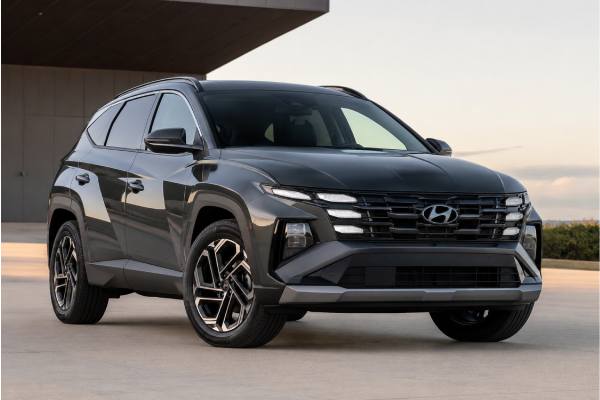
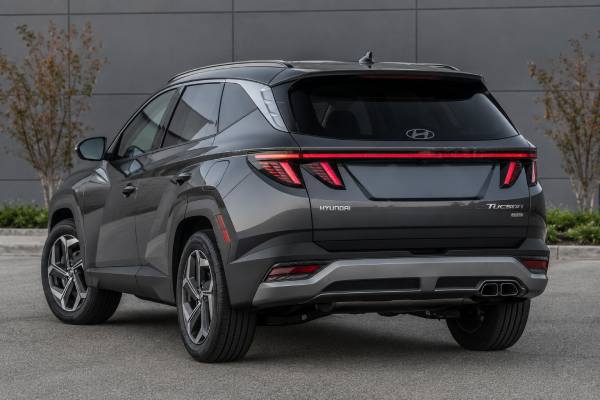
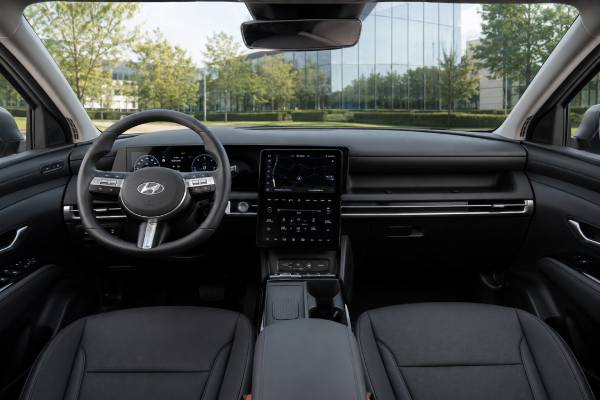
The facelifted Hyundai Tucson FWD with the Smartstream 1.6 T-GDi sits in the middle of the compact SUV class: big enough for family use, efficient enough for daily commuting, and more practical than many crossovers with sportier styling. In 2024–2025 form, the NX4 facelift brought a cleaner cabin layout, newer infotainment, improved equipment, and the same useful 1.6-litre turbo petrol base.
For this 160 hp version, the key choice is not just trim level. It is whether you want the simpler 6-speed manual petrol or the 48V mild-hybrid 7-speed dual-clutch model. Both are front-wheel drive, both use the same 1,598 cc turbocharged engine family, and both suit normal family driving better than heavy towing or enthusiastic performance use.
Final Verdict
The 2024–2025 Hyundai Tucson FWD 1.6 T-GDi 160 hp is a strong choice for buyers who want a spacious, well-equipped petrol family SUV without moving to a full hybrid or plug-in hybrid. Its best qualities are cabin space, comfort, safety equipment, and a flexible turbo engine with good low-rpm torque. The main tradeoff is that real-world fuel economy and long-term durability depend heavily on driving pattern and maintenance discipline, especially with short trips, 19-inch tyres, or the 7DCT mild-hybrid version. Buy one with full service history, completed recalls, clean software updates, and no low-speed DCT shudder.
| Pros | Cons |
|---|---|
| Roomy cabin and large boot for family use | Not as frugal as Tucson full hybrid versions |
| 160 hp turbo engine has useful mid-range torque | 7DCT can feel hesitant in slow traffic |
| Facelift cabin has better screens and controls | 19-inch wheels reduce ride comfort on rough roads |
| Strong standard safety and ADAS equipment | ADAS repairs need proper sensor calibration |
| FWD layout keeps weight and complexity down | Wet-road traction is tyre-dependent under boost |
Table of Contents
- Tucson 1.6 T-GDi Overview
- Specifications and Technical Data
- Trims, Options, and Safety
- Reliability, Issues, and Service Actions
- Maintenance and Buyer’s Guide
- Driving, Performance, and Efficiency
- Comparison with Rivals
Tucson 1.6 T-GDi Overview
The facelifted NX4 Tucson 1.6 T-GDi FWD is best understood as the practical petrol model in the range. It is less complex than AWD, HEV, or PHEV versions, but still has enough torque and equipment to feel modern.
This version uses Hyundai’s Smartstream 1.6-litre turbocharged petrol engine. In 2024–2025 European and UK-style specifications, the 160 PS engine is paired either with a 6-speed manual gearbox or, in 48V mild-hybrid form, a 7-speed dual-clutch transmission. The mild-hybrid version does not drive like a full hybrid. It cannot run meaningful distances on electric power alone; instead, it helps smooth stop-start operation and can slightly improve official fuel consumption.
The facelift matters because the Tucson’s cabin was one of the biggest areas of change. The earlier NX4 already had bold exterior styling, but the updated model brought a cleaner dashboard, larger digital displays, newer infotainment, more wireless connectivity, and revised switchgear. For a daily driver, that makes a real difference. It feels less like a first-generation digital cabin and more like a mature family SUV.
The 1.6 T-GDi FWD is aimed at buyers who do not need AWD traction, plug-in charging, or the extra cost of a full hybrid. It works well for mixed driving, school runs, commuting, and motorway travel. It is less ideal for owners who regularly tow near the rated limit, drive mainly in stop-start congestion, or expect diesel-like fuel economy from a petrol SUV.
The manual model is the simpler long-term ownership choice. The 48V 7DCT model is easier in traffic and more efficient on paper, but it needs a careful test drive because dual-clutch gearboxes can show low-speed hesitation or clutch judder if abused, poorly calibrated, or driven mostly in creeping urban traffic.
For used buyers, trim level and equipment can be tempting, but condition matters more. A clean service record, matching tyres, smooth cold start, no warning lights, and evidence of recall checks are worth more than a panoramic roof or premium audio.
Specifications and Technical Data
The 2024–2025 Tucson FWD 1.6 T-GDi is a five-seat compact SUV with a turbocharged 1,598 cc petrol engine, front-wheel drive, and either a 6-speed manual or 48V mild-hybrid 7DCT layout. The most important technical points are the 265 Nm torque band, large cargo area, 54-litre fuel tank, and the difference between the manual petrol and mild-hybrid DCT versions.
| Item | Hyundai Tucson FWD 1.6 T-GDi 160 |
|---|---|
| Engine family | Smartstream G1.6 T-GDi |
| Fuel type | Unleaded petrol |
| Configuration | Inline-four, DOHC, 16 valves |
| Displacement | 1,598 cc, 1.6 litres |
| Induction | Turbocharged |
| Bore × stroke | 75.6 × 89.0 mm |
| Compression ratio | 10.5:1 |
| Maximum power | 160 PS / 118 kW at 5,500 rpm |
| Maximum torque | 265 Nm from 1,500–4,500 rpm |
| Emissions standard | Euro 6e in listed European specifications |
| Item | Specification |
|---|---|
| Drive type | Front-wheel drive |
| Manual version | 6-speed manual, non-mild-hybrid petrol |
| Mild-hybrid version | 48V mild hybrid with 7-speed dual-clutch transmission |
| Hybrid capability | 48V assist only; not EV-only driving |
| Steering | Motor-driven power steering |
| Front suspension | MacPherson strut |
| Rear suspension | Multi-link |
| Item | Value |
|---|---|
| Body style | 5-door compact SUV, 5 seats |
| Length | 4,510–4,520 mm, depending on trim styling |
| Width | 1,865 mm excluding mirrors |
| Wheelbase | 2,680 mm |
| Height | 1,650–1,653 mm, depending on trim |
| Turning circle | 11.0 m |
| Fuel tank | 54 litres |
| Kerb weight | About 1,618 kg in listed FWD 160 PS versions |
| Gross vehicle weight | 2,095 kg |
| Maximum roof load | 100 kg |
| Item | 6MT petrol FWD | 48V 7DCT FWD |
|---|---|---|
| Boot volume, seats up | 620 litres | 577 litres |
| Boot volume, seats down | 1,799 litres | 1,756 litres |
| 0–62 mph | 9.9 seconds | 9.4 seconds |
| Top speed | 119 mph / 192 km/h | 119 mph / 192 km/h |
| Braked towing limit | 1,510 kg | 1,510 kg |
| Unbraked towing limit | 750 kg | 750 kg |
| WLTP combined economy | About 6.8–7.0 L/100 km | About 6.3–6.4 L/100 km |
| WLTP CO2 | About 154–158 g/km | About 142–145 g/km |
| Item | Typical specification |
|---|---|
| Engine oil | 4.8 litres, SAE 0W-20, API SN PLUS/SP or ILSAC GF-6 |
| DCT fluid | SAE 70W dual-clutch fluid, around 1.6–1.7 litres |
| Brake fluid | DOT-4 LV / ISO 4925 Class 6 |
| Coolant | Ethylene glycol-based coolant for aluminium engines |
| Common tyre pressures | 240 kPa / 35 psi on listed full-size tyres |
| Wheel nut torque | 107–127 Nm / 79–94 lbf-ft |
Trims, Options, and Safety
The Tucson’s trim structure matters because many comfort and ADAS features are trim-dependent. Mechanically, the biggest differences are gearbox choice, wheel size, mild-hybrid availability, and whether advanced driving aids are tied to DCT-equipped cars.
In the UK-style 2024–2025 facelift range, the main grades are Advance, Premium, N Line, N Line S, and Ultimate. Other countries use different names, but the equipment pattern is similar: lower trims focus on value, mid trims add comfort, N Line adds sportier styling, and higher trims add lighting, parking cameras, premium audio, and more driver assistance.
Trim and equipment highlights
Advance is the sensible entry point. It commonly brings 17-inch alloy wheels, roof rails, dual-zone climate control, a 12.3-inch navigation screen, a 12.3-inch driver display, wireless Apple CarPlay and Android Auto, front and rear parking sensors, rear camera, LED daytime running lights, and a strong base safety package.
Premium is often the better daily-driver trim because it adds useful comfort without forcing the sportier N Line look. Depending on market, it may add 18-inch wheels, heated front seats, electric front seat adjustment, heated steering wheel, smart tailgate, rear sun blinds, and KRELL audio.
N Line is mostly a visual and cabin package rather than a major mechanical upgrade. It usually gets 19-inch wheels, body-coloured wheel arches, sportier bumpers, N Line interior trim, and sportier seat materials. It looks sharper but rides more firmly than 17- or 18-inch versions.
N Line S and Ultimate are the most equipment-rich. They may bring Matrix LED headlights, panoramic sunroof, ventilated front seats, heated rear seats, surround-view monitor, blind spot view monitor, side parking distance warning, and more advanced parking assistance. These are desirable features, but they also increase repair cost after screen, bumper, mirror, or windscreen damage.
Quick identifiers are straightforward. Look for “1.6T 160PS” or market-equivalent wording in the sale listing, then confirm whether the car is 6MT or 48V 7DCT. The 7DCT version usually has shift-by-wire controls and may unlock adaptive cruise with stop-and-go, Highway Drive Assist, and certain parking-assist features. N Line cars are visually obvious from the exterior trim, sportier wheels, and interior details.
Safety ratings
The NX4 Tucson achieved a five-star Euro NCAP rating in the 2021 test cycle, with scores of 86% adult occupant protection, 87% child occupant protection, 66% vulnerable road user protection, and 70% safety assist. For the 2024–2025 facelift, this remains the most relevant public Euro NCAP reference for the NX4 generation unless your market lists a separate retest.
That rating is a good result, but it should be read correctly. A five-star rating does not mean every trim has every advanced feature, and Euro NCAP protocols change over time. A 2021 five-star result is not directly identical to a five-star result under a newer, stricter test year.
Safety systems and ADAS
Standard and commonly available systems include ABS, stability control, tyre-pressure monitoring, hill-start assist, downhill brake control, eCall, seatbelt reminders, lane keeping, lane following, intelligent speed limit assistance, forward collision avoidance with car, pedestrian, and cyclist detection, and rear ISOFIX points on the outer rear seats.
Higher trims or DCT-equipped versions may add adaptive cruise with stop-and-go, Highway Drive Assist, surround-view monitor, blind spot view monitor, side parking sensors, and parking collision avoidance assist. These features are useful, but buyers should check that all cameras, radar sensors, and parking sensors work cleanly.
After a windscreen replacement, front bumper repair, wheel alignment, suspension repair, or accident damage, ADAS calibration matters. A Tucson with poor lane-centering behaviour, false warnings, unavailable driver-assist functions, or a crooked steering wheel after alignment needs proper diagnosis, not just a reset.
Reliability, Issues, and Service Actions
The facelifted 2024–2025 Tucson 1.6 T-GDi is still relatively young, so long-term reliability patterns are not as mature as they are for older Tucson generations. The safest view is that the basic engine is promising when serviced well, while the 7DCT, electronics, software, tyres, and maintenance history deserve the closest inspection.
| Area | Prevalence | Cost risk | What to check |
|---|---|---|---|
| Engine oil condition and consumption | Occasional | Medium | Oil level, service dates, smoke, cold-start noise |
| 7DCT clutch behaviour | Occasional | Medium to high | Judder, hesitation, heat warnings, harsh take-up |
| 12V battery and stop-start faults | Occasional | Low to medium | Weak starts, warning messages, battery age |
| Infotainment and OTA software | Occasional | Low to medium | Screen freezes, navigation faults, update history |
| ADAS sensors and cameras | Occasional | Medium | False alerts, unavailable systems, accident history |
| Tyres, alignment, and 19-inch wheel wear | Common | Low to medium | Uneven wear, road noise, wheel damage |
Engine and turbo issues to watch
The Smartstream 1.6 T-GDi is a small turbo petrol engine moving a fairly large SUV, so oil quality and change frequency matter. Most problems to watch are not dramatic failure patterns; they are maintenance-sensitive issues that become expensive when ignored.
Symptoms such as rough cold idle, misfire, rising oil level, heavy fuel smell in the oil, blue smoke, or repeated low-oil warnings should be taken seriously. Possible causes include short-trip oil dilution, ignition faults, PCV system problems, injector issues, turbo oil seal wear, or poor maintenance. The remedy should start with a diagnostic scan, service record review, compression or leak-down testing if needed, and fresh oil of the correct specification.
Direct-injection turbo engines can also suffer from intake deposits over high mileage, especially with short trips and poor-quality fuel. This is usually a later-life issue rather than a new-car concern. Regular full-temperature driving, correct oil, and timely spark plug replacement help reduce risk.
7DCT and mild-hybrid behaviour
The 48V mild-hybrid 7DCT is smoother once moving, but it should not be treated like a torque-converter automatic. Long creeping on hills, holding the car on the throttle, and repeated stop-start manoeuvring can heat the clutches. On a test drive, check for smooth take-up from rest, clean reverse engagement, no burning smell, no gearbox temperature warnings, and no harsh 1–2 changes.
Some hesitation at very low speed can be normal dual-clutch character. Persistent judder, banging shifts, or warning lights are not normal. Software updates, clutch adaptation, and careful diagnosis can help in some cases, but a badly worn clutch pack is a bigger repair.
Software, ADAS, and recalls
Modern Tucsons are software-heavy. Infotainment updates, driver-assistance calibrations, instrument display software, and connected services can all affect ownership. Before buying, check for completed campaigns through the official VIN lookup for your country and ask the dealer for service campaign proof.
North American recall records for 2024–2025 Tucson models include label-related campaigns and small-population safety campaigns, while market-specific recalls can differ by factory, VIN range, engine, and equipment. European cars should be checked through Hyundai’s local network or national recall database, not assumed to match US recalls.
The practical buying rule is simple: do not rely on “no warning lights today.” Ask for proof that recalls, service campaigns, infotainment updates, and ADAS calibrations have been completed when relevant.
Maintenance and Buyer’s Guide
The Tucson 1.6 T-GDi rewards conservative maintenance. For long ownership, use the correct oil, shorten intervals for severe use, and treat tyres, brakes, battery health, and gearbox behaviour as part of the service routine rather than afterthoughts.
| Interval | Service items |
|---|---|
| Every 10,000 km or 12 months | Engine oil and filter, tyre rotation, inspection for leaks and wear |
| Severe use: every 5,000 km | Engine oil and filter for short trips, dust, heat, towing, heavy traffic |
| Every service | Brake pads, rotors, tyres, lights, wipers, suspension, steering boots |
| Every 30,000 km or 24 months | Brake fluid, cabin air filter, deeper brake and chassis inspection |
| Every 40,000 km or 48 months | Engine air filter replacement under normal schedule |
| Every 70,000 km | Spark plugs |
| Every 90,000 km or 72 months | Valve clearance inspection if noise or vibration suggests adjustment |
| Coolant first service | First replacement around 200,000 km or 120 months where applicable |
| Coolant after first service | Every 40,000 km or 24 months |
| 7DCT severe use | Consider fluid service around 100,000 km where severe schedule applies |
Severe use is more common than many owners think. Repeated short trips, cold starts, urban congestion, high ambient heat, dusty roads, mountain driving, frequent roof loads, and towing all justify shorter oil intervals. A turbocharged direct-injection engine is harder on oil than a simple naturally aspirated engine, so cheap maintenance is a false economy.
For timing components, the Smartstream 1.6 T-GDi uses a timing chain rather than a routine timing belt service item. A chain is not maintenance-free in the absolute sense. Listen for cold-start rattle, check for timing-correlation fault codes, and investigate chain, guide, or tensioner wear if noise or fault codes appear.
Buyer inspection checklist
Before buying, inspect the car cold and drive it long enough to warm the engine, gearbox, brakes, and tyres. A five-minute test drive is not enough.
Check these items carefully:
- Full service history with correct oil specification and recorded intervals.
- VIN recall check and proof of completed campaigns.
- Smooth cold start with no rattle, smoke, or unstable idle.
- No oil leaks around timing cover, turbo feed/return lines, sump, or cam cover.
- Clean coolant with no overheating history or coolant smell.
- Smooth clutch action on manual cars.
- Smooth take-off, reverse, and low-speed manoeuvring on 7DCT cars.
- No ADAS, TPMS, airbag, or infotainment warning messages.
- Even tyre wear, matching tyre brand and size, and no damaged 19-inch wheels.
- Straight braking with no vibration, grinding, or rusty rear rotors.
- Clean underside, subframes, brake lines, suspension arms, and exhaust fixings.
The best version for most private buyers is a mid-spec Premium or equivalent on 18-inch wheels, unless the buyer specifically wants N Line styling or top-trim cameras and Matrix LEDs. The 6-speed manual is appealing for lower complexity. The 48V 7DCT is more convenient, but buy only if it drives cleanly in traffic and has a complete service and update history.
Long-term durability should be good if the car is serviced properly, kept on quality tyres, and checked for software campaigns. Neglected turbo petrol engines and abused dual-clutch gearboxes are where costs rise.
Driving, Performance, and Efficiency
The Tucson 1.6 T-GDi FWD feels relaxed rather than sporty. Its strength is easy mid-range torque, stable motorway manners, and a comfortable family-SUV character.
The 265 Nm torque band starts low, so the car does not need high revs in normal driving. Around town, the manual version feels straightforward, though the driver has to work the gearbox more than in a diesel or full hybrid. The 48V DCT version is easier day to day and quicker on paper, but the gearbox can feel cautious when pulling away, parking, or creeping in traffic.
At motorway speeds, the Tucson feels planted. Wind noise is moderate, engine noise is well contained at a cruise, and the long wheelbase helps straight-line stability. The ride depends heavily on wheels. Seventeen- and eighteen-inch cars are more forgiving; nineteen-inch N Line and high-trim cars look better but pass more sharp impacts into the cabin.
Steering is light and predictable. It does not have the feedback of a Mazda CX-5 or Ford Kuga, but it is easy to place in town and secure on faster roads. The FWD layout is fine for normal use. In wet conditions, full-throttle acceleration out of junctions can make the traction control work, especially on worn or budget tyres.
Braking feel is consistent in the petrol version because it does not rely on heavy regenerative blending like a full hybrid. Still, low-mileage cars used in wet climates should have their discs checked for corrosion and uneven pad deposits.
Real-world fuel economy
Official WLTP combined figures sit around 6.8–7.0 L/100 km for the manual petrol and 6.3–6.4 L/100 km for the 48V 7DCT FWD, depending on trim and wheels. Real-world use is usually higher.
Expect roughly:
- City driving: 7.8–9.5 L/100 km, about 25–30 mpg US or 30–36 mpg UK.
- Mixed driving: 6.8–8.2 L/100 km, about 29–35 mpg US or 34–42 mpg UK.
- Steady highway driving: 6.2–7.4 L/100 km, about 32–38 mpg US or 38–46 mpg UK.
Cold weather, roof boxes, short trips, 19-inch tyres, low tyre pressure, and heavy traffic can all push consumption higher. The mild-hybrid DCT usually has its biggest advantage in mixed and urban use, but it is still not a substitute for the Tucson full hybrid if fuel economy is the main goal.
Towing and load use
The 1.6 T-GDi FWD is rated to tow useful loads, but it is not the strongest Tucson for regular heavy towing. For occasional small trailers, bike racks, camping gear, or a light braked trailer, it is suitable if maintained well. For frequent motorway towing, hills, or near-limit loads, the hybrid, diesel in markets where offered, or AWD versions may feel more secure.
When loaded, expect longer overtakes, more frequent downshifts, and higher fuel use. Keep tyre pressures correct, stay within nose-weight and gross vehicle limits, and service the car more conservatively if towing is frequent.
Comparison with Rivals
The Tucson 1.6 T-GDi FWD competes best as a spacious, comfortable, well-equipped family SUV. It is not the sportiest, not the most efficient, and not the cheapest, but it combines enough of each quality to make sense for many buyers.
| Rival | Where it beats the Tucson | Where the Tucson fights back |
|---|---|---|
| Kia Sportage 1.6 T-GDi | Similar platform, often strong warranty and value | Tucson cabin design may feel calmer after facelift |
| Nissan Qashqai mild hybrid | Lighter feel, easy urban driving, efficient engines | Tucson offers more cabin and cargo space |
| Toyota Corolla Cross Hybrid | Better fuel economy and hybrid simplicity in traffic | Tucson feels larger, stronger, and more refined |
| Volkswagen Tiguan | More premium road feel and broad engine range | Tucson can offer better equipment for the money |
| Mazda CX-5 | Sharper handling and more traditional cabin feel | Tucson has newer screens and stronger rear-seat packaging |
Against the Kia Sportage, the choice is mostly design, dealer support, and trim pricing. Mechanically, the two are closely related in many markets, so buying the better-maintained example matters more than brand preference.
Against the Qashqai, the Tucson feels more substantial. The Nissan may be easier to park and lighter on fuel in some versions, but the Hyundai gives rear passengers and luggage more room.
Against Toyota hybrids, the Tucson 1.6 T-GDi cannot match fuel economy in city use. The Toyota advantage is strongest for drivers who spend most of their time in traffic. The Hyundai’s advantage is cabin size, equipment value, and a more conventional turbo-petrol driving feel.
Against the Tiguan, the Tucson is usually the value play. The Volkswagen may feel more polished in some trims, but comparable equipment can cost more. Against the Mazda CX-5, the Mazda is more enjoyable on a back road, while the Tucson feels more modern inside and better packaged for family life.
For most buyers, the Tucson’s closest rival is still the Sportage. Choose the Tucson if you prefer its interior, smoother styling balance, and equipment mix. Choose the full hybrid version instead of the 1.6 T-GDi petrol if low fuel use in town is your top priority.
References
- Hyundai TUCSON | Technical, Specifications and Pricing | Model year 2025 | May 2024 2024 (Technical Specifications) ([Hyundai News][1])
- Recommended lubricants and capacities | 2025 Hyundai Tucson 2025 (Owner’s Manual) ([Hyundai Owners Manual][2])
- Normal Maintenance Schedule (Smartstream 1.6 T-GDi) 2025 (Owner’s Manual) ([Hyundai Owners Manual][3])
- Euro NCAP | Hyundai TUCSON 2021 (Safety Rating) ([Euro NCAP][4])
- Vehicle Detail Search – 2025 HYUNDAI TUCSON SUV FWD | NHTSA 2025 (Recall Database) ([NHTSA][5])
Disclaimer
This article is for informational purposes only and is not a substitute for professional diagnosis, repair, or official Hyundai service documentation. Specifications, torque values, service intervals, software campaigns, and procedures can vary by VIN, market, trim, production date, and equipment. Always verify maintenance and repair information against the official owner’s manual, workshop data, dealer records, and local recall database for the exact vehicle.
If this guide helped you, please consider sharing it on Facebook, X/Twitter, or your preferred car community to support our work.