
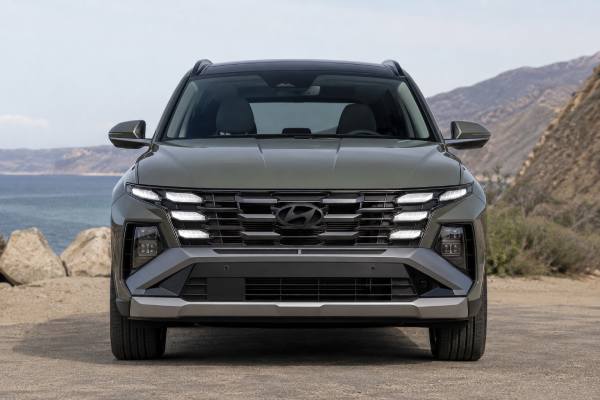
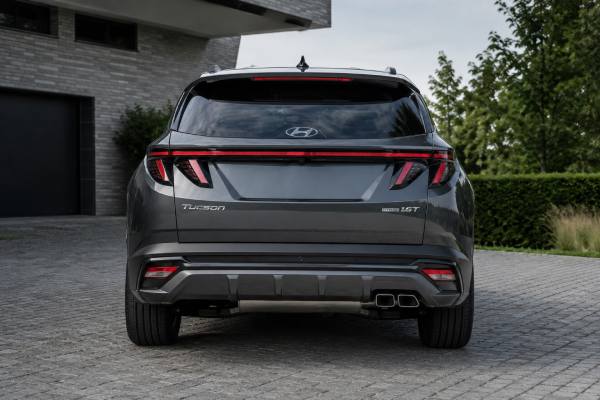
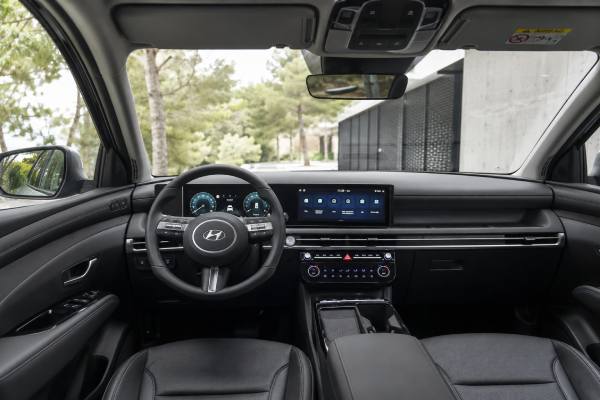
The facelifted Hyundai Tucson Hybrid HTRAC AWD is the most rounded version of the NX4 Tucson for many family SUV buyers. It combines the useful cabin space of the standard Tucson with a turbocharged petrol-hybrid powertrain, a conventional 6-speed automatic gearbox, and Hyundai’s all-wheel-drive system. For 2024–2025 European-market facelift cars, the key figure is the 215 PS hybrid output, paired with practical equipment updates such as the curved digital cockpit, improved driver assistance, and a cleaner interior layout.
This version suits drivers who want better town efficiency than a pure petrol Tucson, more traction than a front-wheel-drive hybrid, and less charging commitment than a plug-in hybrid. It is not the cheapest Tucson to buy or run, but it is one of the easiest to live with.
Final Verdict
The 2024–2025 Hyundai Tucson Hybrid HTRAC AWD is a strong choice if you want a comfortable, spacious family SUV with confident all-weather traction and no need to plug in. Its best appeal is the combination of smooth hybrid assistance, a conventional automatic gearbox, generous equipment, and a useful 616-litre boot. It suits mixed driving, family use, wet or snowy roads, and buyers who value warranty cover. The main tradeoff is that the AWD system, 19-inch wheels, and higher trims reduce fuel-economy advantage compared with front-wheel-drive hybrids. Buy only with verified service history, completed software/recall actions, and a clean hybrid-system diagnostic check.
| Pros | Cons |
|---|---|
| 215 PS hybrid system gives easy, quiet everyday performance | AWD economy trails the lighter front-wheel-drive Tucson Hybrid |
| HTRAC adds useful wet-road, snow, and hill traction | More driveline parts mean more fluid-service points |
| 6-speed automatic feels more natural than many hybrid CVTs | Turbo direct-injection engine needs disciplined oil changes |
| 616-litre boot remains excellent for a self-charging hybrid SUV | Plug-in Tucson offers more electric-only use for short commutes |
| Facelift cabin gains cleaner controls and strong digital displays | ADAS cameras and sensors need careful calibration after repairs |
Table of Contents
- Tucson Hybrid AWD Overview
- Specifications and Technical Data
- Trims, Options, Safety and ADAS
- Reliability, Issues and Service Actions
- Maintenance and Buyer’s Guide
- Driving, Performance and Efficiency
- How the Tucson Hybrid AWD Compares
Tucson Hybrid AWD Overview
The Tucson Hybrid HTRAC AWD is best understood as the practical middle ground of the Tucson range. It is more efficient and smoother in town than the non-hybrid petrol model, more convenient than the plug-in hybrid if you cannot charge daily, and more secure in poor weather than the front-wheel-drive hybrid.
The NX4 generation Tucson arrived with a more dramatic design than earlier Tucsons, but the 2024 facelift made the car feel more mature inside. The dashboard became cleaner, the digital displays were better integrated, and physical controls returned for several everyday functions. That matters because the Tucson is a family car first. The best version is not simply the one with the most technology; it is the one that makes school runs, commutes, motorway trips, and winter driving easier.
The 1.6 T-GDi hybrid uses a turbocharged petrol engine supported by an electric motor and a small lithium-ion polymer battery. It is a self-charging hybrid, not a plug-in hybrid. The battery is charged by the engine and regenerative braking, so there is no charging cable and no electric-only range claim in the same sense as a PHEV. In traffic, parking manoeuvres, gentle starts, and low-speed cruising, the electric motor can reduce engine use and smooth the drive.
HTRAC AWD is the important difference in this version. In normal driving it behaves like an efficient road-biased all-wheel-drive system, sending torque where needed rather than acting like a heavy-duty off-road setup. It helps when accelerating on wet roads, pulling away on snow, driving on loose surfaces, or towing within the vehicle’s rating. It does not turn the Tucson into a rugged 4×4, and tyre choice still matters more than many buyers expect.
The 215 PS facelift hybrid should also be separated from later or other-market Tucson hybrids that use different outputs. In the UK and much of Europe, the 2024–2025 facelift specification covered here is the 215 PS self-charging hybrid. Some markets use different horsepower ratings, trim names, wheel packages, and warranty terms, so a buyer should check the VIN-specific data before ordering parts or comparing used listings.
Specifications and Technical Data
This Tucson uses Hyundai’s Smartstream 1.6-litre turbocharged petrol engine, a permanent-magnet electric motor, a lithium-ion polymer hybrid battery, a 6-speed automatic transmission, and HTRAC AWD. The technical appeal is not one headline number but the way the components work together: useful low-speed electric assistance, strong mid-range turbo torque, and a conventional automatic gearbox that avoids the high-revving feel some drivers dislike in hybrid CVT systems.
| Item | Hyundai Tucson Hybrid HTRAC AWD 215 PS |
|---|---|
| Engine | Smartstream 1.6 T-GDi turbocharged petrol |
| Configuration | Inline 4-cylinder, DOHC, 16 valves |
| Displacement | 1,598 cc |
| Bore x stroke | 75.6 x 89.0 mm |
| Compression ratio | 10.5:1 |
| Combined output | 215 PS, about 212 hp / 158 kW |
| Engine torque | 264 Nm from 1,500–4,500 rpm |
| Electric motor | Permanent-magnet synchronous motor |
| Motor output | 60 PS / 44.1 kW |
| Motor torque | 265 Nm |
| Hybrid battery | Lithium-ion polymer |
| Item | Specification |
|---|---|
| Transmission | 6-speed automatic |
| Drive type | HTRAC all-wheel drive / 4WD, market wording varies |
| 0–62 mph | 8.5 seconds |
| Top speed | 116 mph / 187 km/h |
| Braked towing capacity | 1,360 kg |
| Unbraked towing capacity | 750 kg |
| Roof load | 100 kg |
| Item | Specification |
|---|---|
| Body style | 5-door midsize family SUV |
| Seats | 5 |
| Length | 4,510–4,520 mm, depending on trim styling |
| Width | 1,865 mm excluding mirrors |
| Wheelbase | 2,680 mm |
| Turning circle | 11.0 m |
| Kerb weight | Up to 1,771 kg for 4WD hybrid specification |
| Gross vehicle weight | 2,250 kg |
| Payload | 479 kg |
| Cargo volume | 616 litres seats up; 1,795 litres seats folded |
| Fuel tank | 52 litres |
| Item | Specification or practical note |
|---|---|
| Front suspension | MacPherson struts |
| Rear suspension | Multi-link |
| Common alloy wheels | 18-inch or 19-inch, depending on trim |
| Official AWD hybrid economy | About 6.5–6.6 L/100 km |
| Official AWD hybrid economy | About 42.8–43.5 mpg UK / 35.6–36.2 mpg US |
| CO2 emissions | About 148–149 g/km, depending on trim |
| Emissions standard | Euro 6e for the relevant UK facelift specification |
| Item | Reference value |
|---|---|
| Engine oil grade | SAE 0W-20 full synthetic, API SN PLUS/SP or ILSAC GF-6 |
| Engine oil refill | About 4.8 litres with drain and refill |
| Brake fluid | DOT-4 LV / ISO 4925 Class 6 type |
| Rear differential oil | GL-5 SAE 75W/85; about 0.53–0.63 litres |
| Transfer case oil | Specification and capacity must be confirmed by VIN |
These figures make the Tucson Hybrid AWD easy to place. It is not a performance SUV, but it is quick enough for family use, motorway merging, and loaded holiday driving. It is also not a heavy tow car, but the 1,360 kg braked rating is useful for small caravans, trailers, and outdoor equipment when the car is correctly loaded.
Trims, Options, Safety and ADAS
For the 2024–2025 facelift, the best Tucson Hybrid AWD equipment is usually found in the higher trims. In the UK specification, the self-charging hybrid range included trims such as Advance, Premium, N Line, N Line S, and Ultimate, while 4WD availability was concentrated toward higher-grade hybrid models.
The trim names differ by country, but the buying logic is similar. Lower trims give the Tucson’s core space and hybrid efficiency. Mid and upper trims add the equipment that makes the facelift feel more premium: larger wheels, higher-grade lighting, upgraded audio, surround-view camera functions, more advanced driver assistance, and extra comfort features.
Trim and option highlights
The facelift interior is one of the biggest reasons to choose a 2024–2025 car over an earlier NX4. The digital instrument display and central infotainment screen sit in a cleaner layout, and the cabin has a more modern feel without relying only on touch controls.
Useful equipment to look for includes:
- 12.3-inch navigation display and 12.3-inch digital driver display.
- Wireless Apple CarPlay and Android Auto, where fitted by market.
- Dual-zone or tri-zone climate control, depending on trim.
- Smart power tailgate on higher trims.
- KRELL premium audio on selected higher-grade models.
- Matrix LED headlights on upper trims.
- Surround-view monitor and blind-spot view monitor on high trims.
- Heated and ventilated front seats on well-equipped versions.
- Panoramic roof on selected upper trims.
N Line versions are mainly a styling and equipment choice rather than a major mechanical upgrade. They bring a sportier exterior and interior look, commonly with 19-inch wheels. Those wheels sharpen the appearance but can make the ride firmer and tyres more expensive. For comfort-focused buyers, an 18-inch wheel package is often the sweeter setup.
Quick identifiers are simple. Check for Hybrid badging, HTRAC or 4WD listing in the build data, the trim badge or specification sheet, wheel size, digital cockpit layout, and the presence of surround-view cameras. A VIN-based build sheet is the safest way to confirm whether a used car is truly the AWD hybrid, not a front-wheel-drive hybrid advertised loosely.
Safety ratings
The NX4 Hyundai Tucson was awarded a 5-star Euro NCAP rating in 2021, and the rating was reviewed for the facelift in 2024 while retaining the earlier result. The tested model was a Tucson 1.6 T-GDi hybrid, and the rating applies across relevant variants including hybrid 4×4 versions.
The headline Euro NCAP category scores were:
| Category | Score |
|---|---|
| Overall rating | 5 stars |
| Adult occupant | 86% |
| Child occupant | 87% |
| Vulnerable road users | 66% |
| Safety assist | 70% |
Those are strong family SUV results, though not perfect. The adult and child protection scores are the Tucson’s strongest areas. Vulnerable road-user and safety-assist scores are respectable but remind buyers that driver-assistance systems are aids, not replacements for attention.
Driver assistance and calibration
The facelift Tucson can be well equipped with ADAS, but availability depends on trim and country. Important systems can include forward collision avoidance assistance with pedestrian and cyclist detection, lane keeping assistance, lane following assistance, intelligent speed limit assistance, adaptive cruise control, Highway Driving Assist, blind-spot monitoring, rear cross-traffic assistance, and parking collision-avoidance assistance.
The practical ownership point is calibration. Windscreen replacement, front bumper repair, grille damage, suspension work, wheel alignment, and camera or radar replacement can all affect ADAS accuracy. A repaired Tucson that has not been calibrated properly may show warning lights, poor lane centring, false braking alerts, or disabled driver-assistance functions. On a used car, check that the systems operate cleanly on a test drive and that any body repair was followed by proper calibration.
For child seats, the Tucson’s wide rear cabin and ISOFIX/LATCH mounting points on the outer rear seats make it one of the easier SUVs in this class to use as family transport. Still, bulky rear-facing seats should be test-fitted before purchase because front-passenger legroom can change significantly depending on seat design.
Reliability, Issues and Service Actions
The Tucson Hybrid is generally a solid modern SUV, but it is not a maintenance-free appliance. The most important ownership risks are oil-service neglect on the turbo petrol engine, software or sensor faults, brake corrosion from light hybrid braking, 12-volt battery weakness, and neglected AWD fluid checks.
Because the 2024–2025 facelift is relatively recent, long-term failure patterns are still developing. It is better to think in systems and symptoms rather than assume every car will suffer the same faults.
| Area | Prevalence | Typical severity | What to watch for |
|---|---|---|---|
| 12 V battery and low-voltage errors | Occasional | Low to medium | Random warnings, no-start, weak accessories after short trips |
| Infotainment or Bluelink glitches | Occasional | Low | Freezing screen, pairing issues, update prompts |
| Brake disc corrosion | Common in wet climates | Low to medium | Rusty rear discs, pulsing, scraping after gentle use |
| Turbo-GDI oil neglect | Condition-dependent | Medium to high | Noisy cold starts, oil consumption, sludge, timing faults |
| ADAS sensor calibration | Repair-dependent | Medium | Lane, camera, radar, or collision-warning faults |
| AWD transfer/rear differential service neglect | Occasional | Medium | Driveline noise, vibration, leaks, poor service history |
Engine and hybrid system
The 1.6 T-GDi is a small turbocharged direct-injection engine working in a relatively heavy AWD SUV. It benefits from high-quality oil, correct viscosity, and short intervals in severe use. Repeated short trips, cold starts, stop-go traffic, towing, and long idling all make the engine work harder than the mileage alone suggests.
Symptoms that deserve attention include:
- Cold-start rattling that lasts more than a brief moment.
- Oil level dropping between services.
- Check-engine lights related to timing correlation, boost pressure, misfires, or fuel trim.
- Coolant smell, visible leaks, or low coolant warnings.
- Hesitation under boost or uneven petrol-electric transitions.
The timing drive is chain-based rather than a routine timing-belt replacement item. That does not mean it should be ignored. Chain stretch, guide wear, tensioner issues, or oil-related wear can still occur if servicing is poor. A noisy cold start, cam/crank correlation fault, or rough running should be investigated before further use.
The hybrid side is usually less troublesome if the car is kept updated and not left unused for long periods. Pre-purchase diagnostics should include hybrid control-unit fault codes, battery state-of-health information where available, DC–DC converter status, cooling-system checks, and confirmation that no high-voltage warnings have been cleared recently.
Transmission, AWD and chassis
The 6-speed automatic is a major reason the Tucson Hybrid feels familiar to drive. It shifts like a normal automatic rather than letting the engine flare like some eCVT hybrids. On a test drive, shifts should be smooth when cold and warm, with no harsh engagement when moving from Park to Drive or Reverse.
HTRAC AWD adds useful traction, but it also adds service items. The transfer case, rear differential, driveshafts, CV joints, and rear coupling area should be checked for leaks, torn boots, vibration, and noise. Cars used in snow, salted roads, towing, steep terrain, or wet rural areas deserve closer inspection.
Suspension wear is not unusual for a family SUV on large wheels. Listen for front-end knocks, rear suspension creaks, worn drop links, uneven tyre wear, and steering vibration. A Tucson on 19-inch wheels may look better but is less forgiving of potholes and kerbs than one on smaller wheels.
Software, recalls and service actions
Modern Hyundais rely heavily on software for hybrid control, driver assistance, infotainment, and battery management. Updates can improve drivability, resolve warning messages, adjust charging behaviour, or correct sensor logic. The official remedy for some faults may be a reflash rather than a part replacement.
Before buying, ask for:
- A printed dealer service history.
- Confirmation of completed recalls and field service actions.
- Evidence of infotainment and control-module updates.
- Warranty documentation for the hybrid components.
- Diagnostic scan results from all modules, not just the engine ECU.
Recall and service-action status must be checked by VIN through Hyundai or the official recall database in the vehicle’s market. Do not rely only on a seller saying “there are no recalls.” Some actions are market-specific, and a used import may have a different service campaign history from a domestic-market car.
Maintenance and Buyer’s Guide
The Tucson Hybrid AWD rewards preventive maintenance more than repair-after-failure ownership. The best used examples are not necessarily the lowest-mileage cars; they are the ones with correct oil changes, clean diagnostic history, healthy tyres, completed recalls, and proof that AWD and hybrid systems were checked properly.
| Item | Normal guidance | Severe-use guidance or buying note |
|---|---|---|
| Engine oil and filter | 15,000 km / 10,000 miles or 12 months | 7,500 km / 4,500 miles or 6 months |
| Engine air filter | Inspect at routine service | Replace sooner in dusty or rural use |
| Cabin filter | Inspect yearly | Replace sooner with pollen, dust, pets, or smoke |
| Spark plugs | Follow VIN-specific schedule | Do not extend intervals on a turbo DI engine |
| Fuel filter | Usually not a routine owner service item | Investigate lean running, pressure faults, or poor fuel history |
| Timing chain | No routine belt-style replacement | Inspect if rattling, oil-neglected, or timing faults appear |
| Drive belts | First major inspection around 90,000 km / 60,000 miles | Then inspect about every 30,000 km / 20,000 miles |
| Brake fluid | Test and replace by official interval | Do not ignore moisture content on low-use hybrids |
| Brake pads and discs | Inspect every service | Check rear-disc corrosion from gentle regen-heavy use |
| Automatic transmission fluid | Inspect for leaks and shift quality | Severe use may require replacement around 90,000 km / 60,000 miles |
| Rear differential and transfer case | Inspect for leaks and noise | Severe use may require oil service around 120,000 km / 80,000 miles |
| Tyres | Rotate around 15,000 km / 10,000 miles or yearly | Align if wear is uneven, especially on 19-inch wheels |
| 12 V battery | Test from year three onward | Replace early if warning lights or low-voltage faults appear |
| Hybrid system | Scan for DTCs and check cooling loops | Request state-of-health data before purchase where available |
The severe-use schedule matters because many Tucson Hybrids live exactly that life: short journeys, school traffic, cold starts, urban congestion, hills, and occasional holiday loading. A low-mileage car that has done only short trips may need more frequent oil changes than a higher-mileage car used mostly on open roads.
Used buying checklist
A good pre-purchase inspection should cover more than paint and tyre tread. Focus on the systems that are expensive, safety-related, or easy to neglect.
Check the following before committing:
- Service records showing correct oil grade and time-based servicing.
- VIN-based recall and service-action completion.
- Hybrid-system scan with no stored high-voltage or battery-management faults.
- Smooth petrol-to-electric transitions during gentle driving.
- No harsh engagement from Drive or Reverse.
- No coolant smell, oil seepage, or turbo-hose damage.
- Clean operation of adaptive cruise, lane support, cameras, and parking sensors.
- Even tyre wear across all four tyres.
- No vibration under acceleration or tight low-speed turns.
- Brake discs free from heavy corrosion or deep lips.
- Rear differential, transfer case, and driveshaft areas dry and quiet.
- Windscreen and bumper repairs documented with ADAS calibration.
The best trims depend on priorities. Premium-style trims often make the most sense for comfort, equipment, and value. N Line and N Line S models look sharper and feel more special, but check tyre costs and ride comfort. Ultimate versions can be very well equipped, but a used buyer should confirm every advanced feature works because high-trim sensors and cameras are costly to diagnose after accident damage.
For long-term durability, the Tucson Hybrid AWD should age well if serviced correctly. The engine is the part most sensitive to neglect, the AWD system adds fluid-service discipline, and the hybrid system benefits from software updates and regular use. A clean, well-maintained example is preferable to a cheaper car with patchy records.
Driving, Performance and Efficiency
On the road, the Tucson Hybrid AWD feels stronger than its engine size suggests. The electric motor fills in the low-speed response, the turbo engine gives useful mid-range pull, and the 6-speed automatic makes the car feel more conventional than many hybrids.
In town, the Tucson is smooth and easy. It can move off gently on electric assistance, creep in traffic without fuss, and restart the petrol engine without much vibration when everything is working correctly. The brake pedal blends regenerative and friction braking, though the feel may be slightly different from a non-hybrid car. A healthy example should not grab, pulse, or scrape heavily once surface rust has cleared.
At motorway speeds, the Tucson Hybrid is more relaxed than sporty. The steering is light, straight-line stability is good, and cabin noise is well controlled for a family SUV. On 19-inch wheels, sharp bumps and broken urban roads are more noticeable. On 18-inch wheels, the Tucson feels calmer and better suited to long-distance family use.
The 0–62 mph time of 8.5 seconds is quick enough for confident merging and overtaking. More important is the 50–80 mph feel, where the combination of turbo torque and automatic kickdown gives the car decent response. It is not as instantly forceful as a strong plug-in hybrid with a fully charged battery, but it is consistent because it does not depend on external charging.
Efficiency in real driving
Official AWD hybrid economy is around 6.5–6.6 L/100 km, or roughly 42.8–43.5 mpg UK. Real-world figures depend heavily on temperature, tyres, route, load, and speed.
A realistic expectation is:
| Use case | Likely real-world range |
|---|---|
| Urban and suburban driving | About 5.5–7.0 L/100 km / 40–51 mpg UK |
| Mixed driving | About 6.0–7.2 L/100 km / 39–47 mpg UK |
| Fast motorway driving | About 6.8–8.0 L/100 km / 35–42 mpg UK |
| Cold winter short trips | Often 10–20% worse than mild-weather driving |
| Loaded or towing use | Expect a clear penalty, especially above 90 km/h |
The hybrid system works best in stop-start and rolling traffic. On fast motorways, the petrol engine does more of the work, so the economy gap over a normal petrol SUV narrows. In winter, cabin heat, cold oil, battery temperature, and short journeys all reduce the hybrid advantage.
HTRAC AWD is useful rather than dramatic. In normal conditions the Tucson feels front-biased and efficient. When grip drops, torque transfer helps the rear axle contribute. Snow mode and stability-control tuning can make the car easier to manage on poor surfaces, but winter tyres remain the biggest upgrade for true cold-weather performance.
For towing, stay within the rated limit and pay attention to nose weight, tyre pressures, and cooling load. The Tucson Hybrid AWD can tow a small braked trailer or lightweight caravan, but it is not a substitute for a larger diesel SUV if towing is frequent, heavy, or mountainous.
How the Tucson Hybrid AWD Compares
The Tucson Hybrid AWD competes in a crowded field, but its blend of warranty, cabin space, equipment, and conventional automatic driving feel gives it a clear identity. It is not the economy champion, and it is not the sportiest SUV, but it is one of the easiest family hybrids to recommend as an all-rounder.
| Rival | Where the Tucson is stronger | Where the rival may be better |
|---|---|---|
| Kia Sportage Hybrid AWD | Similar hardware with a cleaner facelift Hyundai cabin feel | Kia styling, trim value, or warranty package may appeal more |
| Toyota RAV4 Hybrid AWD | More premium-feeling cabin and conventional automatic feel | Excellent efficiency, resale value, and hybrid reputation |
| Honda CR-V e:HEV AWD | Often better value and sharper interior technology | Very smooth hybrid operation and strong family practicality |
| Nissan Qashqai e-Power | More cargo space and available AWD in Tucson specification | Electric-drive feel can be smoother in urban use |
| Peugeot 3008 Hybrid | More rear-seat and boot practicality in many comparisons | More distinctive interior style and premium design feel |
Against the Kia Sportage Hybrid, the decision is mostly personal. The two share a broad engineering family, but the cabin design, trim pricing, warranty details, and dealer offers can decide the winner. Test both on the same roads if possible, especially if choosing 19-inch wheels.
Against the Toyota RAV4 Hybrid, the Tucson feels more polished inside and more conventional in gearbox behaviour. The Toyota’s hybrid system has a long reputation and strong economy, but some drivers dislike the e-CVT sound under hard acceleration. The Tucson’s 6-speed automatic gives a more familiar rhythm.
Against the Honda CR-V e:HEV, the Tucson is often the value play. The Honda can feel exceptionally smooth and spacious, but it is usually positioned at a higher price point. The Hyundai fights back with equipment, warranty appeal, and a strong boot.
The Tucson Hybrid AWD is the right rival choice if you want a refined, well-equipped, no-plug family SUV with real AWD usefulness. Choose the RAV4 if maximum hybrid economy and resale confidence matter most. Choose the Sportage if you prefer Kia’s design and package. Choose a plug-in hybrid only if you can charge regularly and your daily trips fit the electric range.
References
- Hyundai TUCSON | Technical, Specifications and Pricing | Model year 2025 | May 2024 2024 (Official specifications) ([Hyundai News][1])
- Euro NCAP | Hyundai TUCSON 2021/2024 (Safety Rating) ([Euro NCAP][2])
- Scheduled Maintenance Services | 2025 Hyundai Tucson 2025 (Owner’s Manual) ([Hyundai Owners Manual][3])
- Recommended lubricants and capacities | 2025 Hyundai Tucson 2025 (Owner’s Manual) ([Hyundai Owners Manual][4])
- Severe Usage Maintenance (Europe) | 2025 Hyundai Tucson 2025 (Owner’s Manual) ([Hyundai Owners Manual][5])
Disclaimer
This article is for informational purposes only and is not a substitute for professional diagnosis, repair, inspection, or official Hyundai service information. Specifications, torque values, service intervals, capacities, software actions, procedures, and approved fluids can vary by VIN, market, trim, production date, and equipment. Always verify details against the vehicle’s official service documentation, owner’s manual, dealer records, and VIN-specific recall information before buying parts or approving repairs.
If this guide helped you, please consider sharing it on Facebook, X/Twitter, or your preferred social platform to support our work.