


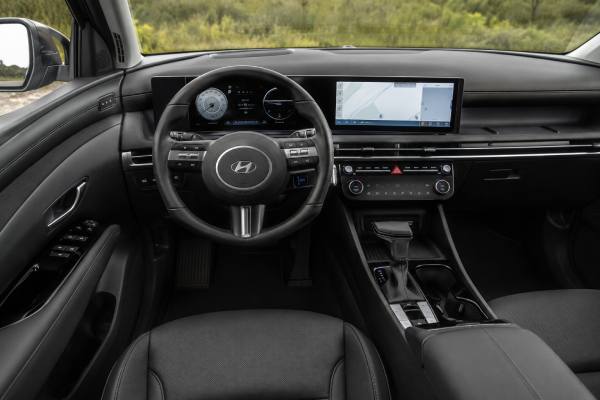
The facelifted Hyundai Tucson Hybrid FWD is the front-wheel-drive, self-charging hybrid version of the fourth-generation NX4 Tucson. In this 239 hp form, it pairs Hyundai’s Smartstream 1.6 T-GDi turbo petrol engine with an electric motor, a small high-voltage battery, and a conventional 6-speed automatic transmission rather than a CVT. That makes it a practical family SUV for drivers who want lower urban fuel use, strong mid-range pull, and no plug-in charging routine.
This guide focuses on the 2025–present facelift version with the 1.6 T-GDi full hybrid drivetrain and front-wheel drive. Equipment and exact figures can vary by country, trim, tyres, and model-year naming, but the core mechanical layout and ownership priorities are consistent.
Final Verdict
The Hyundai Tucson FWD 1.6 T-GDi Hybrid is a strong choice for family buyers who want a roomy, well-equipped SUV with smooth hybrid assistance and more power than the earlier Tucson HEV. Its best appeal is everyday usability: good cabin space, useful safety tech, a proper automatic gearbox, and respectable economy without charging. The main tradeoff is that real motorway fuel use can rise quickly, and the hybrid system adds inspection complexity. Buy one with complete dealer service history, completed software/recall checks, and evidence that oil and brake-fluid maintenance has not been stretched.
| Pros | Cons |
|---|---|
| 239 hp hybrid system gives strong everyday acceleration | FWD traction can struggle on wet roads under hard throttle |
| 6-speed automatic feels more natural than many hybrid CVTs | Motorway fuel economy is less impressive than city efficiency |
| Spacious rear cabin and large family-friendly boot | Hybrid hardware makes pre-purchase diagnostics more important |
| Generous safety and infotainment equipment from lower trims | Higher trims on 19-inch wheels ride more firmly |
| Long warranty support in many European markets | Dealer software history matters for ADAS and display systems |
Table of Contents
- Hyundai Tucson Hybrid FWD Overview
- Specifications and Technical Data
- Trims, Safety and Driver Assistance
- Reliability, Common Issues and Service Actions
- Maintenance and Buyer’s Guide
- Driving, Performance and Efficiency
- How the Tucson Hybrid FWD Compares to Rivals
Hyundai Tucson Hybrid FWD Overview
The Tucson Hybrid FWD is best understood as the comfort-focused, lower-consumption Tucson rather than the sporty one. It is quick enough for family use, easier to live with than the plug-in hybrid if you cannot charge at home, and more efficient in town than the non-hybrid petrol model.
The NX4-generation Tucson has always stood out for its sharp exterior design, broad cabin, and generous equipment. The facelift brought a cleaner dashboard layout, larger connected displays, improved infotainment, more physical controls than before, and updated driver-assistance features. The 239 hp hybrid powertrain adds another layer: it gives the Tucson stronger performance while keeping fuel use reasonable in slow traffic and mixed driving.
This is a full hybrid, not a mild hybrid and not a plug-in hybrid. The car can move briefly on electric power at low speed, recover energy while slowing down, and shut the petrol engine off more often in traffic. It does not need external charging, and it will not deliver long EV-only range like the Tucson Plug-in Hybrid.
For buyers, the key appeal is balance. The Tucson HEV gives you:
- a practical five-seat SUV body;
- a turbocharged 1.6-litre petrol engine;
- electric assistance for low-speed response;
- a conventional 6-speed automatic;
- front-wheel drive for lower weight and better economy than AWD;
- useful towing ability for a hybrid SUV;
- a strong safety package.
The FWD version is usually the most sensible Tucson Hybrid for road use. It is lighter and more efficient than the AWD version, and it avoids extra rear driveline parts. The AWD model is better if you often drive in snow, on steep wet roads, or with a trailer on poor surfaces. For normal commuting, school runs, holidays, and motorway use, FWD is the cleaner ownership choice.
The biggest ownership caveat is that the Tucson Hybrid is more complex than a plain petrol Tucson. It has a turbo engine, direct injection, an automatic gearbox, power electronics, a high-voltage battery, a DC–DC converter, regenerative braking, and several software-controlled safety systems. None of that should scare buyers away, but it means service history and diagnostic checks matter more than they do on a simpler petrol SUV.
Specifications and Technical Data
The 2025–present Tucson Hybrid FWD uses Hyundai’s Smartstream 1.6 T-GDi petrol engine with hybrid assistance. The electric motor is packaged into the hybrid driveline, while the front wheels are driven through a 6-speed automatic gearbox. The result is a self-charging hybrid SUV with strong combined output, useful torque, and no charging socket.
| Item | Hyundai Tucson FWD 1.6 T-GDi Hybrid |
|---|---|
| Generation | NX4 facelift, 2025–present scope |
| Body style | 5-door compact SUV, 5 seats |
| Engine | Smartstream 1.6 T-GDi turbocharged petrol inline-four |
| Displacement | 1,598 cc |
| Fuel system | Turbocharged gasoline direct injection |
| Engine output | 132 kW / 180 PS, 265 Nm |
| Electric motor output | 48 kW / 65 PS |
| Combined system output | 176 kW / 239 PS, up to 379 Nm |
| Hybrid battery | 1.49 kWh lithium-ion polymer battery |
| Charging | Self-charging through engine operation and regenerative braking |
| Item | Specification |
|---|---|
| Transmission | 6-speed automatic torque-converter gearbox |
| Drive type | Front-wheel drive |
| Front suspension | MacPherson strut |
| Rear suspension | Multi-link independent rear suspension |
| Steering | Electric power-assisted rack-and-pinion |
| Wheels | 17-, 18- or 19-inch alloys, depending on trim |
| Brakes | Four-wheel discs with regenerative braking support |
| Item | Value |
|---|---|
| Length | 4,525 mm; about 4,535 mm on N Line-style bodywork |
| Width | 1,865 mm excluding mirrors |
| Height | About 1,650 mm |
| Wheelbase | 2,680 mm on European short-wheelbase NX4 models |
| Ground clearance | About 170 mm |
| Turning circle | About 10.9 m |
| Boot volume | About 616 litres; up to about 1,795 litres seats folded |
| Fuel tank | About 52 litres |
| Kerb weight | About 1,647 kg, depending on trim and equipment |
| Braked towing capacity | Up to 1,510 kg where rated |
| Item | Official or practical figure |
|---|---|
| 0–100 km/h | About 8.2 seconds, depending on trim and test basis |
| Top speed | 196 km/h |
| WLTP combined fuel use | 5.6–5.9 l/100 km |
| WLTP equivalent | About 39.9–42.0 mpg US / 47.9–50.4 mpg UK |
| CO₂ emissions | About 126–133 g/km, depending on trim and wheels |
| Electric-only use | Short low-speed operation only; no plug-in EV range |
| Service item | Useful reference value |
|---|---|
| Engine oil | 0W-20 full synthetic, API SN PLUS or higher where specified |
| Oil capacity | About 4.8 litres with filter |
| Oil drain plug torque | About 39 Nm, with new sealing washer |
| Brake fluid | DOT 4; commonly replaced every 2 years |
| Wheel nut torque | Typically around 110–130 Nm, verify by wheel and market |
| Normal service interval | Up to 30,000 km or 24 months in some European schedules |
The headline figures are strong for a family SUV, but they need context. The WLTP number is achievable only with calm mixed driving, moderate speeds, and correct tyre pressures. In cold weather, short trips, or sustained motorway running, the petrol engine does more work and the hybrid advantage narrows.
Trims, Safety and Driver Assistance
The Tucson Hybrid’s trim structure is a major reason it sells well: even lower grades tend to include the main safety and infotainment hardware. The smartest buy is usually a mid-level trim with smaller wheels, because it keeps the useful technology while avoiding the firmest ride and highest tyre costs.
In Germany and several European markets, the facelifted Tucson Hybrid has been offered with lines such as Select, Trend, N Line, Prime, and N Line X. Names differ by country, but the pattern is similar.
Select is the sensible base trim. It commonly brings LED lighting, 17-inch wheels, heated front seats, dual-zone climate control, front and rear parking sensors, a reversing camera, the 12.3-inch digital instrument display, 12.3-inch navigation touchscreen, wireless smartphone integration, USB-C ports, and Hyundai’s core Smart Sense safety systems.
Trend is often the sweet spot. It usually adds comfort and convenience equipment such as larger wheels, ambient lighting, a heated steering wheel, upgraded upholstery, powered tailgate availability, privacy glass, and Highway Driving Assist 1.5. For a family buyer, Trend-style equipment gives the Tucson the premium feel most people expect without pushing the car into expensive tyre and trim territory.
N Line is mainly visual and tactile. It adds sportier exterior trim, 19-inch wheels, red interior stitching, a sportier steering wheel, aluminium-style pedals, and darker cabin details. It looks sharper, but it is not a performance suspension or engine upgrade in the sense of a true N model.
Prime and N Line X are the luxury-leaning versions. Expect items such as ventilated front seats, leather upholstery in some markets, memory function, head-up display, heated outer rear seats, three-zone climate control, KRELL audio, Matrix LED headlights, digital key features, sun blinds, and more advanced parking camera functions.
Quick identifiers include the wheel size, N Line exterior trim, dark headlining, red stitching, Matrix LED headlights, head-up display, and digital key equipment. The hybrid badge alone is not enough to confirm the exact output or trim, because earlier Tucson HEV versions used lower system output in some markets. A VIN check or build sheet is the safest way to confirm the exact model-year powertrain calibration.
Euro NCAP rated the NX4 Tucson at five stars, and the rating validity includes the 1.6 T-GDi HEV 4×2 variant. The facelift was reviewed under the same rating generation, so buyers should understand it as a strong result under the applicable protocol, not as a completely new 2025 crash test.
Safety equipment typically includes seven airbags, including a front-centre airbag between the front occupants, anti-lock brakes, electronic stability control, hill-start assist, downhill brake control, multi-collision braking, lane-keeping support, lane-following support, autonomous emergency braking with pedestrian and cyclist detection, junction-turning support, driver-attention warning, traffic-sign recognition, blind-spot warning, exit warning, and rear occupant alert.
Child-seat usability is good for family use. Rear ISOFIX/LATCH-style mounting points are fitted on the outer rear seats, and the wide rear bench gives better access than many smaller crossovers. As always, bulky rear-facing child seats should be test-fitted behind the intended front-seat position before purchase.
ADAS calibration matters. Windscreen replacement, front bumper repair, radar replacement, suspension alignment work, or crash repairs can affect camera and radar operation. On a used Tucson, check that no warning lights appear, adaptive cruise and lane functions work cleanly, and any repaired car has documentation for sensor calibration.
Reliability, Common Issues and Service Actions
The 239 hp facelift hybrid is still a relatively new version, so long-term reliability evidence is not as deep as it is for older Tucson petrol and diesel models. The good news is that the 1.6 T-GDi hybrid layout is not an experimental concept; the engine family, hybrid battery size, and 6-speed automatic layout have already been used across Hyundai-Kia products.
Most expected issues fall into low-to-medium severity categories if caught early. Expensive failures are more likely when oil changes are stretched, software updates are skipped, crash repairs are poorly calibrated, or hybrid warning lights are ignored.
| Area | Prevalence | Symptoms | Likely remedy |
|---|---|---|---|
| 12 V battery | Occasional | No-start, warning messages, low-voltage errors | Battery test, charging-system check, software update |
| Infotainment/software | Occasional | Display glitches, phone pairing faults, warning resets | Dealer update or over-the-air update |
| GDI carbon deposits | Occasional with age | Rough idle, hesitation, reduced economy | Inspection, intake cleaning if confirmed |
| Turbo oil sensitivity | Maintenance-dependent | Noise, smoke, sluggish response | Shorter oil intervals, diagnose leaks or bearing wear |
| Brake corrosion | Common in wet climates | Rusty discs, pulsing, scraping after parking | Regular friction braking, service or replace discs |
| ADAS sensors | Occasional after repairs | Lane, cruise, camera or radar warnings | Calibration and fault-code diagnosis |
The hybrid battery is small, heavily managed, and not used like an EV battery. Severe degradation is uncommon in normal use, but buyers should still ask for a dealer health scan on higher-mileage cars. The important checks are state-of-health, hybrid system fault history, cooling fan operation, battery temperature data, and whether any high-voltage warnings have been stored.
The DC–DC converter is also important because it keeps the 12 V system alive. A weak 12 V battery can create misleading hybrid warnings, so diagnosis should start with voltage and charging checks before assuming high-voltage failure.
The 6-speed automatic is usually smoother and more familiar than a CVT-style hybrid transmission. During a test drive, it should move away cleanly, shift without harsh flares, and engage Drive or Reverse without a heavy thump. Fluid neglect, towing, or repeated high-load use can shorten its life, so a cautious buyer should prefer cars with documented fluid inspections or preventive fluid service.
The petrol engine uses direct injection and turbocharging. That means oil quality matters. Short trips where the engine rarely reaches full temperature can promote fuel dilution, moisture buildup, and intake deposits over time. A car used mostly for short urban runs should receive more frequent oil changes than the longest official interval suggests.
Timing-chain issues are not a routine maintenance item, but they should not be ignored. Listen for cold-start rattles, check for cam/crank correlation fault codes, and investigate any persistent chain noise. Replace the chain, guides, and tensioner only when symptoms or measurements show a problem.
Service actions and recalls vary by country and VIN. Examples in North American recall data have included wiring-related rollaway concerns on some 2025 Tucson vehicles, airbag-label compliance actions, and instrument-display software campaigns on some 2025–2026 Hyundai models including hybrid variants. These do not automatically apply to every European Tucson Hybrid FWD, but they show why a VIN check is essential before buying.
Ask for:
- a full service record with dates, mileage, oil grade, and invoices;
- proof of completed recalls and service campaigns;
- evidence of infotainment, cluster, ECU, BMS, and ADAS updates;
- diagnostic scan results from all modules, not only the engine ECU;
- tyre wear records and alignment history;
- brake inspection notes, especially if the car has low mileage.
A Tucson Hybrid that has been serviced on time, updated properly, and driven regularly should be a dependable family SUV. A neglected one can hide expensive faults behind a clean-looking cabin.
Maintenance and Buyer’s Guide
The Tucson Hybrid rewards preventive maintenance. The official European interval can be long in normal use, but owners who keep the car for many years should use shorter oil and inspection intervals if they drive mainly in town, in cold weather, on dusty roads, or with frequent heavy loads.
| Interval | Recommended work |
|---|---|
| Every 10,000–15,000 km or 12 months | Engine oil and filter for severe use; inspect tyres, brakes, coolant, leaks |
| Up to 30,000 km or 24 months | Normal scheduled service, cabin filter, brake-fluid replacement, diagnostic scan |
| Every 30,000 km | Engine air filter inspection or replacement; rotate tyres; alignment check |
| Every 45,000–60,000 km | Inspect spark plugs, auxiliary belt, hoses, suspension joints, brake discs |
| Every 60,000–90,000 km | Consider ATF service for heavy city use, towing, mountains, or hot climates |
| Every 90,000–120,000 km | Renew spark plugs if due; inspect coolant loops, engine mounts, wheel bearings |
| At every service | Check hybrid fault history, 12 V battery health, recalls, and software status |
Engine oil is the most important routine item. Use the specified low-viscosity full synthetic oil, usually 0W-20 with the required API classification, and do not add aftermarket oil additives. A turbocharged GDI engine depends on clean oil for the turbo bearings, chain tensioner, valve timing system, and piston cooling.
Brake fluid should not be ignored just because regenerative braking reduces pad wear. The Tucson Hybrid may use the friction brakes less often in gentle driving, which can leave discs rusty and calipers underused. At least once a week, use the brakes firmly and safely from moderate speed to keep the discs clean. In wet or salted climates, inspect rear discs closely.
The high-voltage system does not need owner servicing, but it does need clean cooling airflow and proper diagnostics. Do not block battery ventilation areas, do not pressure-wash orange high-voltage cabling, and do not let non-hybrid specialists guess at warning lights. Hybrid fault codes should be read with Hyundai-capable diagnostic equipment.
Tyres are more important than many buyers expect. The FWD Tucson Hybrid has strong torque and a relatively heavy nose, so cheap front tyres can cause wheelspin, noisy braking, and poor wet grip. Rotate tyres regularly and check alignment if the steering wheel is off-centre or the inner shoulders wear early.
For used buyers, the best inspection checklist is simple but strict:
- Start the car cold and listen for chain rattle, belt noise, exhaust leaks, and misfire.
- Confirm smooth transition between electric drive, petrol start, and blended acceleration.
- Test Drive, Reverse, hill starts, and low-speed parking manoeuvres.
- Check that adaptive cruise, lane support, blind-spot warning, cameras, and parking sensors work.
- Inspect brake discs for heavy lips, corrosion, scoring, or vibration.
- Look underneath for oil leaks, coolant crusting, damaged undertrays, and accident repairs.
- Check tyre brand, date codes, tread pattern match, and uneven wear.
- Scan for stored hybrid, battery, transmission, ADAS, airbag, and infotainment faults.
- Confirm recall and service campaign completion through an official VIN lookup or dealer.
The most desirable cars are usually mid-level versions with a complete dealer history, smaller wheels, no accident repairs, and no unexplained warning-light history. High-spec Prime or N Line X cars are attractive, but their larger wheels, electronic comfort features, cameras, and sensors make inspection more important.
For long-term durability, the Tucson Hybrid FWD looks promising if maintained properly. The engine is working in a hybrid duty cycle, which can reduce some load in town, but it is still a turbocharged direct-injection petrol engine. Treat it as a modern turbo engine first and a hybrid second: clean oil, correct coolant, good fuel, software updates, and regular diagnostics are the difference between easy ownership and expensive troubleshooting.
Driving, Performance and Efficiency
The Tucson Hybrid FWD drives like a refined family SUV with useful torque rather than a sporty crossover. Its strongest moments are urban driving, relaxed A-road use, and short overtakes where the electric motor fills in before the turbo engine is fully awake.
Throttle response is smooth in normal use. From a stop, the electric motor helps the Tucson move away without the flat feeling some turbo petrol SUVs have at low rpm. The petrol engine starts and stops frequently, and the transition is generally subtle unless the engine is cold or the driver asks for sudden acceleration.
The 6-speed automatic is one of the Tucson Hybrid’s advantages. It gives stepped gear changes and a more conventional feel than many e-CVT hybrids. Under gentle driving, it shifts early and keeps noise down. Under heavy throttle, the engine becomes more vocal, but it does not drone in the same way as some hybrid rivals.
Ride comfort depends heavily on wheels. Versions on 17- or 18-inch wheels usually feel more settled over broken surfaces. N Line and high-spec cars with 19-inch wheels look better but can add tyre noise and sharper impacts. The Tucson’s suspension is tuned for comfort and stability, not sharp steering feedback. It corners securely, but it is not as playful as a lighter hatchback or a sportier SUV.
FWD traction is fine for normal driving. In wet conditions, hard acceleration out of junctions can make the front tyres work hard, especially on 19-inch wheels or worn tyres. The stability control is sensible, but buyers who tow frequently or live in snowy areas may prefer AWD.
Braking feel is good once you understand the blending between regenerative and friction braking. At low speeds, the pedal can feel slightly different from a non-hybrid car, but it is easy to judge in daily use. Rusty discs can make the brakes feel rough, so maintenance and periodic firm braking matter.
Real-world economy depends strongly on speed and trip pattern:
- City driving: about 5.0–6.2 l/100 km is realistic when the battery can assist often.
- Mixed driving: about 5.8–7.0 l/100 km is a fair expectation.
- Motorway at 100–120 km/h: about 6.5–8.0 l/100 km is more realistic than the WLTP figure.
- Cold short trips: expect a noticeable increase because the engine must warm itself and the cabin.
The Tucson Hybrid has no external charging performance to consider. It is not a plug-in hybrid, so there is no Level 1, Level 2, DC fast charging, or electric-only range figure that changes ownership. The only “charging” is regenerative braking and engine-driven battery management. That is precisely the point: lower complexity for owners who cannot charge at home.
Towing is possible where the vehicle is rated for it, with a braked capacity up to 1,510 kg. For occasional small trailers, bikes, or a light camping trailer, that is useful. For frequent high-speed towing, mountain towing, or heavy caravan work, the AWD model or a larger tow-focused vehicle may be a better fit. Always check local homologation, towbar rating, nose-weight limit, and insurance rules.
How the Tucson Hybrid FWD Compares to Rivals
The Tucson Hybrid FWD competes in one of the toughest family SUV segments. Its main advantage is not one standout number; it is the combination of space, equipment, warranty support, strong hybrid performance, and an easy-to-drive automatic gearbox.
| Rival | Where the Tucson is stronger | Where the rival may be better |
|---|---|---|
| Toyota RAV4 Hybrid | More modern cabin feel and strong equipment value | Excellent hybrid reputation and proven long-term durability |
| Honda CR-V e:HEV | Often better value at similar equipment levels | Very smooth hybrid operation and roomy cabin |
| Kia Sportage Hybrid | Similar hardware with a different interior and styling approach | May offer better deals or preferred trim packaging |
| Nissan Qashqai e-Power | Larger boot and more traditional SUV practicality | More EV-like low-speed driving feel |
| Renault Austral E-Tech | More conventional gearbox feel and broader dealer familiarity | Strong efficiency focus and distinctive cabin design |
| Volkswagen Tiguan | Hybrid power and equipment value in one package | Broader engine range and premium-brand cabin feel |
Against the Toyota RAV4 Hybrid, the Tucson feels more design-led and often more generous with screens, comfort features, and safety equipment. The Toyota counters with a long-standing hybrid reputation and strong residual values. A buyer who keeps cars for ten years may lean Toyota; a buyer who wants more cabin tech for the money may prefer Hyundai.
Against the Honda CR-V e:HEV, the Tucson is usually the value play. The CR-V is very polished and spacious, but it can cost more. The Hyundai’s 6-speed automatic also gives a more familiar stepped-gear feel, while Honda’s hybrid system has its own smooth, engine-generator character.
The Kia Sportage Hybrid is the closest relative. It shares broad engineering philosophy with the Tucson but has different styling, cabin ergonomics, trim structures, and dealer offers. Choose between them based on seating comfort, visibility, dashboard preference, warranty terms in your country, and price.
The Nissan Qashqai e-Power feels more electric at low speed because its petrol engine works mainly as a generator. That can be appealing in town. The Tucson, however, is larger and more practical, especially for families who regularly use the rear seats and boot.
The Renault Austral E-Tech is efficient and clever, but the Tucson’s ownership case is simpler for some buyers because Hyundai’s hybrid layout and conventional automatic feel familiar. The Renault may suit drivers focused mainly on economy and cabin flair.
The Volkswagen Tiguan is the more conservative premium-feeling choice, especially in high trims. But depending on engine and market, it may not match the Tucson Hybrid’s blend of self-charging hybrid efficiency and standard equipment at the same price.
The best reason to choose the Tucson Hybrid FWD is that it asks for few compromises. It is not the most exciting SUV, not the cheapest, and not always the most efficient at high speed. But it is spacious, well-equipped, comfortable, strong enough, and easy to recommend when bought with the right history.
References
- Der Hyundai TUCSON Hybrid: Spitzenreiter bei Design und Technik 2025 (Manufacturer publication)
- Hyundai Owner’s Manual 2025 (Owner’s Manual)
- Euro NCAP | Hyundai TUCSON 2021, facelift review 2024 (Safety Rating)
- Hyundai Tucson 1.6 T-GDI HEV Trend Automatik (ab 09/25) 2025 (Technical Data)
- Hyundai – Recalls 2026 (Recall Database)
Disclaimer
This article is for informational purposes only and is not a substitute for professional diagnosis, servicing, or repair. Specifications, torque values, service intervals, software campaigns, safety equipment, towing limits, and procedures can vary by VIN, market, model year, trim, wheel package, and equipment. Always verify important data against the official owner’s manual, service documentation, dealer records, and current recall databases for the exact vehicle. If this guide helped, please share it on Facebook, X/Twitter, or your preferred social platform to support our work.