
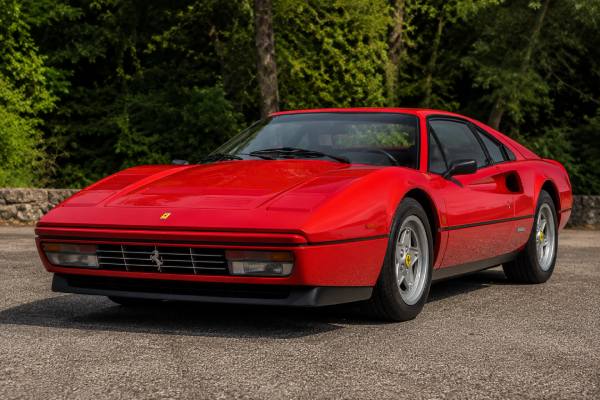
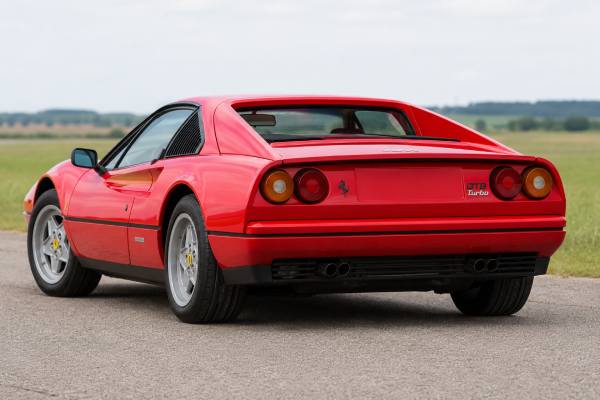
The Ferrari GTB Turbo, chassis type F 106 AB/TR, was the fixed-roof 2.0-litre turbocharged V8 Ferrari built from 1986 to 1989 for buyers who wanted 328-style pace without crossing Italy’s tax-heavy 2.0-litre displacement line. Its engine, the F 106 N 000, used Bosch K-Jetronic fuel injection, an intercooler, and a water-cooled IHI turbocharger to produce 254 metric horsepower from just 1,990.64 cc.
This car matters because it is not simply a smaller-engine 328 GTB. It is the final and most developed version of Ferrari’s Italian-market two-litre V8 idea, following the naturally aspirated 208 and the earlier 208 Turbo. It kept the compact Pininfarina berlinetta shape, added the cleaner 328-era bodywork, and delivered performance close to the 3.2-litre 328 while using a completely different power-delivery character. For collectors, the appeal is rarity: only 308 GTB Turbo coupés were built, far fewer than the open GTS Turbo and vastly fewer than standard 328 models.
Quick Take
The Ferrari GTB Turbo is a rare, Italy-focused 328-era berlinetta with a small-displacement, high-specific-output turbo V8 and a more technical personality than its naturally aspirated relatives. Its strongest appeal is the combination of low production, classic Pininfarina mid-engine proportions, and genuine 1980s turbo character. The main caution is that the parts, tuning, and inspection needs are more specialized than a normal 328, especially around the turbo system, fuel injection, cooling, and originality-sensitive trim.
Table of Contents
- Why the GTB Turbo Matters
- Engine, Chassis and Key Specifications
- Production, Variants and Factory Details
- Design, Engineering and Special Features
- Road Feel, Performance and Character
- Reliability, Maintenance and Restoration
- Market Value, Buying Guide and Rivals
Why the GTB Turbo Matters
The GTB Turbo matters because it turned Ferrari’s tax-driven two-litre V8 into a serious performance car. Earlier two-litre Ferraris existed mainly because Italian buyers faced heavy tax penalties on cars above 2.0 litres, but by 1986 the turbocharged and intercooled version had become fast, rare, and technically interesting in its own right.
The story begins with the 208 line. Ferrari created the 208 GTB and GTS as smaller-displacement versions of the 308, mainly for the domestic Italian market. The first naturally aspirated 2.0-litre V8 was exotic on paper but modest in output for a Ferrari. The 208 Turbo of 1982 fixed much of that problem by adding forced induction, becoming Ferrari’s first turbocharged road car. The 1986 GTB Turbo was the next step: a 328-era body and chassis, an improved turbo system, intercooling, and a higher-output F 106 N 000 engine.
Ferrari also changed the naming. The earlier car was called 208 GTB Turbo, but the facelifted model was usually badged simply GTB Turbo. That can confuse buyers because advertisements often mix 208 Turbo, GTB Turbo, 328 Turbo, and 2.0 Turbo wording. For this exact car, the important identifiers are the F 106 AB/TR chassis type, fixed-roof GTB body, 1986–1989 production period, and F 106 N 000 engine.
Its position in Ferrari history is unusual. It belongs visually and structurally to the 308/328 family, but its turbocharged engine links it to Ferrari’s broader 1980s forced-induction period, which also included Formula 1 turbo engines, the 288 GTO, and the F40. It was not designed as a homologation special like the 288 GTO, and it was not a flagship supercar like the F40. Its purpose was more practical: give Italian customers a Ferrari with tax-friendly displacement and proper performance.
Today, that narrow purpose makes it collectible. The GTB Turbo is rarer than the GTS Turbo and much rarer than the 328 GTB. It also appeals to buyers who want something less obvious than a standard 328, but still want the usability and familiar shape of Ferrari’s 1980s mid-engine V8 cars. It is best understood as a specialist collector Ferrari: not the fastest, not the most famous, but technically distinct, historically important, and easy to misjudge if judged only by displacement.
Engine, Chassis and Key Specifications
The GTB Turbo’s main technical story is its 1,990.64 cc turbocharged V8, which produced 254 metric horsepower and 328 Nm of torque. Those figures gave it performance very close to the larger 328 while creating a sharper boost-led character.
| Item | Specification |
|---|---|
| Production years | 1986–1989 |
| Body style | Two-seat fixed-roof berlinetta coupé |
| Chassis type | F 106 AB/TR |
| Engine code | F 106 N 000 |
| Engine layout | Rear-mid-mounted transverse 90-degree V8 |
| Displacement | 1,990.64 cc |
| Bore x stroke | 66.8 mm x 71.0 mm |
| Valvetrain | Double overhead camshafts, 2 valves per cylinder, 16 valves total |
| Fuel system | Bosch K-Jetronic mechanical fuel injection |
| Induction | Intercooled, water-cooled IHI turbocharger |
| Compression ratio | 7.5:1 |
| Power | 187 kW / 254 PS at 6,500 rpm |
| Torque | 328 Nm at 4,100 rpm |
| Transmission | 5-speed manual |
| Drivetrain | Rear-wheel drive |
The engine was an all-alloy V8 mounted transversely behind the cabin, paired with a five-speed manual transaxle. Ferrari used a relatively small displacement, low compression, and forced induction to create high specific output. The result was about 127 PS per litre, an impressive figure for a road car of the mid-1980s.
The intercooler is the major difference from the earlier 208 Turbo. By lowering intake-air temperature, it allowed Ferrari to increase performance and improve consistency. The IHI turbocharger also replaced the earlier KKK unit used on the first-generation 208 Turbo. These changes gave the later GTB Turbo stronger torque and cleaner response, though it still behaves like an old-school turbo car rather than a modern, always-on boosted engine.
| Item | Specification |
|---|---|
| Frame | Tubular steel chassis |
| Front suspension | Independent unequal-length wishbones, coil springs, telescopic dampers, anti-roll bar |
| Rear suspension | Independent unequal-length wishbones, coil springs, telescopic dampers, anti-roll bar |
| Brakes | Ventilated discs front and rear |
| Steering | Rack and pinion |
| Front tyres | 205/55 VR 16 |
| Rear tyres | 225/50 VR 16 |
| Wheelbase | 2,350 mm |
| Length | 4,255 mm |
| Width | 1,730 mm |
| Height | 1,128 mm |
| Dry weight | About 1,265 kg |
| Fuel capacity | 74 litres |
| 0–100 km/h | About 6.3 seconds |
| Top speed | 253 km/h |
The chassis layout was familiar Ferrari V8 practice: a compact tubular frame, double wishbones, coil springs, anti-roll bars, and four-wheel disc brakes. Unlike later Ferraris with more complex electronic systems, the GTB Turbo remains largely mechanical. That makes it engaging, but it also means the car’s condition matters enormously. A fresh, correctly set-up example feels alert and balanced; a tired one can feel laggy, loose, hot, and expensive.
Production, Variants and Factory Details
The GTB Turbo coupé was built in very small numbers, with 308 examples produced between 1986 and 1989. The open-roof GTS Turbo was more numerous, with 828 examples, making the fixed-roof GTB the rarer body style.
| Model | Years | Key identity | Production |
|---|---|---|---|
| 208 GTB Turbo | 1982–1985 | 308-era fixed-roof two-litre turbo | 437 examples |
| 208 GTS Turbo | 1983–1985 | 308-era targa two-litre turbo | 250 examples |
| GTB Turbo | 1986–1989 | 328-era fixed-roof intercooled two-litre turbo | 308 examples |
| GTS Turbo | 1986–1989 | 328-era targa intercooled two-litre turbo | 828 examples |
The distinction between early and late two-litre turbo Ferraris is important. The earlier 208 Turbo has sharper 308-style details, different cooling arrangements, and a lower-output non-intercooled engine. The later GTB Turbo has 328-style bodywork, a more integrated appearance, improved cooling, and the 254 PS intercooled engine. For buyers, this difference affects value, parts sourcing, and authenticity.
The GTB Turbo was left-hand drive and aimed mainly at Italy, although cars have since migrated across Europe, the UK, the Middle East, Japan, and North America. Many examples were originally delivered in familiar Ferrari colours such as Rosso Corsa, often with black, beige, cream, or tan leather interiors. Less common colour combinations can be attractive to collectors, but originality matters more than novelty.
The chassis number range is a useful screening tool, but it should not replace documentation. Ferrari road-car numbering changed during the period, and cars may have histories involving later registration, export, repainting, or restoration. A buyer should look for:
- chassis number consistent with the GTB Turbo production range
- engine number and gearbox number recorded in documentation
- Ferrari Classiche data, factory build information, or credible marque-specialist records
- original manuals, pouch, tool roll, jack, spare wheel equipment, and service book where available
- evidence that the car is a genuine GTB Turbo, not a modified 328, 208 Turbo, or misdescribed GTS Turbo
Factory details can matter more on this car than on a normal production Ferrari because many items are turbo-specific. The engine lid, intercooler ducting, rear bumper ventilation, boost gauge, turbo badging, exhaust layout, and engine-bay hardware are all part of the car’s identity. Missing or incorrect pieces can be difficult to replace.
Late-production cars may have details associated with the final 328-era updates, including ABS on some examples. Do not assume every late GTB Turbo has the same wheel, brake, or equipment specification. Verify the individual car through factory records, physical inspection, and period documentation.
Design, Engineering and Special Features
The GTB Turbo looks like a cleaner, sharper 328-era Ferrari, but its body details were shaped by the needs of the turbocharged two-litre engine. The most important design features are functional: they feed air, remove heat, and distinguish the car from a standard 328 GTB.
Pininfarina’s basic berlinetta shape remained low, compact, and balanced. The short nose, flying buttress rear quarters, side intakes, and flat rear deck give it the classic mid-engine Ferrari stance. Compared with the earlier 308-based 208 Turbo, the later GTB Turbo benefits from the smoother 328-style front and rear treatment, with body-coloured bumpers and a more integrated look.
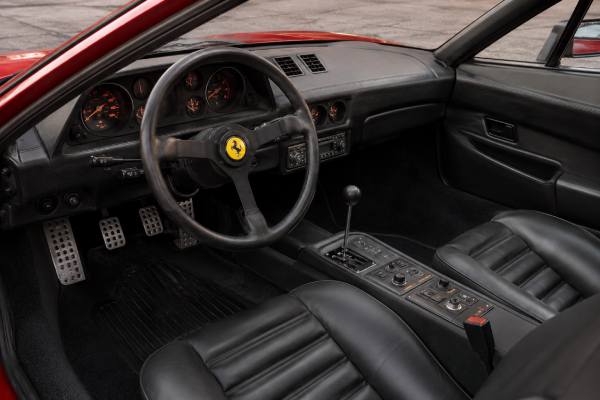
The turbo-specific features are easy to miss if the car is viewed quickly. NACA ducts ahead of the rear wheel openings help feed the intercooler and engine-bay airflow. The engine cover is reworked for the turbo installation. The rear bumper has additional ventilation, and the black roof spoiler gives the car a more purposeful profile. Inside, the boost gauge is one of the clearest signs that this is not a normal 328.
The engineering challenge was packaging. Ferrari had to place a turbocharger, intercooler, extra plumbing, heat shielding, and cooling support into a compact transverse V8 bay. Heat management is central to the car’s character. The engine bay is crowded, and the turbo system adds temperature stress to hoses, wiring, fuel lines, gaskets, and surrounding parts. That is why inspection of the engine bay is not cosmetic on a GTB Turbo; it is a core part of assessing the car.
The sound is also different from a 328. The naturally aspirated 3.2-litre V8 has a cleaner, more linear intake-and-exhaust voice. The GTB Turbo adds turbine noise, wastegate character, and a slightly muted exhaust note under some conditions. It can sound mechanical and urgent rather than purely musical. For some owners, that is the whole appeal. It feels like a bridge between traditional analogue Ferrari and the turbocharged performance thinking of the 1980s.
The cockpit is classic Ferrari V8: low seats, thin pillars by modern standards, a gated manual shifter, clear Veglia-style instruments, leather surfaces, and a driving position that rewards familiarity. It is not roomy, but it feels focused. Ergonomics are period-correct rather than modern. Switchgear, ventilation, seat adjustment, and pedal offset require tolerance, especially for taller drivers.
Because the GTB body has a fixed roof, it offers a slightly more cohesive feel than the GTS Turbo. The difference is not night-and-day in normal road use, but collectors often value the closed berlinetta shape for its cleaner lines and lower production number. That combination of rarity, visual purity, and turbo-specific engineering is the GTB Turbo’s design sweet spot.
Road Feel, Performance and Character
A healthy GTB Turbo feels quick, compact, and more dramatic than its displacement suggests. Its defining trait is not outright speed but the way power arrives: modest below boost, then increasingly urgent as the turbocharger wakes up.
The quoted 0–100 km/h time of about 6.3 seconds and 253 km/h top speed put it close to the larger 328 in period terms. The difference is delivery. A 328 builds power in a more progressive, naturally aspirated way. The GTB Turbo asks the driver to manage revs, throttle position, and boost. Below roughly the lower-middle rev range, it can feel civil and even restrained. Once the turbo is working, the car gains a harder edge and pulls with more torque than its small capacity suggests.
This makes gear choice important. The five-speed manual is central to the experience, not just a control. Keeping the engine in the right part of the rev range brings the chassis alive. Lazy driving can make the car feel softer than expected, while committed driving reveals why the model earned respect in period. The boost is not as sudden as some older turbo cars, but it is still clear enough to define the car.
Steering is unassisted rack-and-pinion, so it has weight at low speed and real feedback once moving. The front end feels light compared with front-engine GT cars, and the wheelbase is short enough to make the car feel agile on narrow roads. As with other 308/328-family Ferraris, the chassis rewards smooth inputs. The car is not best driven with abrupt throttle lifts or clumsy mid-corner corrections, especially on old tyres or damp roads.
Braking performance depends heavily on condition. The ventilated discs are suitable for fast road use, but old hoses, tired pads, aged fluid, and seized calipers can make a car feel far less confidence-inspiring than it should. A sorted example has a firm, progressive brake pedal. A neglected one may feel wooden or uneven.
Ride quality is better than many people expect from a 1980s Ferrari, provided the dampers, bushings, tyres, and alignment are correct. Over poor roads, worn suspension can make the car nervous. Old tyres are a major issue because even a low-mileage collector car can be unsafe or unpleasant if it sits on aged rubber. Correct-size, high-quality modern tyres often transform the car.
The cabin experience is intimate. Visibility is good forward and to the sides for a low mid-engine car, while rear visibility is more limited. Heat, noise, and ventilation are period Ferrari realities. Air conditioning should be judged as a classic-car system, not a modern climate-control unit. In city traffic, cooling-system health is vital; on open roads, the car is far happier.
The best GTB Turbo driving experience comes from a car that is used, warmed properly, and maintained by someone who understands Bosch mechanical injection and 1980s Ferrari turbo systems. It is not a car that enjoys long inactivity followed by hard use. It rewards mechanical sympathy.
Reliability, Maintenance and Restoration
The GTB Turbo can be dependable when maintained correctly, but it is not a low-risk classic Ferrari. The turbo hardware, age-sensitive fuel system, cooling demands, and rarity of model-specific parts make specialist inspection essential.
The base 308/328-family architecture is relatively straightforward by Ferrari standards. The transverse V8 layout gives better service access than some later engine-out Ferraris, and many chassis and suspension concepts are familiar to specialists. The problem is not basic design weakness. The problem is age, heat, parts scarcity, and uneven maintenance history.
Mechanical areas to inspect carefully
The engine needs a cold start, hot restart, compression or leak-down testing where appropriate, careful oil-pressure observation, and inspection for leaks. Blue smoke, heavy crankcase pressure, uneven idle, poor hot running, or boost inconsistency should not be dismissed as “normal old Ferrari” behaviour.
The timing belts, tensioners, cam seals, water pump, accessory belts, valve clearances, ignition components, and fuel lines should be treated as major-service items. Documentation matters. A seller saying “belts done” is not the same as invoices showing who did the work, when it was done, what parts were replaced, and whether related items were addressed.
The turbo system deserves its own inspection. Check shaft play, oil leakage, wastegate operation, boost control, intercooler condition, air hoses, clamps, heat shields, exhaust manifold condition, and signs of improvised repairs. Turbo-specific parts are not as easy to source as common 328 service pieces, so originality and completeness have real financial value.
Bosch K-Jetronic fuel injection can work very well, but it dislikes neglect, stale fuel, vacuum leaks, incorrect pressures, and amateur adjustment. Poor starting, flat spots, high fuel smell, or uneven boost fueling can require patient diagnosis. Fuel distributors, warm-up regulators, injectors, pumps, accumulators, and rubber hoses should be inspected by someone who knows the system.
Body, chassis and electrical risks
The tubular chassis and body should be checked for corrosion, accident damage, poor repairs, and distortion. Look closely around lower panels, sills, wheel arches, front compartment areas, suspension mounting points, door bottoms, screen surrounds, and jacking points. Many Ferraris of this era have had paintwork. A repaint is not automatically bad, but poor preparation, hidden rust, incorrect trim refitting, or mismatched panels can seriously reduce value.
Electrical issues are common on ageing 1980s Italian cars. Inspect fuse boxes, relays, connectors, cooling fans, window motors, lights, instruments, alternator output, grounds, and aftermarket alarm or stereo wiring. The boost gauge and turbo-related instrumentation should work correctly. Air conditioning, while rarely modern in performance, should at least be complete and functional if the car is priced as a strong example.
Interior restoration can be expensive. Leather shrinkage, sticky or faded plastics, warped trim, cracked switchgear, worn seat bolsters, sagging headliners, and incorrect retrims all affect value. Originality is important, but preservation must be balanced against usability. A beautifully retrimmed interior in the correct pattern and colour can be acceptable; a cheap retrim with wrong materials can hurt the car.
| Area | Why it matters | Buyer action |
|---|---|---|
| Timing belts and major service | Age-sensitive and central to engine health | Require dated specialist invoices, not verbal claims |
| Turbocharger and intercooler system | Model-specific and heat-stressed | Check boost behaviour, leaks, heat shielding, and originality |
| Bosch K-Jetronic injection | Reliable when correct, frustrating when misadjusted | Test cold start, hot start, idle, fuel pressure, and drivability |
| Cooling system | Turbo heat makes marginal cooling costly | Inspect radiator, fans, hoses, thermostat, water pump, and coolant history |
| Body and chassis | Rust or accident repairs can exceed normal service costs | Use a lift inspection and paint-depth readings |
| Turbo-specific trim | Rare parts can be difficult to replace | Verify engine lid, vents, badges, boost gauge, and exhaust details |
Restoration is rarely economical if the car is incomplete or heavily modified. A needy GTB Turbo can look tempting because it is rare, but engine work, turbo-system correction, paint, interior, suspension, brakes, and missing parts can quickly exceed the difference between a poor example and a good one. The best ownership strategy is to buy the most complete, best-documented car available.
Market Value, Buying Guide and Rivals
The GTB Turbo sits in a specialist corner of the Ferrari market: rarer than a 328, more technical than a 208 Turbo, and less universally known than either a 308 or 328. Value depends heavily on documentation, originality, condition, and whether buyers understand the model.
Recent public sales and listings show a wide range. Usable but imperfect cars can sell well below the best examples, especially if they have registration complications, long static storage, missing history, or obvious recommissioning needs. Well-documented cars with original colours, matching mechanical components, proper tools and books, strong service history, and recent specialist work can command much stronger money. Exceptional low-mileage or highly original cars may sit outside normal guide ranges because supply is so thin.
For most buyers, the right question is not “Is it cheaper than a 328?” but “Is it the correct GTB Turbo, and what will it cost to make it right?” A cheap car with old tyres, stale fuel, a tired turbo, overdue belts, weak cooling, and missing trim can become very expensive. A more costly car with recent engine-out-equivalent major work, fuel-system sorting, correct turbo hardware, strong documentation, and clean bodywork may be the better buy.
What to seek
Look for a car with a coherent story. The best examples usually have:
- matching chassis, engine, and gearbox evidence
- Ferrari Classiche data or credible factory build information
- long-term service records from Ferrari or respected specialists
- recent timing-belt, cooling, fuel, brake, and suspension work
- original colour combination or high-quality evidence of any changes
- complete turbo-specific hardware and trim
- original books, tools, jack, spare items, and period paperwork
- clean import, registration, tax, and title history
Mileage should be judged with care. Very low mileage can be attractive, but long periods of inactivity are risky. A regularly exercised, well-serviced 60,000 km car may be healthier than a 12,000 km car that has sat for years. On this model, condition and maintenance quality matter more than odometer bragging rights.
What to avoid
Avoid cars with unclear identity, missing engine numbers, badly modified turbo systems, non-original body vents, improvised exhausts, poor repainting, accident damage, incomplete paperwork, or a seller who cannot explain the difference between a 208 Turbo, GTB Turbo, and 328 GTB. Also be cautious with cars advertised using inflated power claims unless supported by proper dyno work and reversible modifications.
Modifications are a sensitive issue. Period-style upgrades such as improved cooling fans, modern hoses, better tyres, or discreet electrical improvements can improve usability. Major engine tuning, non-standard turbo conversions, aftermarket wheels, cut interiors, and poorly executed repainting usually reduce collector appeal. The car’s value is tied to its rarity and factory identity, so originality carries weight.
Rivals and alternatives
The closest Ferrari alternative is the 328 GTB. It is more familiar, naturally aspirated, easier for most buyers to understand, and often simpler to sell. The 328 GTS offers open-roof usability and much larger supply. The earlier 208 GTB Turbo is rarer in some forms and historically important as Ferrari’s first turbo road car, but it lacks the later car’s intercooler and 328-era refinement.
Outside Ferrari, the Porsche 911 Turbo 3.3 is the clearest period turbo rival, with greater fame and a very different rear-engine character. The Lotus Esprit Turbo offers mid-engine turbo drama at a different price and maintenance profile. The Lamborghini Jalpa brings Italian V8 rarity, but not the same Ferrari parts and specialist ecosystem. The Maserati Biturbo family shares the Italian forced-induction theme but occupies a very different market position and quality expectation.
The GTB Turbo is safest for a buyer who already likes 1980s Ferrari V8s and wants a rarer, more technical variant rather than a default choice. It is not the ideal first classic Ferrari for someone who wants the easiest ownership path. It is better suited to a collector who values small-production Ferrari history, understands the importance of specialist care, and is willing to wait for the right car.
Period safety expectations also matter. This is a compact 1980s sports car without modern stability control, modern crash electronics, or contemporary driver aids. Some late examples may have ABS-related equipment, but buyers should verify the individual car rather than assume. The best safety investment is mechanical condition: fresh tyres, correct brakes, sound suspension, proper alignment, reliable cooling, and a driver who respects boost and road conditions.
References
- Ferrari GTB Turbo (1986) – Ferrari.com 1986 (Manufacturer Specifications)
- Ferrari 208 GTB Turbo (1982) – Ferrari.com 1982 (Manufacturer Specifications)
- Ferrari GTS Turbo (1986) – Ferrari.com 1986 (Manufacturer Specifications)
- 1989 Ferrari GTB Turbo | Monaco 2024 | RM Sotheby’s 2024 (Auction Listing)
- Ferrari 208 & GTB/GTS Turbo Market – CLASSIC.COM 2026 (Market Data)
Disclaimer
This article is for informational purposes only and is not a substitute for professional diagnosis, inspection, maintenance, or repair. Specifications, torque values, service intervals, procedures, parts, and equipment can vary by VIN, market, production date, and individual vehicle history. Always verify details against official Ferrari service documentation and consult a qualified Ferrari specialist before buying, servicing, or restoring a GTB Turbo.
If this guide helped you, please consider sharing it on Facebook, X/Twitter, or your favourite car community to support our work.