
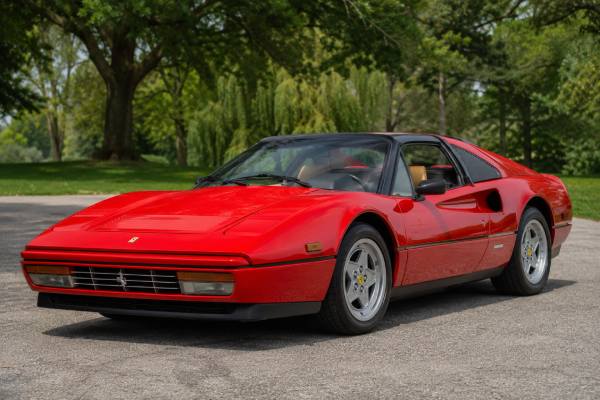
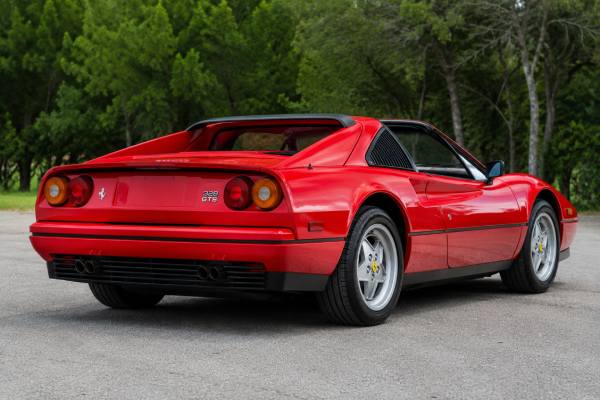
The Ferrari 328 GTS is the removable-roof version of Ferrari’s mid-engine V8 sports car built from 1985 to 1989, powered here by the F 105 CB 000 3.2-litre naturally aspirated V8 rated at 270 hp. It replaced the 308 GTS Quattrovalvole with a larger engine, smoother bodywork, improved cabin details, and a more polished road character while keeping the classic transverse V8 layout, gated manual gearbox, and Pininfarina shape that made the 308 family famous.
Its appeal today is easy to understand. The 328 GTS has the look and sound people expect from an eighties Ferrari, but it is generally less intimidating to maintain than many later mid-engine Ferraris. It is also condition-sensitive, documentation-sensitive, and increasingly treated as a collectible rather than just an older exotic. The best cars are not simply the shiniest ones; they are the ones with original identity, strong service history, correct details, healthy mechanical systems, and no hidden accident or corrosion story.
Quick Take
The Ferrari 328 GTS is one of the most usable classic mid-engine Ferraris: a 270 hp, 3.2-litre V8 targa with a gated five-speed gearbox, compact proportions, strong parts support, and a reputation for being robust when maintained properly. Its main tradeoff is that it is still a hand-built exotic with age-related fuel, cooling, electrical, suspension, interior, and bodywork risks. For buyers, originality, matching numbers, service records, roof and body condition, and specialist inspection matter more than mileage alone.
Table of Contents
- Model History and Why It Matters
- Engine, Chassis, and Key Specifications
- Production, Variants, and Factory Details
- Design, Engineering, and Special Features
- Driving Experience and Real Performance
- Reliability, Maintenance, and Restoration
- Market Value, Buying Guide, and Rivals
Model History and Why It Matters
The 328 GTS matters because it was the final development of Ferrari’s original 308-based mid-engine V8 line before the 348 moved the formula into a wider, more angular, more complex era. It kept the basic appeal of the 308 but made the car faster, easier to live with, and more mature without losing the compact feel that collectors now value.
Ferrari introduced the 328 series in 1985 as the successor to the 308 GTB and GTS Quattrovalvole. The name followed Ferrari’s simple period logic: “32” for about 3.2 litres and “8” for eight cylinders. GTB identified the fixed-roof berlinetta, while GTS identified the removable-roof targa-style version. The GTS became the more popular body style because it gave drivers open-air drama without turning the car into a full convertible.
The car sits in a very important place in Ferrari history. It arrived after the carburetted 308s, after the injected 308s, and after the four-valve 308 QV had restored much of the performance lost to emissions equipment. The 328 took that 32-valve V8 idea and added displacement, torque, better cooling, updated styling, improved ergonomics, and a more complete road-car feel.
It was also one of the last Ferraris developed and launched during Enzo Ferrari’s lifetime. That matters to many collectors, even though it should not be the only reason to buy one. More practically, the 328 is admired because it combines old-school Ferrari character with a level of usability that earlier cars do not always provide. It has mechanical fuel injection rather than carburettors, a strong five-speed manual gearbox, a compact steel body, and a service layout that does not usually require removing the engine for routine belt work.
The 328 GTS was not a motorsport special, and it was not built as a limited-edition collector car. Its importance comes from being a beautifully resolved road Ferrari. It is the refined final chapter of a design language that started with the 308 GTB in the mid-1970s and became one of the most recognizable Ferrari shapes of the late twentieth century.
Today, buyers care about the 328 GTS for several overlapping reasons:
- It has the classic Ferrari wedge shape without the extreme values of earlier rare models.
- It uses a naturally aspirated V8 with a mechanical, high-revving personality.
- It has a gated manual gearbox, now a major collector-car value factor.
- It is generally considered more approachable to own than some later mid-engine Ferraris.
- It offers a strong link to the 308 but with better performance and refinement.
- It has enough production volume for parts support and market liquidity, but good examples are still scarce.
The 328 GTS is often described as a “usable classic Ferrari,” but that phrase needs context. It is usable compared with many exotics, not compared with a modern sports car. It still needs careful warm-up, proper fluids, experienced technicians, and regular use. A neglected 328 can quickly become more expensive than a better car bought at a higher price.
Engine, Chassis, and Key Specifications
The core of the 328 GTS is its F 105 CB 000 V8: a 3.2-litre, naturally aspirated, transverse-mounted engine behind the cabin and ahead of the rear axle. It is the main reason the car feels more flexible and more complete than the 308 QV it replaced.
| Item | Specification |
|---|---|
| Engine code | F 105 CB 000 |
| Configuration | Rear-mid, transverse 90-degree V8 |
| Displacement | 3,185.76 cc |
| Bore x stroke | 83 mm x 73.6 mm |
| Valve gear | Double overhead camshafts per bank, four valves per cylinder |
| Fuel system | Bosch K-Jetronic mechanical fuel injection |
| Ignition | Marelli electronic ignition |
| Lubrication | Wet sump |
| Maximum power | 270 hp at 7,000 rpm |
| Maximum torque | 304 Nm at 5,500 rpm |
| Transmission | Five-speed manual with gated shifter |
| Drive | Rear-wheel drive |
The chassis follows Ferrari’s familiar period layout: a tubular steel structure with independent suspension at all four corners. The engine and gearbox are mounted as a compact transverse unit, which helps keep the wheelbase short and the car agile. The five-speed gearbox sits below and behind the engine, and the shift gate gives the car much of its mechanical charm.
| Item | Specification |
|---|---|
| Chassis family | F106 series; GTS designation commonly associated with F 106 MS 100 for main European-market cars |
| Body style | Two-seat targa-top coupé |
| Frame | Tubular steel |
| Front suspension | Independent unequal-length wishbones, coil springs, telescopic dampers, anti-roll bar |
| Rear suspension | Independent unequal-length wishbones, coil springs, telescopic dampers, anti-roll bar |
| Steering | Unassisted rack and pinion |
| Brakes | Vented discs front and rear |
| Front tyres | 205/55 VR 16 |
| Rear tyres | 225/50 VR 16 |
| Length | 4,255 mm |
| Width | 1,730 mm |
| Height | 1,128 mm |
| Wheelbase | 2,350 mm |
| Fuel tank | 74 litres |
| Dry weight | About 1,273 kg |
Performance figures vary slightly by market, test conditions, and source, especially for U.S.-market cars with emissions equipment. For the 270 hp European-specification car, Ferrari’s headline top speed was 263 km/h. The usual 0–100 km/h figure is around 6.4 seconds, though some period road tests recorded slightly different results.
| Measure | Figure |
|---|---|
| Top speed | 263 km/h |
| 0–100 km/h | About 6.4 seconds |
| 0–400 m | About 14.3 seconds |
| 0–1,000 m | About 25.7 seconds |
The numbers are not shocking by modern standards, but they do not explain the car’s appeal. The 328 GTS is light, compact, low, and mechanical. It rewards accurate inputs and gives the driver far more physical feedback than a modern dual-clutch supercar.
Production, Variants, and Factory Details
The 328 GTS was the higher-volume 328 body style, with 6,068 GTS examples built compared with 1,344 GTB coupés. That makes it easier to find than the GTB, but top-quality, original, well-documented GTS examples are still carefully watched by collectors.
The 328 range was built from 1985 to 1989. The GTS used a removable roof panel that could be stored behind the seats, giving it a more open feel than the closed GTB. The two versions shared the same basic mechanical package, but the GTB’s fixed roof gives it a slightly different structural feel and greater rarity. For many buyers, the GTS is the more enjoyable road car; for some collectors, the GTB’s lower production number makes it more tempting.
A few details matter when identifying and judging a 328 GTS:
- The car should have a correct chassis identity for its market and body type.
- The engine number should be checked against documentation, not just accepted from a listing.
- Market specification affects power, emissions equipment, lighting, bumpers, instruments, and value.
- Late cars can have anti-lock brakes and related wheel and suspension changes.
- Right-hand-drive GTS examples are much rarer than left-hand-drive cars.
- Factory books, tools, jack, manuals, pouch, warranty records, and original order documents add value.
The late-production ABS cars are a notable subset. Anti-lock braking arrived late in the 328’s production life, along with associated changes such as convex wheel design and revised suspension geometry. Some buyers like the later cars because they feel more developed and have the added safety system. Others prefer earlier cars for the cleaner original layout. Neither choice is automatically better; condition and documentation matter more.
Factory options and market equipment were modest by modern Ferrari standards. Air conditioning is common and highly desirable for usability. Leather interior trim, carpets, wheel design, rear aerofoil spoiler, radio equipment, and market-specific emissions or lighting details all matter when judging originality. Some cars have later stereo systems, aftermarket alarm wiring, non-original wheels, sports exhausts, or altered suspension. Those changes may improve usability, but they should be understood and priced correctly.
Original colour also affects desirability. Rosso Corsa over tan or cream leather is the classic poster-car combination and remains easy to sell. Black, silver, blue, white, and other colours can be very attractive, especially when original to the car and supported by documents. A rare colour is not automatically more valuable if the repaint quality is poor or the history is weak.
Matching numbers are increasingly important. A 328 GTS is not as rare as a 275 GTB or Daytona, but it is now valuable enough that identity details matter. Buyers should verify:
- chassis number
- engine number
- gearbox identity where possible
- original colour and trim
- market delivery specification
- ownership history
- service book entries
- major invoices
- inspection reports
- Ferrari Classiche certification where available or desirable
A complete history file can separate a strong car from a risky one. A car with ordinary mileage, original paint where possible, regular maintenance, and honest records can be more attractive than a low-mileage car that sat unused for years and now needs fuel-system, brake, tyre, belt, cooling, and suspension work.
Design, Engineering, and Special Features
The 328 GTS is visually close to the 308, but its details are smoother, cleaner, and more integrated. Pininfarina retained the familiar wedge profile and side intake shape while modernising the bumpers, nose, tail, lighting, and cabin finish.
The biggest design change is the body-coloured treatment of the bumpers and lower panels. Earlier 308s have a more separate bumper look, especially in some markets. The 328 blends those elements into the body, giving the car a more unified appearance. The nose is softer, the tail is cleaner, and the car feels less like a 1970s design updated for the 1980s and more like a properly finished late-eighties Ferrari.
The GTS roof panel is central to the car’s identity. It gives the car open-air character without requiring a full convertible structure. The panel is removable rather than folding, so it is simple and light, but it also depends on good seals, careful storage, and correct fit. A poorly adjusted or damaged roof panel can create wind noise, water leaks, paint marks, and annoying rattles.
The body is mostly steel, with aluminium used for certain panels such as the front lid. This matters for inspection because corrosion, accident repair, and panel alignment require specialist attention. The 328 is better protected than earlier Ferraris, but it is not immune to rust. Cars that have lived in wet climates or have been stored badly need careful checking underneath, around seams, around the windscreen, near the lower doors, and in the sills.
Mechanically, the 328’s engineering is simple by modern exotic standards but sophisticated for its period. The four-valve-per-cylinder V8 breathes well at high rpm, while Bosch K-Jetronic injection gives more predictable starting and running than carburettors when the system is healthy. The engine does not have the instant low-rpm torque of a modern turbocharged car, but it is more flexible than a 308 QV and feels eager once the revs build.
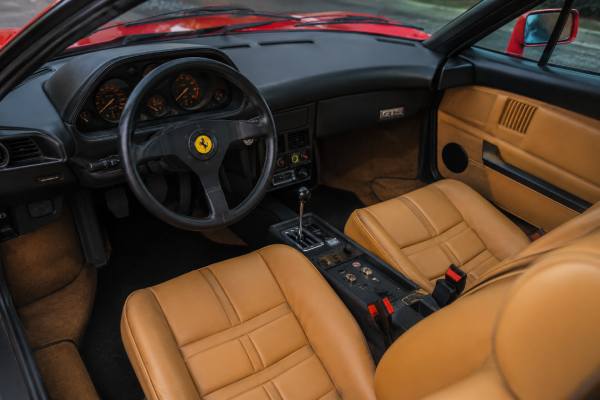
The cockpit is low, narrow, and purposeful. The driver faces clear analogue instruments, a thin-rim steering wheel on many cars, and the famous metal shift gate. Visibility is better than many later supercars because the car is compact and the glass area is generous. The driving position is not perfect for every body type, and tall drivers should sit in the exact car before committing. Pedal offset and steering-wheel position are part of the old Ferrari experience.
The car’s signature sensory features are not gimmicks. The intake sound behind the cabin, the metallic click of the gearlever through the gate, the unassisted steering, and the compact body all define the 328 GTS. Modern cars are faster, safer, and easier, but few make low-speed driving feel as mechanical and deliberate.
Driving Experience and Real Performance
A good 328 GTS feels precise, light, and alive rather than brutally fast. Its performance is best understood as classic analogue speed: modest by modern supercar numbers, but involving because the driver works directly with the engine, gearbox, steering, and brakes.
The V8 needs revs. Below the middle of the tachometer it is flexible enough for normal driving, but the car comes alive as it climbs toward the upper range. The 3.2-litre engine has more torque than the 308 QV, so it is easier to drive in traffic and on flowing roads, but it still rewards drivers who keep it in the right gear.
The gated five-speed manual is a major part of the experience. It is not supposed to feel like a modern short-throw shifter. When cold, second gear can be reluctant, and forcing it is poor technique. Many owners shift from first to third until the gearbox oil warms. Once warm and properly adjusted, the shift should feel clean, deliberate, and satisfying.
The steering is unassisted, which means effort is noticeable at parking speeds. Once moving, it becomes one of the car’s best features. The front end feels light but communicative, and the driver gets clear information through the wheel. Tyre choice and suspension condition have a large effect. Old tyres, hardened bushings, incorrect ride height, or poor alignment can make a 328 feel nervous or dull.
The ride is firm but not punishing when the suspension is healthy. The car was designed for real roads, not only smooth tracks. It feels narrow and easy to place compared with modern wide Ferraris. That compactness is a major reason many drivers enjoy the 328 on mountain roads and smaller back roads.
Braking performance is period-correct. The vented discs are capable for fast road use when the system is fresh, but the feel and stopping power are not like a modern car with large carbon-ceramic brakes and stability control. Brake hoses, fluid, pads, calipers, discs, and tyre age all matter. A car that has been sitting may stop poorly until properly recommissioned.
The GTS roof changes the cabin experience. With the panel removed, the car feels more dramatic and the engine sound is more present. With the roof in place, expect more cabin noise than a modern coupé. Some wind noise and mechanical sound are normal, but heavy rattles, water leaks, or poor roof fit suggest adjustment or seal issues.
The 328 GTS is not a relaxed city car in modern terms. The clutch, steering, heat, visibility over the low nose, and gearbox all require attention. But it is usable enough for regular fair-weather drives, events, touring, and weekend trips if maintained properly. The healthiest cars are often the ones that are driven regularly and serviced correctly, not the ones that sit untouched for years.
Reliability, Maintenance, and Restoration
The 328 GTS has a strong reputation among classic Ferraris, but that does not make it cheap to own. Its reliability depends on regular specialist maintenance, fresh age-sensitive parts, correct setup, and avoiding deferred work disguised as “low mileage.”
The engine itself is robust when serviced. The major maintenance item is the timing-belt system, including belts, tensioner bearings, cam seals, and related inspection work. One advantage of the 328 over some later mid-engine Ferraris is that routine belt service can generally be done with the engine in the car. That reduces labour compared with engine-out models, but it is still a specialist job.
Important mechanical areas include:
- Timing belts, tensioners, cam seals, and valve adjustment.
- Water pump, radiator, fans, coolant hoses, and thermostat.
- Fuel injectors, accumulator, warm-up regulator, fuel lines, and tanks.
- Ignition modules, coils, plug leads, sensors, and grounds.
- Clutch wear, cable or hydraulic condition depending on specification, and release bearing noise.
- Gearbox synchros, especially cold second-gear behaviour.
- Engine mounts and exhaust mounts.
- Oil leaks from cam covers, seals, sump areas, and gearbox joints.
Fuel-system condition deserves special attention. Bosch K-Jetronic can work very well, but old hoses, stale fuel, dirty injectors, weak pumps, and incorrect pressures cause hard starting, rough running, hesitation, and poor hot restart behaviour. Any smell of fuel should be treated seriously.
Cooling systems are another major ownership area. A 328 should not overheat when the radiator, fans, relays, hoses, cap, thermostat, and coolant passages are healthy. Cars that run hot in traffic may need more than a simple coolant change. Old hoses hidden in difficult areas can fail without much warning.
Electrical issues are common in old exotics. The fuse and relay panel, grounds, window motors, switches, fans, lighting, alternator, starter, and added alarm or stereo wiring should all be inspected. Slow windows are common, but they can point to tired motors, old grease, poor wiring, or alignment issues. Untidy aftermarket wiring lowers confidence.
The body and chassis need a different kind of inspection. Accident damage can be more serious than normal wear because panel fit, chassis tubes, suspension pickup points, and paint quality all affect value. Rust is less dramatic than on some older Ferraris, but it still appears. Check the lower doors, sills, wheel arches, front compartment, windscreen surround, floor areas, battery area, and places where trim traps moisture.
Interior restoration can be expensive. Leather shrinks, dashboards pull, seat bolsters wear, carpets fade, switchgear ages, and roof seals harden. Original interiors with honest patina are often preferable to over-restored cabins with incorrect materials. Buyers should be wary of fresh retrims that hide water leaks or poor storage history.
A proper pre-purchase inspection should include:
- Cold start from overnight, not a pre-warmed demonstration.
- Compression or leak-down testing when condition is uncertain.
- Inspection for fuel smell, oil leaks, coolant leaks, and exhaust smoke.
- Gearbox check when cold and warm.
- Brake, steering, tyre, wheel bearing, and suspension assessment.
- Underside inspection on a lift by someone familiar with Ferrari tubular chassis cars.
- Paint-depth readings and panel-gap review.
- Verification of engine number, chassis number, books, tools, manuals, and invoices.
Restoration choices should be made carefully. Mechanical upgrades such as modern tyres in correct sizes, improved cooling fans, or discreet fuse-panel improvements may make sense for driving. But visible non-original changes, incorrect wheels, poor repainting, modified interiors, and missing factory equipment can reduce collector appeal.
Market Value, Buying Guide, and Rivals
The 328 GTS market rewards originality, condition, documentation, colour, mileage, and recent specialist maintenance. Public market data in May 2026 showed ordinary driver-quality cars trading far below exceptional low-mileage or unusually preserved examples, so one average price never tells the whole story.
A realistic buying view is to split cars into broad groups:
| Type of Car | What It Usually Means | Buyer Risk |
|---|---|---|
| Project or neglected car | Needs recommissioning, cosmetics, records, or mechanical sorting | High; can exceed the cost of buying a better car |
| Driver-quality car | Usable, some wear, decent history, not concours | Moderate; inspection and recent service matter |
| Strong collector-driver | Good records, correct details, fresh maintenance, attractive colours | Lower, but still condition-dependent |
| Exceptional preserved car | Low mileage, complete accessories, high originality, documented history | Low mechanically only if maintained; high premium risk if overpaid |
The biggest value drivers are not complicated:
- original colour and trim
- matching engine and correct identity
- full service history
- recent belt and fluid service
- books, tools, jack, pouch, manuals, and records
- low but believable mileage
- no major accident history
- no corrosion story
- clean roof fit and seals
- correct wheels and market equipment
- high-quality paint if repainted
- Ferrari Classiche certification where appropriate
Cars to avoid include those with missing records, unclear import history, inconsistent mileage, poor paintwork, bad panel alignment, hot-running behaviour, fuel smell, non-functioning electrical systems, damaged roof panels, or sellers who discourage specialist inspection. A cheap 328 GTS can be a very expensive Ferrari if it needs belts, tyres, brakes, hoses, suspension, fuel-system work, interior work, paint correction, and documentation recovery all at once.
Market context also matters. The GTS is more common than the GTB, but it is also more widely wanted by drivers. The GTB may carry extra appeal for collectors who prioritize rarity and fixed-roof purity. The GTS carries extra appeal for buyers who want the classic Ferrari image and open-air driving.
Closest Ferrari alternatives include the 308 GTS Quattrovalvole, 328 GTB, Mondial 3.2, 348 TS, and early F355. The 308 QV is slightly older in feel and usually less powerful. The 328 GTB is rarer and more structurally closed-in. The Mondial 3.2 offers related mechanical character with more cabin space but a different image. The 348 is more modern and more dramatic, but it is also more complex and can be more demanding. The F355 is faster and more exotic, but ownership costs are usually higher.
Period non-Ferrari rivals include the Porsche 911 Carrera 3.2, Lamborghini Jalpa, Lotus Esprit Turbo, and later Acura NSX as a different kind of mid-engine benchmark. The Porsche is easier to use and often cheaper to maintain. The Jalpa is rarer and more unusual but has a narrower market. The Esprit is dramatic and sharp but has its own specialist needs. The NSX is more modern, easier, and more reliable, but it does not offer the same old-world Ferrari feel.
The 328 GTS is best bought as a high-quality example, not as a bargain. The right car should feel tight, start cleanly, idle properly, run cool, shift well when warm, stop straight, track confidently, and show a history file that supports the seller’s claims. The wrong car will still look beautiful in photographs, which is exactly why inspection matters.
For long-term collectability, the 328 GTS has a strong foundation. It is a recognizable Pininfarina Ferrari with a naturally aspirated V8, gated manual gearbox, manageable size, clear model identity, and broad enthusiast demand. It is not rare enough for every car to be precious, so condition will keep separating values. The best examples should remain desirable because they offer something newer Ferraris cannot easily recreate: compact analogue performance, mechanical involvement, and the final polish of the 308-derived line.
References
- Ferrari 328 GTS (1985) – Ferrari.com 1985 (Manufacturer Specifications)
- Ferrari 328 GTS: Ferrari History 1985 (Manufacturer History)
- Ferrari 328 GTS Market – CLASSIC.COM 2026 (Market Data)
- 1988 Ferrari 328 GTS | Cliveden House 2025 | RM Sotheby’s 2025 (Auction Reference)
- Safer Car Vehicle Safety, Ratings and Recalls | NHTSA 2026 (Recall Database)
Disclaimer
This article is for informational purposes only and is not a substitute for professional diagnosis, repair, appraisal, or pre-purchase inspection. Specifications, torque values, service intervals, procedures, equipment, and identification details can vary by VIN, market, production date, and factory specification. Always verify critical information against the official service documentation for the exact car and consult a qualified Ferrari specialist before buying, repairing, or restoring a Ferrari 328 GTS.
If you found this guide useful, please consider sharing it on Facebook, X/Twitter, or your preferred car community to support our work.