
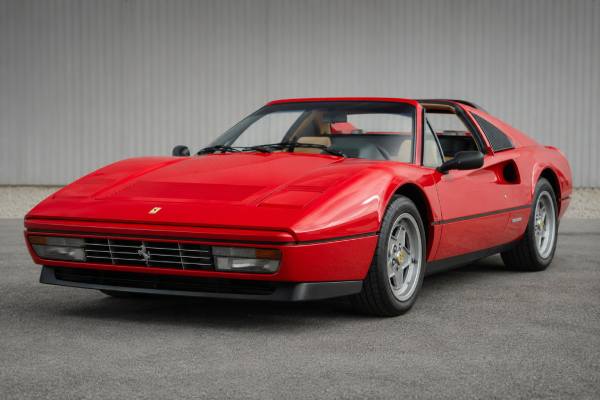
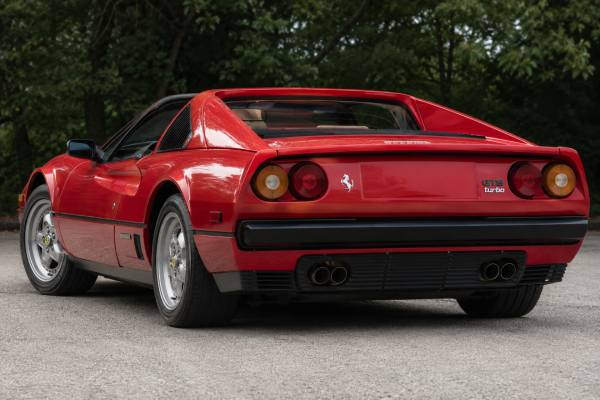
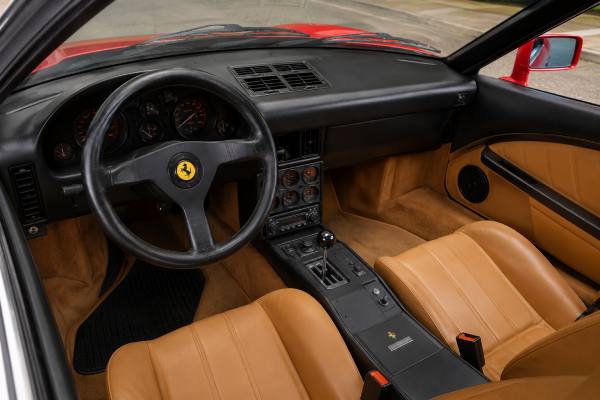
The Ferrari GTS Turbo (F 106 AS/TR) is the open-roof, 328-based two-seat Ferrari built from 1986 to 1989 for markets where a two-litre engine brought a major tax advantage. Its engine, the F 106 N 000, is a 1,991 cc turbocharged V8 rated at 254 PS, or about 251 bhp, and it gives the car a very different personality from the naturally aspirated 328 GTS that shares much of its body, chassis layout, and cabin architecture.
This is one of Ferrari’s most interesting 1980s special-market cars because it combines classic Pininfarina 328 styling, a removable targa roof, a gated manual gearbox, rear-wheel drive, and a small-displacement turbo V8 with unusually high specific output for its period. It was created mainly for Italy’s tax rules, but today it attracts buyers for a different reason: rarity, mechanical character, and the link between Ferrari’s road-going turbo experiments and the wider turbo era that produced cars like the 288 GTO and F40.
The GTS Turbo is not simply a cheaper 328 with a smaller engine. It is a narrow-purpose Ferrari with specific body details, a unique engine code, dedicated chassis identification, and maintenance needs that reward careful ownership. Its appeal depends heavily on condition, documentation, originality, and whether the turbocharged fuel-injection system has been maintained by people who understand it.
Quick Take
The Ferrari GTS Turbo’s strongest appeal is its mix of 328-era looks, open-roof usability, and rare two-litre turbocharged V8 character. It is historically important as Ferrari’s final Italian-market “tax break” V8 and technically interesting because the F 106 N 000 engine uses Bosch mechanical injection, a Behr intercooler, and a water-cooled IHI turbo to deliver near-328 performance from only 1,991 cc. The tradeoff is ownership sensitivity: tired cooling, fuel, ignition, turbo, and belt-service work can quickly erase any saving over a regular 328, so the best cars are original, well documented, regularly serviced, and inspected by a Ferrari specialist before purchase.
Table of Contents
- Model History and Significance
- Engine, Chassis and Key Specs
- Production, Variants and Options
- Design, Engineering and Features
- Driving Character and Performance
- Maintenance, Restoration and Reliability
- Market Values, Buying and Rivals
Model History and Significance
The GTS Turbo matters because it was Ferrari’s last mid-engined two-litre tax-special V8 and one of the rarest open-roof derivatives of the 308/328 family. It replaced the earlier 208 GTS Turbo and brought the idea into the sharper, more modern 328 generation.
The reason for the car was Italy’s tax system. Larger-displacement private cars faced heavier taxation, so Ferrari built sub-two-litre versions for the domestic market. The idea began with the 208 GT4 in the 1970s, continued through the 208 GTB and GTS, then became more serious when turbocharging arrived in the early 1980s. By 1986, Ferrari had the 328 in production, and the company adapted that platform into the GTB Turbo coupe and GTS Turbo targa.
The GTS Turbo was launched in 1986 and stayed in production until 1989, when the 348 replaced the 328 family. It occupied a narrow place in Ferrari’s catalogue: a smaller-engined, turbocharged alternative to the naturally aspirated 328 GTS, aimed mainly at buyers who wanted Ferrari performance while staying under the two-litre tax threshold.
Its significance is partly technical. A 1,991 cc V8 producing 254 PS was remarkable in the mid-1980s. It gave the GTS Turbo a power-per-litre figure of roughly 127 PS per litre, a figure that still looks strong for a road car of the period. The car also arrived during a moment when Ferrari had deep turbocharging knowledge from Formula 1 and the 288 GTO program, even though the GTS Turbo itself was a road-biased, production sports car rather than a homologation special.
It is also significant because it is easy to misunderstand. Many listings call it a 208 GTS Turbo, especially because it belongs to the two-litre Ferrari line, but the 1986–1989 328-based car was commonly presented as the GTS Turbo. The chassis reference F 106 AS/TR helps identify the open-roof Turbo version, while the engine code F 106 N 000 separates it from both the earlier 208 Turbo engines and the naturally aspirated 328’s 3.2-litre V8.
Today the GTS Turbo sits in an interesting collector position. It is rarer than a normal 328 GTS, more obscure than an F40 or 288 GTO, and less universally understood than a standard 308 or 328. That makes buyer knowledge important. A good example offers distinctive Ferrari history and a lively driving experience; a neglected one can become a complex restoration project with a smaller pool of specialists and parts knowledge than the mainstream 328.
Engine, Chassis and Key Specs
The heart of the GTS Turbo is the F 106 N 000, a transverse mid-mounted 1,991 cc V8 with Bosch K-Jetronic fuel injection, intercooling, and a water-cooled IHI turbocharger. It sends power to the rear wheels through a gated five-speed manual gearbox and a limited-slip differential.
| Item | Specification |
|---|---|
| Production years | 1986–1989 |
| Body style | Two-seat targa, removable roof panel |
| Chassis type | F 106 AS/TR |
| Engine code | F 106 N 000 |
| Engine layout | Rear mid-mounted, transverse 90-degree V8 |
| Displacement | 1,991 cc |
| Bore x stroke | 66.8 mm x 71.0 mm |
| Valvetrain | 16 valves, belt-driven camshafts |
| Induction | Water-cooled IHI turbocharger, Behr intercooler |
| Fuel system | Bosch K-Jetronic mechanical fuel injection |
| Compression ratio | 7.5:1 |
| Power | 254 PS at 6,500 rpm |
| Torque | 328 Nm at 4,100 rpm |
| Transmission | Five-speed manual |
| Drivetrain | Rear-wheel drive |
The engine’s numbers tell only part of the story. The GTS Turbo was not designed to outgun the 328 GTS on paper. Ferrari could have extracted more power from the turbo system, but the car was tuned to sit close to the 328’s performance while keeping the engine below two litres. That made it usable, quick, and tax-efficient without turning it into a fragile boost monster.
The chassis followed the familiar 328 pattern: a tubular steel structure, independent suspension, vented disc brakes, unassisted rack-and-pinion steering, and 16-inch alloy wheels. The suspension used unequal-length wishbones, coil springs, telescopic dampers, and anti-roll bars at both ends. This gave the GTS Turbo the same broad mid-engined balance that made the 308 and 328 family so popular.
| Area | Detail |
|---|---|
| Wheelbase | 2,350 mm |
| Length | 4,255 mm |
| Width | 1,730 mm |
| Height | 1,128 mm |
| Dry weight | About 1,275 kg |
| Fuel capacity | 74 litres |
| Front tyres | 205/55 R16 |
| Rear tyres | 225/50 R16 |
| Top speed | About 253 km/h |
| 0–100 km/h | About 6.3 seconds |
The quoted figures vary slightly by source and testing conditions, but the broad picture is clear. The GTS Turbo was a genuinely fast 1980s sports car, not a slow tax workaround. It delivered performance close enough to the 328 GTS to make the smaller displacement feel like clever engineering rather than compromise.
Production, Variants and Options
The GTS Turbo was the removable-roof version of Ferrari’s 1986–1989 GTB/GTS Turbo pair. Ferrari built far fewer of these cars than regular 328 GTS models, with widely cited production totals of 828 GTS Turbo examples and 308 GTB Turbo coupes.
The GTS Turbo used the F 106 AS/TR chassis designation, while the fixed-roof GTB Turbo used F 106 AB/TR. Both were left-hand drive, and both were closely related to the 328 in structure, cabin layout, and exterior proportions. The GTS is the more open, leisure-oriented version thanks to its removable roof panel, while the GTB is the rarer coupe.
For identification, the most important clues are:
- Chassis type F 106 AS/TR for the targa GTS Turbo.
- Engine code F 106 N 000.
- Two-litre turbocharged V8 rather than the 3.2-litre 328 engine.
- NACA-style side intake ducts ahead of the rear wheelarches.
- Raised engine cover to clear the intercooler.
- Five cooling slots in the rear bumper.
- Standard black rear roof spoiler.
- Boost gauge in the instrument cluster.
- Turbo script and Turbo-specific cabin details.
Because the car is rare and often advertised under slightly different names, documentation matters. A seller may describe the same basic model as a Ferrari GTS Turbo, 208 GTS Turbo, GTS Turbo Intercooler, or 328-based GTS Turbo. The name on a sales listing is less important than the chassis, engine, factory papers, original books, service file, and physical details.
Factory options were typical for an upper-level Ferrari of the period. Depending on market and individual car, buyers could specify items such as leather upholstery, metallic paint, air-conditioning, fitted luggage, Pirelli tyres, and extended leather trim. Many surviving cars have had trim work, stereos, tyres, exhaust parts, and air-conditioning systems changed over the decades, so a buyer should separate factory specification from later improvements.
Originality carries real value here. The strongest cars usually have:
- Matching engine and chassis identity.
- Correct Turbo body panels and cooling details.
- Original colour and trim, or documented factory colour changes.
- Owner’s manual, tool kit, jack kit, books, and service records.
- Evidence of timing-belt, cooling-system, fuel-system, and turbo maintenance.
- No hidden accident repair around the front structure, sills, rear quarters, or engine bay.
Late-production cars can differ in small details, and some market descriptions mention ABS-era wheel and suspension changes on related 328-family cars. Do not assume those features from the model year alone. On a GTS Turbo, verify equipment by VIN, factory records, physical inspection, and a specialist who knows the 1986–1989 Turbo cars.
Design, Engineering and Features
The GTS Turbo looks familiar because it shares the 328 family’s clean Pininfarina shape, but its cooling details and raised engine cover give it a distinct identity. The design is restrained by modern supercar standards, yet every Turbo-specific change has a practical purpose.
The 328 shape was an evolution of the long-running 308 design, with smoother bumpers, cleaner surfaces, and a more integrated 1980s look. The GTS Turbo kept that low wedge profile, pop-up headlights, wide rear haunches, and targa roof format. The removable roof panel made the car more relaxed and scenic than the GTB, but it also means buyers must check roof seals, storage condition, wind noise, and evidence of water leaks.
The most visible engineering change is cooling. A turbocharged mid-engined car has to manage intake temperature and engine-bay heat, especially when packaging space is tight. Ferrari added side NACA ducts to feed the intercooler and reshaped the engine cover with a taller bulge. The rear bumper’s extra louvres help extract heat, and the black rear spoiler became a standard visual signature.
Inside, the GTS Turbo is mostly 328 in feel: low seating, slim pillars by modern standards, a gated shifter, analogue instruments, and a cabin that rewards familiarity rather than offering instant ergonomic perfection. The boost gauge is one of the key Turbo-specific details. It changes how the driver reads the car, because engine load and turbo behaviour become part of the experience rather than hidden background events.
The engine bay is the most distinctive part of the car. The small V8’s alloy intake casting, intercooler plumbing, turbo hardware, and fuel-injection layout create a more technical look than the naturally aspirated 328. It is also more demanding. Heat shielding, vacuum lines, boost hoses, fuel pressure, ignition health, and cooling efficiency all matter because a turbocharged, mechanically injected engine is less forgiving of neglect than a simpler carbureted or naturally aspirated setup.
The exhaust and induction sound are different from a 328. The GTS Turbo does not have quite the same broad, naturally aspirated V8 voice. Instead, it blends Ferrari V8 tone with turbo whistle, boost rise, and a slightly harder-edged mechanical feel. That character is a major reason enthusiasts seek the car out.
Driving Character and Performance
The GTS Turbo drives like a classic analogue Ferrari with an added layer of turbo timing and torque. It is quick by 1980s standards, but its real charm is the way the small V8 builds urgency once the turbo is awake.
At low rpm, the two-litre engine is not as instantly muscular as a 3.2-litre 328. It needs revs, clean fueling, and the right gear. Below the boost threshold, it feels lighter and more delicate than its numbers suggest. As revs rise and boost builds, the car becomes much more serious. The torque peak at around 4,100 rpm gives it a strong midrange surge, while peak power at 6,500 rpm encourages the driver to keep the engine working.
The five-speed gated manual is central to the experience. Like many Ferraris of this period, it prefers patience when cold. Second gear can feel reluctant until the transaxle oil has warmed. A good car rewards measured inputs and clean timing; a worn car may feel obstructive, vague, or noisy. Buyers should not dismiss all cold stiffness as a fault, but grinding, jumping out of gear, heavy clutch action, or poor engagement need specialist investigation.
Steering is unassisted and full of period feedback. At parking speeds it takes effort, especially with modern tyres, but on the move it becomes one of the car’s best features. The front end feels light, direct, and talkative. Compared with modern assisted steering systems, the GTS Turbo requires more physical involvement and gives more information back.
The chassis is balanced rather than intimidating. The mid-engined layout gives the car strong turn-in and good traction, but it still demands respect on old tyres, damp roads, or poor alignment. Boost adds another variable. Applying power too abruptly while cornering can change the car’s attitude, especially if tyres, dampers, bushings, or limited-slip differential condition are not at their best.
The brakes are vented discs all round and are suitable for fast road use when fresh. Expectations need to be period-correct. The pedal feel should be firm and progressive, but the system will not feel like a modern carbon-ceramic setup. Old hoses, tired fluid, sticky calipers, aged pads, or poor storage history can make the brakes feel wooden or uneven.
As a road car, the GTS Turbo is more usable than its rarity suggests. Visibility is decent, the cabin is compact but not impossible, and the targa roof adds occasion without turning the car into a full convertible. Cabin heat, noise, old air-conditioning performance, and roof sealing are the usual classic-Ferrari compromises. On a mountain road, it feels alive. In traffic, it can feel hot, heavy, and impatient if cooling and fueling are not perfect.
Maintenance, Restoration and Reliability
The GTS Turbo can be reliable when maintained correctly, but it is not a casual old sports car. Its belt-driven Ferrari V8, mechanical fuel injection, turbocharging hardware, cooling demands, and age-related electrical issues make specialist inspection essential.
The most important maintenance area is the cam-belt service. The engine uses timing belts, and neglecting belt age is one of the fastest ways to turn a valuable Ferrari into a major engine rebuild. Buyers should look for dated invoices, not verbal claims. A recent belt service is most convincing when it includes tensioners, accessory belts, cam seals where needed, water pump inspection, and proper setup by a Ferrari specialist.
The turbo system needs equal attention. The IHI turbocharger, intercooler, boost hoses, wastegate control, oil feed and return lines, and heat shielding must all be in good order. Smoke, boost hesitation, oil contamination, cracked hoses, loose clamps, excessive shaft play, or poor boost control can point to expensive work. Because heat is a major enemy, inspect the engine bay carefully for brittle wiring, hardened hoses, tired insulation, and signs of overheating.
Fuel and ignition condition are critical. Bosch K-Jetronic mechanical injection can work very well, but it depends on correct fuel pressure, clean injectors, healthy warm-up control, no air leaks, and accurate adjustment. Marelli ignition components, sensors, connectors, and grounds must also be sound. A poorly running GTS Turbo may be suffering from several small issues rather than one obvious failure.
Cooling-system health is another major buying point. Radiator condition, fans, thermostat, water pump, hoses, expansion tank, and correct bleeding all matter. A mid-engined Ferrari with old hoses and marginal fans may behave well on a short test drive but struggle in traffic or hot weather.
| Area | What to check |
|---|---|
| Timing belts | Recent documented belt and tensioner service |
| Turbo system | Boost control, oil leaks, smoke, hose age, heat shielding |
| Fuel injection | Cold start, warm idle, fuel pressure, air leaks, injector balance |
| Cooling | Radiator, fans, hoses, water pump, overheating history |
| Gearbox | Cold second-gear behaviour, synchros, clutch feel, leaks |
| Suspension | Bushings, dampers, ball joints, alignment, tyre age |
| Body | Corrosion, accident repair, sill condition, roof fit, panel gaps |
| Electrics | Fusebox, grounds, window motors, lights, gauges, fans |
Rust is less obvious than on some earlier classics, but it must not be ignored. Check the lower body, sills, wheelarches, door bottoms, front compartment, rear structure, floor areas, suspension mounting points, and any place where old repairs may trap moisture. Accident damage is just as important. The car’s value depends heavily on correct structure and body fit, and repairing a bent or poorly restored mid-engined Ferrari is expensive.
Restoration requires discipline. Returning a rough GTS Turbo to top condition can cost more than the price gap to a better car. Turbo-specific trim, engine parts, correct wheels, books, tools, and small body details can be hard to source. Sensible upgrades such as improved cooling fans, modern hoses, or careful air-conditioning conversion may improve use, but modifications should be reversible and documented if collector value matters.
Market Values, Buying and Rivals
The GTS Turbo market is thin, so value is driven more by individual car quality than by a large pool of comparable sales. Recent public auction and listing activity suggests usable to strong examples often sit around the high five-figure to low six-figure range in euros, pounds, or dollars, with exceptional originality, low mileage, colour, documentation, and location affecting the result.
This is not a car to buy only because it is rarer than a 328 GTS. Rarity helps, but the buyer pool is more specialised. Some collectors prefer the simpler, better-known 328 GTS. Others are specifically drawn to the Turbo because it is unusual, Italian-market, and linked to Ferrari’s forced-induction period. That split means the right GTS Turbo can be very desirable, while a poorly documented or modified one may take longer to sell.
The most important value drivers are:
- Original chassis and engine identity.
- Factory colour and trim desirability.
- Service history from recognised Ferrari specialists.
- Evidence of regular use rather than long neglect.
- Correct Turbo-specific body and cabin details.
- Books, tools, manuals, and import documentation.
- Low ownership count when supported by records.
- No accident history or poor repainting.
- Fresh tyres, belts, fluids, hoses, and cooling-system work.
- Honest mileage records, especially on five-digit odometers.
The buyer inspection should be deeper than a normal used-car check. A proper pre-purchase inspection should include compression or leak-down testing where appropriate, fuel-pressure checks, boost behaviour, cooling-system pressure testing, gearbox assessment, underbody inspection, paint-depth readings, suspension condition, brake condition, and confirmation that the car’s identity matches its documents.
Cars to seek are original, regularly serviced examples with clear Italian or European history, correct body details, clean interiors, and no signs of overheating or improvised turbo repairs. Cars to avoid include those with missing records, unexplained engine changes, heavy modifications, poor cold starting, smoky boost, accident evidence, cheap repainting, incorrect wheels, missing roof parts, or long periods of static storage without recommissioning invoices.
The closest Ferrari rival is the 328 GTS. The 328 is more widely recognised, has a larger market, and uses a naturally aspirated 3.2-litre V8 that many owners find easier to understand. The GTS Turbo counters with rarity, a distinctive engine, and a more unusual story. The earlier 208 GTS Turbo is another alternative, but it is less powerful and belongs to the earlier 308-based generation. The GTB Turbo coupe is rarer still, though it lacks the targa-roof appeal of the GTS.
Outside Ferrari, period alternatives include the Porsche 911 Turbo, Maserati Biturbo variants, Lotus Esprit Turbo, and later turbocharged sports cars from the late 1980s and early 1990s. None offers exactly the same mix of Pininfarina Ferrari shape, two-seat targa body, mid-mounted V8, and two-litre tax-special engineering.
The long-term collectability case is strongest for well-preserved, correct cars. The GTS Turbo has the right ingredients: limited production, manual gearbox, analogue controls, distinctive engine, attractive 328-era design, and a story tied to Italian legislation and Ferrari’s turbo period. Its risk is the same as its appeal: it is specialised. The best purchase is not the cheapest example, but the one with the least mystery.
References
- Ferrari GTS Turbo (1986) – Ferrari.com 1986
- Ferrari GTS Turbo (F106 AS/TR) 2.0 V8 Specs, Performance, Comparisons 2026
- Ferrari GTB Turbo & GTS Turbo Guide — Supercar Nostalgia 2020
- Ferrari 208 & GTB/GTS Turbo Market 2026
- 1986 Ferrari GTS Turbo For Sale by Auction in Vantaa, Suomi, Europe, Finland | Collecting Cars 2024
Disclaimer
This article is for informational purposes only and is not a substitute for professional diagnosis, repair, appraisal, or inspection. Specifications, torque values, service intervals, parts compatibility, and procedures can vary by VIN, market, production date, and equipment, so owners and buyers should verify all details against official Ferrari service documentation and a qualified Ferrari specialist.
If this guide helped you, please consider sharing it on Facebook, X/Twitter, or your preferred car community to support our work.