
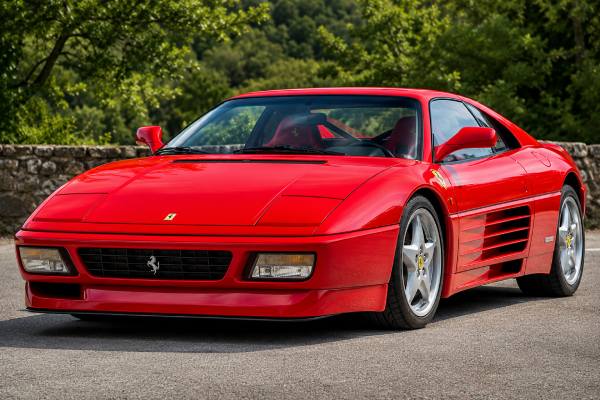
The Ferrari 348 GT Competizione is the rare, lightweight final evolution of the 348 berlinetta, built around the Tipo F119H 3.4-liter naturally aspirated V8 and sold in tiny numbers for 1993–1994. It sits at the sharp end of the 348 family: more focused than the normal 348 GTB, more collectible than the regular tb and ts, and closely tied to Ferrari’s early-1990s return to customer GT competition.
Its appeal is not only the 320 hp engine. The car matters because it turned the often-debated 348 into something harder, lighter, more purposeful, and much closer in spirit to a road-going club-racing Ferrari. Carbon-Kevlar body parts, Speedline wheels, a stripped cockpit, special seats, short gearing, and a very limited production run make it one of the most interesting modern classic V8 Ferraris. It also asks more from an owner than a standard 348, because originality, documentation, lightweight parts, and specialist maintenance carry much of the car’s value.
Quick Take
The Ferrari 348 GT Competizione is the 348 for buyers who want rarity, mechanical honesty, and a stronger motorsport connection than a regular road car can offer. Its F119H V8, manual gearbox, lightweight construction, and late-production chassis changes give it a raw, compact feel that suits fast road use and careful track driving, but its value depends heavily on authenticity, correct lightweight parts, service history, and proof that it has not been poorly repaired, modified, or confused with the separate Michelotto competition cars.
Table of Contents
- History and Collector Significance
- F119H Engine, Chassis and Key Specs
- Production, Variants and Factory Details
- Design, Engineering and Special Features
- Driving Feel and Real-World Performance
- Maintenance, Reliability and Restoration Risks
- Market Values, Buying Checks and Rivals
History and Collector Significance
The 348 GT Competizione matters because it was the final and most focused road-going 348, created when Ferrari was reconnecting its V8 road cars with customer racing. It arrived at the end of the 348’s life, just as the F355 was about to make the older model look less refined but also more mechanical and raw.
The base Ferrari 348 was launched in 1989 as the successor to the 328. It moved Ferrari’s junior mid-engine V8 line into a more modern era, with a longitudinally mounted V8 paired to a transverse gearbox, side radiators, a wider body, and styling that echoed the Testarossa. The early 348 gained a mixed reputation. It looked dramatic and sounded like a proper Ferrari, but road testers and owners often criticized its handling balance, build quality, and sensitivity to setup.
By the time the 348 GTB and GTS arrived, Ferrari had improved the car. The later F119H engine brought 320 hp, suspension geometry was revised, and the overall package became more sorted. The GT Competizione built on that late 348 GTB base, adding a sharper specification with racing influence and serious weight reduction.
The timing is part of the car’s story. In the early 1990s, GT racing was regaining momentum. Ferrari customer teams and specialist builders such as Michelotto were active with competition versions of the 348. The GT Competizione road car was closely linked in spirit to that environment, although it should not be treated as the same thing as a Michelotto-built race car. The road version was a limited Ferrari factory model; the Michelotto cars were more heavily modified competition machines.
That distinction matters to collectors. A road-going 348 GT Competizione is rare, usable, and factory-built. A Michelotto 348 GT Competizione or GTC/LM is a different category, with competition history, roll-cage structure, race-specific equipment, and a separate market. Buyers sometimes blur the names, so the first job is always to identify exactly which type of car is being discussed.
Today, the 348 GT Competizione is collectible for four main reasons:
- It is the rarest factory road-going 348 variant.
- It represents the most developed version of the 348 berlinetta platform.
- It has real lightweight hardware rather than only cosmetic changes.
- It is a manual, naturally aspirated V8 Ferrari from the last pre-digital era.
The car also has a useful place in Ferrari history. It came before the better-known Challenge Stradale, 430 Scuderia, 458 Speciale, and 488 Pista formula of lighter, sharper V8 specials. It is not as polished as those later cars, and it was not marketed with the same global force, but the idea is familiar: take a mid-engine V8 Ferrari, remove weight, improve response, sharpen the chassis, and make the car feel closer to a competition machine.
F119H Engine, Chassis and Key Specs
The 348 GT Competizione uses the late Tipo F119H version of Ferrari’s 3.4-liter quad-cam V8, rated at 320 hp. The important point is that it combines the stronger late 348 engine with less weight and shorter gearing, so the car feels more urgent than the raw power number suggests.
| Item | Specification |
|---|---|
| Model years | 1993–1994 |
| Engine code | Tipo F119H |
| Engine layout | Rear-mid-mounted 90-degree V8 |
| Displacement | 3,404.70 cc |
| Bore x stroke | 85 mm x 75 mm |
| Induction | Naturally aspirated |
| Fuel and ignition | Bosch Motronic M2.7 electronic management |
| Maximum power | 235 kW / 320 hp at 7,200 rpm |
| Maximum torque | 324 Nm at 5,000 rpm |
| Lubrication | Dry sump |
| Transmission | 5-speed manual transaxle |
| Driven wheels | Rear-wheel drive |
The V8 is all aluminum, with twin overhead camshafts per bank and four valves per cylinder. It is not a torque-heavy engine by modern standards. The best work happens higher in the rev range, where the engine becomes harder-edged and more responsive. The dry-sump lubrication system is also important because it helps oil control under hard cornering and allows the engine to sit lower than a wet-sump layout would allow.
The transmission is central to the 348’s identity. Ferrari mounted the engine longitudinally but placed the gearbox transversely, a layout reflected in the original 348 tb and ts names. In the GT Competizione, the shorter final-drive ratio helps the car feel more alert. It does not turn the 348 into a straight-line monster, but it improves the sense of response when exiting corners or using second and third gear on a fast road.
| Area | Detail |
|---|---|
| Chassis structure | Pressed steel monocoque with rear subframe |
| Body style | Two-seat berlinetta coupe |
| Front suspension | Independent unequal-length wishbones, coil springs, dampers, anti-roll bar |
| Rear suspension | Independent unequal-length wishbones, coil springs, dampers, anti-roll bar |
| Brakes | Ventilated discs with ABS |
| Wheelbase | 2,450 mm |
| Length | 4,230 mm |
| Width | 1,894 mm |
| Height | 1,170 mm |
| Dry weight | 1,180 kg |
| Typical quoted top speed | Around 280 km/h, depending on source and setup |
The dry-weight figure is one of the most important numbers for the GT Competizione. A standard 348 is not a featherweight by 1990s standards, but the GTC removed meaningful mass through composite panels, lighter glazing, reduced trim, and competition-influenced equipment. Buyers should be careful with weight claims, because dry weight, curb weight, market equipment, and later modifications can create confusing comparisons.
The chassis layout also explains much of the ownership experience. The rear engine and gearbox are carried by a subframe that can be removed for major work. This helps access but also means large services are labor-heavy. The suspension is conventional in layout but sensitive to tires, bushings, alignment, and ride height. A tired 348 can feel nervous; a correctly set-up late 348 can feel much more precise.
Production, Variants and Factory Details
The factory 348 GT Competizione road car was built in a run of 50 cars, which is why provenance and identification matter so much. At this level, a car’s production number, original components, factory records, and uninterrupted history can be worth as much as its mileage.
The road car is based on the late 348 GTB platform and should not be mixed up with the Michelotto competition cars. The names are similar, and both are tied to the same racing period, but they are not the same product.
| Version | Main identity | Buyer relevance |
|---|---|---|
| 348 GT Competizione road car | Factory-built limited road model, 50 examples | Best choice for collectors wanting road usability and rarity |
| 348 GT Competizione Michelotto | Competition-focused cars developed with Michelotto | Separate race-car market; inspect for history, eligibility, and event use |
| 348 GTC/LM | More serious endurance racing derivative | Very different costs, maintenance, documentation, and value drivers |
| 348 Challenge | One-make racing conversion based on existing 348s | Often cheaper than a GTC, but history and conversion quality vary |
The most commonly cited production split is 50 factory road cars, with only a small number in right-hand drive. Some marque sources cite eight right-hand-drive examples, while others give a slightly different number. That uncertainty is a reminder to check the car, not just the story. Ferrari Classiche certification, factory paperwork, early registration records, service invoices, original books, and period photos all help establish what the car actually is.
Key identification points
A correct road-going GT Competizione should show more than a badge. Important identifiers include:
- a late 348 GTB-based body and mechanical package
- Tipo F119H engine specification
- lightweight carbon-Kevlar doors and bumpers
- polycarbonate rear window on correct cars
- special 18-inch Speedline five-spoke wheels
- fixed-back lightweight seats with composite structure
- competition-style interior trim and reduced comfort equipment
- numbered steering wheel or production identification details
- 348 GT Competizione script and correct exterior badging
Because these cars are rare and valuable, small details matter. A normal 348 fitted with wheels, seats, badges, and a sports exhaust is not a GT Competizione. A real car missing its original lightweight panels may still be genuine, but the missing parts become a major value issue.
Colors, trim and options
The GT Competizione was not a broad personalization model in the modern Ferrari Tailor Made sense. It is generally associated with Rosso Corsa paint, competition-style seats, red interior fabric on the lightweight seat shells, and black cabin trim. Since surviving cars can show market differences, period changes, restoration work, or later owner choices, the safest approach is to compare the car against its factory records.
Factory options were limited or effectively absent compared with normal road Ferraris. The point of the car was weight reduction and focus, not luxury. That makes later additions worth checking carefully. Air-conditioning, audio equipment, extra carpeting, normal seats, retrimmed leather, modern electronics, or a non-original steering wheel may make the car easier to live with, but they can reduce collector purity unless the original parts are documented and retained.
For buyers, the best cars are usually those with:
- matching engine and chassis records
- original lightweight doors, bumpers, glass, seats, wheels, and steering wheel
- clear chain of ownership
- Ferrari Classiche or comparable expert verification
- no unexplained racing accident history
- no heavy repaint or poor composite repair
- complete books, tools, invoices, and period documentation
Design, Engineering and Special Features
The GT Competizione looks like a late 348, but its details make it feel more serious and less road-car soft. The special parts are not decoration; they reduce weight, sharpen response, and connect the car visually with Ferrari’s early-1990s GT racing activity.
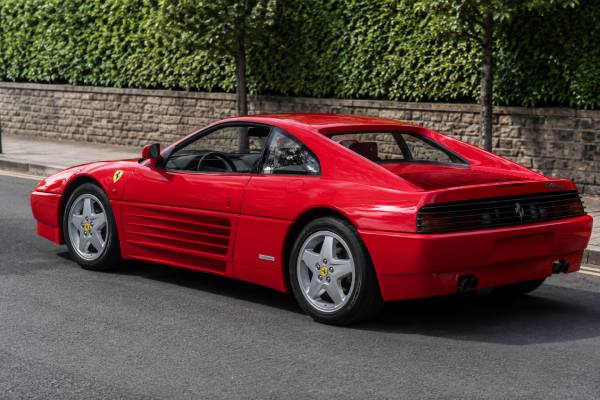
The 348 shape was styled by Pininfarina and strongly reflects its period. The side strakes feed air toward the radiators, the rear black grille hides rectangular lamp units, and the overall stance is wide, low, and angular. It shares design language with the Testarossa more than with the smoother F355 that followed.
On the GT Competizione, Ferrari kept the familiar 348 silhouette but added a leaner, more competition-minded specification. The carbon-Kevlar doors and bumpers are the headline features. These parts cut weight high and at the body extremities, which helps more than the numbers alone suggest. Lightweight panels can also make the car feel more delicate, because damage repair is more specialized than on ordinary steel or aluminum panels.
The rear window is another important feature. Polycarbonate saves weight but ages differently from glass. It can scratch, haze, or distort if cleaned incorrectly. On a collector car, a correct original or properly sourced replacement matters because ordinary rear glass changes the identity of the car.
The wheels also give the GTC a different stance. The 18-inch Speedline five-spoke wheels look more modern and purposeful than the standard 348 wheels. They fill the arches better and allow a more aggressive tire package. Wheel condition deserves close inspection. Old magnesium or lightweight competition-style wheels can suffer from age, corrosion, cracks, poor refinishing, or incorrect hardware, depending on construction and previous care.
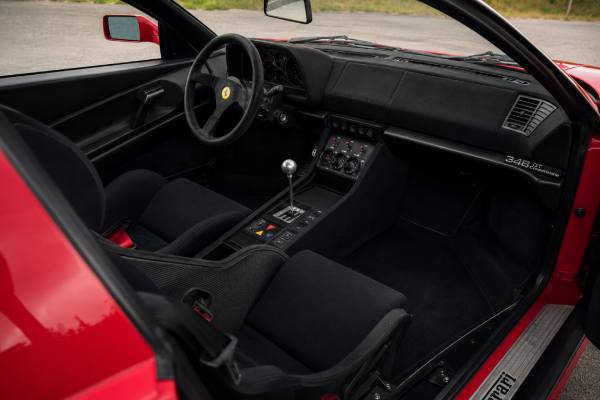
Inside, the GT Competizione moves away from the normal 348’s road-car atmosphere. The lightweight seats are central to the experience. They hold the driver more firmly, reduce mass, and change the way the car feels before it even moves. The cabin is louder, more focused, and less insulated. The gearlever remains the classic open-gate Ferrari manual, which gives the car much of its charm.
The special features are not just about speed. They change the relationship between driver and machine. A standard 348 is already compact by modern supercar standards, but the GTC feels more concentrated. Less trim, more noise, firmer seating, shorter gearing, and lighter panels make every input feel more direct.
Why the engineering feels different from a regular 348
A normal late 348 GTB and a GT Competizione share the same basic architecture, but the GTC changes the emphasis. A regular GTB is a road car with sporting ability. The GT Competizione is a road-legal special that feels like it was prepared for committed use.
The biggest engineering differences are felt in four areas:
- less mass, especially in body and cabin parts
- more direct seating and driver support
- shorter gearing for stronger response
- chassis and tire specification aimed at sharper cornering
That does not mean it is automatically faster in every setting. On poor roads, old tires or tired suspension can make the car less confidence-inspiring than a well-maintained standard 348. The GTC rewards condition and setup more than paper figures.
Driving Feel and Real-World Performance
The 348 GT Competizione is fast enough to feel special, but its main appeal is the way it delivers speed. It is a high-revving, manual, mid-engine Ferrari with no modern turbo torque, no dual-clutch gearbox, and no electronic performance layer to hide poor setup or lazy inputs.
The engine needs revs. Below the middle of the tachometer, it is responsive but not explosive. Above that, the V8 becomes sharper and more urgent, with the dry mechanical tone that defines many 1990s Ferraris. The F119H does not have the five-valve scream of the later F355, but it has a harder, slightly rawer voice. The GT Competizione’s reduced insulation and freer breathing make that character more present in the cabin.
The open-gate manual gearbox is part of the ritual. Like many Ferraris of the era, it prefers patience when cold. Second gear can feel reluctant until the gearbox oil warms, and forcing shifts is the wrong approach. Once warm, the shift action is mechanical and satisfying, especially when the driver matches revs cleanly. The short gearing helps keep the engine in its useful range.
Steering feel depends heavily on condition, tires, and alignment. A properly sorted 348 GTC has direct, informative steering and a strong sense of front-end placement. A poorly aligned one can feel edgy. This is one reason pre-purchase inspection should include a proper road test by someone who knows 348s, not just a lift inspection.
The chassis has more grip and discipline than early 348 stereotypes suggest. The late GTB base already benefited from Ferrari’s development work, and the GTC’s wheel, tire, and suspension changes add confidence. It still behaves like a mid-engine car. Fast inputs, old tires, damp roads, and lifted throttle mid-corner can expose the balance. It is not a modern stability-managed supercar.
Braking performance is strong for the period when the system is fresh. Pedal feel should be firm and confidence-inspiring. If the pedal is long, the car pulls under braking, the ABS warning light behaves oddly, or the discs show heat damage, the issue needs attention before spirited driving.
Ride quality is firm but not unusable. The GT Competizione is not a grand tourer, and long trips will remind occupants that sound deadening and soft seats were not the goal. Cabin heat, road noise, limited luggage space, and low seating are part of the experience. On the right road, those compromises become part of the appeal. In traffic or bad weather, they become less romantic.
As a performance car, the GTC now sits below modern hot hatchbacks in some raw numbers, but that is not how it should be judged. The attraction is connection: throttle response, manual shifting, compact size, visibility over the front wings, engine noise behind the seats, and the sense that the car improves when the driver is precise.
Maintenance, Reliability and Restoration Risks
A 348 GT Competizione should be treated as a rare Ferrari first and a used 348 second. The mechanical base is serviceable by Ferrari-specialist standards, but the lightweight parts, authenticity questions, and low production numbers make mistakes expensive.
The F119H V8 is not fragile when maintained correctly, but neglect is costly. Timing belts, tensioners, cam seals, oil leaks, cooling hoses, fuel lines, ignition components, and engine-management sensors all deserve routine attention. Many cars cover very low mileage, which can be misleading. A Ferrari that sits for years may need more work than one that has been exercised regularly.
Major services are labor-intensive because proper access often involves removing the rear subframe and powertrain assembly. Buyers should not judge a 348 by mileage alone. A 10,000-mile car with old belts, ancient tires, stale fluids, leaking seals, and no recent invoices is not “ready to enjoy.” It is a project with shiny paint.
Common inspection areas
Before purchase, focus on these areas:
- timing-belt age and proof of the last major service
- oil leaks from cam covers, seals, and engine joints
- coolant leaks, radiator condition, hose age, and fan operation
- fuel-line age and any smell of fuel after running
- clutch condition, pedal feel, and engagement point
- gearbox synchromesh, especially cold second-gear behavior
- suspension bushings, dampers, ball joints, and wheel bearings
- brake disc condition, caliper function, ABS lights, and fluid history
- engine-management warning lights and smooth running on both banks
- condition of the lightweight panels, rear window, seats, and wheels
Electrical issues are also common on aging low-volume Italian cars. Window motors, switches, relays, fuse-box connections, sensors, grounds, lighting circuits, HVAC parts if fitted, and warning lamps can all cause trouble. None of this is unusual, but poor diagnosis can become expensive.
Body and restoration concerns
The GTC’s lightweight parts are the biggest restoration concern. Carbon-Kevlar doors and bumpers are not ordinary replacement panels. Poor repairs, hidden cracks, mismatched weave, incorrect paint preparation, and filler-heavy work can reduce value sharply. The same applies to the polycarbonate rear window and special interior pieces.
Accident history needs careful review. A repaired normal 348 may still be acceptable at the right price. A repaired GT Competizione needs deeper documentation because originality drives so much of the car’s value. Look for paint-meter readings, underside evidence, panel fit, welding repairs, suspension pickup-point damage, and signs that a normal 348 shell or parts have been used to rebuild a damaged car.
The best maintenance approach is conservative and documented. Keep original parts, avoid irreversible upgrades, and use specialists who understand the 348 platform. Some upgrades may improve usability, such as modern tires, careful alignment, improved cooling details, or reversible electrical improvements, but originality should lead every decision.
| Area | Why it matters | Buyer priority |
|---|---|---|
| Major service history | Belts, seals, fluids, and hoses age even with low mileage | Very high |
| Lightweight panels | Correct carbon-Kevlar parts are rare and value-critical | Very high |
| Documentation | Confirms identity, originality, mileage, and ownership chain | Very high |
| Transmission | Manual gearbox condition affects drivability and repair cost | High |
| Suspension setup | Poor alignment or worn bushes can make the car feel nervous | High |
| Interior originality | Seats, steering wheel, trim, and carpets are hard to replace correctly | High |
Safety expectations should also be realistic. This is an early-1990s specialist sports car. It has period structure, brakes, tires, belts, and ABS technology, not modern crash ratings, stability control, or advanced driver assistance systems. Condition matters more than brochure claims.
Market Values, Buying Checks and Rivals
The 348 GT Competizione market is thin, so individual cars can vary widely in value. A correct, documented, low-mileage road car with original lightweight parts is a very different purchase from a modified car, a car with missing parts, or a Michelotto race car with competition history.
Recent public data shows why broad price guides can be misleading. Factory road cars have appeared at auction in the low-to-mid six-figure pound range, while asking prices for exceptional or very low-mileage cars can be much higher. Michelotto competition cars form a separate market, where race history, eligibility, spares, engine condition, and documentation may matter more than road usability.
The main value drivers are:
- confirmed factory GT Competizione identity
- original lightweight body parts
- original seats, steering wheel, wheels, rear window, and trim
- matching engine and drivetrain records
- Ferrari Classiche certification or strong factory documentation
- low but believable mileage
- complete service records
- no serious accident history
- correct color and interior specification
- quality of recent major service
A cheaper GTC can become expensive quickly if it needs missing original parts or correction work. A higher-priced car may be better value if it comes with original components, recent specialist maintenance, strong records, and no stories.
Pre-purchase checklist
Use a specialist inspection and ask direct questions before discussing price seriously:
- Confirm the chassis number, engine number, and factory identity against records.
- Check whether the car is a road-going GTC, a Michelotto competition car, or a modified standard 348.
- Verify the lightweight panels, rear window, seats, steering wheel, wheels, and interior trim.
- Review all major-service invoices, not only stamps in a book.
- Inspect the underside, suspension pickup points, door structures, and composite repairs.
- Road-test the car from cold and hot to check gearbox, clutch, cooling, brakes, and engine behavior.
- Confirm that any removed original parts are present, labeled, and in usable condition.
- Compare the seller’s story with registration records, auction history, photographs, and specialist knowledge.
Cars to seek are original, documented, and mechanically fresh. Cars to avoid are those with unclear identity, unexplained gaps in history, missing GTC-specific parts, poor repainting, heavy track damage, or “upgrades” that cannot be reversed.
Rivals and alternatives
The closest alternatives depend on what the buyer wants. A Ferrari 348 Challenge gives a stronger track association but lacks the same factory road-special identity. A 348 GTB is much cheaper and more usable, but not nearly as rare. A Ferrari F355 Berlinetta is faster, more polished, and more famous, yet it carries its own maintenance risks and lacks the GTC’s scarcity.
Outside Ferrari, the Porsche 964 Carrera RS is the most obvious period lightweight rival in spirit. It is sharper, better known, and easier to place in the broader collector market. The Lotus Esprit Sport 300 and Esprit S4s offer turbocharged 1990s performance and rarity, but not the same Ferrari cachet. The Lamborghini Diablo is more dramatic and more expensive to run, but it sits in a different performance and ownership category.
Compared with later Ferrari V8 specials, the 348 GT Competizione is more obscure and less polished. It is also more analog. Buyers who want speed and usability may prefer a 360 Challenge Stradale or F430 Scuderia. Buyers who want rarity, manual shifting, early-1990s feel, and a car that still sits slightly outside the obvious collector script may find the 348 GTC more rewarding.
Long-term collectability looks strong because the ingredients are right: limited production, manual gearbox, naturally aspirated V8, factory lightweight specification, and a clear place in Ferrari’s road-to-race story. The caution is liquidity. Rare cars can be hard to price and slow to sell if they have condition questions. Buy the best-documented example you can justify, because this is not the Ferrari to buy on price alone.
References
- Ferrari 348 GT Competizione (1993) 1993 (Manufacturer Specifications)
- Ferrari 348 GT Competizione: Ferrari History 1993 (Manufacturer History)
- Vehicle Detail Search – 1994 FERRARI 348 | NHTSA 2026 (Recall Database)
- 1994 Ferrari 348 GT Michelotto Competizione | Milan | RM Sotheby’s 2021 (Auction Record)
- Ferrari 348 GT Michelotto Competizione Market – CLASSIC.COM 2026 (Market Data)
Disclaimer
This article is for informational purposes only and is not a substitute for professional diagnosis, repair, inspection, valuation, or restoration advice. Specifications, torque values, service intervals, parts, procedures, and equipment can vary by VIN, market, production detail, and later modification, so owners and buyers should verify all work against official Ferrari service documentation and a qualified Ferrari specialist.
If you found this guide useful, please consider sharing it on Facebook, X/Twitter, or your favorite car community to support our work.