
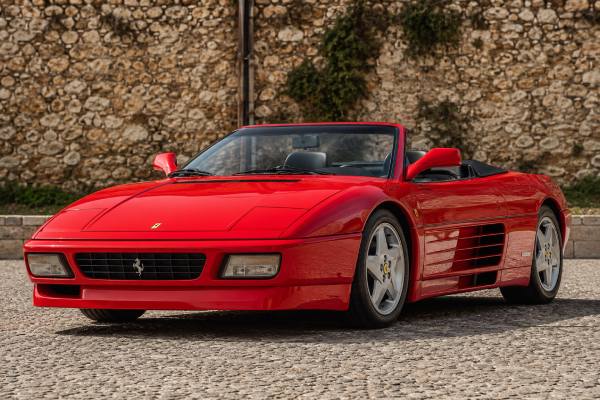
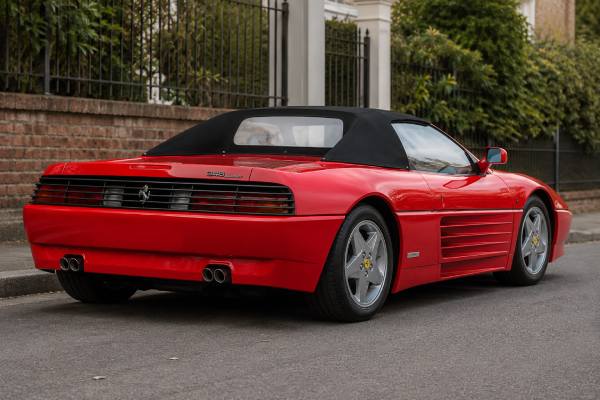
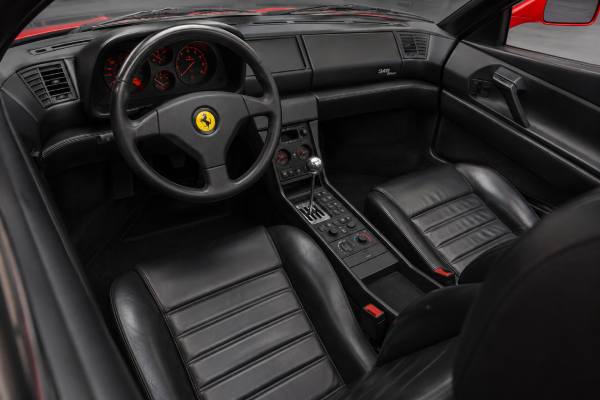
The Ferrari 348 Spider is the open-top version of Ferrari’s early-1990s mid-engine V8 sports car, built from 1993 to 1995 with the Tipo F119H 3.4-liter V8 rated at 320 hp. It matters because it was not just a 348 with the roof removed. The Spider introduced the later 348 updates, including the more powerful F119H engine, revised presentation, body-color lower panels, and structural reinforcements for proper open-air use.
For many buyers, the 348 Spider sits in an interesting place. It has the raw feel of an older analog Ferrari, with a gated manual gearbox, hydraulic steering, a naturally aspirated V8, and very little electronic filtering. At the same time, it is newer and more usable than a 308 or 328, while usually costing less than an equivalent F355 Spider. The appeal is strong, but ownership depends heavily on condition, service history, alignment, tires, and whether expensive age-related work has already been done.
Quick Take
The Ferrari 348 Spider’s strongest appeal is its combination of open-air Ferrari drama, a longitudinal 3.4-liter V8, a gated manual gearbox, and the visual sharpness of the late-348 update. Its identity is technical as much as emotional: the F119H engine, steel monocoque structure, transverse gearbox layout, and roofless two-seat body make it a distinct bridge between the 328 era and the more polished F355. The main caution is that a cheap 348 Spider can become expensive quickly if timing belts, cooling parts, clutch hardware, suspension bushings, tires, electrical details, or soft-top parts have been neglected. The best cars are original, well-documented, correctly serviced, and set up by specialists who understand how sensitive the 348 is to tires, ride height, and alignment.
Table of Contents
- Model History and Why It Matters
- Engine, Chassis and Key Specifications
- Production, Variants and Factory Options
- Design, Engineering and Special Features
- Driving Experience and Real Performance
- Reliability, Maintenance and Restoration Reality
- Market Value, Buying Guide and Rivals
Model History and Why It Matters
The 348 Spider is important because it was Ferrari’s first regular-production two-seat convertible since the Daytona Spider era. It also arrived when Ferrari was refining the 348 after early criticism, so it represents one of the more mature versions of the model rather than the earliest form.
The 348 range replaced the 328 and moved Ferrari’s junior V8 line into a more modern technical format. Earlier 308 and 328 models used a tubular chassis and a transverse V8. The 348 adopted a pressed-steel monocoque body structure, a longitudinally mounted V8, and a transverse five-speed gearbox. That layout gave the car its “t” identity in the earlier 348 tb and 348 ts names, with “tb” meaning transverse berlinetta and “ts” meaning transverse spider, even though the ts was actually a targa-style car rather than a full convertible.
The Spider came later, launched in 1993 as the first true open 348. It arrived with the more powerful Tipo F119H engine, which was also used in the later 348 GTB and 348 GTS. This made the Spider more than a body-style addition. It effectively helped introduce the final development phase of the 348 family.
The 348’s design was by Pininfarina and clearly shared visual themes with the Testarossa. The side strakes, horizontal rear treatment, pop-up headlights, and wedge-like proportions gave it a strong late-1980s and early-1990s identity. Today, that once-controversial look is part of the car’s charm. The 348 Spider feels less rounded and polished than the F355 that replaced it, but more aggressive and more mechanical.
Its reputation has also changed over time. For years, the 348 lived in the shadow of the F355. The later car had more power, a six-speed gearbox, five-valve heads, and a more forgiving chassis. But the 348 has gained respect because it offers a more direct, less refined Ferrari experience. The steering, gearshift, engine sound, and cockpit feel are all unmistakably analog.
Collectors care about the Spider because production was limited, the body style is desirable, and many cars were used rather than preserved. Enthusiasts care because it delivers a strong Ferrari experience without the electronics, paddles, or heavy driver aids of later models. Buyers care because it can still be one of the more attainable open V8 Ferraris, but only if they understand the maintenance risk.
Engine, Chassis and Key Specifications
The Ferrari 348 Spider uses the Tipo F119H 3.4-liter naturally aspirated V8, mounted longitudinally behind the cabin and paired with a transverse five-speed manual gearbox. The headline numbers are 320 hp at 7,200 rpm, 324 Nm of torque, rear-wheel drive, and a factory top speed of over 280 km/h.
| Category | Specification |
|---|---|
| Production years | 1993–1995 |
| Engine | Tipo F119H 90-degree V8 |
| Displacement | 3,404.70 cc |
| Bore x stroke | 85 mm x 75 mm |
| Compression ratio | 10.8:1 |
| Valvetrain | DOHC, 4 valves per cylinder |
| Fuel and ignition management | Bosch Motronic M2.7 electronic injection and ignition |
| Lubrication | Dry sump |
| Maximum power | 320 hp at 7,200 rpm |
| Maximum torque | 324 Nm at 5,000 rpm |
| Transmission | 5-speed gated manual |
| Drivetrain | Rear-wheel drive with limited-slip differential |
The F119H engine is an all-alloy, four-cam V8 with a dry-sump oiling system. Dry sump lubrication helps oil control under hard cornering and allows the engine to sit lower than a conventional wet-sump layout would usually permit. The F119H also benefited from updates over earlier 348 engines, including a higher compression ratio and breathing improvements.
The gearbox is one of the car’s defining features. It is a traditional open-gate manual with five forward speeds. The engine is mounted lengthwise, but the gearbox sits transversely behind it. This layout kept the drivetrain compact and gave the 348 a strong technical link to Ferrari’s race-derived thinking, even though the road car itself was built for customers rather than competition.
| Category | Specification |
|---|---|
| Body type | Two-seat spider |
| Structure | Steel monocoque with rear subframe |
| Suspension | Independent double wishbones, coil springs, anti-roll bars |
| Brakes | Ventilated discs with ABS |
| Steering | Rack and pinion, non-assisted on most cars |
| Front tires | 215/50 ZR17 |
| Rear tires | 255/45 ZR17 |
| Length | 4,230 mm |
| Width | 1,894 mm |
| Height | 1,170 mm |
| Wheelbase | 2,450 mm |
| Dry weight | 1,370 kg |
| Fuel capacity | 88 liters |
| 0–100 km/h | About 5.4 seconds |
| Top speed | Over 280 km/h |
The chassis layout is important for buyers. The 348 is not a soft cruiser under the skin. It uses double wishbones, wide rear tires, mid-engine balance, and a structure that must be in good condition to feel right. Poor alignment, old tires, tired dampers, worn bushings, or incorrect ride height can make a 348 feel nervous. A well-set-up Spider feels much better than the model’s older reputation suggests.
Production, Variants and Factory Options
The 348 Spider was built in relatively small numbers, with commonly cited production of 1,090 cars. That makes it more numerous than the later 348 GTB and GTS, but still limited enough that color, originality, mileage, market specification, and documentation can have a major effect on value.
The broader 348 family started with the 348 tb coupe and 348 ts targa-style model. Those early cars used the 300 hp version of the 3.4-liter V8 in most markets. The later phase brought the 348 Spider, followed by the 348 GTB and 348 GTS. These later cars shared the 320 hp F119H engine and several cosmetic and mechanical refinements.
How the Spider differs from earlier 348 models
The Spider is easiest to identify by its full convertible body and folding soft top, but the differences go deeper. Compared with earlier tb and ts cars, the Spider brought:
- the more powerful Tipo F119H engine
- body-color lower panels instead of black lower cladding
- a revised front grille appearance
- a different rear deck and engine-cover treatment
- structural reinforcement to compensate for the missing roof
- the more mature late-348 chassis and presentation
The roof is manually operated rather than powered, which is a benefit in some ways. There are fewer motors and switches to fail, but the fabric, frame, seals, latches, rear window, and tonneau area all need close inspection.
Factory identity and documentation
For a collector-grade 348 Spider, documentation matters almost as much as mileage. A strong file should include service invoices, timing-belt history, owner’s books, tools, jack kit, radio code where relevant, warranty booklet, emissions labels where required, and import or market paperwork. Ferrari Classiche certification may matter for top examples, especially if the car has rare colors, very low mileage, or unusual provenance.
Matching identity is also important. Buyers should check that the VIN, chassis plate, engine number, gearbox number, paint code, and trim details are consistent with the car’s documents. A repainted or retrimmed 348 Spider is not automatically a bad car, but the work should be disclosed and supported by invoices and photographs.
Factory options and desirable details
The 348 Spider was not optioned like a modern Ferrari with endless carbon packs and digital features. Desirable period items are more traditional:
- original leather interior in good condition
- correct convertible-top hardware and tonneau cover
- factory tool roll and jack kit
- books, manuals, and pouch
- Schedoni luggage, where supplied
- original wheels in correct size and finish
- period-correct radio or carefully documented replacement
- desirable paint and interior color combinations
- clear market identity, such as European, U.S., or right-hand-drive specification
Color can strongly influence desirability. Rosso Corsa over tan remains the classic image, but black, yellow, silver, blue, and darker metallic colors can suit the 348’s sharp bodywork well. Condition should still come first. A tired car in the “right” color is usually a worse buy than a properly maintained car in a less obvious color.
Design, Engineering and Special Features
The 348 Spider is visually distinctive because it combines Testarossa-style drama with smaller mid-engine proportions and a low, open cabin. Its design is not subtle, but the functional details matter: side intakes feed the cooling system, the low nose reduces visual mass, and the rear deck has to manage heat from a tightly packaged V8.
Pininfarina’s styling gave the 348 a strong horizontal theme. The side strakes are the most obvious feature, but the rear grille, concealed rectangular rear lamps, pop-up headlights, and flat surfaces all contribute to the car’s period character. On the Spider, the absence of the fixed roof makes the beltline and rear haunches more visible, giving the car a lower and more dramatic stance.
The body uses steel panels in key areas, with aluminum used for some closures and composite material for certain bumper and apron sections. The open body required extra reinforcement around the doors, sills, pillars, and related structural areas. This matters because a Spider with accident damage or poor repairs can suffer from panel-fit issues, roof-seal problems, scuttle shake, or uneven behavior on the road.
Cooling and packaging
The 348’s side intakes are not just decoration. The car uses side-mounted radiators, which helped open up useful front luggage space and influenced the shape of the doors and rear quarters. The arrangement also means buyers should inspect radiator condition, fans, coolant hoses, and debris buildup in the side intake areas.
Engine access is decent for basic inspection, but major service work is specialist territory. The drivetrain is carried in a rear subframe, and significant engine work often involves lowering or removing the assembly. That is one reason a deferred-maintenance 348 can be expensive even if the purchase price looks attractive.
Cockpit character
Inside, the 348 Spider feels narrow, low, and focused. The driving position is more old-school than modern. The seats are supportive, the gauges are simple, and the open metal gear gate dominates the interaction with the car. There is no large screen, no drive-mode controller, and no modern interface layer between driver and machine.
The cabin is also a place where age shows quickly. Leather can shrink around the dashboard and instrument binnacle, seat bolsters can crack, switchgear can become sticky or worn, and air-conditioning performance depends heavily on system condition. On a Spider, sun exposure can accelerate leather and trim wear, especially if the car spent years in warm climates with the top down.
Driving Experience and Real Performance
A properly maintained Ferrari 348 Spider feels mechanical, vocal, and highly sensitive to setup. It is fast enough to feel special today, but its real appeal is the way the engine, steering, gearbox, and open cabin involve the driver at normal road speeds.
The F119H V8 likes revs. Below the midrange it is clean rather than explosive, then it hardens as the tachometer climbs. The sound is sharper and more metallic than many modern turbocharged engines. With the roof down, intake noise, exhaust tone, gear whine, and road noise become part of the experience rather than background detail.
The gated manual gearbox is central to the car’s character. When cold, shifts can be stiff, especially into second gear. This is common for Ferraris of the period and should not be rushed. Once warm, a good gearbox has a deliberate, satisfying action. A poor one may grind, resist selection, pop out of gear, or feel vague because of wear, linkage issues, clutch problems, or old fluids.
Steering is heavy at parking speeds but much better once moving. The 348 does not flatter lazy inputs. It wants measured hands, good tires, and smooth weight transfer. That is part of the reason early reviews were mixed. The car can feel nervous if driven badly or if the setup is off. With modern, correctly sized tires, healthy dampers, and proper alignment, the Spider is more confidence-inspiring than its old reputation suggests.
Ride quality is firm but not brutal. The car is low and wide, so rough roads, steep driveways, and broken city surfaces need care. The open body can have more shake than the coupe or GTS, but a good example should not feel loose or rattly. Excessive flex, roof squeaks, door movement, or inconsistent panel gaps deserve closer inspection.
Braking performance is period-supercar rather than modern carbon-ceramic. The ventilated discs and ABS are adequate when maintained, but old brake hoses, tired fluid, worn pads, or seized calipers can ruin pedal feel. For fast road use, freshness matters more than upgrades.
The 348 Spider is not a relaxed luxury convertible. It has cabin heat, mechanical noise, limited rear visibility with the roof up, modest luggage space, and old-school ergonomics. That is also why people like it. It feels alive at speeds where many newer supercars are barely awake.
Reliability, Maintenance and Restoration Reality
The 348 Spider can be reliable when serviced properly, but it is not forgiving of neglect. The biggest ownership mistake is buying on paint, mileage, and price while ignoring belts, cooling-system age, clutch condition, electrical health, suspension wear, and the soft top.
Timing-belt service is the major recurring concern. The F119H engine uses belts, tensioners, and related components that must be treated seriously. Many specialists handle belt service on a time basis as well as mileage, because age matters even on low-mile cars. A proper major service may also include tensioners, water pump inspection or replacement, cam seals, accessory belts, fluids, filters, valve-cover gaskets, and “while you are there” items.
Common inspection areas
A buyer or owner should pay special attention to:
- timing belts, tensioners, and the date of the last major service
- oil leaks from cam covers, seals, and lower engine areas
- coolant hoses, radiator condition, fans, and water pump history
- clutch wear, release bearing noise, and hydraulic leaks
- gearbox shift quality when cold and warm
- differential and driveline noises under load
- engine mounts and subframe mounts
- suspension bushings, ball joints, dampers, and wheel bearings
- brake calipers, hoses, discs, pads, and ABS warning lights
- alternator output, fuse-board condition, grounds, and connectors
- slow windows, central locking, lighting, and HVAC operation
- sticky or damaged interior plastics and leather shrinkage
- convertible-top fabric, frame alignment, seals, latches, and rear window
- signs of accident repair around the front structure, sills, rear quarters, and roof mechanism
The cooling system deserves respect. Mid-engine cars often hide heat-related issues until traffic, hot weather, or hard driving exposes them. A 348 Spider should hold temperature steadily, cycle its fans correctly, and show no coolant smell, residue, or unexplained fluid loss.
Restoration and originality
Restoring a 348 Spider is rarely cheap. Mechanical parts, trim pieces, roof components, correct wheels, and original accessories can be expensive or difficult to source. Paintwork also needs care because panel fit, lower-body finish, and correct details affect value.
Originality matters, but sensible maintenance is not a negative. A car with documented belt services, rebuilt suspension, renewed hoses, fresh tires, and a properly repaired roof is often more desirable than a lower-mile car running on old rubber and ancient fluids. The danger is poorly chosen modification. Non-original wheels, loud exhausts, cheap retrims, incorrect badges, aftermarket electronics, and undocumented engine work can narrow the buyer pool.
For an owner who wants to drive the car, sympathetic updates may be reasonable if they are reversible and documented. Examples include modern tires in the correct sizes, improved radiator fans, high-quality hose replacements, upgraded fuse or relay solutions where appropriate, and careful air-conditioning refurbishment. For a collector, factory-correct presentation and complete records carry more weight.
Market Value, Buying Guide and Rivals
The 348 Spider remains one of the more accessible open Ferrari V8 models, but the market strongly separates excellent cars from needy ones. As of 2026, public market data often places ordinary transaction benchmarks below the best advertised examples, while low-mileage, highly original, freshly serviced cars can ask significantly more.
A sensible buyer should treat advertised prices carefully. Asking price is not the same as sale price, and a car needing a major service, tires, roof work, clutch work, sticky interior restoration, and suspension refresh can be more expensive than a better car at a higher initial price. The right 348 Spider is bought on condition and records first, mileage second, and color third.
| Priority | Why it matters |
|---|---|
| Major service history | Belts, tensioners, fluids, and related engine work are major cost drivers. |
| Specialist inspection | The 348 is setup-sensitive and hides expensive problems from casual checks. |
| Roof condition | Soft-top frame, seals, fabric, and fit affect usability and value. |
| Originality | Correct wheels, trim, books, tools, and factory details support collectability. |
| Accident history | Structural and panel repairs can affect roof fit, alignment, and resale value. |
| Tires and alignment | Old or incorrect tires can make the car feel far worse than it should. |
| Interior condition | Leather, switchgear, HVAC parts, and sticky trim can be costly to restore properly. |
Cars to seek
The best 348 Spiders usually share a few traits: clear ownership history, recent specialist service, correct wheels, clean paint meter readings, good panel gaps, a dry engine, a smooth warm gearbox, working electrics, a clean roof, and no excuses in the documentation. A moderately used car with regular maintenance is often safer than a museum-mile car that has sat for years.
Cars to avoid
Be careful with cars that have missing records, vague belt history, poor cold-start behavior, overheating, weak oil pressure, gearbox noise, clutch slip, roof leaks, non-original wiring, cheap repainting, corrosion in structural areas, or a seller who discourages an independent inspection. A 348 Spider is not the place to save money by skipping due diligence.
Rivals and alternatives
The closest Ferrari alternative is the F355 Spider. It is quicker, more polished, and often more desirable, but it brings its own maintenance costs and usually commands more money. The 328 GTS is older, lighter in feel, and more classic in appearance, but it is a targa rather than a true Spider. A 360 Spider is newer and faster, but less analog and often fitted with the F1 automated manual rather than a gated manual.
Outside Ferrari, period alternatives include the Porsche 911 Carrera Cabriolet, Porsche 911 Turbo for buyers with a larger budget, Acura NSX-T, Lotus Esprit, and later Dodge Viper RT/10. None offers quite the same combination of mid-engine Ferrari V8 sound, open roof, and gated manual theater. The 348 Spider’s appeal is not that it is the fastest or easiest choice. It is that it feels unmistakably like a transitional Ferrari: raw, beautiful, demanding, and still usable when properly maintained.
Long-term collectability looks solid for the best cars. The 348 Spider has the right ingredients: limited production, manual gearbox, naturally aspirated V8, Pininfarina design, open body, and a growing appreciation for analog 1990s performance cars. The market will likely continue to punish neglected examples and reward originality, documentation, mechanical freshness, and correct presentation.
References
- Ferrari 348 Spider (1993) – Ferrari.com 1993 (Manufacturer Model Page)
- Ferrari 348 Challenge (1993) – Ferrari.com 1993 (Manufacturer Model Page)
- Vehicle Detail Search – 1994 FERRARI 348 | NHTSA 2026 (Recall Database)
- Ferrari 348 GTB / 348 GTS / 348 Spider Guide — Supercar Nostalgia 2021 (Historical and Technical Guide)
- Ferrari 348 Spider Market – CLASSIC.COM 2026 (Market Data)
Disclaimer
This article is for informational purposes only and is not a substitute for professional diagnosis, repair, appraisal, or pre-purchase inspection. Specifications, torque values, service intervals, repair procedures, parts, and equipment can vary by VIN, market, production date, and vehicle condition. Always verify details against the official Ferrari service documentation for the specific car and consult a qualified Ferrari specialist before buying, repairing, or restoring a 348 Spider.
If this guide helped you, please share it on Facebook, X/Twitter, or your favorite car community to support our work.