
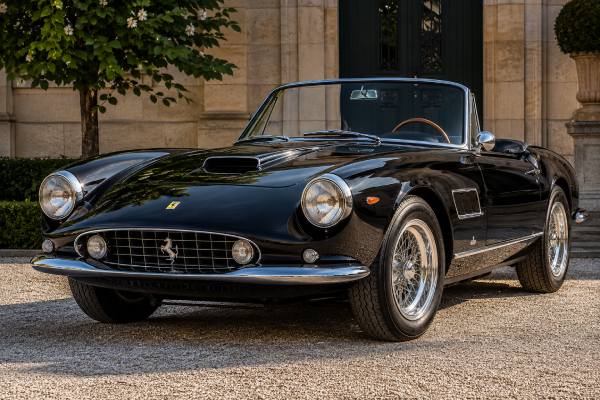
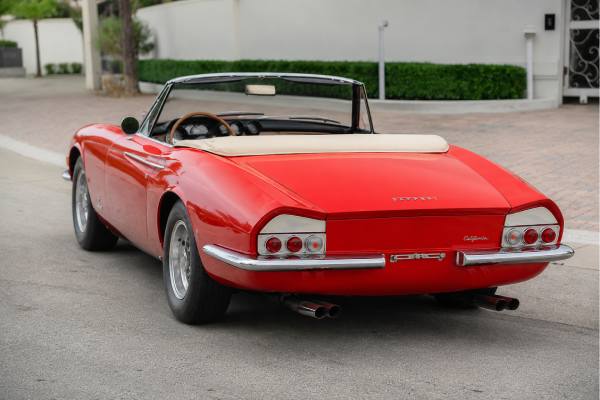
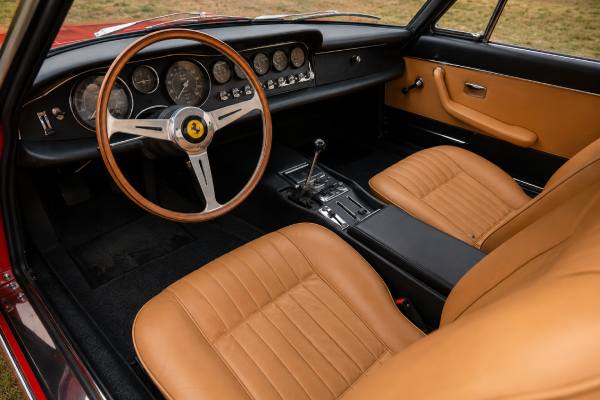
The Ferrari 365 California is the rare open grand tourer that introduced Ferrari’s 4.4-liter 365-series V12 in 1966 and carried the factory’s most exclusive front-engine luxury tradition into its final coachbuilt chapter. Built by Pininfarina in tiny numbers from 1966 to 1967, it combined a Tipo 217B Colombo-based V12, a five-speed manual gearbox, power steering, four-wheel disc brakes, and a dramatic open body on the Tipo 598 chassis used for Ferrari’s upper-tier touring cars.
It was not a replacement for the 250 GT California Spider in spirit alone, and it was not a sports racer dressed for the road. The 365 California was a large, expensive, hand-built convertible for a very small group of clients who wanted Ferrari performance, open-air touring, and social presence in one car. Its importance comes from that mix: it was the first production Ferrari 365, one of the last coachbuilt Ferrari flagship spyders, and one of the rarest open V12 road Ferraris of the 1960s.
Quick Take
The 365 California’s strongest appeal is its blend of rarity, Pininfarina coachwork, and early 4.4-liter V12 character. It is more luxury flagship than lightweight sports car, with a long wheelbase, a live rear axle, and a touring-focused cabin, but its 320 hp V12 and five-speed gearbox give it serious period performance. The main caution is condition sensitivity: originality, matching numbers, chassis integrity, correct trim, and restoration quality matter far more than ordinary mileage or cosmetic freshness.
Table of Contents
- History and Collector Importance
- Tipo 217B V12, Chassis and Specs
- Production, Variants and Authenticity
- Pininfarina Design and Engineering Details
- Road Feel, Performance and Usability
- Maintenance, Restoration and Known Risks
- Values, Buying Advice and Rivals
History and Collector Importance
The 365 California matters because it sits at the end of Ferrari’s hand-built flagship spider line and at the start of the 365 engine era. It was shown at Geneva in 1966 and gave Ferrari’s most privileged road-car customers a new open model above the regular GT range.
Ferrari had already built a tradition of expensive, limited-production grand touring cars for elite buyers. The 410 Superamerica, 400 Superamerica, and 500 Superfast were not high-volume models. They were tailored, costly, and often aimed at clients who expected personal attention from Maranello and Pininfarina. The 365 California followed that path, but with a more theatrical open body and a name that deliberately recalled the celebrated 250 GT California Spider.
That name can mislead modern readers. The 250 GT California Spider was closely tied to Ferrari’s dual-purpose road-and-competition culture. The 365 California was different. It was larger, more luxurious, more formal, and aimed at effortless high-speed touring rather than club racing. It used a front-mounted V12, rear-wheel drive, a manual gearbox, and a traditional steel tubular chassis, but its role was closer to a coachbuilt luxury convertible than a raw sports machine.
Pininfarina shaped and built the body, continuing the Ferrari-Pininfarina relationship that defined many of the company’s finest road cars. The design arrived at a transitional moment. Ferrari was still using traditional chassis construction and coachbuilt bodies for its most special models, yet the market was moving toward more standardized production. Within a few years, the Daytona, 365 GTC/4, and 365 GT 2+2 would make the 4.4-liter engine more familiar, while the 365 California would remain a rare and unusual opening act.
Its production run is the heart of its collector status. Only 14 examples are generally recognized, including the prototype. That puts the car in a much smaller group than the better-known 275 GTS, 330 GTS, 365 GTS, or Daytona Spider. It is also far rarer than the 365 GT 2+2, which used the same broad engine family but served a very different market.
The 365 California also occupies a useful place in Ferrari history because it links several themes:
- the last wave of coachbuilt Ferrari luxury spyders
- the introduction of the 4.4-liter 365 V12 displacement
- Pininfarina’s mid-1960s move from soft curves toward sharper, longer forms
- the American-market appeal of open V12 Ferraris
- the growing importance of provenance and Ferrari Classiche certification in modern collecting
Today, the car is prized less as a pure driver’s weapon and more as a high-level concours, tour, and collection car. A correct 365 California can be welcome at major Ferrari gatherings, concours events, and prestige touring rallies. Its rarity means buyers are not simply choosing a model; they are evaluating one specific chassis, its history, restoration record, original equipment, and documentation.
Tipo 217B V12, Chassis and Specs
The 365 California used Ferrari’s Tipo 217B 4.4-liter V12, a single-overhead-cam-per-bank development of the Colombo V12 family. Its quoted output was 320 hp, or 235 kW, at 6,600 rpm, with a factory-listed top speed of about 245 km/h.
| Item | Specification |
|---|---|
| Production years | 1966–1967 |
| Body style | Open grand touring spyder/cabriolet by Pininfarina |
| Chassis type | Tipo 598 tubular steel frame for production cars |
| Engine type | Tipo 217B 60-degree V12 |
| Displacement | 4,390.35 cc |
| Bore x stroke | 81 mm x 71 mm |
| Valvetrain | Single overhead camshaft per bank, two valves per cylinder |
| Fuel system | Three Weber 40 DFI carburetors |
| Maximum power | 320 hp at 6,600 rpm |
| Transmission | Five-speed manual |
| Driven wheels | Rear-wheel drive |
| Top speed | 245 km/h / 152 mph |
The engine is the main technical story. Ferrari increased displacement over earlier 4.0-liter applications by using an 81 mm bore with a 71 mm stroke. The result was a long-legged V12 with enough torque and smoothness for a large open touring car. It was not a high-strung racing engine, but it still had the crisp, mechanical feel expected from a carbureted Ferrari V12.
The five-speed manual gearbox was important in a car of this character. Many luxury convertibles of the era leaned toward relaxed touring manners, but Ferrari kept the driver involved. The gearbox, clutch, steering, and brakes all require proper adjustment, and a good car feels mechanical rather than heavy or vague.
| Area | Specification |
|---|---|
| Front suspension | Independent wishbones, coil springs, telescopic dampers, anti-roll bar |
| Rear suspension | Live rear axle with radius arms, semi-elliptic leaf springs, coil springs and telescopic dampers |
| Brakes | Four-wheel servo-assisted disc brakes |
| Steering | Power-assisted recirculating-ball steering |
| Wheelbase | 2,650 mm |
| Length | About 4,900 mm |
| Width | About 1,780 mm |
| Height | About 1,330 mm |
| Dry weight | About 1,320 kg |
| Fuel capacity | About 100 liters |
| Tires | 205 x 15 period fitment |
The chassis layout was proven rather than advanced. The front suspension was independent, but the rear axle was live, supported by leaf springs and coil-over dampers. By 1966, this was already old-fashioned beside more modern independent rear suspension designs. In a closed coupe the compromise was easier to accept. In an open, long-wheelbase luxury Ferrari, it means body condition, chassis stiffness, suspension setup, and tire choice have a major effect on how the car feels.
Braking came from servo-assisted discs at all four corners. In excellent order, they suit the car’s performance and weight. In tired condition, a 365 California can feel far older than its specification suggests, with long pedal travel, uneven pull, or heat-related fade under repeated use.
Production, Variants and Authenticity
The 365 California was built in just 14 examples, and the differences between individual cars matter more than normal model-year changes. The prototype used a Tipo 571 basis, while the production cars are associated with the Tipo 598 chassis.
The Geneva show car, chassis 08347, is usually treated as the prototype. It was built before the short production run and differed in its chassis basis. The remaining cars were built in 1966 and 1967, with Pininfarina handling the bodywork before the cars were completed mechanically by Ferrari. That hand-built process means no two cars should be assessed as perfectly interchangeable.
For buyers, the most important identification issues are not trim-package names or normal factory options. They are chassis identity, engine identity, body identity, gearbox number, rear axle number, factory colors, delivery market, and the accuracy of later restoration work. A beautifully restored car with incorrect details can still be worth less than a car with strong documentation and known original components.
Important authentication points include:
- chassis number and factory records
- matching-number engine, gearbox, rear axle, and bodywork
- Pininfarina body details and job-number evidence where available
- original exterior color and interior trim
- delivery-market equipment, including instruments and lighting
- history from new, especially long-term ownership and major restoration records
- Ferrari Classiche Red Book certification when available
- invoices, correspondence, photographs, and concours records
The production run also included rare right-hand-drive examples. These cars have added interest for collectors in the United Kingdom, Australia, Japan, and other right-hand-drive markets, although condition and provenance still dominate value.
Factory equipment could vary by owner request. These were expensive, personal cars, and period Ferrari clients often specified details that make each chassis distinctive. Air conditioning, radio equipment, special upholstery, seat belts, headrests, power accessories, instrumentation, and lighting details can all matter during an inspection.
Original color is especially important. A 365 California may look spectacular in red, dark blue, silver, or lighter metallic shades, but a return to original colors can carry extra weight in concours judging and specialist-market valuation. The question is not simply whether a color is attractive; it is whether the color is correct for that chassis and supported by factory evidence.
Pininfarina Design and Engineering Details
The 365 California’s design is distinctive because it mixes 500 Superfast-style formality with open California branding and several unusual Pininfarina details. Its long body, faired lighting, sharp rear treatment, and decorative side elements make it unlike Ferrari’s smaller open cars of the same period.
The front end is one of the car’s most recognizable features. It has a low oval grille, a long hood, covered headlamp treatment, and auxiliary driving lamps integrated into the front design. The nose gives the car a more formal grand-touring look than the earlier 250 GT California Spider. It is elegant, but not delicate.
The side profile emphasizes length. The 2,650 mm wheelbase and long overhangs make the car look substantial, especially compared with a 275 GTS or 330 GTS. The triangular flourish around the door-handle area is a signature detail and one of the features that separates the 365 California from more restrained Ferrari convertibles.
At the rear, Pininfarina used a sharp, almost Kamm-like tail treatment. The result is visually dramatic and somewhat divisive. Some collectors love the car’s confidence and rarity; others prefer the cleaner proportions of the 275 GTS or the more athletic shape of the 330 GTS and 365 GTS. That divided design reaction is part of the car’s identity.
Body construction and hand-built variation
The body was coachbuilt by Pininfarina, and that matters for restoration. Panels, gaps, trim pieces, lamps, handles, and interior fittings are not as simple to source or replace as parts on a more numerous production car. A missing or damaged special trim item can become a major project.
Hand-built cars also show small variations. An expert inspection should not judge every detail by a single generic photo. It should compare the car against factory documentation, period images, known chassis histories, and the details expected for that specific build.
Cockpit and touring character
Inside, the 365 California was intended for high-end touring. The cabin is more spacious and formal than Ferrari’s smaller sports models. The driving position is upright by sports-car standards, and the car was available with luxury features that suited long-distance use.
The dashboard, instruments, leather, carpets, seats, soft top, and hardware all carry major restoration significance. Correct materials matter. Over-restored interiors can look impressive at first but lose authenticity if grain, stitching, patterns, switchgear, or color tones are wrong.
Sound and mechanical character
The sensory appeal comes from the large carbureted V12. At low speed, it should feel smooth and flexible once warm. As revs rise, the engine takes on the layered intake and exhaust sound that makes Colombo-family V12s so appealing. The 365 California does not need to be driven aggressively to feel special. Its appeal is the combination of mechanical precision, open-air sound, and long-distance stride.
Road Feel, Performance and Usability
A good 365 California feels like a fast, open, luxury Ferrari from the mid-1960s, not a lightweight competition spider. Its performance is strong for the period, but the driving pleasure depends heavily on warm-up, carburetor tune, suspension condition, tires, brakes, and chassis integrity.
The V12 is the highlight. Once properly warmed, it should pull cleanly from low and medium rpm, then become more urgent as it approaches the upper half of the rev range. The engine is not as explosive as later four-cam Ferrari V12s, but it has smoothness, reach, and enough power to make the car feel genuinely quick on open roads.
Acceleration estimates vary by source and condition, but a healthy car is usually discussed in the mid-to-high six-second range for 0–100 km/h, with a 245 km/h top speed. Those numbers should be treated as period context, not as the main reason to buy the car. The real experience is the way the engine, gearbox, steering, and open body combine at speed.
The five-speed gearbox should feel deliberate and mechanical. Cold oil can make shifting slower, and the driver should not rush the gearbox when the car is not fully warm. Synchromesh condition is a key inspection point. A worn gearbox can transform the car from elegant to frustrating, and rebuild work is specialist territory.
Steering is power-assisted, which suits the car’s size and touring role. It should not feel modern or razor sharp. The best examples have stable straight-line behavior, progressive steering weight, and enough feedback to place the car with confidence. Poor alignment, old tires, tired bushings, or chassis issues can make the car wander or feel imprecise.
Ride quality should be composed rather than firm. The long wheelbase helps the car cover distance well, but the live rear axle can reveal itself over rough surfaces. On smooth roads, the car is graceful. On broken pavement, a tired example can feel loose, heavy, or noisy. This is where restoration quality becomes obvious.
Braking performance is acceptable when the system is fresh and correctly adjusted. The driver still needs period expectations. It is not a modern car with ABS, stability control, or carbon-ceramic brakes. Pedal feel, straight stopping, fluid condition, hoses, calipers, discs, and servo operation all need attention.
Usability is better than its rarity might suggest, provided the car has been maintained for driving. The V12 is from a known Ferrari family, the gearbox is conventional, and the car was built for road use. The challenges are value, parts availability, bodywork, and the fear of damaging irreplaceable details. Many cars now live as collection pieces, so a buyer who wants to tour should prioritize a car that has been exercised, serviced, and sorted under real road conditions.
Maintenance, Restoration and Known Risks
The 365 California is not difficult because its layout is mysterious; it is difficult because it is rare, valuable, coachbuilt, and detail-sensitive. The biggest ownership risks are poor restoration, corrosion, accident history, incorrect parts, stale mechanical systems, and incomplete documentation.
The Tipo 217B V12 requires specialist care. Carburetor setup, ignition timing, valve adjustment, cooling condition, oil leaks, and fuel delivery all affect drivability. A car that starts, idles, and drives well from cold in a sales video may still need serious work if it has been stored, run on old fuel, or tuned only enough to cross an auction stage.
Key mechanical inspection areas include:
- compression and leak-down readings
- oil pressure when hot
- timing-chain, valve-train, and cam-cover condition
- carburetor wear and synchronization
- fuel lines, pumps, filters, and tank condition
- radiator, fans, hoses, thermostat, and water pump
- clutch operation and release bearing noise
- gearbox synchromesh, bearing noise, and oil leaks
- driveshaft, differential, and rear axle condition
- brake servo, calipers, discs, hoses, and master cylinders
- steering box, power-steering system, and front-end wear
The cooling system deserves special attention. A large V12 in a coachbuilt nose needs a clean radiator, correct fans, sound hoses, and proper coolant flow. Overheating can be expensive and can mask deeper problems. Any sign of repeated hot running should be investigated carefully.
Corrosion is a major issue. The car has a steel chassis and steel body structure, and many examples have lived through decades of storage, repainting, restoration, and climate changes. Rust in visible lower panels is only part of the story. Chassis tubes, suspension pickup areas, floors, sills, inner structures, door bottoms, wheel arches, and the rear body area need expert inspection.
Accident repair is another serious risk. The 365 California’s long nose, rare trim, and handmade body panels make crash damage expensive to correct. A car can look glossy and still have poor panel alignment, filler-heavy repairs, incorrect lamp fitment, or compromised structure. On a car this rare, proper metalwork is not optional; it is central to value.
Restoration quality varies widely. A restoration completed decades ago by a respected specialist may now need recommissioning. A recent restoration can still be wrong if it used incorrect materials or skipped mechanical detail. The best cars usually have a photographic record, invoices, specialist names, and evidence that the car has been road-tested after completion.
Originality must be balanced against usability. Some discreet improvements can make a car safer or more reliable for touring, such as modern internal materials for hoses, careful electrical renewal, or improved cooling efficiency that does not visibly alter the car. But obvious modifications, incorrect finishes, non-original components, or undocumented engine changes can reduce value.
A proper pre-purchase inspection should involve a Ferrari specialist who understands 1960s coachbuilt cars, not just modern Ferraris. The inspection should include a lift check, road test, number verification, documentation review, paint-depth evaluation, trim assessment, and a realistic estimate of immediate sorting needs.
Values, Buying Advice and Rivals
The 365 California sits in a thin, specialist market where public auction estimates can move widely depending on chassis history, documentation, restoration quality, color, and timing. Recent high-profile offerings have placed excellent cars in the multi-million-dollar range, but individual results vary because so few examples appear publicly.
A normal price-guide approach is not enough. With only 14 cars, there is no deep pool of comparable sales. One sale may involve a concours restoration and Ferrari Classiche certification. Another may involve long-term storage, older restoration, missing records, color change, or unresolved mechanical issues. These differences can be worth hundreds of thousands of dollars, and sometimes much more.
The strongest value factors are:
- matching-number engine, gearbox, rear axle, and body
- Ferrari Classiche certification
- original color combination or well-documented factory-correct restoration
- complete ownership chain
- known early history and delivery-market details
- respected restoration by a recognized specialist
- concours awards or major event history
- evidence of regular servicing and successful road use
- absence of major accident damage or poor structural repair
- completeness of rare Pininfarina trim and fittings
The examples to seek are the ones with clear identities and no awkward stories. A car with a slightly older but honest restoration, strong records, and correct mechanical components may be more attractive than a fresh cosmetic restoration with unclear numbers. For this model, paperwork is not a bonus. It is part of the asset.
Avoid cars with vague descriptions, missing number data, unexplained color or trim changes, poor panel fit, weak hot oil pressure, cooling issues, brake imbalance, gearbox noise, or undocumented restoration claims. A bargain 365 California can become extremely expensive once rare bodywork, trim, mechanical rebuilds, and certification problems are addressed.
| Priority | Why it matters |
|---|---|
| Numbers and identity | Matching components and verified chassis history drive value. |
| Body and chassis condition | Coachbuilt metalwork and structural repairs are costly and highly visible to experts. |
| Restoration records | Invoices, photos, and specialist names help separate real work from cosmetic claims. |
| Mechanical health | The V12, gearbox, brakes, and cooling system can require major spending if neglected. |
| Correct trim | Unique Pininfarina details are difficult to replace and important for concours accuracy. |
| Driving condition | A car that has been used and sorted is usually easier to enjoy than a static showpiece. |
Its closest Ferrari alternatives depend on what the buyer wants. A 275 GTS is smaller, cleaner, and generally easier to understand, but it lacks the same flagship rarity. A 330 GTS or 365 GTS feels more athletic and is highly desirable, but those cars have a different design language and market identity. A 365 GT 2+2 offers the same broad V12 family in a more usable and far less expensive package, though without the open coachbuilt exclusivity.
The 250 GT California Spider is the obvious nameplate reference, but it is a different kind of car and usually a much more expensive one in top form. The 365 California is not the purist’s substitute for a 250 California. It is a separate collector proposition: rarer, more formal, more luxurious, and tied to Ferrari’s final coachbuilt flagship era.
Outside Ferrari, rivals include the Maserati 5000 GT, Aston Martin DB6 Volante, and other low-volume luxury GTs of the 1960s. The Ferrari’s advantage is the combination of V12 power, Pininfarina design, tiny production, and marque strength. Its disadvantage is that it can be less universally loved than Ferrari’s cleaner, more sporting open cars.
For long-term collectability, the outlook is strong because the supply is fixed and extremely small. But the best cars will continue to separate from weaker examples. In this market, condition and history are not details; they are the difference between a blue-chip Ferrari and a complicated restoration liability.
References
- Ferrari 365 California (1966) – Ferrari.com 1966 (Manufacturer Model Page) ([Ferrari][1])
- 1967 Ferrari 365 California Spider | Gooding Christie’s 2013 (Auction and Technical Specs) ([Gooding & Co.][2])
- 1967 Ferrari 365 California Spyder by Pininfarina | Monterey 2024 | RM Sotheby’s 2024 (Auction Listing) ([RM Sotheby’s][3])
- 365 California Spyder – Register 2026 (Registry and Specifications) ([barchetta.cc][4])
Disclaimer
This article is for informational purposes only and is not a substitute for professional diagnosis, repair, appraisal, or restoration advice. Specifications, torque values, service intervals, restoration procedures, and original equipment can vary by chassis number, market, factory order, and later history. Always verify details against official Ferrari documentation, Ferrari Classiche records, factory build information, and a qualified specialist inspection before buying, repairing, or restoring a 365 California.
If this guide helped you, please consider sharing it on Facebook, X/Twitter, or your favorite automotive community to support our work.