
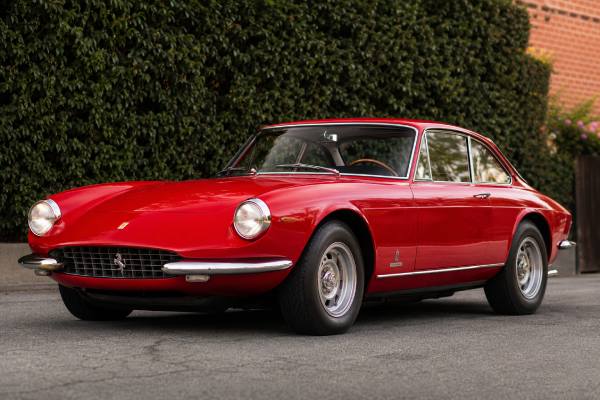
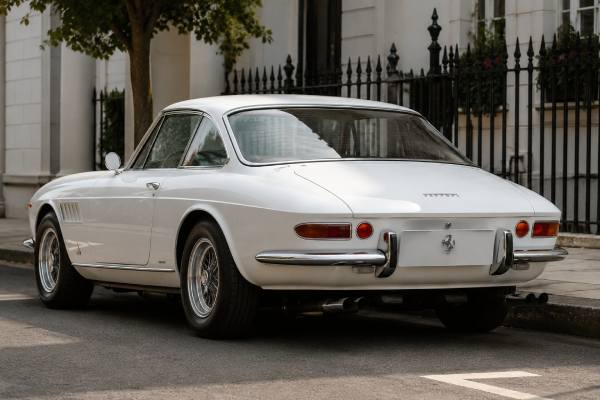
The Ferrari 365 GTC was the 4.4-liter, 320 hp evolution of Ferrari’s elegant 330 GTC, built from 1968 to 1970 on the Tipo 592C chassis and powered by the Tipo 245/C Colombo V12. It was a two-seat Pininfarina coupe made for fast road use rather than racing theater: discreet, compact, expensive, and mechanically serious.
Its appeal sits in a narrow but important part of Ferrari history. The 365 GTC kept the graceful proportions, transaxle layout, independent rear suspension, and refined cabin of the 330 GTC, but added a larger 4.4-liter V12 with more torque and easier real-world performance. It arrived at the same time as louder Ferrari headlines such as the 365 GTB/4 Daytona, which partly explains why the GTC remained rare and quietly prized rather than famous in the usual poster-car sense.
Today, collectors search for the 365 GTC because it combines classic front-engine Ferrari character with genuine usability. It is smaller and more restrained than the Daytona, rarer than the 330 GTC, and easier to enjoy on public roads than many more dramatic Ferraris of the same era. It is also a car where originality, documentation, body condition, and specialist maintenance matter enormously.
Quick Take
The Ferrari 365 GTC is one of the most refined late-1960s Ferrari road cars: a rare Pininfarina two-seat coupe with a torquey 4.4-liter Colombo V12, five-speed rear transaxle, independent suspension, and understated styling. Its strongest appeal is the blend of usability, rarity, and classic V12 feel, while the main caution is that restoration, corrosion repair, engine work, and missing original details can easily outweigh a tempting purchase price. The best examples are documented, matching-numbers cars with known ownership history, correct bodywork, strong mechanical health, and evidence of expert Ferrari specialist care.
Table of Contents
- History and Significance
- Engine, Chassis and Specifications
- Production, Variants and Options
- Design, Engineering and Special Features
- Driving Experience and Performance
- Maintenance, Reliability and Restoration
- Market Value, Buying Guide and Rivals
History and Significance
The 365 GTC matters because it represents the final, most muscular form of Ferrari’s classic 1960s two-seat road coupe before the brand’s grand tourers moved toward larger, sharper, and more complex designs. It was not a clean-sheet model, and that is part of its charm: Ferrari took the already excellent 330 GTC and gave it a stronger 4.4-liter V12, subtle mechanical updates, and just enough visual change to mark it as the later car.
The 330 GTC had been introduced in 1966 as a refined two-seat coupe positioned between Ferrari’s more practical four-seat models and its more aggressive berlinettas. It borrowed ideas from several important Ferrari lines: the front-end elegance associated with the 500 Superfast, the compact proportions of the 275-series cars, and a sophisticated rear transaxle layout that helped weight distribution. The 365 GTC continued that formula but added more capacity and torque.
Ferrari introduced the 365 GTC in 1968, during a crowded and transitional period. The company was selling the larger 365 GT 2+2, preparing the Daytona era, and widening its range with the Dino line. Against that background, the 365 GTC was a gentleman’s express rather than a headline act. It suited buyers who wanted a fast, beautifully made Ferrari that could be used for long-distance travel, city driving, and mountain roads without the visual drama of the Daytona.
The name followed Ferrari’s traditional logic of the period: “365” referred to the approximate displacement of one cylinder. With twelve cylinders, the total displacement came to 4,390 cc. The “GTC” badge stood for Gran Turismo Coupe, and that identity is important. This was not a stripped competition car, even though the model name includes the letter “C.” It was a luxury road car with serious performance.
Pininfarina designed and built the body, continuing the close relationship between Ferrari and the Turin coachbuilder. The 365 GTC’s shape was almost identical to the 330 GTC at a glance. The easiest exterior clue is the ventilation: the 330 GTC used triple vents behind the front wheels, while the 365 GTC moved its black cooling vents to the rear edge of the hood.
The car’s significance has grown with time. For decades, many collectors focused on more famous Ferraris: 250-series cars, Daytonas, California Spiders, and competition models. The 365 GTC appealed to a narrower group who valued road manners, rarity, and mechanical purity. As the market matured, those traits became more appreciated.
Its collector status comes from four main factors:
- It is rare, with low production compared with the 330 GTC.
- It uses a classic front-mounted Colombo V12.
- It combines a five-speed transaxle with independent rear suspension.
- It has restrained Pininfarina styling that has aged gracefully.
The 365 GTC is also important because it was among the last Ferrari road cars of this type to use the single-overhead-cam-per-bank Colombo V12 layout. Later Ferrari V12 grand tourers moved into different technical and stylistic territory. That makes the 365 GTC feel like the close of one chapter rather than the start of another.
Engine, Chassis and Specifications
The 365 GTC’s core technical identity is its Tipo 245/C 4.4-liter V12 installed in the reinforced Tipo 592C chassis. The car kept the 330 GTC’s balanced transaxle layout and independent suspension, but the larger engine gave it a more relaxed and flexible character.
| Item | Specification |
|---|---|
| Production years | 1968–1970 |
| Body style | Two-seat coupe |
| Coachbuilder | Pininfarina |
| Chassis type | Tubular steel Tipo 592C |
| Engine | Tipo 245/C Colombo 60-degree V12 |
| Displacement | 4,390 cc |
| Bore x stroke | 81 mm x 71 mm |
| Valve gear | Single overhead camshaft per bank, two valves per cylinder |
| Fuel system | Three twin-choke Weber carburetors |
| Maximum output | 320 hp at 6,600 rpm |
| Transmission | Five-speed manual rear transaxle |
| Drivetrain | Front engine, rear-wheel drive |
| Suspension | Independent front and rear, unequal-length wishbones, coil springs, telescopic dampers |
| Brakes | Four-wheel disc brakes |
| Wheelbase | 2,400 mm |
| Fuel capacity | About 90 liters |
| Top speed | About 250 km/h, depending on source and specification |
The engine is the major difference from the 330 GTC. The earlier 330 used a 4.0-liter V12, while the 365 GTC adopted the larger 4.4-liter unit related to the 365 GT 2+2 and 365 California. The bore increased to 81 mm while the stroke remained 71 mm, creating a short-stroke V12 that could rev freely but no longer needed to be worked hard to feel quick.
The engine’s construction was familiar Ferrari practice: aluminum block and heads, wet-sump lubrication, single plug ignition, and carburetion rather than fuel injection. It was not as exotic on paper as Ferrari’s four-cam V12 engines, but it was smooth, flexible, and very well suited to a road-focused GT.
The transmission layout is just as important as the engine. Instead of placing the gearbox directly behind the engine, Ferrari used a rear transaxle connected by a torque tube. This helped balance the car and gave the 365 GTC a planted, neutral feel compared with older front-engine GTs that carried more mass ahead of the cabin.
The chassis was a development of the 330 GTC structure, but Ferrari reinforced and repositioned the engine mounting points to suit the larger V12. That update created the Tipo 592C designation. The suspension remained fully independent, using wishbones, coil springs, dampers, and anti-roll bars at both ends. For a late-1960s road Ferrari, this was a sophisticated setup.
The braking system used discs all round. Buyers should remember that period disc brakes are not the same as modern high-performance brakes. In correct condition they are effective and confidence-inspiring, but they depend on good hydraulics, proper pad material, fresh flexible hoses, and accurate setup.
Dimensions and weight vary slightly by source, restoration state, equipment, and market specification. The important practical point is that the 365 GTC is compact by modern GT standards. Its 2,400 mm wheelbase, slim pillars, and two-seat cabin make it feel more intimate than later Ferrari 365 models.
Production, Variants and Options
The 365 GTC was built in very small numbers, and that rarity is central to its desirability. Most references cite 168 coupe examples from 1968 to 1970, though some auction descriptions use lower production wording, so serious buyers should verify any specific chassis through factory records and expert documentation.
There was no broad range of factory variants in the modern sense. The 365 GTC was a short-run coupe, closely related to the open 365 GTS. The GTS is much rarer, with only a tiny number produced, and belongs to a different market tier. The coupe, however, is the more practical and usable of the pair.
Key production identifiers include:
- Pininfarina two-seat coupe body.
- Hood-mounted black ventilation grilles.
- No “330” script on the rear.
- Tipo 245/C 4.4-liter V12.
- Five-speed rear transaxle.
- Tipo 592C chassis designation.
- Late-1960s Ferrari interior with wood veneer and leather trim.
The 365 GTC did not receive the sort of annual model-year changes common in mass-market cars. Changes were subtle and often mechanical or equipment-related. Carburetor specification can vary, with earlier cars generally associated with Weber 40 DFI/5 carburetors and later cars with DFI/7 units. Market equipment also varied, especially for cars delivered to the United States.
Factory and period options were limited but important. Typical desirable features include:
- Air conditioning.
- Radio.
- Borrani wire wheels.
- Special-order paint.
- Leather interior color choices.
- Market-specific lighting and reflector equipment.
Air conditioning deserves special mention. It adds desirability for some buyers, especially in warmer climates, but it also adds components that must be complete and working. A missing or improvised system can become expensive to correct.
Borrani wire wheels are visually attractive and period-correct when documented, but they should not be judged only by appearance. Wire wheels need proper inspection for spoke condition, rim truth, hub splines, corrosion, and correct fitment. Many owners prefer the simpler cast alloy wheels for regular driving, while concours-focused buyers may value documented original wheel specification more highly.
Factory documentation is crucial. The ideal file includes ownership history, old registration documents, invoices, correspondence, restoration records, photos from previous work, and a Ferrari Classiche file if applicable. A Massini report or comparable marque-expert history can be valuable, but it should support the car’s story rather than replace physical inspection.
Matching-numbers status is a major value factor. The best cars retain their original chassis, engine, gearbox, and body identity. A replacement engine does not automatically make a 365 GTC undesirable, but it changes the collector calculation. The price must reflect the difference, and the reason for the replacement should be well documented.
Because the cars were hand-built and many have been restored, buyers should not expect every detail to be identical from car to car. Small trim differences, color changes, and equipment changes can be part of a car’s history. The question is whether the current configuration is documented, reversible, and consistent with period Ferrari practice.
Design, Engineering and Special Features
The 365 GTC’s design is special because it hides serious engineering under a calm, elegant Pininfarina shape. It is not a flamboyant Ferrari, and that restraint is exactly why many collectors now admire it.
The body has a long hood, compact cabin, slim pillars, and a short rear deck. The proportions are classic front-engine Ferrari, but the surfacing is cleaner than many earlier coachbuilt cars. The exposed headlamps, modest grille opening, and delicate side profile give the car a light look, even though the mechanical package is substantial.
The most obvious visual difference from the 330 GTC is the hood vent arrangement. On the 365 GTC, black vents sit near the rear edge of the hood to help extract heat from the larger engine. The 330 GTC’s side vents behind the front wheels were removed. It is a small change, but it gives the 365 GTC a distinct identity once a reader knows where to look.
Pininfarina’s body construction followed high-end Ferrari practice of the era. Bodies were not stamped out with modern uniformity. They were built with a degree of hand finishing, and this means panel gaps, edge profiles, and trim fit should be judged by period standards, not by modern production-car standards. Even so, poor door fit, uneven hood alignment, bubbling paint, and heavy filler are warning signs, not “hand-built charm.”
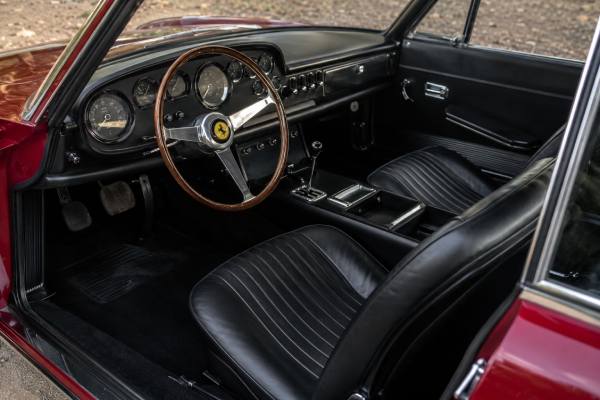
Inside, the 365 GTC feels like a proper Italian GT. The cabin is airy for a 1960s Ferrari, thanks to slim pillars and good glass area. A wood-rim steering wheel, wood dashboard fascia, leather upholstery, analog instruments, and a simple manual gear lever create a cockpit that is elegant but not fussy. Behind the seats, the parcel shelf adds useful luggage space for touring.
The engineering choices reveal Ferrari’s priorities. The rear transaxle, torque tube, independent rear suspension, and compact wheelbase all help the car feel balanced. The engine sits at the front, but the car does not feel like a nose-heavy luxury coupe when properly set up. It is a driver’s GT, not merely a stylish object.
The V12 also defines the sensory character. A 365 GTC in tune has a crisp mechanical note at idle, a smooth rise through the rev range, and a harder-edged intake and exhaust sound as the carburetors open. It is not as raw as a competition Ferrari, and it is not as explosive as a Daytona at full commitment. Its charm is the way it builds speed with smooth authority.
Cooling and heat management are important parts of the design. The larger engine generated more heat than the 330’s 4.0-liter unit, which is why correct radiator condition, ducting, fans, hoses, and venting matter. A car that runs hot in traffic may not simply need “old car patience”; it may need a careful cooling-system rebuild.
The 365 GTC’s special quality is cohesion. None of its individual systems is shocking on paper, but the combination is rare: small two-seat body, large V12, rear transaxle, independent suspension, Pininfarina elegance, and real road comfort. That is why it feels more complete than its modest public profile suggests.
Driving Experience and Performance
A good 365 GTC feels fast, flexible, and balanced rather than brutal. Its 4.4-liter V12 gives it more easy torque than the 330 GTC, so the driver can cover ground quickly without constantly chasing the upper rev range.
The engine is the heart of the experience. When properly warmed and tuned, it pulls cleanly from low speeds and becomes increasingly urgent as revs rise. The car’s quoted output of 320 hp was very strong for the period, and the broad torque delivery makes it feel more relaxed than smaller-displacement Ferrari V12s.
Carburetor behavior matters. A well-set-up car starts, warms, and responds cleanly, though it still needs old-car mechanical sympathy. A tired or poorly adjusted car may hesitate, load up in traffic, smell rich, or stumble when the throttle is opened. Many complaints about “temperamental” classic Ferraris are really complaints about neglected carburetion, ignition, fuel delivery, or cooling.
The five-speed gearbox has a mechanical feel that rewards patience. Like many classic Ferraris, it may be stiff when cold, especially into second gear. Forcing the shift is the wrong approach. Once the oil warms, a properly rebuilt and adjusted transaxle should shift with precision. Crunching, jumping out of gear, or heavy resistance when warm points to expensive trouble.
Steering is one of the car’s great strengths. There is weight at low speeds, as expected for a classic front-engine GT without modern assistance, but the effort turns into feel once moving. The car communicates through the wheel, and the slim tires allow progressive breakaway compared with modern high-grip rubber.
Ride quality is better than many people expect. The 365 GTC was built as a road car, not a track special, so it can absorb real surfaces with composure. Correct dampers, bushings, tires, and ride height are essential. A car on old tires, incorrect modern rubber, tired springs, or worn suspension joints may feel nervous or harsh in a way the original design did not intend.
Braking performance is period-appropriate. The discs can stop the car effectively, but the pedal feel, response, and fade resistance depend heavily on maintenance. Old hoses, contaminated fluid, seized calipers, and mismatched pads can make a healthy design feel poor. Buyers should judge brakes after a full inspection, not after a gentle parking-lot test.
Visibility is excellent by exotic-car standards. The cabin is compact but not claustrophobic, and the thin pillars help place the car accurately on narrow roads. This is one reason the 365 GTC is so usable. It does not intimidate the driver with width, blind spots, or theatrical controls.
On a fast road, the 365 GTC’s personality is mature. It is quick enough to feel genuinely special, but not so aggressive that it becomes a chore. The best use case is a flowing road where the driver can lean on the V12’s torque, use the gearbox deliberately, and enjoy the chassis balance. It is less about lap times and more about rhythm.
Maintenance, Reliability and Restoration
The 365 GTC can be a dependable classic Ferrari when it is used, serviced, and stored correctly, but neglected examples are financially dangerous. The car is mechanically robust in concept, yet every major system is expensive to restore properly.
The engine is strong when maintained, but rebuild costs are significant. Buyers should look for oil pressure records, compression and leak-down results, cooling-system work, carburetor rebuilds, ignition service, valve adjustment history, and evidence that the car has been driven rather than left dormant. Long inactivity can be as harmful as high mileage.
Common mechanical inspection areas include:
- Timing chain noise and tensioner condition.
- Oil leaks from seals, cam covers, and sump areas.
- Cooling-system corrosion, blocked radiator cores, weak fans, and old hoses.
- Carburetor wear, fuel leaks, sticking floats, and poor synchronization.
- Distributor wear, weak ignition components, and incorrect advance behavior.
- Clutch wear, cable adjustment, and release mechanism condition.
- Transaxle synchro wear, bearing noise, and differential condition.
- CV joint and driveshaft condition on later driveline components.
The cooling system deserves serious attention. A 4.4-liter V12 in a compact engine bay produces real heat. A freshly painted engine bay with old hoses, tired wiring, and marginal fans is not reassuring. Proper cooling work should include radiator condition, correct caps, thermostat function, fan operation, hose quality, coolant passages, and careful bleeding.
Corrosion is one of the biggest risks. The 365 GTC’s value can justify major metalwork, but the cost and difficulty should not be underestimated. Areas to inspect include lower door skins, sills, wheel arches, floor sections, spare-wheel area, lower front fenders, hood and trunk edges, suspension mounting points, and areas previously repaired after accident damage.
Accident repair is another major concern. These cars were valuable enough to repair even decades ago, but not always valuable enough at the time to repair correctly. Look for uneven wheelbase measurements, poor panel alignment, distorted inner structures, heavy filler, crude welds, mismatched metalwork, and evidence that trim is being used to hide body problems.
Electrical systems are simple compared with modern Ferraris, but age creates faults. Brittle wiring, poor grounds, tired switches, old fuse boxes, and improvised accessories can cause frustrating problems. Electrical originality also matters because a messy harness can lower confidence in the entire restoration.
Interior restoration is expensive because correct materials, trim patterns, instruments, switches, and hardware matter. A retrim in generic leather may look pleasant but still reduce collector appeal if it loses the original texture, stitching, color accuracy, or dashboard details. Instruments should be correct, readable, and functional.
Parts availability is mixed. Many mechanical items can be sourced through specialists, rebuilt, or reproduced, but body trim, correct interior details, original tools, books, jacks, wheels, and model-specific fittings can be difficult and costly. Missing small items should be priced as real problems, not minor bargaining points.
The best ownership approach is preventive. A 365 GTC should be serviced by a shop that understands carbureted V12 Ferraris, not merely by a general classic-car garage. Regular use, fluid changes, brake maintenance, fuel-system care, and careful warm-up habits do more for reliability than occasional cosmetic work.
Market Value, Buying Guide and Rivals
The 365 GTC sits in a strong collector niche: rarer and more powerful than the 330 GTC, less famous and usually less expensive than the Daytona, and more usable than many older coachbuilt Ferraris. Its market value depends less on mileage alone and more on authenticity, documentation, condition, and quality of previous work.
Recent public auction and market-tracking data show the model trading broadly in the mid-six-figure to high-six-figure range, with exceptional cars capable of more. Currency, location, color, history, originality, and sale venue can move the result considerably. A car with a tempting asking price may be the most expensive choice if it needs body correction, engine work, interior restoration, missing parts, and documentation repair.
The main value drivers are:
- Matching engine and gearbox.
- Original chassis and body identity.
- Factory color combination or documented attractive period colors.
- Ferrari Classiche certification or strong marque-expert documentation.
- Complete ownership history.
- High-quality restoration by known specialists.
- Correct wheels, tools, manuals, and accessories.
- Evidence of regular recent mechanical use.
- Clean body structure with no hidden corrosion.
- No major accident history unless repaired to a documented high standard.
A pre-purchase inspection should be done by a recognized Ferrari classic specialist. A normal used-car inspection is not enough. The inspector should understand Ferrari chassis stamping locations, engine and gearbox numbers, Pininfarina body features, corrosion patterns, transaxle behavior, carburetor setup, and the difference between cosmetic restoration and real mechanical health.
| Area | What to confirm | Why it matters |
|---|---|---|
| Identity | Chassis, engine, gearbox, body numbers, documents | Authenticity drives value |
| Body | Rust, accident repair, panel fit, filler, inner structure | Metalwork is costly and specialist |
| Engine | Compression, leak-down, oil pressure, cooling, carburetion | V12 rebuilds are major expenses |
| Transaxle | Synchros, bearings, clutch action, differential noise | Driveline repairs require expertise |
| Suspension and brakes | Bushings, dampers, calipers, hoses, wheel bearings | Condition affects both safety and feel |
| Interior | Correct trim, instruments, switches, dash, carpets | Small details are hard to source |
| History file | Invoices, ownership chain, restoration photos, expert reports | Documentation supports market confidence |
Cars to seek are complete, honest, and mechanically sorted. A lightly used, older-restored example with excellent records can be a better ownership choice than a freshly restored car with vague invoices. Fresh paint is not a substitute for structural proof. A beautiful engine bay is not a substitute for leak-down numbers and road-test behavior.
Cars to avoid include incomplete projects, poorly converted cars, examples with unclear identity, cars missing major original components, and cars with shiny cosmetics over unknown metalwork. A 365 GTC is valuable, but restoration can still outrun the finished value if the starting point is poor.
The closest Ferrari alternatives are the 330 GTC, 365 GTB/4 Daytona, 365 GTC/4, and 365 GT 2+2. The 330 GTC offers much of the same beauty with less power and higher production. The Daytona is faster, more famous, and more dramatic, but also larger in personality and often more expensive. The 365 GTC/4 is a later, softer 2+2 with different styling and a different ownership profile. The 365 GT 2+2 is more spacious but less intimate.
Period rivals include the Aston Martin DB6, Lamborghini Islero, Maserati Mexico, and high-end Jaguar E-Type variants. The Ferrari stands apart because of its compact size, V12 character, transaxle layout, and Pininfarina refinement. It is not the most flamboyant choice, but it may be one of the most satisfying to drive and own when bought correctly.
For long-term collectability, the outlook remains strong. The 365 GTC has the ingredients collectors usually reward: rarity, beauty, usability, mechanical importance, and a clear place in Ferrari history. The risk is not demand; the risk is buying the wrong car. Condition, identity, and expert documentation matter more than chasing the cheapest example.
References
- Ferrari 365 GTC & 365 GTS Guide — Supercar Nostalgia 2021 (Historical and Technical Appraisal)
- 1968 Ferrari 365 GTC by Pininfarina | Villa Erba 2013 | RM Sotheby’s 2013 (Auction and Model History)
- 1969 Ferrari 365 GTC by Pininfarina | London 2025 | RM Sotheby’s 2025 (Auction and Market Reference)
- 1969 Ferrari 365 GTC by Pininfarina | Cliveden House 2025 | RM Sotheby’s 2025 (Auction and Documentation Reference)
- Ferrari 365 GTC Market – CLASSIC.COM 2026 (Market Data)
Disclaimer
This article is for informational purposes only and is not a substitute for professional diagnosis, repair, appraisal, or restoration advice. Specifications, torque values, service intervals, parts, and procedures can vary by VIN, market, equipment, and restoration history. Owners and buyers should verify all details against official Ferrari service documentation and consult a qualified classic Ferrari specialist before making mechanical or purchase decisions.
If this guide helped you, please share it on Facebook, X/Twitter, or your favorite enthusiast community to support our work.