
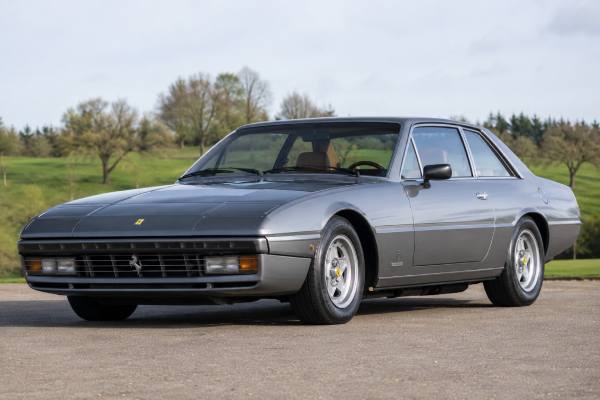
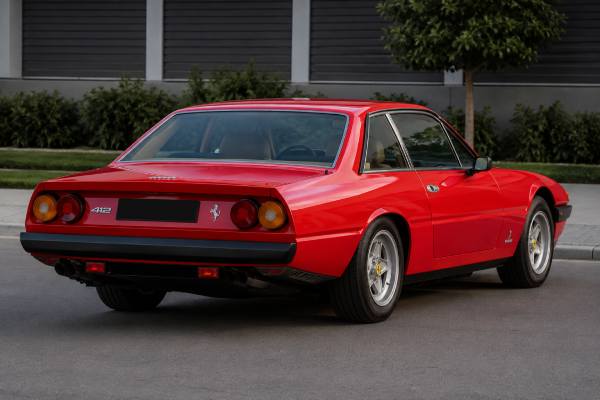
The Ferrari 412 with the F 101 EL 170 chassis designation and F 101 E 070 engine code is the automatic-transmission version of Ferrari’s final 1980s front-engine V12 2+2 grand tourer. Built from 1985 to 1989, it used a 4.9-liter Colombo-derived V12 rated at 340 hp and brought the long-running 365 GT4 2+2, 400, 400i, and 412 family to its most developed form. It was not a mid-engine poster car like the Testarossa, and it was never meant to be one. The 412 was a formal, expensive, long-distance Ferrari for people who wanted four-seat usability, quiet confidence, and a large V12 in front.
The car matters today because it sits at an unusual point in Ferrari history. It was among the last Ferraris to carry the classic Colombo V12 lineage, it introduced ABS to Ferrari road-car buyers, and it closed the book on a Pininfarina three-box shape that had been evolving since the early 1970s. Buyers still search for it because values remain far below the most famous front-engine V12 Ferraris, yet ownership costs, restoration needs, and specification differences can be very serious.
Quick Take
The Ferrari 412 is most appealing as a refined, understated V12 Ferrari with real 2+2 practicality, especially in well-documented, original condition. The F 101 E 070 automatic suits the car’s grand-touring character, while the rarer five-speed manual is usually more valuable and more enthusiast-focused. The main caution is that a neglected 412 can be expensive to rescue, with corrosion, electrical faults, fuel-injection issues, aging rubber, TRX tire costs, and interior restoration quickly overwhelming the apparent bargain price. Buy on condition, documentation, originality, and specialist inspection rather than headline mileage alone.
Table of Contents
- Model History and Collector Significance
- Engine, Chassis, and Key Specifications
- Production, Variants, and Factory Details
- Design, Engineering, and Special Features
- Driving Character and Performance
- Reliability, Maintenance, and Restoration
- Market Value and Buying Guide
Model History and Collector Significance
The Ferrari 412 was the final and most polished version of Ferrari’s long-running front-engine V12 2+2 line that began with the 365 GT4 2+2. Its importance comes from what it represents: the last stage of a formal Pininfarina grand tourer, a final development of the classic V12 formula, and the bridge before Ferrari returned to the front-engine 2+2 layout with the 456.
The 365 GT4 2+2 arrived in the early 1970s as a very different kind of Ferrari. Instead of low, flamboyant curves, it used a clean three-box body with a long hood, slim pillars, a squared-off cabin, and a reserved profile. That shape carried through the 400, 400i, and finally the 412. By the mid-1980s, the market had changed. Ferrari’s showroom also included sharper, more dramatic cars such as the 328 and Testarossa. Against those, the 412 looked discreet, almost conservative. That was part of its purpose.
The 412 was launched in 1985 as the replacement for the 400i. The major mechanical change was the increase in engine displacement from 4.8 liters to just under 5.0 liters. Ferrari also raised power back to 340 hp, giving the fuel-injected 2+2 a stronger identity after the earlier 400i had been softer than the carbureted 400. Styling changes were subtle but useful: body-color bumpers, revised front and rear detailing, new wheels, a slightly raised rear deck, and a more modern cabin treatment.
The model’s position in the range was clear. It was not the cheapest Ferrari and not the fastest-looking one. It was the mature Ferrari for owners who wanted a long-legged V12 GT with space, comfort, luggage capacity, air conditioning, leather, and automatic transmission availability. The F 101 EL 170 / F 101 E 070 version was the automatic model, using a three-speed automatic gearbox. Ferrari also built a five-speed manual version, usually identified by different chassis and engine-number logic.
Collector interest has grown because the 412 combines several traits that once worked against it. Its understated styling now looks elegant rather than dated. Its 2+2 layout gives it a kind of usability that many two-seat classics lack. Its V12 heritage matters more as later Ferrari V12s become increasingly expensive. Most important, good surviving cars are not common. Many examples lived through years when values were too low to justify proper maintenance, so the supply of genuinely sorted, original, rust-free cars is smaller than the production number suggests.
For concours and serious collector use, the 412 is not judged only by paint shine or mileage. Original colors, correct trim, factory books, tools, jack, service records, matching engine and gearbox numbers, and evidence of specialist care all matter. Ferrari Classiche certification can help, especially on high-value manual cars or very original examples. Still, a Classiche file does not replace a mechanical inspection. These cars are complex enough that paperwork and condition must be evaluated together.
Engine, Chassis, and Key Specifications
The 412 used a front-mounted 60-degree V12 of 4,943 cc, Bosch fuel injection, and rear-wheel drive. The F 101 E 070 engine code identifies the automatic version, while the same model family also included the manual F 101 E 010 version.
| Item | Specification |
|---|---|
| Production period | 1985–1989 |
| Body style | Two-door 2+2 coupe |
| Engine | 60-degree V12, front longitudinal |
| Engine code | F 101 E 070 automatic; F 101 E 010 manual |
| Displacement | 4,943 cc |
| Bore x stroke | 82 mm x 78 mm |
| Fuel system | Bosch K-Jetronic mechanical fuel injection |
| Maximum power | 340 hp at 6,000 rpm |
| Maximum torque | About 451 Nm at 4,200 rpm |
| Drive | Rear-wheel drive |
| Transmission | Three-speed automatic or five-speed manual |
The engine is the heart of the car’s appeal. It is not a highly strung racing-style V12 in the way some people imagine every classic Ferrari engine to be. It is a large, smooth, torque-rich unit designed for fast road use. The increase to 4,943 cc came from a bore increase, while the 78 mm stroke was retained. With two valves per cylinder, four camshafts, mechanical injection, and electronic ignition, the 412 blended traditional Ferrari architecture with 1980s drivability needs.
The chassis was a tubular steel structure with steel body panels and independent suspension. The layout remained conventional for a large GT: engine in front, gearbox behind it, driven rear wheels, and a long wheelbase to give the cabin usable space. Power-assisted steering made the car manageable at low speeds, while four-wheel disc brakes provided the stopping hardware expected of a heavy V12 Ferrari. The 412’s most important braking distinction was the availability of Bosch ABS, widely noted as a Ferrari first.
| Item | Typical figure |
|---|---|
| Length | 4,810 mm |
| Width | 1,798 mm |
| Height | 1,314 mm |
| Wheelbase | 2,700 mm |
| Dry weight | About 1,805 kg manual; about 1,810 kg automatic |
| Wheels and tires | Michelin TRX metric tire fitment, commonly 240/55 VR 415 |
| Top speed | About 250 km/h manual; about 245 km/h automatic |
| 0–100 km/h | About 6.7 seconds manual; about 8.3 seconds automatic |
| Fuel tank | About 120 liters |
The automatic and manual versions share the same basic personality, but they are not identical in the market or on the road. The automatic is calmer and more relaxed. The manual is quicker, more involving, and more valuable. Buyers looking specifically at an F 101 EL 170 / F 101 E 070 car should judge it as a luxury V12 GT rather than as a substitute for a manual sports Ferrari.
Production, Variants, and Factory Details
The 412 was a low-production Ferrari, with 579 examples commonly broken down into 270 manual cars and 309 automatic cars in specialist production lists. Some sources round the total to 576, so buyers should focus less on one headline number and more on the exact car’s identity, documents, and matching components.
There were two main factory versions:
| Variant | Transmission | Typical identifiers | Collector note |
|---|---|---|---|
| 412 GT | Five-speed manual | Often associated with F 101 E 010 engine logic | Rarer in feel, more driver-focused, usually higher value |
| 412 Automatic | Three-speed automatic | F 101 EL 170 chassis family and F 101 E 070 engine code | More relaxed GT character, often less costly to buy |
The automatic version should not be dismissed as a lesser car. It matches the 412’s original luxury brief well. The large V12 has enough torque to make relaxed progress, and the cabin’s leather, air conditioning, electric equipment, and long-distance layout suit the automatic gearbox. The market, however, has generally placed a premium on manual cars because gated manual V12 Ferraris have become especially desirable.
Year-to-year changes were not dramatic. The 412 itself was already the update. Compared with the 400i, it brought the larger engine, revised styling, improved interior details, updated wheels, and the important ABS development. The later the car, the more buyers tend to expect better factory refinement, but condition and maintenance matter far more than model year.
Authenticity checks should include:
- VIN and chassis-number consistency with the stated market and transmission.
- Engine number, gearbox number, and differential number where documentation is available.
- Original color and trim information from books, invoices, build records, or Ferrari Classiche material.
- Factory books, warranty card, pouch, tool kit, jack, spare wheel, and period accessories.
- Evidence that any repaint or retrim matches original specification or is clearly documented.
- Correct metric wheels and suitable TRX tires, unless a reversible wheel change has been made for driving use.
Factory colors vary widely, and the best choice depends on whether the buyer values elegance, resale strength, or originality. Dark blue, silver, black, gray, and darker metallic shades suit the formal body very well. Red exists, but the 412’s shape often looks more natural in sober grand-touring colors than in the brighter shades associated with mid-engine Ferraris. Interior originality is especially important because redoing leather, carpets, headlining, switchgear, and trim properly can become expensive.
The 412 was not officially sold in the United States in the same way as Ferrari’s U.S.-market cars of the period, so many American-market examples arrived through importation and federalization channels. That history makes documentation important. Buyers in the U.S. should confirm import records, compliance work, emissions equipment, title history, and whether any modifications were done cleanly and reversibly.
Design, Engineering, and Special Features
The 412’s design is best understood as formal grand-touring architecture rather than sports-car theater. Pininfarina gave the car a long, low, three-box profile with a restrained beltline, slim glasshouse, and enough cabin volume to make the rear seats more than decoration.
The body was an evolution of the 365 GT4 2+2 and 400 shape, but the 412 received enough changes to look more modern. Body-color bumpers reduced the visual weight of the earlier black bumper treatment. The deeper front spoiler helped the nose look lower and more planted. The rear was revised with cleaner detailing, and the raised rear deck improved luggage space. Black window trim and flatter-faced metric wheels gave the car a more 1980s appearance without losing the original Pininfarina restraint.
The engineering choices support the same character. The long wheelbase gives the cabin useful room and helps high-speed stability. The front V12 sits ahead of the driver, but the car does not feel like a small sports car with extra seats added as an afterthought. It feels like a purpose-built luxury GT. That is why the automatic version makes sense historically. Ferrari was serving customers who wanted effortless speed and refinement, not just lap times.
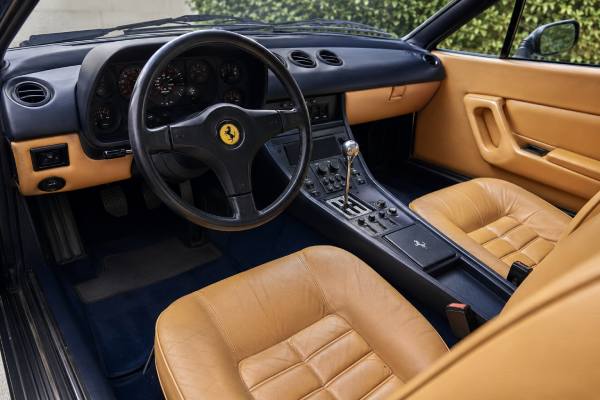
The cockpit is one of the car’s defining features. It combines a traditional Ferrari driving position with a luxury cabin: leather seats, electric equipment, air conditioning, a broad dashboard, clear instruments, and a sense of width. Visibility is better than in many mid-engine Ferraris because of the upright glass and conventional shape. The rear seats are best for shorter trips or smaller adults, but they are meaningful by Ferrari standards, and the luggage area is genuinely useful.
Special features and details that matter include:
- Bosch ABS, an important Ferrari road-car milestone.
- Bosch mechanical injection, chosen for smoother emissions-era drivability.
- Marelli electronic ignition, which helped modernize the V12.
- Metric TRX wheel and tire package, very period-correct but costly today.
- Power steering, important in a heavy front-engine V12 GT.
- Electric seats, windows, mirrors, and luxury cabin equipment on many cars.
- A formal Pininfarina body that rewards subtle colors and correct panel fit.
The sound is also different from the stereotype. A healthy 412 does not scream like a later high-revving V12 supercar. It has a deep, layered, mechanical V12 note, smoother and more cultured than aggressive. At low speed it feels expensive and slightly old-world. At higher revs it becomes more urgent, but still with the sense of a grand tourer covering distance rather than a track car chasing tenths.
Driving Character and Performance
A good Ferrari 412 feels smooth, stable, torquey, and expensive, not nervous or razor-edged. The automatic F 101 E 070 version is at its best when driven as a fast, relaxed V12 GT, while the manual version adds sharper acceleration and more driver involvement.
The V12’s strength is its broad delivery. It does not need to be worked hard to feel special. Around town, the automatic gearbox makes the car easy to use once warm, although the size, visibility over the long hood, and heavy doors remind you that this is a substantial machine. On open roads, the engine settles into a smooth stride. The 412 was built for high-speed European travel, and that is still where it makes the most sense.
The manual version can feel surprisingly quick for such a large 1980s GT, with period 0–100 km/h figures around the high-six-second range. The automatic is slower on paper, commonly quoted around the low-eight-second range, but the difference matters less in the way many owners use the car. The automatic’s appeal is the way it gathers speed with little fuss. It suits long highways, sweeping roads, and relaxed touring.
Steering is assisted and generally lighter than in older unassisted Ferraris. It should feel accurate, but not ultra-sharp by modern standards. A tired suspension, old tires, worn bushings, or poor alignment can make the car feel vague, heavy, or unsettled. A properly sorted 412 should track cleanly, ride with dignity, and feel composed at speed.
Braking feel depends heavily on condition. Cars with ABS need their systems inspected carefully, and brake fluid, hoses, calipers, pads, and discs must be maintained to a high standard. The 412 is heavy, so weak brakes or old tires quickly undermine confidence. Correct tires matter more than some buyers expect. A car on aged TRX rubber may look correct but drive poorly and brake worse than it should.
The cabin experience is part of the performance story. The 412 is quieter and more insulated than many classic Ferraris. The driving position is upright by supercar standards. The view forward over the long hood gives the car ceremony. Heat, air conditioning performance, window operation, seat motors, and ventilation all affect enjoyment because this is a car people buy to use as a GT, not merely to admire.
A good road test should include:
- Cold start, warm idle, and hot restart.
- Smooth pull through the rev range without hesitation.
- Stable coolant temperature in traffic and at speed.
- Clean automatic shifts or precise manual engagement.
- No driveline clunks under load changes.
- Straight braking without vibration or pulling.
- No steering wander, harsh suspension knocks, or rear-end looseness.
- Full operation of lights, windows, fans, seats, gauges, and air conditioning.
The main difference between a wonderful 412 and a disappointing one is rarely the specification sheet. It is condition. These cars can feel elegant and special when maintained correctly, or tired and ponderous when neglected.
Reliability, Maintenance, and Restoration
The Ferrari 412 can be dependable in specialist-maintained condition, but it is not a cheap classic to run. Its biggest risks are age, corrosion, deferred maintenance, fuel-system issues, electrical faults, interior deterioration, and the cost of making a complex V12 GT correct again.
The engine itself is strong when serviced properly. It needs clean oil, correct cooling-system care, good ignition components, healthy injection, and regular use. Long storage is often worse than mileage. Cars that sit can develop fuel varnish, stuck components, brittle hoses, leaking seals, weak pumps, and electrical gremlins. A low-mileage car with poor recent maintenance can be riskier than a higher-mileage car that has been exercised and documented.
Common ownership concerns include:
- Fuel injection imbalance, old fuel lines, weak pumps, and hot-start problems.
- Cooling-system neglect, radiator issues, tired hoses, thermostat faults, and fan problems.
- Oil leaks from age-hardened seals and gaskets.
- Ignition faults, poor grounds, aging connectors, and failing relays.
- Automatic gearbox leaks or lazy shift behavior on neglected cars.
- Manual clutch wear, linkage issues, or expensive clutch-related work.
- Suspension bushing wear, tired dampers, and rear suspension looseness.
- Brake system aging, including calipers, hoses, master cylinder, ABS components, and fluid neglect.
- Air-conditioning weakness, which can be expensive to correct properly.
- Electric seat, window, mirror, lighting, and fuse-board problems.
Corrosion is a major inspection point. The 412’s steel body and tubular structure mean rust must be treated seriously. Check sills, lower doors, wheel arches, floor sections, front and rear valances, suspension mounting points, windshield and rear-window surrounds, trunk areas, and previous repair zones. Paint bubbles are only the visible part of the problem. A shiny repaint can hide poor metalwork.
Interior restoration is another major cost driver. Correct leather, carpets, switchgear, headlining, wood or trim pieces, and instrument details are expensive to restore well. A worn but original cabin may be preferable to a poorly retrimmed one. Patina is acceptable if the car is honest and usable. Torn leather, shrinking trim, missing parts, and non-original modifications reduce both pleasure and value.
The TRX tire issue deserves special attention. The metric tires are correct and part of the original driving package, but they are expensive and less widely available than conventional tire sizes. Some owners fit alternative wheels for regular driving and keep the originals for shows. That can be a sensible, reversible approach, but buyers should make sure the original wheels are included and undamaged if originality matters.
Restoration costs often exceed the difference between a mediocre car and an excellent one. A cheap 412 needing paint, leather, suspension, cooling work, electrical sorting, fuel-system renewal, tires, brakes, and air-conditioning repair can become financially painful. The best buy is usually the car that has already had major age-related work completed by recognized specialists, with invoices to prove it.
Market Value and Buying Guide
The Ferrari 412 remains one of the more attainable classic front-engine V12 Ferraris, but the market now rewards the best cars clearly. Manual cars usually command a strong premium, while automatic cars offer better entry pricing but still require the same expensive maintenance standards.
Recent market data shows a large gap between manual and automatic examples. Manual 412 GTs tend to sit around the six-figure benchmark in strong condition, with exceptional sales going higher. Automatic cars often trade lower, with values more dependent on color, condition, originality, mileage, and documentation. Asking prices can be ambitious, especially in Europe, but buyers should separate asking price from completed-sale evidence.
The key value factors are:
| Factor | Why it matters |
|---|---|
| Transmission | Manual cars are rarer in character and usually more valuable; automatics suit GT use but trade lower. |
| Originality | Factory colors, correct trim, original wheels, books, tools, and matching numbers support collector value. |
| Condition | Rust, tired interiors, and deferred mechanical work can erase any purchase-price saving. |
| Documentation | Service invoices, ownership history, import records, and certification reduce uncertainty. |
| Color combination | Elegant period colors often suit the car best and may be easier to sell than awkward later repaint choices. |
| Specialist care | Recognized Ferrari workshops add confidence, especially for fuel, cooling, electrical, and brake work. |
A serious pre-purchase inspection should be done by someone who knows 365/400/412-series Ferraris, not only modern Ferraris. The inspection should include a lift check, corrosion assessment, compression or leak-down testing where appropriate, fuel-system evaluation, cooling-system pressure testing, electrical review, road test, brake inspection, and verification of numbers and documents.
Seek cars with:
- Clear ownership history and consistent mileage records.
- Original books, tool kit, jack, and spare wheel.
- Strong cold and hot starting.
- Stable temperature in traffic.
- Recently renewed tires, hoses, fluids, and belts where applicable.
- Correct ride height, clean steering, and no suspension knocking.
- Working air conditioning and electrical accessories.
- No hidden rust, accident damage, or poor structural repairs.
- A file of specialist invoices rather than vague verbal claims.
Avoid cars with:
- Fresh paint over visible bubbling or poor panel gaps.
- Missing documentation and unexplained import history.
- Long storage with little recommissioning.
- Non-working ABS, air conditioning, windows, lights, or instruments.
- Cheap interior retrims, incorrect wheels, or missing original parts.
- Fuel smells, overheating, weak oil pressure, or rough running.
- Seller claims that “they all do that” without evidence.
Long-term collectability looks positive for the best examples because the 412 has the right ingredients: front V12 engine, Pininfarina design, low production, Ferrari heritage, 1980s character, and genuine usability. It may never have the broad glamour of a Daytona or Testarossa, but that is also why it remains interesting. The right 412 is not a substitute for those cars. It is a different kind of Ferrari: quieter, more formal, more practical, and often more satisfying than its old reputation suggests.
References
- Ferrari 412 (1985) – Ferrari.com 1985 (Manufacturer Specifications)
- Ferrari 412: Ferrari History 1985 (Manufacturer History)
- FERRARI 412 OWNER’S MANUAL Pdf Download | ManualsLib 1986 (Owner’s Manual)
- Ferrari 412 – Manual Market – CLASSIC.COM 2026 (Market Data)
- Ferrari 412 – Automatic Market – CLASSIC.COM 2026 (Market Data)
Disclaimer
This article is for informational purposes only and is not a substitute for professional diagnosis, repair, valuation, or inspection. Specifications, torque values, service intervals, fluids, procedures, and equipment can vary by VIN, market, production date, and individual vehicle history. Always verify details against official Ferrari service documentation and consult a qualified Ferrari specialist before buying, repairing, restoring, or modifying a Ferrari 412.
If you found this guide useful, please consider sharing it on Facebook, X/Twitter, or your favorite enthusiast community to support our work.