
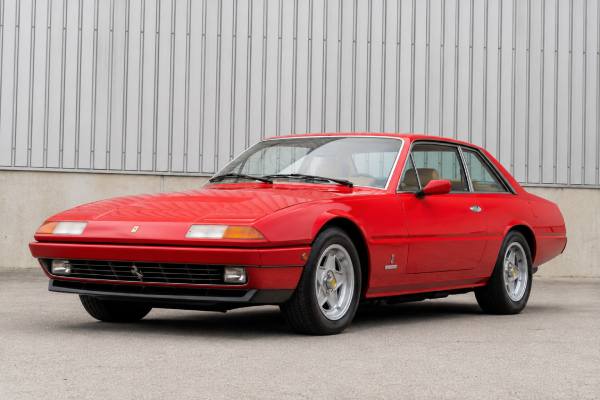
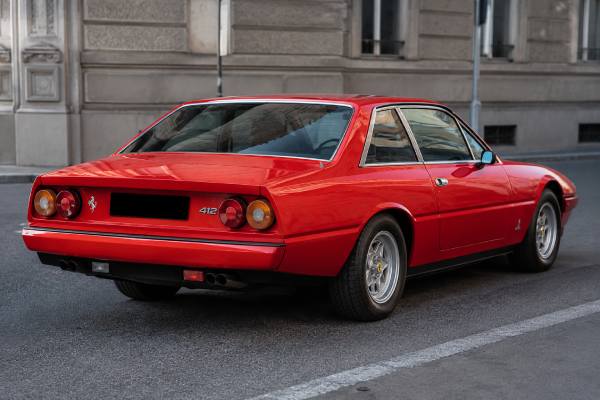
The Ferrari 412 with the F 101 EL 110 chassis designation and F 101 E 010 manual-transmission V12 is the final form of Ferrari’s long-running front-engine 2+2 grand tourer line that began with the 365 GT4 2+2 in the early 1970s. Produced from 1985 to 1989, it combined a 4.9-liter naturally aspirated V12, Pininfarina’s restrained three-box body, a usable four-seat cabin, and enough long-distance refinement to make it very different from the mid-engine Ferraris that usually dominate the same era.
The 412 matters because it closed a chapter. It was the last evolution of the 365/400/400i family, the last Ferrari of that shape, and one of the last classic Ferrari V12 grand tourers before the cleaner, more modern 456 arrived in the 1990s. It also brought meaningful updates: more displacement, restored performance compared with the earlier injected 400i, a revised body with better luggage space, and Bosch ABS, widely regarded as a Ferrari first. Today, buyers search for the 412 because it offers old-school V12 character, real touring usability, and relative rarity, but it also demands careful inspection because neglected examples can turn expensive quickly.
Quick Take
The Ferrari 412 is most appealing as a discreet, hand-built V12 Ferrari for long trips rather than a sharp-edged sports car. Its identity rests on the front-mounted 4.9-liter Colombo-family V12, Pininfarina styling, standard ABS, and a rare mix of luxury and mechanical seriousness. The tradeoff is that values have historically lagged behind more glamorous Ferraris, so many cars were maintained below the standard they deserved. The best buy is a documented, original, specialist-maintained manual F 101 E 010 car with strong corrosion history, working electrics, correct trim, and no deferred fuel, cooling, suspension, or hydraulic work.
Table of Contents
- History, Position, and Significance
- Engine, Chassis, and Key Specifications
- Production, Variants, and Factory Options
- Design, Engineering, and Special Features
- Driving Experience and Performance Character
- Reliability, Maintenance, and Restoration
- Market Value and Buying Guide
History, Position, and Significance
The Ferrari 412 was the final and most developed version of Ferrari’s angular V12 2+2 series. It replaced the 400i in 1985 and kept the same basic grand touring idea: a front-mounted V12, rear-wheel drive, a long wheelbase, leather-lined four-seat cabin, and understated Pininfarina bodywork.
This model line began with the 365 GT4 2+2, moved through the 400 and 400i, and ended with the 412. The shape was not new by 1985, but Ferrari used the 412 to make the car feel more modern and more complete. The larger engine helped restore the performance that had softened when the 400i adopted fuel injection. The raised rear deck improved luggage capacity. Body-color bumpers, revised spoilers, black trim, and flat-face wheels gave the car a cleaner late-1980s look.
The 412 also sat in an unusual place in Ferrari history. It was not a supercar like the 288 GTO or F40, and it was not a small mid-engine sports car like the 328. It was Ferrari’s gentleman’s express: quiet by Ferrari standards, expensive when new, and designed for fast travel with passengers and luggage. That makes it more relevant to collectors who value elegance, originality, and usable engineering than to buyers chasing poster-car drama.
Its significance rests on several points:
- It was the last evolution of the 365 GT4 2+2, 400, and 400i family.
- It used a front-mounted, naturally aspirated V12 when much of Ferrari’s image was being shaped by mid-engine cars.
- It was among Ferrari’s earliest road cars to use Bosch ABS as standard equipment.
- It bridged the gap between the old coachbuilt-feeling V12 GTs and the more modern 456 GT.
- It was produced in small numbers, making correct, well-kept examples uncommon.
The 412’s reputation has changed over time. For years it was one of the more affordable classic V12 Ferraris, partly because the styling was subtle and the automatic cars did not fit the usual enthusiast image of a Ferrari. That lower market position was a mixed blessing. It made the model accessible, but it also meant many examples lived through periods when major service bills could exceed what owners wanted to spend.
Today the 412 is better understood. It is not a budget route into Ferrari ownership if it needs work. It is a low-production V12 grand tourer whose value depends heavily on condition, history, originality, and correct specification.
Engine, Chassis, and Key Specifications
The Ferrari 412’s core specification is a 4,943.03 cc front-mounted V12 making 340 hp at 6,000 rpm and 451 Nm at 4,200 rpm. In F 101 E 010 manual form, it is paired with a five-speed gearbox and rear-wheel drive.
The 412’s engine was enlarged from the 400i by increasing bore to 82 mm while keeping the 78 mm stroke. The result was a smoother, torquier, and more capable version of the injected V12. It was not built to be peaky or nervous. It was built to move a heavy luxury coupe quickly and effortlessly over long distances.
| Item | Specification |
|---|---|
| Engine type | Front longitudinal 60-degree V12 |
| Engine code | F 101 E 010 for manual-transmission cars |
| Displacement | 4,943.03 cc |
| Bore x stroke | 82 x 78 mm |
| Compression ratio | 9.6:1 |
| Fuel system | Bosch K-Jetronic mechanical injection |
| Ignition | Marelli Microplex electronic ignition |
| Maximum power | 340 hp at 6,000 rpm |
| Maximum torque | 451 Nm at 4,200 rpm |
| Lubrication | Wet sump |
The chassis followed traditional Ferrari GT practice. The 412 used a tubular steel frame with steel bodywork, independent suspension, power steering, and four-wheel disc brakes. Compared with lightweight sports Ferraris, it is a large and heavy car, but that is part of its purpose. It was designed as a stable high-speed GT, not a stripped driver’s car.
| Item | Specification |
|---|---|
| Chassis designation | F 101 EL 110 for manual cars |
| Body style | 2-door 2+2 coupe |
| Transmission | 5-speed manual |
| Drive layout | Rear-wheel drive |
| Front suspension | Independent unequal-length wishbones, coil springs, telescopic dampers, anti-roll bar |
| Rear suspension | Independent unequal-length wishbones with self-leveling arrangement |
| Steering | Power-assisted rack and pinion |
| Brakes | Four-wheel discs with Bosch ABS |
| Tyres | 240/55 VR 16 |
| Fuel capacity | 120 liters |
| Item | Manual F 101 E 010 |
|---|---|
| Length | 4,810 mm |
| Width | 1,798 mm |
| Height | 1,314 mm |
| Wheelbase | 2,700 mm |
| Dry weight | About 1,805 kg |
| 0–100 km/h | About 6.7 seconds |
| Top speed | About 250 km/h |
The important point is balance. The 412 was powerful, but not extreme. It had the engine capacity and torque to cruise quickly, the wheelbase to feel settled, and the cabin equipment to suit serious travel. Its technical personality is closer to a hand-built Italian V12 express than to a raw sports machine.
Production, Variants, and Factory Options
The 412 was produced from 1985 to 1989 in limited numbers, with manual and automatic versions built alongside each other. Commonly accepted production figures list 576 total cars, split between 270 manual cars and 306 automatics.
For the manual version covered here, the key identifiers are the F 101 EL 110 chassis designation and F 101 E 010 engine code. Automatic cars used related F101 designations and a three-speed automatic transmission. The automatic suits the car’s relaxed GT brief, but the five-speed manual is generally more attractive to many collectors because it gives the large V12 coupe a more direct mechanical feel and lower production volume.
Manual vs automatic identity
The 412 was not a car with wild special editions or track packages. The major distinction is the gearbox.
| Version | Transmission | Character | Collector Relevance |
|---|---|---|---|
| 412 manual | 5-speed manual | More interactive, more mechanical, quicker in period figures | Lower production and usually more desirable to enthusiasts |
| 412 automatic | 3-speed automatic | Softer, more relaxed, well matched to touring use | Useful and collectible, but often valued below equivalent manuals |
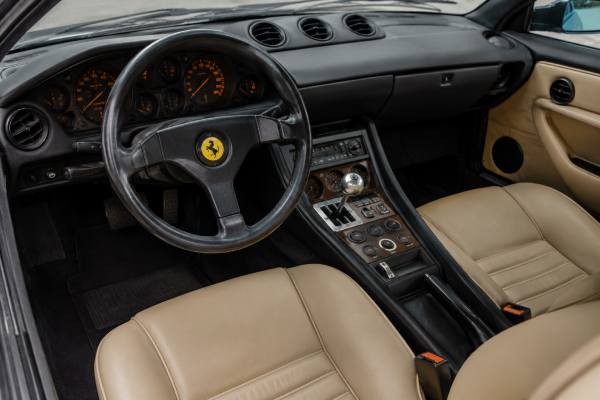
Factory equipment was generous for the period. Leather upholstery, air conditioning, electric windows, electric seats, central locking, power steering, and a proper audio system suited the car’s luxury mission. Options were fewer than on later Ferraris, but important items included a sunroof, Schedoni fitted luggage, and dual-zone air conditioning with rear-cabin control on some cars.
Originality matters because interior trim, switchgear, metric or period-correct wheel and tire details, tools, books, and luggage are expensive or difficult to replace. A complete car with its handbook pack, service book, tool roll, jack, spare wheel equipment, and old invoices is stronger than a cosmetically shiny car with missing documentation.
Documentation and authenticity
For a 412, “matching numbers” should not be treated casually. A buyer should confirm chassis, engine, gearbox, and body identification against factory-style records, ownership history, service invoices, and any available Ferrari Classiche or specialist documentation. A Classiche-certified example can be attractive, but certification alone does not replace a detailed mechanical inspection.
Useful checks include:
- Chassis number and engine number consistency.
- Correct manual-transmission identity for F 101 E 010 cars.
- Evidence of long-term specialist maintenance.
- Original paint color and interior color records.
- Factory books, warranty card, and service booklet.
- Tool kit, jack kit, spare, keys, and period accessories.
- Records of rust repair, repainting, accident damage, or leather retrim.
The best 412s tend to be honest, complete cars with a continuous story. Fresh cosmetic work with vague mechanical history is much less reassuring.
Design, Engineering, and Special Features
The Ferrari 412’s design is deliberately restrained: a long, low, formal Pininfarina coupe with slim pillars, a broad hood, and a proper trunk. Its appeal is not flamboyance but proportion, detail, and a quiet sense of expense.
The underlying shape came from Leonardo Fioravanti’s work at Pininfarina. By the time the 412 arrived, the basic body had already served Ferrari for many years, but the revisions helped it fit the late 1980s. The rear deck was raised to improve luggage capacity, the bumpers were body-colored, the lower front spoiler was deeper, and the trim became darker and cleaner. The result looks more modern than an early 400 while keeping the same formal GT profile.
The flat-face alloy wheels are a major visual cue. They also sit over the ABS braking system, one of the car’s most important engineering features. Ferrari was not always first to adopt driver aids, so the 412’s Bosch ABS gives it a notable place in the brand’s road-car development.
Inside, the 412 is a proper 2+2 rather than a token rear-seat coupe. The long 2,700 mm wheelbase gives it better rear accommodation than many performance cars, and the cabin is wide enough to feel like a genuine luxury GT. The driving position is classic Ferrari of the era: low dashboard, big steering wheel, gated manual shift on manual cars, deep leather seats, and a view over a long hood.
Several design and engineering choices define the 412:
- The V12 sits ahead of the cabin, giving the car a traditional grand touring layout.
- The long wheelbase favors stability and passenger space.
- The trunk is more useful than the earlier 400i due to the revised rear body line.
- The cabin has real luxury equipment, but still feels hand-built and mechanical.
- The Bosch K-Jetronic system gives smoother fueling than carburetors, but requires specialist setup.
- The manual gearbox turns the car from a relaxed cruiser into a more engaging GT.
The sound is also part of the design. The 412 does not have the sharp intake bark of a carbureted Daytona or the wild edge of a flat-plane V8. Its V12 is smoother, deeper, and more mature. At low speed it is cultured. At higher rpm it reminds the driver that this is still a Ferrari twelve-cylinder engine, just wrapped in a conservative suit.
Driving Experience and Performance Character
The 412 manual drives like a large classic Ferrari GT: smooth, torquey, stable, and more rewarding the faster and farther it goes. It is not light or delicate, but a good one feels composed, expensive, and capable.
The V12’s best quality is flexibility. Peak power arrives at 6,000 rpm, but the car does not need to be driven hard to feel special. Torque at 4,200 rpm gives useful mid-range pull, and the engine’s smoothness makes long-distance cruising easy. Compared with many smaller Ferraris of the period, the 412 feels less frantic and less sharp, but also more relaxed in real traffic.
The five-speed manual gearbox is central to the appeal of the F 101 E 010 version. Like many classic Ferraris, it can feel stiff when cold, and the shift quality depends heavily on adjustment, gearbox condition, oil temperature, and driver sympathy. Once warm, the gated shift adds involvement that the automatic cannot match. The manual also makes the car’s performance feel more accessible because the driver can keep the V12 in its stronger range.
Steering is power assisted and generally lighter than older non-assisted Ferraris. It should still feel accurate and settled. A tired car may wander, clunk, tramline, or feel vague because of worn bushings, old tires, tired dampers, or incorrect alignment. The rear self-leveling system must be working properly; if not, the car can sit wrong and lose the balanced GT feel it was designed to have.
Braking is strong for the period when the system is healthy. The ABS gives the 412 a more modern safety margin than earlier cars, but buyers should not expect modern supercar braking feel. Old hoses, tired fluid, sticky calipers, worn discs, and neglected ABS components can transform the brake pedal from reassuring to expensive.
The ride should be firm but not harsh. The 412 was designed to cover distance, and a good example has a calm high-speed gait. Noise levels are lower than in mid-engine Ferraris, visibility is better than expected, and the cabin feels more usable than many exotic cars. In cities, size, heat, heavy controls when cold, and attention to temperature gauges remind the driver that this is still a classic Ferrari.
Period-style expectations matter. A 412 will not feel like a modern automatic GT, and it will not hide poor maintenance. It needs warming through, smooth inputs, and mechanical sympathy. When it is healthy, that is part of its charm rather than a flaw.
Reliability, Maintenance, and Restoration
The Ferrari 412 can be reliable in the way a well-maintained classic V12 GT can be reliable, but it is not cheap to make right after neglect. The biggest ownership risk is not one famous defect; it is accumulated age, deferred maintenance, corrosion, and the cost of model-specific parts.
The V12 itself is robust when serviced correctly. It uses chain-driven camshafts rather than the timing belts found on many later Ferraris, which removes one familiar belt-service concern. That does not make the engine inexpensive. Valve adjustment, ignition diagnosis, cooling work, fuel-injection setup, oil leaks, and access around a large V12 still require specialist knowledge.
Fuel and ignition systems are high-priority areas. Bosch K-Jetronic mechanical injection is durable, but it dislikes stale fuel, air leaks, incorrect pressures, and old components. Poor cold starts, uneven idle, hesitation, hot-start trouble, and fuel smell need proper diagnosis rather than guesswork. Marelli Microplex ignition parts and sensors should also be checked carefully because intermittent faults can be time-consuming to trace.
Common ownership concerns include:
- Aging fuel hoses, pumps, injectors, accumulators, and warm-up components.
- Cooling-system weakness from old radiators, fans, thermostats, hoses, or water pumps.
- Oil leaks from cam covers, seals, gaskets, and aged fittings.
- Worn clutch components on manual cars.
- Gearbox stiffness beyond normal cold behavior.
- Worn suspension bushings, ball joints, dampers, and self-leveling rear parts.
- ABS faults, old brake hoses, seized calipers, and tired master cylinders.
- Electrical issues in windows, lights, relays, fuse panels, switches, and grounds.
- Air-conditioning leaks or weak performance.
- Slow pop-up headlamp operation.
- Interior leather shrinkage, faded trim, cracked veneers, and sticky or fragile switchgear.
Rust is one of the most serious inspection areas. Even a beautiful 412 can hide corrosion if it has lived in wet climates or had poor previous repairs. Check the sills, jacking points, wheel arches, lower doors, floor edges, front valance, rear quarters, trunk floor, windshield and rear-window surrounds, and chassis tubes where visible. Rust repair on a Ferrari 2+2 can easily exceed the price difference between a cheap car and a strong car.
Restoration is possible but rarely economical unless the car is rare, highly original, or personally important to the owner. The model’s complexity means a full restoration involves bodywork, paint, leather, wood or trim finishing, electrical sorting, mechanical rebuilds, suspension renewal, brake work, and often fuel-system rebuilding. A partially restored car can be risky if the expensive hidden work was skipped.
| Area | What to Check | Why It Matters |
|---|---|---|
| Engine | Compression, leaks, oil pressure, cooling behavior, service records | V12 work is specialist and expensive |
| Fuel injection | Cold start, hot start, idle, fuel pressure, fuel smell | K-Jetronic faults can cause poor running and safety risks |
| Manual gearbox | Cold shift, warm shift, synchros, clutch bite, leaks | Manual cars are desirable, but repairs are costly |
| Suspension | Ride height, self-leveling function, bushings, dampers | A tired chassis ruins the GT character |
| Body | Sills, arches, floors, screen surrounds, accident repairs | Corrosion is one of the largest cost drivers |
| Electrical system | Windows, lights, fans, relays, gauges, fuse panels | Small faults can point to wider neglect |
| Interior | Leather, seat motors, dashboard, switches, trim originality | Correct interior parts are hard and costly to replace |
A pre-purchase inspection by a Ferrari specialist is essential. A general classic-car inspection is not enough. The inspector must know the 400/412 family, understand the chassis and body corrosion points, and be able to price mechanical work realistically.
Market Value and Buying Guide
The Ferrari 412 remains one of the more attainable classic Ferrari V12s, but the market increasingly separates excellent documented cars from needy examples. Recent public auction results show a wide spread, from tired or poorly presented cars in the lower ranges to strong examples around or above the six-figure euro or Swiss-franc level.
That wide range makes condition more important than headline price. A cheaper 412 needing rust repair, suspension work, fuel-system rebuilding, air-conditioning repair, interior trimming, and major servicing can quickly become more expensive than buying the best available car in the first place.
Manual cars generally command more interest because they are rarer and more engaging. However, the automatic should not be dismissed if the car is exceptionally original, well documented, and mechanically excellent. Specification matters, but condition matters more.
What drives value
The strongest 412s usually share the same traits:
- Manual gearbox with correct F 101 E 010 identity.
- Original color and interior combination.
- Low ownership count or clear long-term history.
- Complete books, tools, service file, and supporting documents.
- Evidence of specialist maintenance rather than generic workshop care.
- No serious rust history or properly documented metal repair.
- Correct wheels, trim, badging, lighting, and interior details.
- Working air conditioning, electrics, ABS, and self-leveling suspension.
- High-quality paint with no signs of hidden accident repair.
- Clean road behavior during a proper test drive.
Cars to avoid are often easy to identify if you look beyond shine. Beware of vague service records, recent paint with no bodywork photos, missing tools and books, poor cold start, fuel smell, overheating in traffic, non-working windows or fans, sagging rear suspension, mismatched tires, damp carpets, and sellers who describe every fault as “minor.”
Buyer inspection checklist
Use this sequence before committing to a car:
- Confirm the car’s identity, including chassis number, engine code, gearbox type, and market specification.
- Review the service file for long-term patterns, not just recent invoices.
- Inspect the body on a lift, paying special attention to structural corrosion and old repairs.
- Start the engine from cold and watch oil pressure, idle quality, smoke, leaks, and temperature rise.
- Drive the car until fully warm, then test gearbox quality, braking, steering, suspension, and cooling stability.
- Check every electrical item, including windows, mirrors, lights, fans, gauges, air conditioning, and seat motors.
- Price all faults before negotiation, using Ferrari-specialist labor and parts costs.
The safest purchase is rarely the cheapest. A 412 that has been used regularly, stored properly, and maintained by specialists is usually a better ownership experience than a low-mileage car that has sat for years. Long inactivity can create fuel, brake, seal, cooling, and electrical problems even when the odometer reading looks attractive.
From a collectability point of view, the 412 has several strengths: low production, V12 power, Pininfarina design, Ferrari firsts, and a strong connection to the classic front-engine GT tradition. Its challenge is that it appeals to a narrower audience than more famous Ferraris. That may limit explosive value growth, but it also means the car can still look rational beside many classic V12 alternatives.
For the right buyer, the best Ferrari 412 is not a bargain Ferrari. It is a discreet, rare, usable V12 GT bought with clear eyes and maintained properly. Choose one with documentation, originality, and strong mechanical health, and the car offers a distinctive kind of Ferrari ownership: less theatrical, more elegant, and deeply satisfying over distance.
References
- Ferrari 412 (1985) – Ferrari.com 1985 (Manufacturer Specifications)
- FERRARI 412 OWNER’S MANUAL Pdf Download | ManualsLib 1986 (Owner’s Manual)
- Ferrari 412 Specifications – SBR Engineering 2025 (Technical Specifications)
- 1987 Ferrari 412 | The Tailored for Speed Collection | RM Sotheby’s 2025 (Auction Listing)
- Vehicle Safety Recalls Week: Check for Recalls | NHTSA 2026 (Recall Database)
Disclaimer
This article is for informational purposes only and is not a substitute for professional diagnosis, repair, inspection, or restoration advice. Specifications, torque values, service intervals, procedures, equipment, and parts can vary by VIN, market, model year, and individual vehicle history. Always verify details against official Ferrari service documentation and consult a qualified Ferrari specialist before purchase or repair.
If you found this guide useful, please share it on Facebook, X/Twitter, or your favorite enthusiast community to support our work.