
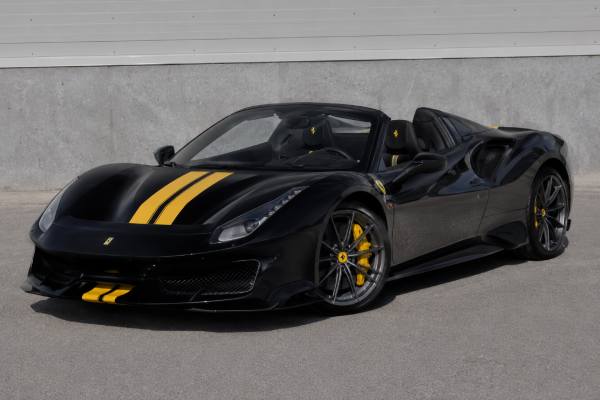
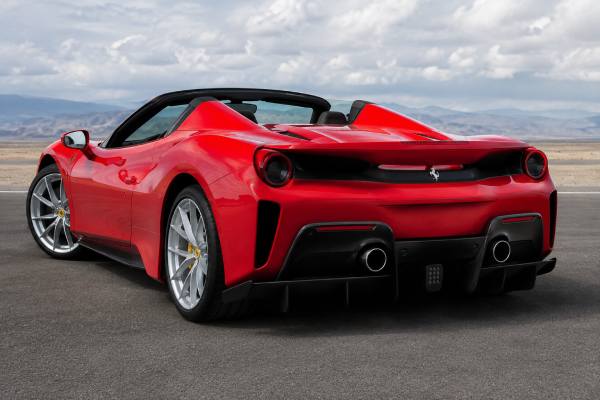
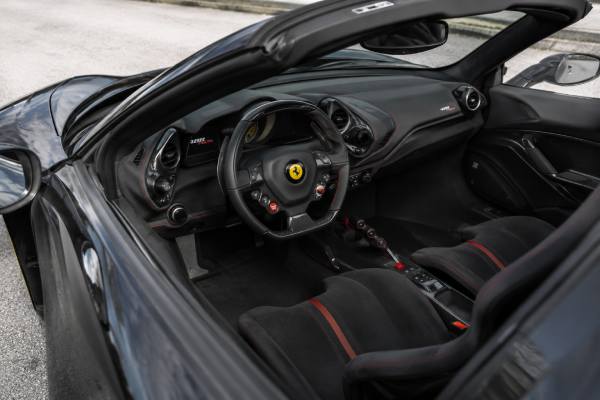
The Ferrari 488 Pista Spider (F142M) is the open-top version of Ferrari’s track-focused 488 Pista, powered by the F154CD 3.9-liter twin-turbo V8 and sold for the 2019–2020 model years. It uses the same 710 hp / 720 cv engine tune as the coupe, paired with a seven-speed dual-clutch gearbox and rear-wheel drive, but adds the drama and complexity of Ferrari’s retractable hardtop Spider body.
This car matters because it sits at a turning point in Ferrari history. It followed the naturally aspirated 458 Speciale A, carried Ferrari’s mid-engine V8 special-series idea into the turbo era, and arrived just before hybrid performance became central to Maranello’s road-car strategy. It was also presented as Ferrari’s 50th open-top model and, when launched, its highest-performing series-production Spider.
For buyers, the 488 Pista Spider is not just a fast convertible. It is a high-value modern collector Ferrari where specification, maintenance history, originality, carbon-ceramic brake condition, paintwork, roof operation, and proof of recall completion can matter as much as mileage. Its appeal is obvious, but so are the inspection demands.
Quick Take
The Ferrari 488 Pista Spider combines the full-force 710 hp Pista powertrain with open-air sound and a retractable hardtop, making it one of the most desirable modern Ferrari V8 spiders. Its identity comes from race-derived engine, aero, and chassis work linked to the 488 Challenge and 488 GTE, not from being a numbered limited edition. The main caution is that values are highly condition- and specification-sensitive, and expensive carbon, brake, roof, tire, and electronic systems make a specialist inspection essential before purchase.
Table of Contents
- History, Model Position and Significance
- Engine, Chassis and Key Specifications
- Production, Variants and Factory Options
- Design, Engineering and Special Features
- Driving Experience and Performance
- Maintenance, Reliability and Repair Risks
- Market Value and Buying Guide
History, Model Position and Significance
The 488 Pista Spider is the open-top special-series peak of the Ferrari 488 family. It took the lighter, sharper, more powerful 488 Pista coupe formula and added Ferrari’s retractable hardtop layout without changing the headline engine output.
The wider 488 story began when Ferrari moved its mid-engine V8 line from the naturally aspirated 458 Italia to the turbocharged 488 GTB. That shift was controversial at first because the 458’s high-revving naturally aspirated engine had become a modern benchmark. Ferrari answered with torque, response, race-derived cooling, and electronic control. The 488 Pista then became the focused version, much as the 360 Challenge Stradale, 430 Scuderia, and 458 Speciale had done for earlier generations.
The Pista Spider was unveiled in 2018 and reached customers for the 2019 model year. It was based on the F142M 488 platform but used major development from Ferrari’s racing programs. Ferrari directly linked the car to the 488 Challenge and 488 GTE, with the GTE connection carrying extra weight because of Ferrari’s endurance racing success in the FIA World Endurance Championship.
Its place in the Ferrari range is important. It was more focused than the regular 488 Spider, more emotional than the closed-roof Pista for some drivers, and more collector-oriented than the later F8 Spider. The F8 Tributo and F8 Spider used the same broad engine family and similar power, but they were not positioned as special-series cars in the same way. The 488 Pista Spider therefore sits in a narrow space: a turbocharged V8 open-top special-series Ferrari before Ferrari’s later hybrid-era models reshaped the performance conversation.
Its significance comes from four main points:
- It was Ferrari’s 50th open-top road model.
- It used Ferrari’s most powerful road-going V8 tune of its period.
- It brought Pista-level aero, engine, and chassis work to a Spider body.
- It bridged the gap between the analog appeal of the 458 Speciale A and the hybrid-enhanced future represented by cars such as the 296 series.
It is also worth being precise about rarity. The 488 Pista Spider is a special-series model, but Ferrari did not market it like a numbered LaFerrari Aperta or a limited-run 458 Speciale A with a fixed public production number. Sellers often make production claims, and some may be directionally reasonable, but serious buyers should treat any “one of x” statement as unverified unless it is supported by factory documentation, build records, or credible provenance.
Today, the car’s reputation is strong because it offers something that modern Ferrari buyers understand immediately: huge turbocharged V8 performance, open-roof sound, track-derived engineering, and real usability. It is not the most delicate, analog Ferrari ever made, and it does not try to be. Its appeal is sharper and more modern: massive torque, very fast shifts, sophisticated electronics, and a chassis that helps a skilled driver go quickly without feeling sterile.
Engine, Chassis and Key Specifications
The core specification is simple but serious: a 3,902 cc twin-turbocharged dry-sump V8, 710 hp, 568 lb-ft of torque, rear-wheel drive, and a seven-speed F1 dual-clutch transmission. The official figures put the 488 Pista Spider firmly in modern supercar territory, even by current standards.
| Category | Specification |
|---|---|
| Model years | 2019–2020 |
| Platform / type | Ferrari 488, F142M |
| Engine code | F154CD |
| Engine type | 90-degree twin-turbo V8, dry sump |
| Displacement | 3,902 cc / 3.9 liters |
| Maximum power | 530 kW / 720 cv / 710 hp at 8,000 rpm |
| Maximum torque | 770 Nm / 568 lb-ft at 3,000 rpm in 7th gear |
| Specific output | 185 cv per liter |
| Transmission | Seven-speed F1 dual-clutch gearbox |
| Drivetrain | Rear mid-engine, rear-wheel drive |
| Electronic systems | E-Diff3, F1-Trac, SSC 6.0, FDE, ABS/EBD with Ferrari Pre-Fill |
The F154CD engine is more than a boost increase over the standard 488 Spider. Ferrari revised the intake layout, moved the intakes from the flanks to the rear spoiler area, used race-derived turbo hardware with rev sensors, and fitted high-value lightweight engine parts. These include Inconel exhaust manifolds, titanium connecting rods, a lighter crankshaft and flywheel, carbon-fiber intake plenums, revised cams, and strengthened internal parts to handle the higher output.
The engine’s character is shaped by torque management. In plain terms, Ferrari does not simply dump all torque into the rear tires at once. The car meters torque by gear and driving mode so the acceleration feels strong, clean, and progressive rather than messy. This is one reason the car can be extremely fast without feeling crude.
| Item | Figure |
|---|---|
| Length | 4,605 mm |
| Width | 1,975 mm |
| Height | 1,206 mm |
| Wheelbase | 2,650 mm |
| Kerb weight | 1,485 kg with optional lightweight content |
| Dry weight | 1,380 kg with optional lightweight content |
| Weight distribution | 41.5% front / 58.5% rear |
| Fuel tank capacity | 78 liters |
| Luggage capacity | 170 liters |
| 0–100 km/h | 2.85 seconds |
| 0–200 km/h | 8.0 seconds |
| Top speed | 340 km/h / 211 mph |
| Fiorano lap time | 1:21.5 |
The chassis uses Ferrari’s aluminum architecture rather than a full carbon tub. That matters for inspection and repair because crash damage, suspension pick-up points, subframe alignment, and panel fit are still major concerns, but the car is not repaired like a carbon-monocoque hypercar.
Suspension is independent all around, with double wishbones at the front and a multi-link rear layout. The Pista Spider uses magnetorheological dampers, stiffer spring tuning than the standard 488 Spider, and Michelin Pilot Sport Cup 2 tires. Standard wheels are 20-inch forged alloys, while optional single-piece carbon-fiber wheels reduce unsprung weight and are highly desirable but expensive to repair or replace.
The brakes are carbon-ceramic. Ferrari lists front brake dimensions of 398 x 223 x 38 mm and rear dimensions of 360 x 233 x 32 mm. For buyers, the important point is not only disc size but rotor condition, heat checking, pad thickness, and whether the car has been tracked.
Production, Variants and Factory Options
The 488 Pista Spider was built as the open-top companion to the 488 Pista coupe, not as a separate numbered hypercar. The most important distinction for buyers is between a clean, well-documented factory-spec Spider and a car whose value is being inflated by vague rarity claims or undocumented modifications.
The main production context is straightforward. The 488 GTB and 488 Spider were the regular production models. The 488 Pista was the lighter, track-focused coupe. The 488 Pista Spider carried the Pista engine, aero package, chassis tuning, and special-series interior approach into a retractable-hardtop convertible.
The Pista Spider did not receive a manual gearbox, naturally aspirated engine, or all-wheel drive. Every car uses the seven-speed dual-clutch transmission and rear-wheel-drive layout. Market differences are usually more about emissions equipment, lighting, safety labels, infotainment details, and regional compliance than about the core performance package.
Key version differences
The 488 Pista coupe and 488 Pista Spider share the same headline power and torque. The Spider’s defining feature is the roof system. It gives the car a different emotional character because the engine, exhaust, turbo noise, and induction sound become more present with the roof down. The tradeoff is extra roof-system complexity and a slightly different weight and structural picture compared with the coupe.
The standard 488 Spider is far softer in purpose. It is still very fast, but it lacks the Pista’s full aero work, lighter engine hardware, special intake routing, more aggressive chassis calibration, and special-series interior treatment. The F8 Spider is newer and also extremely quick, but it is a regular production successor, not the same collector proposition.
Options that matter
Factory options can have a large effect on value. Many Pista Spiders were heavily optioned, and the most desirable cars often combine a strong exterior color with a factory livery, extensive carbon fiber, lightweight wheels, and a carefully chosen interior.
Important factory and personalization items include:
- Optional one-piece carbon-fiber wheels
- Exterior carbon-fiber components
- Racing livery or extended livery
- Carbon-fiber racing seats
- Alcantara interior trim
- Colored stitching, seat stripes, and special interior details
- Carbon-fiber driver-zone components
- Front suspension lift
- Parking camera and sensors
- JBL sound system
- Telemetry or track-oriented equipment where fitted
- Tailor Made paint, trim, or special-order combinations
Carbon-fiber wheels deserve a special note. They are desirable because they reduce unsprung weight and are visually tied to the Pista’s special status, but they also create inspection risk. Any curb impact, crack, poor repair, or heat damage should be treated seriously. A buyer should confirm the wheel type, check part numbers where possible, and inspect the inner barrels, not just the visible outer faces.
Documentation and authenticity
For a modern Ferrari like this, documentation is a major part of value. A complete file should ideally include the original window sticker or build sheet, manuals, tools, battery conditioner, service records, recall records, warranty booklet entries, paint-protection-film invoices, and any factory personalization paperwork.
A car with a rare color and extensive Tailor Made content can be worth more than a plain car with similar mileage, but only when the specification is original and documented. Aftermarket changes are common in high-end exotics. Exhausts, ECU tunes, lowered suspension, wheel swaps, wraps, and non-factory carbon parts may make a car more dramatic, but they can reduce collector confidence unless the original parts and records are included.
Design, Engineering and Special Features
The 488 Pista Spider’s design is driven by cooling, downforce, and weight reduction more than decoration. Its body changes are easiest to understand when viewed as functional airflow management around a very powerful turbocharged mid-engine car.
The front S-Duct is one of the signature features. Air enters through the front bumper, passes through a shaped duct, and exits through the vent in the hood. This helps create front downforce without simply adding a large external wing. It also gives the Pista Spider a clear visual difference from the standard 488 Spider because the nose appears shorter, more technical, and more aggressive.
Cooling was a major part of the engineering work. Turbocharged engines create heat, and the Pista tune asks more of the intercoolers than the regular 488 Spider. Ferrari moved the engine air intakes to the rear spoiler area, shortened the inlet path, improved airflow quality, and changed the front radiator layout. The aim was to increase cooling efficiency without simply adding large, drag-heavy openings.
Aerodynamically, the Pista Spider uses several important ideas:
- S-Duct front aero for downforce over the front axle
- Redesigned front bumper scoops and diffusers
- Rear spoiler intake and blown-spoiler development
- Active rear diffuser flaps
- Underbody vortex generators
- Rear diffuser work influenced by racing experience
- Venting and cooling changes around the front and rear wheels
The result is a car that looks more extreme than a 488 Spider because it needs to. The front opening, hood vent, side sculpting, rear deck, and diffuser are all tied to airflow. The racing stripe, when fitted, reinforces the identity but is not what makes the Pista Spider special.
The roof is also central to the car’s character. Ferrari’s retractable hardtop gives the car coupe-like security and refinement with the roof closed, yet opens quickly enough to make the car feel usable as a Spider rather than a fair-weather showpiece. It is more complex than a fixed roof, so roof operation, alignment, seals, and hydraulic or electric actuation must be checked carefully.
Inside, the cabin is deliberately more focused than a standard Spider. Alcantara, carbon fiber, sculpted door panels, racing-style details, and reduced trim mass all support the Pista theme. It is not a stripped race car, though. Many examples have luxury and convenience options, and buyers should not assume that a more comfortable specification is less desirable. On a Pista Spider, the right specification is the one that is original, coherent, documented, and appealing to the next serious buyer.
The most important dynamic feature is Ferrari Dynamic Enhancer, or FDE. It works within Ferrari’s Side Slip Control system and uses brake pressure control to make high-performance cornering more predictable. It is not simply a safety net. Its job is to help a skilled driver manage lateral movement with more confidence, especially in the CT-Off setting. That distinction matters because the Pista Spider is designed to be exploitable, not merely powerful.
Driving Experience and Performance
The 488 Pista Spider feels brutally quick, but its deeper character comes from response, control, and sound with the roof open. It is not as raw or naturally sharp in tone as a 458 Speciale A, but it is faster, torquier, and more electronically sophisticated.
The engine delivers its strongest impression through torque. The F154CD V8 pulls hard from low and mid revs, then keeps building toward the 8,000 rpm power peak. Turbo lag is well controlled, and Ferrari’s boost and torque strategies help the car feel cleaner than many high-output turbo cars. It does not have the same rising mechanical scream as the naturally aspirated 458 special models, but the Pista Spider has its own appeal: boost pressure, intake rush, sharper exhaust logic, and a deep, urgent V8 note that becomes much more vivid with the roof down.
The gearbox is a major part of the experience. In calmer modes it can be smooth enough for traffic, but in Race mode the shift strategy becomes much more assertive. Ferrari’s short shift times, steering-wheel paddles, and torque calibration make the car feel locked into the driver’s right foot. Full-throttle upshifts are extremely quick and physical without feeling crude.
Steering is very fast, as modern Ferraris tend to be. Drivers coming from older cars may need a few miles to settle into the response. The front axle is alert, and the car changes direction with little delay, but tire temperature matters. Cup 2 tires are excellent when warm and in good condition, yet they are not magic in cold, wet, or old-tire situations.
The chassis balance is defined by rear grip and electronics. The 41.5 / 58.5 weight distribution puts the mass where a mid-engine Ferrari buyer expects it, and the Pista tuning gives the car a more immediate attitude than a regular 488 Spider. Driven gently, it can feel surprisingly manageable. Driven hard, it rewards smooth inputs, warm tires, and a driver who understands that 568 lb-ft can overwhelm the rear tires if conditions are poor.
Braking performance is very strong, but brake feel and condition vary by use. Carbon-ceramic brakes often feel best when properly warmed, and a car that has spent time on track may show pad taper, rotor wear, heat marks, or accelerated tire wear. A low-mile car is not automatically better if it has done hard track sessions and was cleaned up for sale.
As a road car, the Pista Spider is more usable than its numbers suggest. Visibility forward is good for a mid-engine exotic, the dual-clutch gearbox makes city driving manageable, and the suspension has enough compliance for normal roads when not pushed into its firmest behavior. The front lift, if fitted, is valuable for steep driveways and urban use.
The drawbacks are predictable. Road noise is high on Cup 2 tires, the ride can be busy, rear visibility is limited, luggage space is small, and the low front aero pieces are vulnerable. With the roof down, the experience is spectacular, but cabin wind, heat, and noise remind you this is a special-series supercar rather than a grand tourer.
Maintenance, Reliability and Repair Risks
The 488 Pista Spider is generally viewed as a usable modern Ferrari when maintained correctly, but it is still a complex, high-output exotic. Reliability depends heavily on annual servicing, correct documentation, battery care, recall completion, tire age, brake condition, roof health, and whether the car has been tracked or modified.
Ferrari’s maintenance logic for this generation includes regular service every year or 20,000 km for relevant vehicles, with engine oil and filter replacement influenced by vehicle usage under Ferrari’s predictive maintenance system. The car was also covered when new by Ferrari’s seven-year maintenance program, but many 2019–2020 examples are now near the end of that period or already beyond it depending on in-service date. Buyers should verify remaining coverage by VIN rather than relying on seller wording.
The service record matters because Ferrari’s official systems and warranty booklet entries help prove that work was done at the right time and by the right people. A gap in the record is not automatically fatal, but it should be reflected in price and risk.
Common inspection priorities
A pre-purchase inspection should be done by a Ferrari dealer or a specialist who knows 488 Pista models. The inspection should cover more than a standard road test.
Key areas include:
- Engine oil leaks, coolant leaks, and undertray staining
- Turbocharger behavior, boost consistency, and fault codes
- DCT shift quality, clutch data where available, and gearbox leaks
- Carbon-ceramic rotor condition and pad life
- Tire date codes, heat cycling, and uneven wear
- Suspension lift operation, damper faults, and bushing condition
- Roof opening and closing, seal condition, and warning messages
- Battery health and charging-system behavior
- Electronic module faults stored in the car’s systems
- Front splitter, underbody, diffuser, and carbon-fiber damage
- Paint depth, panel fit, accident repair, and PPF condition
- Wheel condition, especially optional carbon-fiber wheels
The engine is highly developed but not fragile in normal use. The bigger concern is misuse, poor maintenance, aftermarket tuning, overheated track running, or ignored warning messages. Turbo engines create more heat than older naturally aspirated engines, so cooling-system condition, heat shielding, and signs of repeated high-temperature operation are important.
The dual-clutch transmission is strong when healthy, but it is expensive when it is not. Harsh engagement, slipping behavior, warning lights, fluid leaks, or inconsistent paddle response should stop the purchase until properly diagnosed. Launch control use, track driving, and high-heat operation can increase wear.
Carbon-ceramic brakes are a major cost driver. A visual check is not enough. The buyer should ask for rotor measurements or condition data where available, inspect for chips and heat damage, and confirm that pads have life remaining. Carbon-ceramic systems can last a long time on road cars, but track use changes the economics.
The retractable hardtop is another key area. The system should operate smoothly several times in a row, with no hesitation, warning messages, fluid leaks, unusual noises, or uneven panel gaps. Water leaks are uncommon on well-kept cars but expensive to chase if seals, alignment, or previous repairs are poor.
One safety item deserves special attention. The 2019–2020 488 Pista and Pista Spider were included in a brake fluid reservoir cap recall involving possible brake fluid leakage and warning-system updates. A buyer should confirm by VIN that the recall repair was completed and documented.
Restoration is not the right word for most Pista Spiders yet. Preservation is. The best cars are kept original, serviced on time, stored correctly, protected with high-quality paint film when new, and repaired only with Ferrari-approved parts and methods. Modified cars may be enjoyable, but they usually need a deeper discount unless the modifications are reversible and fully documented.
Market Value and Buying Guide
The 488 Pista Spider trades as a modern collector Ferrari, not as a normal used exotic. Current market behavior shows a wide spread between completed public sales, dealer asking prices, low-mile special specifications, and cars with ordinary colors or weaker documentation.
In practical terms, buyers should think in broad bands rather than one fixed number. Average examples and higher-mile cars tend to sit below the best low-mile, heavily optioned, Tailor Made, or exceptionally colored cars. Public market trackers and dealer listings show that some examples trade in the high-six-figure range, while especially strong cars can be advertised or sold above seven figures. Asking prices are not the same as sale prices, and this matters a lot with Pista Spiders.
The main value drivers are:
- Original paint and clean accident history
- Low but believable mileage
- Full Ferrari service history
- Recall completion by VIN
- Factory specification and build-sheet support
- Desirable exterior color
- Factory livery or tasteful Tailor Made content
- Carbon-fiber wheels in excellent condition
- Carbon racing seats and high-value interior options
- No ECU tune, exhaust tampering, or non-factory cosmetic changes
- Complete books, tools, battery tender, keys, and accessories
- High-quality PPF installed early, with documentation
- Ferrari Approved status where available
A car does not need to be delivery-mileage to be desirable. In fact, very low mileage can create its own concerns if the car sat unused, missed annual services, aged out its tires, or developed battery and seal issues. A properly driven, carefully serviced car with a clean file can be a better ownership prospect than a museum-mile car with stale fluids, old tires, and no recent inspection.
Buyer inspection checklist
Before committing, a serious buyer should follow a clear process:
- Confirm the VIN, model year, market specification, and original selling dealer.
- Request the factory build sheet, window sticker, option list, and service history.
- Verify recall status directly by VIN.
- Check paint depth and inspect for repaired carbon, aluminum, or underbody damage.
- Inspect carbon-ceramic brakes, tires, wheels, roof, lift system, and electronics.
- Scan all control modules, not only the engine ECU.
- Road test from cold and warm, including roof operation and low-speed gearbox behavior.
- Review any PPF, wrap, repaint, wheel, exhaust, or tune history.
- Compare the car against completed sales, not only dealer asking prices.
- Budget for immediate tires, fluids, battery, alignment, and brake work if history is unclear.
The best examples to seek are original, complete, well-optioned cars in strong colors with full Ferrari history and no stories. The safest collector buy is usually not the cheapest car. It is the car with the fewest unanswered questions.
Cars to avoid include those with unexplained service gaps, old tires presented as “like new,” missing documents, undisclosed paintwork, inconsistent panel gaps, heavily worn driver bolsters at very low claimed mileage, repeated fault codes, roof warnings, aftermarket tuning, or signs of hard track use without matching maintenance.
Long-term collectability looks favorable, but not risk-free. The 488 Pista Spider has the right ingredients: special-series status, open-top drama, strong design identity, a race-linked powertrain, and a place before Ferrari’s hybrid V8 era. Its ceiling is limited by the fact that it was not a formally numbered ultra-limited car, and its values will remain sensitive to mileage, macro collector trends, and competition from other modern Ferraris.
For an owner who wants to drive, the best strategy is simple: buy the cleanest documented car you can afford, keep it original, service it annually, preserve every record, and resist modifications that cannot be reversed. For an investor, the same advice applies, with even more focus on color, options, mileage, and provenance. The 488 Pista Spider is exciting because it is usable, but it is valuable because the best examples are difficult to replace.
References
- Meet the Ferrari 488 Pista Spider: the highest performance Prancing Horse drop-top ever 2018 (Manufacturer Press Release)
- Ferrari 488 Pista Spider – Ferrari.com 2019 (Manufacturer Model Page)
- Ferrari North America Technical Information 2019 (TSB)
- Part 573 Safety Recall Report 22V-536 2022 (Recall Database)
- Ferrari 488 Pista Spider Market – CLASSIC.COM 2026 (Market Data)
Disclaimer
This article is for informational purposes only and is not a substitute for professional diagnosis, repair, valuation, or inspection. Specifications, torque values, service intervals, software procedures, recall status, and parts requirements can vary by VIN, market, model year, and equipment. Always verify details against official Ferrari service documentation and have any purchase inspected by a qualified Ferrari dealer or specialist.
If this guide helped you, please consider sharing it on Facebook, X/Twitter, or your favorite car community to support our work.